DD5LP/P – April 20th 2019 – DL/BE-094 Irschenhausen – for the transatlantic S2S event.

Preparation:

April 20th. 2019 was to be the next Summit to Summit activity event between UK/EU and the Americas and the propagation conditions seemed to have slowly improved over the previous week.

My initial plan had been to activate Wank DL/EW-001 above Garmisch Partenkirchen but then the wife said she wanted to meet up with her school friend and two nieces, so an amended plan was needed. The group from Munich wanted to come out to the Easter Market on the banks of the local lake Ammersee and also take a sail with the paddle steamer on the lake. This wasn’t too bad as a 1-pointer summit that I hadn’t yet activated this year was only about 40 minutes drive away from the lake, Irschenhausen.

As Irschenhausen is a forested summit, there was no reason to try to use the VP2E antenna as verticals simply don’t work in forests, so I decided to take the lightweight set-up of the 6m LambdaHalbe mast and the SOTABeams linked dipole along with my screw-in-the-ground sun umbrella base.

As this was to be an afternoon activation with me arriving at the summit at 1400 local time (1200 UTC), the gear would be packed the morning of the activation.

What could go wrong?

The Activation:

With the Easter road traffic, we set off a little earlier than planned, but the traffic on the back roads was not any worse than normal, so I managed to drop off Gabriele, my wife, 30 minutes ahead of schedule – never mind, this gives me another 30 minutes activation time, or so I thought …

On arriving at the parking spot for Irschenhausen, while unloading the gear from the car, my phone rang and it was the wife. The ferry that I had planned for the groups afternoon cruise following the visit to the market, wasn’t running and so the afternoon would be shorter and could I come back earlier than planned. Oh well, that’s life!

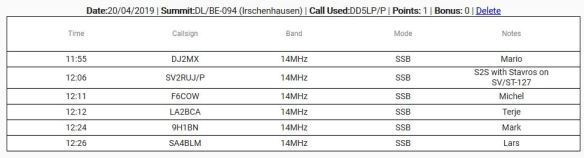
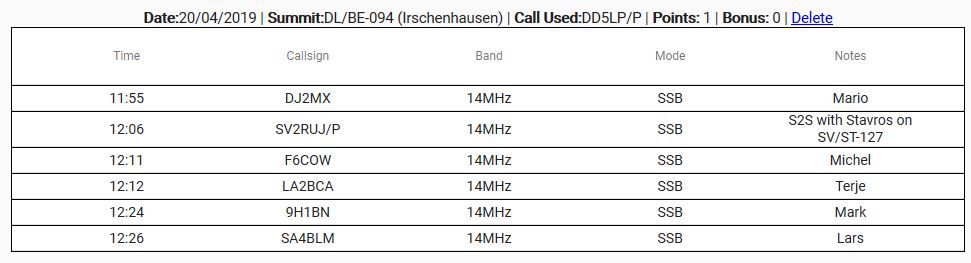
The walk to the summit took about 12 minutes. Upon arrival I could see three new wind turbines that seem to tower over the summit, however they are actually a few kilometres away on the other side of the autobahn. At this distance, they don’t appear to cause any RF interference – at least not on HF. I was soon set up and calling CQ SOTA on 20m. It took a little while until I got my first reply which was a ground wave contact with Mario DJ2MX in Munich. A couple of other European activators were on 20m as well and so I tuned to their frequencies. The one that I could hear had a pile-up that I couldn’t break even as a Summit-to-Summit contact, so I went and found a different free frequency and spotted myself and started the CQ SOTA calls again. In the end during the 45 minutes that I was active, I managed six contacts including one european S2S with Stavros SV2RUJ.

I was aware that I had about a 40 minute drive back to where I had dropped my wife off, so at 1230 UTC, I called it a day and started to pack up, at which point I got a call from the wife to say the friends were leaving and could she be picked up please.

So at the end of the day, at least I did manage an activation. Irschenhausen is an easy summit to access and doesn’t rely on any cable cars, so it gives you flexibility on timing.

Photos:

This slideshow requires JavaScript.

Equipment:

  • Xiegu X108G.
  • Battery box (2 x 5000maH hardcase LIPOs).
  • SOTABeams “Bandhopper” linked dipole.
  • Screw-in Sun Umbrella base.
  • 6 metre LambdaHalbe fibreglass portable mast.
  • Smartphone PocketRxTx App and USB cable with various connection leads.

Log:

Conclusions:

 The propagation was not as good as the previous day and EU-US contacts were only possible late afternoon and early evening. Of course I was there far too early for this opportunity.

73 ’til the next Summit!

DD5LP/P – April 6th 2019 – DL/AL-179 Weichberg – UK/EU – VK/JA/ZL S2S event.

Preparation:

Following the tests on the previous Thursday (report on this website) all equipment was already decided upon and loaded in the car Friday evening ready for an early start on Saturday.

The Activation:

The trip down to Weichberg was again uneventful. Although the weather forecast was for a warm morning with sunshine, I decided to stick with my winter jacket and I’m glad I did as on arrival at the parking spot the car thermometer showed -1°C and even after 4 hours, with the car parked in the sunshine, it had only risen to +4°C. And… it’s foggy again as it was on Thursday. No time to complain as no one knows exactly when the band will open (or not), so it’s grab all the gear from the back of the car and head up the track to the summit, while at least it’s not raining!

The set-up is exactly the same as on Thursday – the tripod, 10m mast and 40/20m VP2E with the X108G on the picnic bench. Actually based on what I saw on Thursday, I brought an additional item. A bright yellow plastic shopping bag which I clipped with a peg onto the antenna wire as it went over the main pathway on the summit. While putting the antenna up, I found the metal guy peg that I had lost on Thursday!

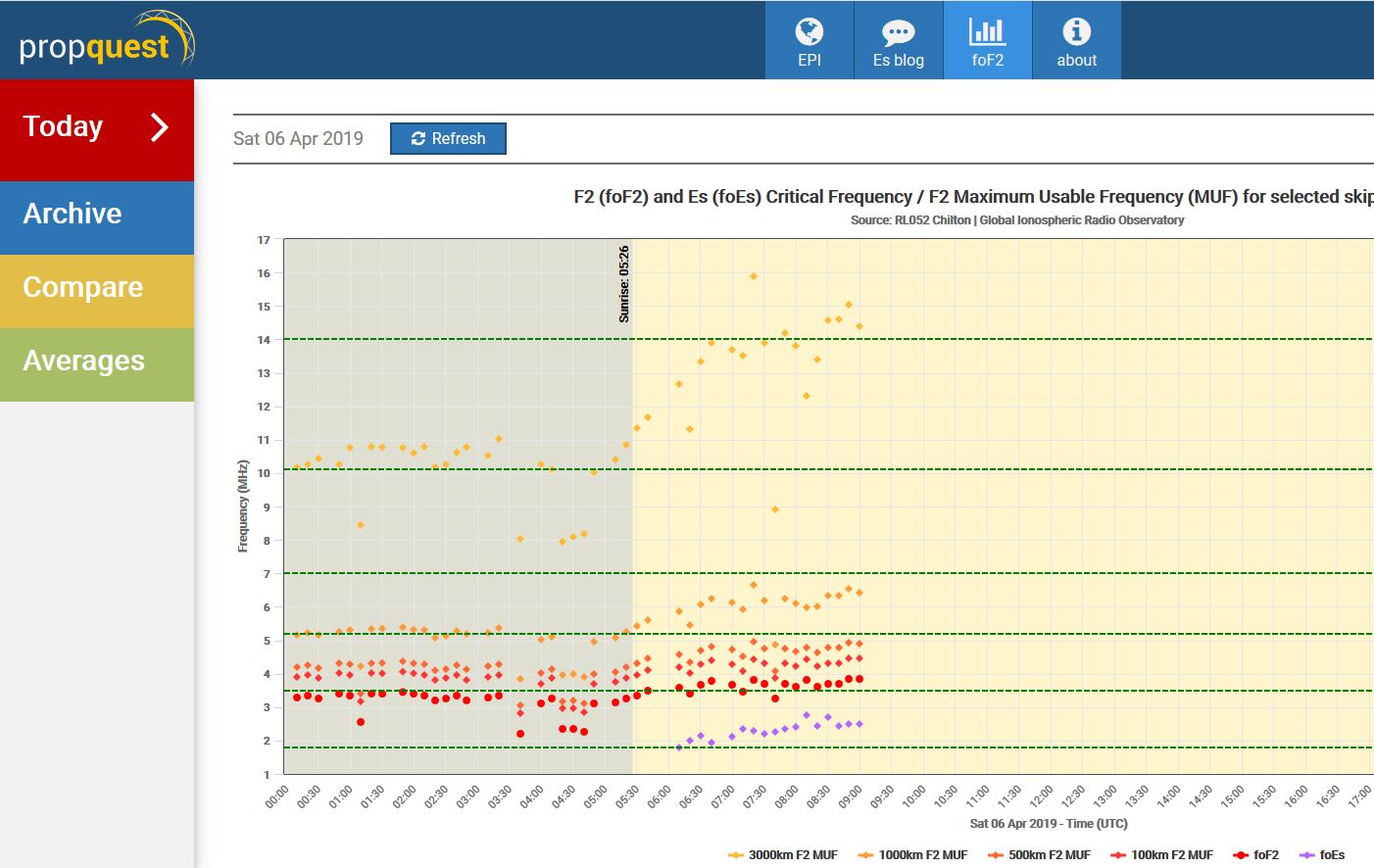
Based on actions over the last few weeks I thought it would be best to start on 40m, then watch the MUF and when it rose over 14MHz switch to 20m. Usually the maximum usable frequency (MUF) shoot up after dawn but of late that hasn’t been happening, so it’s a question whether the MUF gets over 14MHz before the long path window closes.

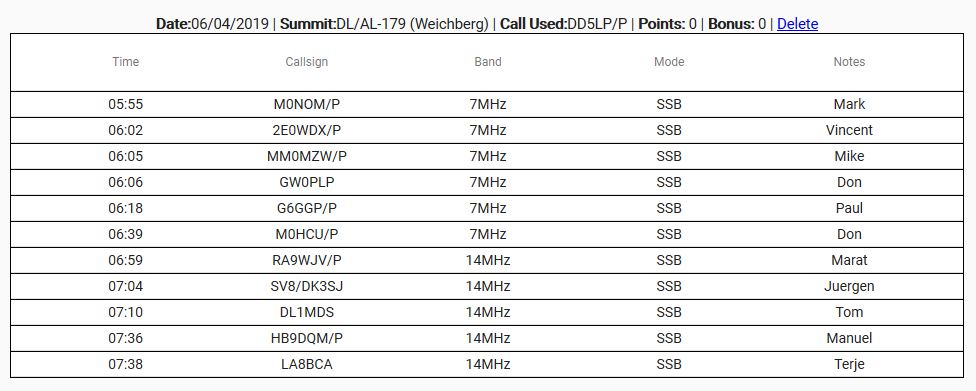
I started at 0540 UTC (0740 local) found a free frequency on what was already a busy 40m band, spotted myself and then started calling CQ, only to have EC4AHH start calling on top of me. I announced the frequency was in use and I’m sure he heard me but he just kept continuing to call CQ. This DQRM action, just because he has more power is a bad trait in some operators. I was hoping some QRO SOTA Chaser might come along and move EC4AHH away from the frequency but it wasn’t to be, so I had to find another frequency rather than waste more of my time with this situation. On the new frequency, I got five calls (four of those S2S), before I was DQRMed again, this time from a Russian speaking station. 40 metres in Europe is becoming a real rat race!

Luckily at this point I saw via my smart-phone that the 3000 km MUF was rising nicely, in the direction of 14MHz, so I lowered the mast, opened the links and then up went the antenna again, now resonant on 20m. Tuning around the band was quiet but not for long, soon there were more and more stations on the band including a VK net booming in at 5-9+ – I tried a call but breaking into a local net in Australia with just 20 watts and a wire antenna from the other side of the world is a lot to ask and indeed it proved impossible. I looked around for a free frequency then spotted myself and called CQ. The first call came from Marat RA9WJV/P on R9U/SO-235 in Asiatic Russia! Following Marat, Juergen DK3SJ on holiday in SV8 (Greece) called and after breaking the contact, the conditions peaked and on a second attempt the QSO was completed. After that 20m quietened down again and only semi-local contacts were possible. Checking on the Internet – the 3000 km MUF had dropped below 14MHz again.

At 0751 UTC (0951 local). I decided to call it a day and pack up and head home.

Here’s what happened to the MUF while I was on the summit and a little afterwards:

Looking at this had I stayed another 20-30 minutes, the MUF rose up over 14MHz again but by that time it is likely the long path window will have closed. So at the moment it looks like the time that contacts between Europe and Australasia are only 10 or perhaps 20 minutes long whereas those on 40m might be up to an hour-long. The problem for me is that for me to get via long path from southern Germany signals are weaker here than in northern Europe, possibly due to another “hop” for the signals being needed. Also chaser stations from Australia tend to have a beam on 20m but only a wire antenna on 40m. A comparison from this activation – a VK station on 40 metres was just copyable and probably not workable, whereas those on 20m were 5-9+.

A lesson learnt – for me to get a contact into VK with the current propagation conditions I need to concentrate on 20m and be on at just the right time. A difficult combination of requirements when operating from a summit.

Photos:

This slideshow requires JavaScript.

Equipment:

  • Xiegu X108G.
  • Battery box (2 x 5000maH hardcase LIPOs).
  • Linked (20m/40m) VP2E (Vertically polarised, 2 element, 20m wire antenna).
  • Antenna warning marker (bright yellow plastic shopping bag).
  • Surveyors tripod.
  • 10 metre DX-Wire fibreglass portable mast.
  • Smartphone PocketRxTx App and USB cable with new EMI stopper board.

Log:

Conclusions:

This activation was not as successful as on Thursday with no contacts into VK. The extra stations on 40m didn’t help however even if there were less DQRMers on the band I think the signals would not have been strong enough to work in any case.

Equipment-wise I have a feeling that the 40m sections of the VP2E are resonant on the bottom of 40m but not at the top of the band, so some testing will be needed and most likely the 40m section of the antenna reduced in length, probably by wrapping the wire back on itself. This needs doing before my next activation using the antenna. Perhaps it can be done at the same time as measuring the directivity of the antenna?

73 ’til the next Summit!

DD5LP/P – April 4th 2019 – DL/AL-179 Weichberg – Trial run for S2S event.

Preparation:

April 6th. 2019 will be the next Summit to Summit activity event between UK/EU and VK/ZL/JA and given the variable propagation conditions at the moment I decided to do a “dry run” to see when the bands open and which bands open, so that I know when to be at the summit on Saturday.

Although I have already activated Weichberg this year and hence will not get any points for either this activation or the one on Saturday, it is relatively close to home and has an area large enough to put the VP2E antenna up.

The same equipment will be taken to the same summit, so this (Thursday) activation, should reflect what is going to be possible on Saturday – at least to an extent.

The equipment was prepared and packed into the car the night before as an early start was planned.

The Activation:

The trip down to Weichberg was uneventful, I have done it so many times before. The last few days had been warm spring days but not this day and luckily I took my think winter jacket but even with that on over the time I was on the summit, I got very cold. After parking and walking up to the summit with all the gear, what greeted me at 0500 UTC was a cold, damp fog actually with ice-cold water droplets in it. Visibility was limited, so no long distance nice views today. Luckily the predicted high winds only arrived as I was leaving. The last time I had activated this summit it had between 2 and 3 metres of snow on it, at least that is gone but the fact that it is gone means the summit no longer curves as it did and I could only just fit the 40m/20m VP2E antenna into the summit area. I had planned to raise the ends of the elements using hiking sticks however this was not necessary as I raised one end by the rope going over a tree branch and the other end had its rope tied off to the top of a signpost.

This site does have the luxury of a picnic bench and seating banks, which is where I set up the station once the antenna on the 10m mast, supported by my surveyors tripod was all set-up.

Prior to the activation Mike 2E0YYY (or 2W0YYY/P in this case) had said he would also be out the same time as I so that we could compare notes on propagation afterwards. I had also lined up some stations in VK to listen for both of us.

Based on actions over the last few weeks we both thought 40m would be the best option for UK/EU-ANZ contacts this morning and indeed from around 06:35 Mike started making contacts into VK & ZL. His first VK contact was Ernie VK3DET whom I could also hear albeit a little week at around 06:35-37 UTC. I could understand every word after a while. Unfortunately when I tried calling Ernie on 40m I wasn’t able to put enough signal back in his direction to get a two-way contact.

I left Mike working VK/ZL stations and once I found a free frequency (the band was sooo full and that on a Thursday morning – which doesn’t bode well for Saturday) I worked quite a few stations around Europe before 0720, when I took the antenna down and switched it to 20m to give it a try. To start with there was nothing on the band and my CQs brought no replies. I then decided to take a tune around and after a while (at around 0735) I came across VK2MIX who was booming in, of course he had plenty of EU QRO stations calling him and I couldn’t get through the pile-up. I went back to my chosen frequency and put out more CQs again with no response, so I tuned around and found VK3TJK, Tim, even stronger than VK2MIX (I made a recording of how strong and clear his signal was – even less chance getting through this pile-up though).
I think the reason the band was dead and then suddenly opened can be explained if we look at the MUF:

I went back to my frequency again and this time I got a call from Michael DJ5AV which overloaded my headset but then I heard something and put out a call for VK/ZL only and to my amazement, there was Ernie VK3DET at 5-5 and he gave me a 3-3 report. To make the day even better Ernie’s call was followed by a call from John VK6NU again 5-5 with me but I was only 3-1 with QSB back to John. The two contacts were made though! After a few more CQ calls with no answers, I tuned around and could no longer find either VK3TSK or VK2MIX, so, as I was freezing cold (the weather had gone from Spring to mid-winter overnight!) I decided to pack up. If I had waited another 20 minutes or so, it looks like the MUF came back over 14MHz again, so further contacts may have been possible but as the winds were increasing and it was approaching 11am local time when I needed to leave in any case, I decided to pack up and call it a day.

My conclusions time-wise (and this is only from my southern Germany location, the UK will be different). for Saturday, are from 0630-0700 to try 40m Long Path and then as soon as the MUF goes over 14MHz switch to 20m as the signals on 20m were far stronger than on 40m with me.

I get the feeling that 40m long path contacts are easier to make from the UK than from southern central Europe and the added gain by the use of beams by chasers on 20m makes all the difference in making a EU-VK contact.

Photos:

This slideshow requires JavaScript.

Equipment:

  • Xiegu X108G.
  • Battery box (2 x 5000maH hardcase LIPOs).
  • Linked (20m/40m) VP2E (Vertically polarised, 2 element, 20m wire antenna).
  • Surveyors tripod.
  • 10 metre DX-Wire fibreglass portable mast.
  • Smartphone PocketRxTx App and USB cable with new EMI stopper board.

Log:

Conclusions:

I’d say this was a successful activation in that I know now when the band is opening on the long path on 40m & 20m and why the 20m opening was delayed (MUF). I tried out the filter unit in the USB connection lead and it appeared to work fine (considering it has had some bad reviews, I’d better order a couple of spares before giving it a good review). My set-up with a USB adapter rather than a cable made is rather short, but the required USB cable has been ordered and should be here in a couple of days, so soon I should be able to put the problem away. Strangely today, I could actually read the display on the rig itself most of the time as it was such a grey morning.

 I could hear one VK on 40m (weak), two on 20m booming in but with pile-ups and worked two pre-arranged VK chasers who were 5-5 with me and I got a 3-3 from one and a 3-1 from the other! VK3DET & VK6NU.

My mechanical modification to my wooden plate to use it as a base for the bottom of the mast worked first time as well!

I lost one of my metal guy pegs this morning on the summit. I put it in my pocket but it fell out somewhere – I looked and looked but couldn’t find it. I’ll take another look on Saturday.

73 ’til the next Summit!

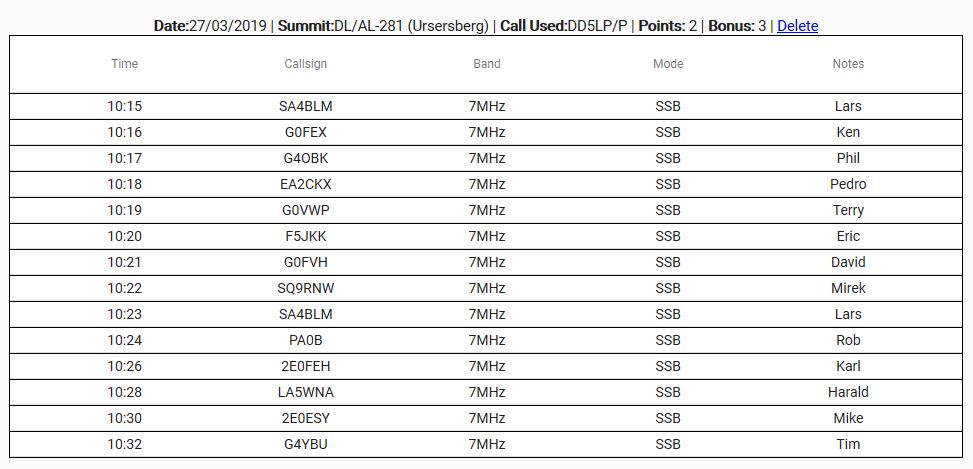
DD5LP/P – March 27th 2019 – DL/AL-149 Blender, DL/AL-281 Urserberg & DL/AL-282 Steig.

Preparation:

All equipment was prepared and loaded in the car the previous day even though I wasn’t planning a very early departure. These were not to be DX-seeking activations rather grabbing the last of the easy summits with winter bonus points before those stop at the end of the week.

The Activation (Blender):

Listening to the radio while having my breakfast with the snow falling outside, I head that the B12 (one of the roads I was intending to use), was totally blocked because of an accident. This meant a longer route via two Autobahns but not a lot of difference time wise. In any case I set off at 8:30 am instead of my planned 9am, – it’s always good to have some time in reserve.

I expected some delays around the Kempten ring road but the navi took me from the autobahn across country to avoid the town and its traffic. The downside of this is that I did not know the route and pulled up at a sign on the road which said access for those who live here only. But i could see the TV tower and before making a really long diversion, I decided to trust the Navi and drove down the road it suggested. part of the way down this road, the surface was gone and I was driving on a pot-holed mud track. Hoping not to get bogged I kept going and then as the tarmac returned, I realised where I was. The navi had brought me in from the other side to what I was used to. In any case I now headed to my usual parking spot, took out the gear I wanted to use, loaded myself up and started on the slog up the hill. I had decided to use the Vertically polarised two element (VP2E) 40/20m antenna on this summit as I knew it was fairly flat and I would be able to fit the antenna in. The temperatures were still cold and so I had my thick jacket on.

On arriving near the seat on the summit, I dropped everything down and proceeded to put the surveyors tripod up to support the 10 metre mast and the VP2E. All went well, but I was aware of some threatening cloud in the sky but luckily the rain held off.

I was not expecting any intercontinental DX as I was too late for long path and too early for short path. There was a time at the start when I wondered if I was getting out but after about 4 CQ calls the chasers appeared. Although I had checked and called to make sure the frequency wasn’t in use, as soon as I started to get calls, some station started up about 1 kHz away causing problems both for me and the chasers. This same problem actually occurred on all three summits!

Eleven contacts in 6 minutes and I was happy and packed up to head to the next summit, one that I have not activated for several years and it turns out that Urserberg isn’t that far from Blender especially if you take the narrow farm roads as directed by the navi!

The Activation (Urserberg):

On approaching Urserberg, I recognised where I was and drove straight into the car park, which is signposted as the car park for the Eschacher  Weiher (pond) on the other side of the road. This is a good place to park as there is a track from here up the hill and the car is safely parked. The navi wanted to take me closer, around the other side of the hill, where I suspect the parking would not have been as good.

It is a fair walk up the track until you reach the summit (above the ski lifts), so I decided not to take the tripod this time chosing my screw-in sun umbrella base and 6 metre mast instead. To go with this I would use the Aerial-51 404-UL OCF dipole. I actually had all antennas in my rucksack, so I could choose a different one if I hit any problems. As had happened the previous week on Senkelekopf.

There’s no seat on this summit, so everything (including myself) was sat on my plastic painters sheet and after putting up the antenna and with some cold winds around, I managed 14 European contacts in 17 minutes, before packing up again to head off to the next summit. The walk up and down from this summit takes about 15 minutes and in my rush to get down I was not as careful as I should have been and slightly strained my ankle. Luckily this wasn’t as bad as it could have been but it underlines that rushing is not good in slippery conditions. I wasn’t going to let this stop me “bagging” summit number three of the day however, so once back at the car, it was time for a bit of lunch, reset the navi for the next summit and set off.

The Activation (Steig):

For some reason, this time the Navi decided to take me back via Kempten and there was some delay getting around the town but not as much as when I approached the summit. Previously I had used notes from Google maps to get to the car park and start of the walking trails in this forest-covered summit. This time I just gave in the summit reference and it directed me to the closed road to the summit – which just happened to end in a farm-yard at the other side of the summit where there are no official tracks to the summit from. To get me to this farm-yard, another length of mud track was included in the route so some interesting driving and some strange looks from the locals. Once I realised what had happened and having no way to tell the navi where the entrance to the forest was that I wanted, I reverted to Google Maps on my phone and was able to pick out two villages where I could tell the navi to bring me to and I knew the road between them and so found my parking spot for Steig with probably 40 minutes delay over a direct route.

This summit also entails a fairly long but not difficult walk, so again I opted for the lighter set-up and left the tripod and 10m mast in the car.

The forest looks a little different to what I remember as an awful lot of the trees have been cut down however the tracks are the same and I soon found my way up to the summit alongside the lookout platform.

Again the painters sheet became the base for operations and the SOTABeams linked dipole went up on the 6m mast and despite the QRM problem again on this summit, I bagged 12 contacts from around Europe in 10 minutes. At this summit the sun actually came out, so I felt like staying longer but as I had lost so much time through mis-navigation and the chance that the weather could change, I decided to pack up and head home, where I was by 15:30.

All in all good day out!

Photos (Blender):

This slideshow requires JavaScript.

Photos (Urserberg):

This slideshow requires JavaScript.

Photos (Steig):

This slideshow requires JavaScript.

Equipment used:

Blender:

  • Xiegu X108G plus battery box (2 x 5000maH hardcase LIPOs)
  • Linked (40m/20m) VP2E antenna
  • 10 metre DX-Wire fibreglass portable mast.
  • Surveyors tripod.
  • Smartphone PocketRxTx App and USB cable.

Urserberg:

  • Xiegu X108G plus battery box (2 x 5000maH hardcase LIPOs).
  • Aerial-51 OCF dipole antenna
  • 10 metre DX-Wire fibreglass portable mast.
  • Surveyors tripod.
  • Thick plastic painters sheet.
  • Smartphone PocketRxTx App and USB cable.

Steig:

  • Xiegu X108G plus battery box (2 x 5000maH hardcase LIPOs)
  • 6 metre lambdahalbe fibreglass portable mast.
  • Thick plastic painters sheet
  • SOTABeams Linked dipole
  • Smartphone PocketRxTx App and USB cable

Log (Blender):

Log (Urserberg):

Log (Steig):

Conclusions:

Don’t trust your Navi (GPS) to take you where you expect it to. I took the summit locations as a KML file from the SOTAMaps website. The Navi will try to get you as close as possible on a normal road but that isn’t always where the parking is or where the tracks go from.

I used different antennas on each of the three summits and all worked fine. I have the feeling that the VP2E was the best of the three and I will most likely use that one for the UK/EU – VK/JA/ZL S2S event on April 6th once I replace the centre mount which broke when I was taking it down at Blender.

73 ’til the next Summit!

DD5LP/P – March 21st 2019 – DL/AL-170 Zwieselberg, DL/AL-172 Senkelekopf & DL/AL-171 Eisenberg – a tale of technical problems.

Preparation:

All equipment was prepared and loaded in the car the previous day following the activation of Buchberg. This activation was initially planned for a leisurely start but brought forward as it looks like there “might” be some 7MHz long path possibilities into VK/ZL. So a pre-7am start was planned for.

I actually woke earlier as the dog woke me up barking at 4 am when the neighbours cat came past the back door! after dealing with that I tried to get a little more sleep before the alarm went off. I was on the road by 6:50am (0550 UTC) and all went to plan heading for my first summit “Zwieselberg” that I had activated a couple of years ago, so I knew the route but despite that I put the Navi (GPS) on in the car to avoid any problems. One SOTA operator had told me the week prior that there were trees blocking the road and hence a longer walk is needed. As this was a day after some very heavy winds, i thought he meant that the trees had been blown down. in that case they will have been cleared by now right? well that wasn’t what he meant – see later. First of all we need to get to the summit …

The main road closed on my route someway away from Zwieselberg – at first I thought it was just in the village where I saw the first signs so I diverted around the outside of that village (Bruggen) and that was the problem solved. That was not to be the case, as I approached the small town of Bernbeuren (under the SOTA summit Auerberg) I could see the main road into the town was dug up! The diversion was NOT well sign-posted. In fact at one point it had you going down a “restricted for motor vehicles” road – but everyone else went down there, so I followed them. The Navi (GPS) doesn’t help when a road is closed, it keeps trying to route you back to the same point and indeed the restricted road it didn’t even have in its maps!

The Activation (Zwieselberg):

So after arriving at Vorderzwieselberg and driving up the private road (there’s a sign: public access but at your own risk), I find what the previous activator meant! it wasn’t that one or two trees had been blown over rather that tens of trees had been cut down and stacked not only along the side of the road but also IN the road in the area where I have parked previously (see photos below). with a bit of trepidation, I decide to drive up and park on the grass bank behind some of the logs. the picture doesn’t show the angle very well, but I can say it took all my strength to open the driver’s door wide enough, to be able to get out. Going to the rear of the car, even with it in gear and the hand brake on, I decided to lodge my large sun umbrella base under the back wheel to act as a check. It was not an ideal situation but it looked solid enough. So I now unpacked the car, loaded myself up with my normal two bags, the 10 metre mast and the Surveyors tripod and set off up the steep track (about 85 metre rise in less than a kilometre would be my estimate, to the summit and summit cross. part of the way up, the ground was still muddy and even with my good hiking boots on, I felt myself sliding, some sideways walking solved that problem and indeed I made it up to the top of the summit as the sun was rising into the sky. This summit has lots of space so I decided to put up the linked VP2E that I had used the previous day on Buchberg. Although there is lots of space, the ground does curve down quite a lot, meaning the ends of the antenna were closer to the ground than I would have liked. But “it is what it is”. The views from this summit are stunning and although it was quite cold, the fact that the sun was shining helped me to start to forget the “aggro” from the closed road and the difficult parking situation both of which had cost me valuable time.

The log shows that despite the expectations and my timing being “OK” despite the delays, no VK contacts were achieved. I had scheds with Ernie VK3DET in Victoria, Australia on both 40m & 20m but to no avail. The conditions were simply not good enough. Added to that there was a “clicking” type of QRM on 40m and something that soundeD like OTHR from 14.140 to 14.350 on 20m. I thought the “clicking” QRM may have been a faulty electrical farmers fence but the noise was still there on the next summit, so it seems it was atmospheric. The 20m QRM was however definitely man-made.

Despite the noise I managed 5 contacts on 40m and in fact it was almost 6 contacts but one I had to mark as a “no contact” as I could not copy my report. I did stay longer, calling and hoping that the bands would improve to let me get through to Ernie in Australia but to no avail. As I had lost time already and I knew that the trip to the next summit (which I hadn’t activated before) would take sometime as the 7-8 km away Senkelekopf needed an over 30 minute drive to get there as there are no direct roads, I decided at 0810 UTC to pack up and head back to the car.

Little did I know that I was about to get my next challenge. The car was still where I had parked it and I could load all the equipment into the back of the car but the placement of the large trees would make it difficult  to turn around (in hindsight, I should have reversed back down off the bank onto the road at the same angle that I came up and reversed back down the whole of the private road). The problem as well as the large logs was that the ground under the car was waterlogged and hence grip was limited. Unfortunately my car, like the majority these days is front wheel drive, so as I backed down the slop trying to turn the rear of the car, the driving wheels were still on the slippery surface. I was very aware of the line of logs directly behind my car and so I would stop and check and stop and check inch by inch until I got almost onto the road BUT the problem was the steering doesn’t work on such surfaces so I wasn’t able to turn the front of the car and trying to drive back up the bank to have another go simply spun the wheels. I did not want to have to walk down to the farm to see if they could help, so I looked around in the car to see what I might put under the front wheels to get some traction and decided on the canvas covers from two folding seats. These I jammed under the front wheels. They made a little difference but I was edging closer and closer to those logs behind me. I was at this point that I realised that when the wheels were spinning, the car was slowly sliding sideways on the muddy bank, so with some brake, clutch and accelerator “trickery” I manager to get the front of the car to slide sideways onto the road BEFORE the back of the car met the stacked logs. PHEW! That was close but after finding the canvas covers (which after a run through the washing machine are as good as new) and putting them in the back of the car, I was, at last, able to drive off in the right direction and on to Senkelekopf with the help of the Navi (GPS).

I’m sure the farmer will wonder what has happened to the grass bank, but if he hadn’t stacked the logs on the road rather than at the side of the road (where there was space) I would never have had this problem!

The Activation (Senkelekopf):

The drive to Senkelekopf from Zwieselberg was along single track farm roads for most of the way and when I arrived at the suggested starting point for the climb, by a country guest house, I wondered if someone would complain about me parking there. There was a gravelled spot for parking two cars which didn’t appear to be on anyones actual property (I expect it was the parking for the chapel, for when they have services). So I parked there and decided what to take with me for this summit I actually took the same set-up as I had for Zwieselberg, except I was expecting to have to use the SOTABeams linked dipole antenna rather than the VP2E, but in case I could get that out, I took the 10 metre mast again not the lighter 6 metre one. In my small rucksack I had 2 VP2E antennas, The SOTABeams linked dipole and the Aerial-51 40m OCF antenna.

This is also a steep climb. There are other not so steep routes but they are a lot longer – nice if you have the time. I took my time climbing up the track, stopping to get my breath and take some photos as I climbed. Eventually I saw the summit. There is some large building near to it, which is obviously accessible via one of the other routes with a tractor or similar – it seems to be some kind of farm building. While approaching it a squirrel ran across about 10 metres in front of me and went up a tree. To the left of the building the ground rises up to the actual summit and on top of that is the Holy Cross – this appears to be totalled fenced in and surrounded within the fencing with bushes and small trees. It’s obvious public access to it is not invited. In any case at a similar height behind the cross there was some fairly flat land where I could easily set-up. There was not enough space for the 40m VP2E so I decided to put up my “old faithful” the SOTABeams Bandhopper linked dipole.

Once the surveyors tripod was set up and the 10m mast within it, it took no time to get the rest of the station deployed on my painters sheet on the ground next to the tripod. I was on the air just after 1000 UTC and there were some other summits being activated, so I tuned around and I could hear a couple of the activators and despite my determined calling, neither of them came back to me. So I picked a free frequency, spotted myself and started calling CQ – nothing. Perhaps there was someone on the same frequency that I can’t hear because they are within my skip zone? tried another frequency, still no calls. Then there was QRM on the frequency, tried another frequency. This is all very strange! I check the rig, all appeared OK. So I dropped the antenna, switched to 20m and got my first calls after being on the summit nearly an hour. 20m wasn’t that good though, so I went back to 40m. Again I could hear plenty of stations but none of them wanted to work me. What could be wrong? split frequency? no. Wrong sideband? no. OK, it had to be the antenna! I lowered the mast took off the linked dipole and put up the Aerial-51 OCF. As soon as I spotted myself and called, I had a pile-up – everything was now working – so what was wrong with the other antenna?

Then the battery box failed – what now? I opened the box and found that one of the diodes that I use to drop the voltage down to an acceptable level from my 4S LIPOs had come loose – I pushed it back in place and all worked again. By this point I had 13 calls in the log and was again running late to my schedule, so it was time at 1130 UTC to pack up and head off.

As I was rolling up the SOTABeams linked dipole the wire from the 20m link came away in my hand – THAT had been the problem! that was the reason why it was OK on 20m but not on 40m. when on 40m, one half of the dipole would have been the correct length while the other side would have been too short. I wonder if this caused the rig to draw more power with the bad VSWR and that was the reason, combined with the extended length of time I was using the rig, that one end of one of the diodes de-soldered itself?

At this point with the series of problems I had had, I wondered whether to cancel my third activation and head home? I decided to make the call once I was back at the car and could see how long it would take to get to Eisenberg – a summit that I have activated several times so I knew what was possible and what not.

After getting to the car and packing the gear in, the Navi told me I’m only about a 1/4 hours drive to the next summit and I still had time to do it, so I decided to include it in the day’s activations as planned. So off to Castle Eisenburg!

The Activation (Eisenberg):

On arriving at Eisenberg, I decided not to take the 10 metre mast, the tripod or the VP2E antennas and stick to the 6 metre mast and the Aerial-51 OCF dipole. I’d just get the minimum 4 contacts and then head back down to the car park and to the restaurant for a well-earned “Weissbier” (Wheat beer).

My favourite spot at this summit is out on the wooden platform that has been built onto the end of the ruins. It has convenient posts to support the mast and the ends of the antenna can be tied off to the wooden railings. I set myself up in a corner on my painters sheet quite quickly as there were no tourists there when I arrived. they came later but caused no issues or interruptions. Starting at 1300 UTC all went well with seven 40m contacts in seven minutes. Just as I finished the last QSO of the seven I lost power from the battery box again and looking at it this time, the diode that had disconnected itself at Senkelekopf has disconnected at both ends this time and so there was no “quick fix”. I no longer use the bump-up bump-down “buck” voltage converters as they create RFI, hence the reason that I switched to the “quiet” diodes but these do need to dissipate some power as heat. After getting home I re-soldered the diode back in place as this is the first time in 10 activations that this has happened. If the problem occurs again I’ll add a second run of terminal block so that the diodes are no longer soldered together.

I packed up at 1310 UTC following the loss of power and headed back to the car park, dropped in all the gear into the car and went across to sit outside the restaurant in the sun, gaze at the views and drink a nice cool, well-earned, Weissbier. A great end to a busy day.

The drive home was a route I knew without needing to use the Navi and went without any more incidents.

That’s 15 activating points today 3 x 2 point summits each with a 3 point winter bonus. There’s still three more summits, all with long walk-ins located a fair distance from the home QTH which, if the weather keeps fine I will try to fit in, in one day, before the winter bonus finishes.

Photos (Zwieselberg):

This slideshow requires JavaScript.

Photos (Senkelekopf):

This slideshow requires JavaScript.

Photos (Eisenberg):

This slideshow requires JavaScript.

Equipment used:

Zwieselberg:

  • Xiegu X108G plus battery box (2 x 5000maH hardcase LIPOs)
  • Linked (40m/20m) VP2E antenna
  • 10 metre DX-Wire fibreglass portable mast.
  • Surveyors tripod.
  • Smartphone PocketRxTx App and USB cable.

Senkelekopf:

  • Xiegu X108G plus battery box (2 x 5000maH hardcase LIPOs).
  • SOTABeams linked dipole.
  • Aerial-51 OCF dipole antenna
  • 10 metre DX-Wire fibreglass portable mast.
  • Surveyors tripod.
  • Thick plastic painters sheet.
  • Smartphone PocketRxTx App and USB cable.

Eisenberg:

  • Xiegu X108G plus battery box (2 x 5000maH hardcase LIPOs)
  • 6 metre lambdahalbe fibreglass portable mast.
  • Thick plastic painters sheet
  • Aerial-51 OCF dipole antenna
  • Smartphone PocketRxTx App and USB cable

Log (Zwieselberg):

Log (Senkelekopf):

Log (Eisenberg):

Conclusions:

A really challenging day with a few problems to resolve but in the end, I managed the three summit activations almost on schedule and all were in sunshine, something that has been rare around here lately.

All three summits had long steep climbs of 80-100m. Despite the cumbersomeness and weight of the surveyors tripod it continues to be my favorite when going to a summit where I know mast supports are limited or to a new summit, where I don’t know whether there will be any supports at all (as was the case with Senkelekopf).

The propagation did not provide the expected improvements and no contacts into VK were possible although I was at the first summit at the right time for long path.

73 ’til the next Summit!
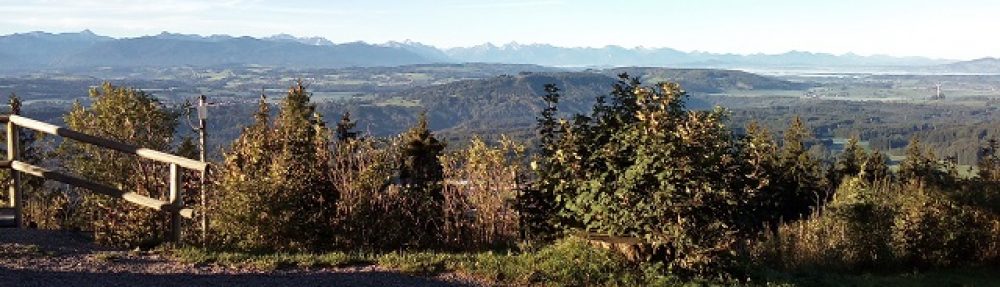
DD5LP/P – March 20th 2019 – DL/BE-093 Buchberg.

Preparation:

With the end of Winter bonus points drawing closer and at last some nicer (if still cold) weather and preparations for the EU-VK/ZL S2S event on April 6th, once I could get the car I decided to grab my bags and the newly constructed linked 40m / 20m VP2E antenna and head off to a not yet activated by me this year (actually not for a couple of years) summit – Buchberg, which is down near the town of Bad Toelz, just over an hours drive from here.

There was little preparation for this activation and as it was to be in the afternoon the DX contacts would be limited as I would be too late for short path to VK/ZL and too early for North America (even if the band conditions were good enough).

No, this would not be an activation seeking DX contacts, only to check out the physical equipment and to “tick-off” another easy summit with winter bonus.

The Activation:

The trip down to Buchberg was uneventful, except for the fact that the Navi wanted me to turn off the main road really early compared to where I had turned on earlier activations. Checking afterwards, it seems that it would have taken me along a restricted road as Google tried 4 years ago. I stuck to my known route in any case.

After I parked the car I loaded up with the two normal bags plus the 10 metre pole (which I need for the 40m VP2E and my surveyor’s tripod and slogged slowly across the field on a well-worn track, up the hill to the Holy Cross and (more importantly) the seating bank. Setting up the tripod was straight forward as was putting the mast into it and this time I remembered to remove my wooden plate that I have fitted to support the Antron A-99 antenna. The 10m mast is just to thick to go through the hole in the wooden plate, so ir needs to ne removed. I’m wondering about a small modification to this plate so that it can be used as a bottom stabiliser for the mast although so fat I have not needed that.

I decided to have the side with the coax feed in it, at the seat bank side of the mast so that the antenna would be “pointing” roughly in the direction of Holland, Belgium and the UK. I still haven’t been able to do conclusive tests to show how directional the antenna is. At the moment, the antenna seems to be better than my normal dipoles. Perhaps that’s because it is vertically polarised and somewhat directional or simply because it puts more wire in the air.

After setting up the antenna, with the links closed for 40m, I put the antenna analyser on the antenna and everything seemed “OK”.

So after that it was time to get at least 4 contacts in the log. I actually got nine 40m contacts in eight minutes, one of which was an S2S with Mike 2E0YYY on Walton Hill in the UK. I also decided to give 20 metres a try so I lowered the mast, took out the links and raised it again for one 5-9 contact into Russia (off the “back” of the antenna) and a 4-4 one into the UK. Band conditions on 20m were not good but at least this proved that the antenna works fine on both bands. After this “acceptable” activation, I decided to pack up and head home as I had three more summits planned for the following day (see later report on these). The drive home was uneventful and I was home in time to get the battery box on charge (it had used about 20% of the capacity of one of the two 5aH LIPO batteries in the box) and make sure all of the equipment was ready and packed for the following days activations as an early start was planned.

Photos:

This slideshow requires JavaScript.

Equipment:

Xiegu X108G.

Battery box (2 x 5000maH hardcase LIPOs).

Linked (20m/40m) VP2E (Vertically polarised, 2 element, 20m wire antenna).

Surveyors tripod.

10 metre DX-Wire fibreglass portable mast.

Smartphone PocketRxTx App and USB cable.

RigExpert AA-30 antenna Analyser.

Log:

Conclusions:

The propagation seemed variable and I was not out at the best time, but overall this was a good test of the equipment. The tripod is cumbersome to carry but it does mean one can put the mast up where you want it to be rather than be restricted to what supports are around.

The display on the X108G was of course unreadable but now using the Smart Phone to view and control the rig seems standard. With the new USB cable configuration the program didn’t hang-up and leave the rig on TX, but it still suffers from RFI from the phone raising the noise floor on the rig’s receiver. This still needs to be addressed. In the meantime once set up on a clear frequency, I can disconnect the lead to the phone and operate that way without the RFI from the phone.

The Linked VP2E antenna appears to perform well. I still don’t know if it really is directional though.

I am happy that I was able to simply “grab my gear and go” as both the terrestrial and space weather are very variable at the moment.

73 ’til the next Summit!

DD5LP/P – March 13th 2019 – DL/AM-180 Berndorfer Buchet, DL/AM-001 Peissenberg & DL/AM-060 Laber – a tale of sudden storms.

Preparation:

Brian VK3BCM from Australia was visiting Munich and I offered to take him to a summit or two while he was over. We played with several possible higher scoring summits only to find some of them had closed their lifts for maintenance a couple of weeks or in one case one day before Brian and his wife arrived in Munich.

The main point (apart from picking up activator points and winter bonus points of course) was to get at least one DL summit qualified so that Brian has another association for his Mountain Explorer award.

The week before Brian arrived the weather turned from being relatively pleasant with the old snow melted, back to winter with new snow coming down and covering everything in just over an hour but much worse we got multiple days of hurricane force winds with sleet and rain.

For this reason I decided we should take a very simple summit first to complete the Mountain Explorer requirement, then go on to some more interesting summits. As Brian was based in the centre of Munich, we arranged that he would get a train to the town of Tutzing on Starnberger Sea (about half way to the closer summits) and I would pick him up from there and take him to the nearby Berndorfer Buchet summit. Once that was completed we’d go to the drive-up Peissenberg summit, where we would also get lunch at the convenient restaurant and then go on to Laber as the higher scoring summit with some great views

Little did we know what the weather was going to deliver to us!

In any case, as I wasn’t sure what Brian would be bringing, I packed several different antennas and mast configurations including the SOTABeams linked dipole, the Aerial-51 OCF dipole, two VP2E antennas and the Kommunica Power HF-Pro2 loaded vertical. As supports I had the small tripod for the Kommunica antenna, the big surveyors tripod to support the telescopic masts and the screw-in sun umbrella base “just in case”. For masts I took two Lambdahalbe 6m masts and my DX-Wire 10m portable mast.

All was packed into the car, the night before (actually in some cases re-packed as I did two activations on the 12th). This as it turned out was a good idea to prepare the night before ….

The Activation (Berndorfer Buchet):

As I was still eating my breakfast, Brian called – he was already on the train heading to Tutzing and would be there in 22 minutes! There had been a misunderstanding as I had expected Brian to take a later train and I had a good 40 minutes drive across to Tutzing. In any case this gave us a good start to the day and we were at the parking spot for Berndorfer Buchet after collecting Brian from the station, almost an hour earlier than I had planned.

Berndorfer Buchet is an easy one-pointer summit with a 10 minute forest walk in from the car parking area and a steep climb up to the actual summit, which as you’ll see from the photos, is fully forested. We arrived on the summit at about 0900 UTC and I wanted to show Brian the trig point stone on the summit but couldn’t find it under the layers of branches and leaves that had come down during the winter.

Both Brian and I had full kits of gear with us but rather than set up two stations close to each other, we agreed to share equipment and so I put up the surveyors tripod which acted as a support for Brian’s 6 metre fibreglass mast and homebrew 40m dipole.  Attached to that coax was Brian’s Elecraft KX3 which I was looking forward to see how it performed as I had only ever seen one previously.

Band conditions were not good but we both got more that the four required contacts on 40m. Brian tried 20m as we “may” have been able to get a contact into VK/ZL from this summit however we were too late for long path and too soon for short path – perhaps from the next summit?

 The weather was cold but dry at Berndorfer Buchet.

The Activation (Peissenberg):

After the drive, we arrived at Peissenberg at about 11:30 UTC (about right for a short path contact into VK/ZL if propagation allowed us). Well, after walking from the car park in sunshine to my standard station location – two benches alongside the church which sits right on the summit and starting to set up the antenna mast, Brian and I spotted some storms in the distance to the west. Within minutes, the winds (over 70 km/h) and sleet / snow hit us (see pictures and linked video below). Brian asked if we should wait for it to pass but as we had planned to take lunch at the restaurant which is also on the summit, we decided to pack up what had been unpacked, drop it all back into the car and head to the restaurant by which time we were covered in ice from head to toe. After sitting down at a window and looking out at the tables that were covered in snow outside, suddenly the sun came out and the storm had passed. As we were already seated, we of course stayed and had lunch to warm us up a little as well.

Once lunch was completed, it was back to the car, grab just my gear (20 watt Xiegu X108G, 6m mast and SOTABeams linked dipole) as we decided to use my gear on this summit and then we went back to the two benches by the church. After setting up the weather conditions were certainly better with a little sunshine. The radio conditions had not improved much however we did get a minor pile-up from this summit and Brian and I easily got the required contacts to qualify the summit. As opposed to the first summit, this 1 point summit came with 3 winter bonus points and I think we earned them!

Just as we had decided to pack up so that we’d have time for the third summit, another storm approached and hit just as we got back to the car with all the gear. We wondered whether, with the high winds we were feeling, the cable car up to Laber would be running but the only way to find out was to go there and see. So the Navi (GPS) was set and off we drove.

The Activation (Laber):

On arriving at the car park for the Laber cable car, we could see it was running and when we asked, the operator said they had not had any bad weather so far today. It had been a nice sunny calm day.

The ride up in the oldest cable car system in Germany went without any issues. This system has just 4 cars on a fixed cable that means that when one car is at the bottom, two are at the half way point and one is at the top. So the cable car always stops at half way up and half way down to allow people to get out of and into the cars at the top and the bottom.

On arriving on the summit, we were greeted by sunshine and great views down into the valley but cold temperatures. The place where I usually set-up was not available as it was covered in snow and restricted from access as it was the top of a ski run. We took a look at the roof platform with the microwave links and cell repeaters on it but settled on the luxury of using the outside tables at the restaurant. This whole area is well within the AZ so there are no problems.

For this summit I had brought along my Komunica Power HF Pro 2 loaded whip and a small tripod as I know in my usual position it can be difficult to get a dipole out. With locating on the restaurant’s balcony however it isn’t difficult and so Brian agreed to put his mast and antenna up and again we used the KX-3.

So the weather conditions are good, if still a little cool, but what are the band conditions like? Horrible! It was a real fight to get the needed 4 contacts but we eventually did and as the last one was made the sleet started again. It seems our friendly snow storm had followed us down from Peissenberg! Once packed up it was time for a quick warm drink in the restaurant before getting the cable car back down the mountain. At first we thought we had missed one car and would have to wait for the next one in 15 minutes but no, we were lucky, the operator held the car and let us get in with 4 other people. The car rocked a little on the way down as the winds increased again but we safely reached the bottom and then it was time to head back to Tutzing for Brian to catch a train back to Munich. What had seemed to be a day with lots of time had shot by and I arrived home about an hour later than I had expected on the original plans but we’d managed to activate three different summit in the one day, which was quite good.

Photos (Berndorfer Buchet):

This slideshow requires JavaScript.

Photos (Peissenberg):

This slideshow requires JavaScript.

VIDEO – Peissenberg on Youtube here.

Photos (Laber):

This slideshow requires JavaScript.

Equipment used:

Berndorfer Buchet:

  • Surveyors Tripod
  • Brian’s Elecraft KX3 and battery box
  • Brian’s 40m dipole and 6m mast
  • Plastic painters sheet.

Peissenberg:

  • Xiegu X108G.
  • Battery box (2 x 5000maH hardcase LIPOs).
  • SOTABeams linked dipole.
  • 6 metre lambdahalbe fibreglass portable mast.
  • Thick plastic painters sheet.
  • Smartphone PocketRxTx App and USB cable.

Laber:

  • Brian’s Elecraft KX3 and battery box
  • Brian’s 40m dipole and 6m mast

Log (Berndorfer Buchet):

Log (Peissenberg):

Log (Laber):

Conclusions:

The propagation again wasn’t great but the weather was worse!

All in all a good if challenging, day out where we managed the three planned summits in the end.

I was able to compare the KX3 with the Xiegu albeit on different summits. I think the extra “punch” of 20+W from the Xiegu makes a difference over the 10W from Brian’s KX3. Both rigs are not easy to hear though the built-in loudspeakers and are better with headphones.

73 ’til the next Summit!

DD5LP/P – March 12th 2019 – DL/AM-177 Kirnberg & DL/AM-178 Ammerleite.

Preparation:

With constant bad weather from the start of March I wanted to get out and grab some Winter bonus points and at the same time make sure all equipment was working, before I was to meet up with Brian VK3BCM from Australia and take him to some SOTA summits. The previous week, I had travelled out to DL/AM-177 Kirnberg only to be forced to pack up after having got the antenna up, due to the high speed and bitterly cold winds. I had alerted for these summits a couple of days earlier but again with the weather had to postpone them.

I was now determined to get these activations in as this day was forecast to be somewhat better (not that weather forecasts are to be trusted nowadays) In any case everything was put ready for an early start as the wife needed the car in the afternoon.

I decided to concentrate on the tried and tested equipment, no testing any new equipment.

The Activation (Kirnberg):

As I approached Kirnberg, things looked fine (but they had done also the last time I was here). It was somewhat more muddy than last time as there had been heavy rain storms in the last few days.

I grabbed the surveyors tripod, one of my 6 metre masts and my usual two bags (one with the radio, battery box and headphones and one with the antennas and other small items in) and headed up the hill to the cross and bench on the summit.

All started well and the tripod allowed me to position the mast where I could run out the linked dipole easily in both directions. One end got tied off to the bottom of the concrete cross (I know not perhaps the best option but it’s there and would not be damaged by the cord) The other end ran down and was pegged into the ground.

At this point the winds started – this summit seems always to be windy and cold! Well I quickly set everything else up and got on the air. 20 metres was totally dead and 40 metres not much better but I managed nine contacts in 25 minutes and while I needed to get the second summit in as well, I called it a day at this point, packed up and carried everything back down to the car and set off for Ammerleite, on the other side of the valley.

The Activation (Ammerleite):

The run to where I park my car for Ammerleite took about 20 minutes and this time, I decided not to take the tripod as I knew there were convenient fence posts that could support the mast and the ends of the linked dipole. So there was less to carry this time, thankfully.

Set-up again on one of the two benches at this “Schnalz” summit and with the X108G connected to the smart phone so that I could see the display in what was now becoming a sunny day, and somewhat warmer than at Kirnberg, I was set to go. I didn’t even try 20 metres this time and concentrated on what was now a much better 40 metres. Signals were stronger with less QSB than at the previous summit.

Starting at 11:10 local (10:10 UTC) I managed twenty contacts in twelve minutes! This is how the activations used to be! There were no DX contacts in the log however even though I did listen specifically for Ernie VK3DET with whom I had a sched hoping to manage a 40 metre short path contact as had been possible in previous weeks at around this time. Today this wasn’t to be though. Rather than continue trying and while the chaser calls had dried up, I decided to pack everything up and head home so that the wife could have the car a little earlier than promised.

Photos (Kirnberg):

This slideshow requires JavaScript.

Photos (Ammerleite):

This slideshow requires JavaScript.

Equipment:

Xiegu X108G.

Battery box (2 x 5000maH hardcase LIPOs).

SOTABeams linked dipole.

Surveyors tripod (only used on Kirnberg).

6 metre lambdahalbe fibreglass portable mast.

Thick plastic painters sheet.

Smartphone PocketRxTx App and USB cable.

Log (Kirnberg):

Log (Ammerleite):

Conclusions:

The propagation again wasn’t great but at least I managed to get two more “easy” summits off my list for the winter bonus activation points. The equipment worked reliably meaning once I recharged the battery, everything would be ready for the follow days planned three activations with Brian VK3BCM.

All in all a good activation after the failed attempt a week earlier. The sunshine and little or no wind on the second summit was a pleasant change.

The sudden high SWR indications occurred with this (known good) antenna as I had seen with the VP2E antenna on the previous activation, so I believe this is false data being sent from the X108G to the smart phone App (PocketRxTx) rather than there being a bad SWR occurring.

73 ’til the next Summit!

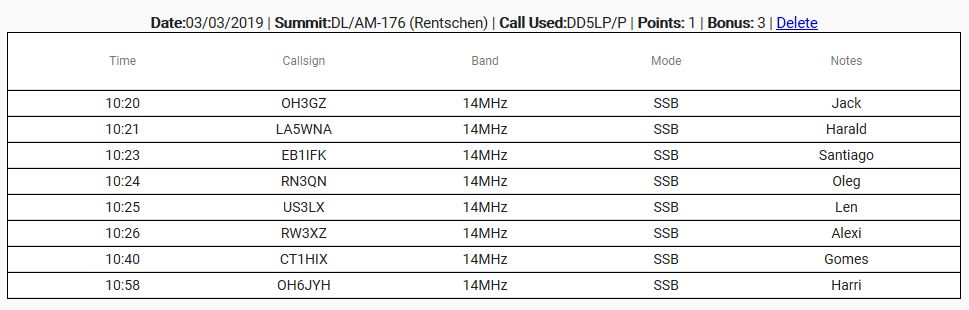
DD5LP/P – March 3rd 2019 – DL/AM-176 Rentschen.

Preparation:

There was little preparation for this activation as it was decided upon when the weather and radio conditions looked a little better, while those in the upcoming days were not looking very good.

For the last few activations I have been trying to make a contact into VK or ZL – something which used to be relatively easy as long as one was on at the right time to use the Long path or short path window. In this case, as the decision to activate was taken after the long path windows was nearly over – the only option was to try during short path window around 1100 UTC.  The closest summit where I could set up my new VP2E antenna up without any problems is Rentschen, the same summit that I couldn’t activate about 2.5 weeks earlier due to 1.5 – 2.0 metres of snow. I was hoping that most of the snow would have melted by now!

Once I had decided to try an activation, I grabbed all the needed gear, in principle my two standard bags, my surveyors tripod, screw-in sun umbrella base and two masts as I planned to put up my 40/20m dipole as well as the VP2E.

The Activation:

As I approached Rentschen, I could still see snow on the upper slopes but luckily when I arrived at the summit, a lot of the snow had gone and I could quickly find a spot to set up and I proceeded to put up the tripod, 6 metre mast and VP2E antenna set to direct its slight gain lobe in the direction of VK/ZL via short path. I was earlier than I expected on site but I decided the best action would be to start calling anyway to pick up the needed 4 contacts  for me to get the activator point plus the three winter bonus points for the summit.

Of interest, is the fact that the high voltage power lines that used to cross exactly over the trig-point / summit marker stone are gone! I presume they have been either buried underground or re-routed in some way.

Although the sun was shining, the temperatures were affected by a very cold wind, which in the end would limit the time I would be on the summit.

I had email contact with Ernie VK3DET and let him know that I was already calling, so he could try to listen for me. Unfortunately he could not hear anything from me – radio conditions were bad again. That being said I did make 8 contacts on what others reported as a “flat” 20m band. I managed two contacts into Finland, one into Norway, one into Portugal, one into Spain, one into the Ukraine and two into Russia. So the antenna does appear to work and the lack of contacts into the direction of the UK suggests some directivity of the antenna.

I had planned to put my second antenna up however a lot of my time was consumed with calming down a dog who came up to the summit on its own from a house down the lane and continually barked at me until she finally got bored and went home. Putting up a second mast with the dog there may have caused more problems with the dog. In any case I decided that as I had got my required 4 contacts fairly quickly I would continue testing with the 20m antenna and trying to get that short path contact into VK. Unfortunately the VK contact wasn’t going to happen, despite 20 watts of SSB and the new antenna, propagation simply did not happen.

To do proper antenna comparisons I think I need a second Op. along so that I can compare and log data and also get a second opinion of what is performing and what not.

Perhaps next time?

Photos:


This slideshow requires JavaScript.

Equipment:

Xiegu X108G.

Battery box (2 x 5000maH hardcase LIPOs).

VP2E (Vertically polarised, 2 element, 20m wire antenna).

Surveyors tripod.

6 metre lambdahalbe fibreglass portable mast.

Thick plastic painters sheet.

Smartphone PocketRxTx App and USB cable.

Log:

Conclusions:

The propagation seemed not to be very good with the noise level raised by yet another solar storm hitting the ionosphere. This was a risk, but at least I managed to activate and qualify the summit.

The display on the X108G was again unreadable so I used the Smart Phone to view and control the rig. With a different cable configuration to last time I had less problems with the program hanging-up and leaving the rig on TX, but it did still happen.

The VP2E antenna does appear to perform well, even though at one point the app on the phone told me that the X108G was seeing a 10:1 SWR but then the next moment it was 1.1 or 1.5:1. A bad connection perhaps? – Something to be looked at.

I am happy that I was able to simply grab my gear and go as the weather for the following week is not looking very good.

73 ’til the next Summit!

DD5LP/P – February 21st 2019 – DL/AL-169 Auerberg.

Preparation:

After analysis of the activation of Peissenberg the previous week, I decided that part of the reason for no VK/ZL contacts was that from my operating position, for the signals to travel on the long path, they would need to pass though the church building – I needed to give this another try from a better summit.

The Church at Auerberg and the land around it, which is the actual summit have been closed for some months hence I needed to find out if it was now accessible again before travelling there to find that I couldn’t set up. This summit is of interest as my location at the back of the church building is at the top of a steep slope dropping off roughly in a NNW direction, which is exactly the direction needed for long path into VK/ZL when a dipole is run along the top of the ridge.

I contacted the local government through their website and was forwarded onto the church group, who told me that the church would only be open after the re-blessing ceremony,  following all the renovation work, in April. I sent another note asking if the area around the church is once again open to the public and the reply was positive but with a warning that there was still a lot of snow up there. I’ve activated Auerberg in winter before, so I knew what to expect.

Unfortunately the space at Auerberg is not enough to deploy the new VP2E antenna for a test and as 40m was more likely to deliver a contact, one of my dipoles (either the linked SOTABeams “bandhopper: or Aerial-51 UL-404 off centre fed dipole) would be better suited to be used for 40m & 20m.

These two dipole antennas are always at the bottom of the small rucksack and so they stayed there, while the two VP2E antennas were removed. I also decided to give the troublesome DX-Wire 10 metre mini-mast another chance as the dipoles work better for DX the more height they have. (I’d also take the 6m Lambdahalbe mast as backup). As for supporting the mast, since the surveyors tripod had done such a good job in the snow on Weichberg about 10 days before, I decided, despite its size and weight, it would go along as well to Auerberg. As it turned out this was a good decision as the fence posts that I used to use were partly bent over by the weight of snow on them.

Again Mike 2E0YYY was going to head out to a summit in the UK and he decided to take a vertical antenna for 20 metres and a dipole for 40m. We informed the usual hams in Australia who promised to try for a contact with one or both of us if the conditions allowed.

Unfortunately our timing was bad with the largest amount of Plasma from a Coronal Hole on the Sun, hitting the Ionosphere  on the evening before the activation but after making all the arrangements, I decided to go anyway “you never know”…

So as this would be an even earlier start than last time (needing to be operational on the summit by 0700 UTC) all the gear was packed into the car the night before and the alarm set for an early start ….

The Activation:

As with the Peissenberg activation the previous week I didn’t need to set the alarm as I was wide awake an hour earlier than I needed to be. I didn’t want to leave early as I would end up sitting around in the snow waiting for the long path window to open, so I actually left home at about my planned time. The trip down was uneventful and although I did have the GPS navi on, I didn’t need it having driven the route a few times previously.

As I approached Auerberg, the snow at the side of the road started to get higher and higher and I wondered what would be facing me when I arrived at the car park (the kind lady from the Church group had told me that the road up to the car park had been cleared, which was indeed the case. Looking up to the church from the car park, I was relieved to see that someone had cleared the complete set of steps from the restaurant up to the church and when I got up there. A track around the church had also been cleared. I headed to my normal spot so that I could put the radios and masts down on the bench seats …. I couldn’t as they’re no longer there. The area at the back of the church was part gravel, part mud and also part snow. So the old reliable painters plastic sheet came out of the rucksack and everything was put on there while I took a look to see how I would put the antenna up. I had already decided to use the Aerial-51 OCF antenna for this activation to avoid the need to lower and raise the antenna when I wanted to change between 20m & 40m. Given that I had decided to use the DX-Wire 10 metre mast – lowering and extending that mast multiple times, with its habit of collapsing into itself, was to be avoided if possible. Before the mast and antenna could go up though the first action was to put up the surveyors tripod. This had to go again into the snowy part of the area and the spiked legs again did a good job. After the tripod was up, the mast was fed through my wooden plate that is permanently fitted to the tripod and then the antenna slid down onto the mast sections. Before extending the mast up, I ran the ends of the antenna out in the two required directions and the coax back to the painters sheet, where the radio would be connected up. Much of the fencing had been damaged by being pushed over by the weight of snow that had been present. It was still over one metre deep in places which made getting the antenna wire out where I wanted it, a little difficult at times.

Up went the mast, I had just about guessed the positioning of the cords on the ends of the elements to two of the remaining upright fence posts so only a little adjustment was needed there.

It was now time to prepare the operating position, so out came the Xiegu X-108G, its microphone, the battery box, my log book and pen and the smart phone and USB cable. I expected to have to use the smart phone to see the settings on the rig and change them when needed, but for most of the two hours that I was on the summit, the display on the X108 was just readable.

After checking for any spots from other activators (the last shown were from hours earlier) I decided to set-up and start on 20 metres. 20 metres during this activation was a flop – I only managed one contact on 20m with Sergei RV9DC at a much lower strength than he normally is. 40 metres was the band to be on, although during the activation I went back to 20m a few times to see if there was any DX to work – there wasn’t. Only European nets it seemed.

Even 40m didn’t deliver the hoped for DX, despite some close calls. At one point I could hear Ernie VK3DET but he couldn’t hear me. Then later he heard me but could break in, in between the European chasers, despite the fact that I specifically listened for VK/ZL stations on several occasions. The conditions were simply not good enough. I mentioned earlier that Mike 2E0YYY and I had planned this together and indeed I worked Mike for an S2S and for a couple of short chats. We ran one frequency between us at one point (for about 30 minutes) which caused some confusion with the chasers calling me Mike on a few occasions and I had to explain who they were actually working. I suspect Mike’s self spot on the frequency was after mine and hence was seen more easily.

Towards the end of the activation, I had a visit from a couple from Garmish Partenkirchen who had come out for a walk and the views. He knew something of what I was doing as he had been a TV repair man before he retired.

At the end of the activation I ended up with 29 contacts all from around Europe and as my location was shaded from the sun, I also ended up very cold until I got back down to the car, which was sat in the sunshine reporting +9C. I believe at my operating location it would rarely have got over the freezing point.

For this activation, I had only planned to try the long path. To have waited for the short path would have been another 2-3 hours after I packed up because of the cold and I would have had to again transmit through the church building, this time for the short path direction.

Photos:

This slideshow requires JavaScript.

Equipment:

Xiegu X108G.

Aerial-51 UL-404 OCF dipole.

Surveyors tripod.

10 metre DX-Wire fibreglass “Mini-Mast”.

Thick plastic painters sheet.

Smartphone PocketRxTx App and USB cable.

Log:

Conclusions:

The propagation seemed to be one-way at times and with the Plasma hitting the Ionosphere still at the time of the activation, it would have been surprising to make any contacts into VK or ZL.

It was strange to hear absolutely nothing from New Zealand.

I was surprised by the DX-Wire mast. For once it held up through the complete activation and the surveyors tripod was certainly worth the extra effort of taking it as it made the setting up of the antenna very straight forward indeed.

Although Mike was running 50 watts to my 20 watts and is at least one “skip-hop” closer to VK/ZL than I via the long path, he also managed no contacts “down under” so it simply wasn’t to be on this occasion.

Although the display was (just) readable on the X108G I did use the Smart Phone to set or change parameters as the small rubberised buttons on the X108G itself are difficult to use – especially in the deep cold. After changing cables and adding more ferrites, since the last outing, the USB link between the rig and phone worked fine on 40 metres but when I changed to 20 metres the link failed often and many times left the rig on Tx after I released the PTT switch. Some noise still comes from the phone into the X108G’s receiver. More work needs to be done on both of these problems.

73 ’til the next Summit!