This was a re-try of the attempted activation from the previous Wednesday when high winds made me call off the activation from the car park before I climbed to the summit. This day was supposed to be a fine, warm, sunny day but as usual, two days before the activation, the forecasts changed to overcast, cold and possible winds.
Despite that, I was determined to be ready for an activation and as long as there were no high winds or torrential rain, I would activate. All the gear was packed in the back of the car on Sunday evening ready for an early start at 7:30 am the next day.
“All” this time was to include the surveyor’s tripod and the large feed-point board for the 20/10m wire beam – this would be the first real test on a summit of the ability to switch the antenna direction from my smartphone, something that had been giving me problems for the last six months. Of course, the usual backpack with radio, battery, masts, backup antennas, food and drink, would also be included along with the RigExpert Antenna Analyser.
The Activation
DL/AL-179 Weichberg
On arriving at the car park for the summit, after an easy (and wind-free) trip down, the winds started to howl between the trees and some threatening-looking clouds were approaching. Despite this, I was determined not to call the activation off again as Ernie in VK3 was going to be available and Mike 2E0YYY/P was heading up to Mow Cop (HEMA G/HSP-020) so that we might make this a three-way contact today (at least on 20m, if not on 10).
After a hard trek up the forest path to the summit, with a loaded rucksack, the tripod over one shoulder and carrying a bag of documents, the antenna plate and antenna analyser in a shopping bag in the other hand, the top was reached and I put most of the gear down at the wooden table.
I unpacked the antenna, mast and Tripod and went straight to the complex installation including the relay board with Bluetooth switching and the trapped antenna elements. If this did not work, I could go back to the simpler setup as I had brought everything with me. Using my Rig Expert antenna analyser I could see that the antenna (initially set in the Long Path Direction (West)) was looking fine, so then I sent a message via the Signal app to the other two, who were both almost ready.
First in the log was Ernie VK3DET followed by Mike 2E0YYY/P a minute later. Both 5-8 to 9 signals on 20 metres. For once, it seemed the system was working well, the first time. My biggest problem was using the messaging app with frozen fingers. There was a light wind which grew over time but was always icy cold. The measured temperature would have been around 3°C but with windchill nearer to -3°C!
We actually managed an easy “net” between the three of us on 20m until Mike said 10m was open and he wanted to try there, so we moved up two bands and I switched the antenna to Short Path for Australia (East from my location). After trying several frequencies, we eventually found a free one and although Ernie was getting to me at around S2, he could not hear me. When Mike tried, I had to switch the beam around to West before I could hear him (again at about S2) again, he could not hear me. So the added problem I had was this need to switch directions to hear the two guys but as they could not hear me at all on 10m, nothing was really lost. they managed to make contact and I told them I’d head off spot myself and try to get some contacts in the log. To me 10 metres sounded rather quiet compared to other days when I have use the simplified version of this antenna but this could also be propagation. in any case I was glad of a ground-wave call from Mario DJ2MX in Munich, so that I had at least one contact on 10m from the summit.
As I was still short of the needed 4th contact, I switched back to 20m, found a frequency, spotted myself and another 15 contacts came in, in quick succession. I was certainly getting out on 20m!
All of this time, I was fighting to have gloves on to try to stop losing all feeling in my fingers and taking them off when I needed to do something on the phone. Time was also passing, so when there seemed to be no more chasers, I called it a day, packed up, returned down the steep forest path and when I got to the car, it started to rain. That was lucky timing!
Photos:
DL/AL-179 Weichberg:
This slideshow requires JavaScript.
Equipment taken:
Mountaintop travelling 40-litre rucksack.
Xiegu G90 radio.
Surveyor’s tripod.
7 metre fibreglass mast.
10-metre band 2-element wire beam (full version).
RigExpert AA-30 Antenna Analyser.
Komunica Power HF-Pro2-PLUS-T loaded vertical antenna and tripod (not used)
Lamdahalbe 6m mini-mast and new metal base peg (not used).
Aerial-51 UL-404 OCF dipole (not used).
4 Ah Eremit LifePO4 battery.
4 Ah LiHV battery(not used).
Painter’s thick plastic sheet (not used).
Gardener’s kneeling pad (not used).
Lightweight headphones.
Smartphone for SOTA spotting.
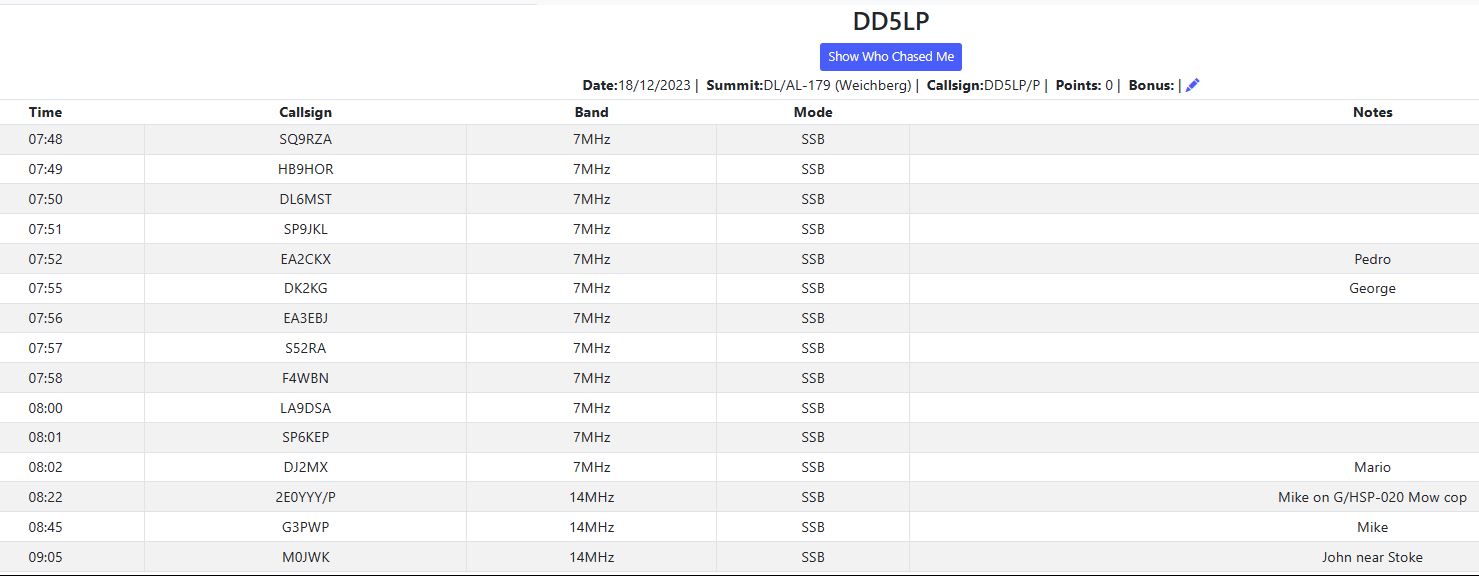
Log:
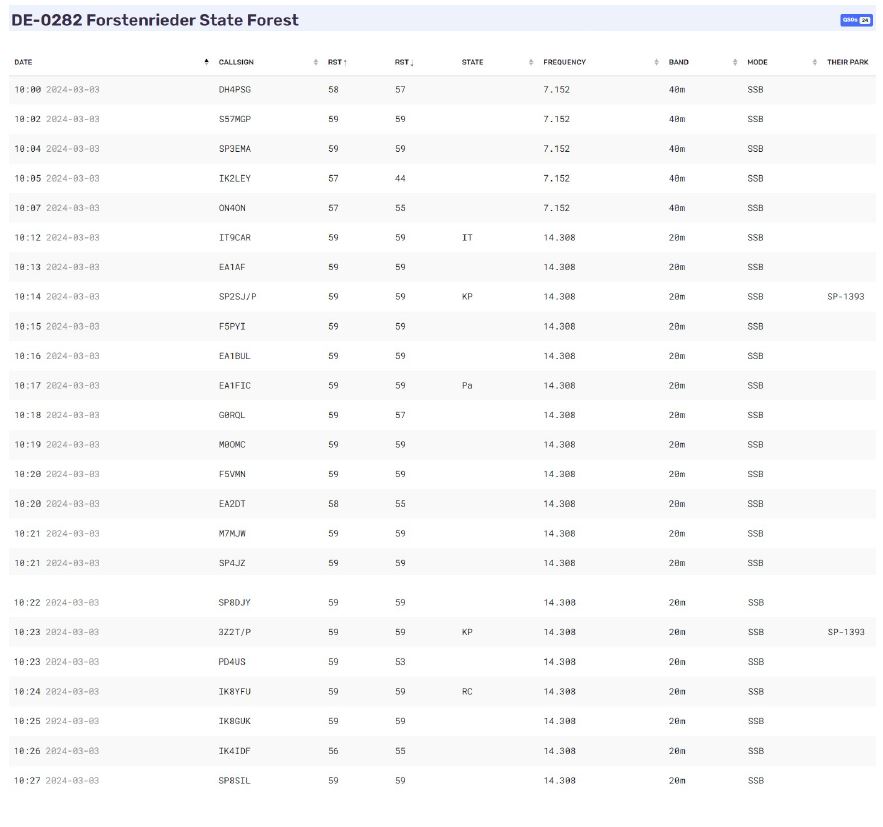
DL/AL-179 Weichberg
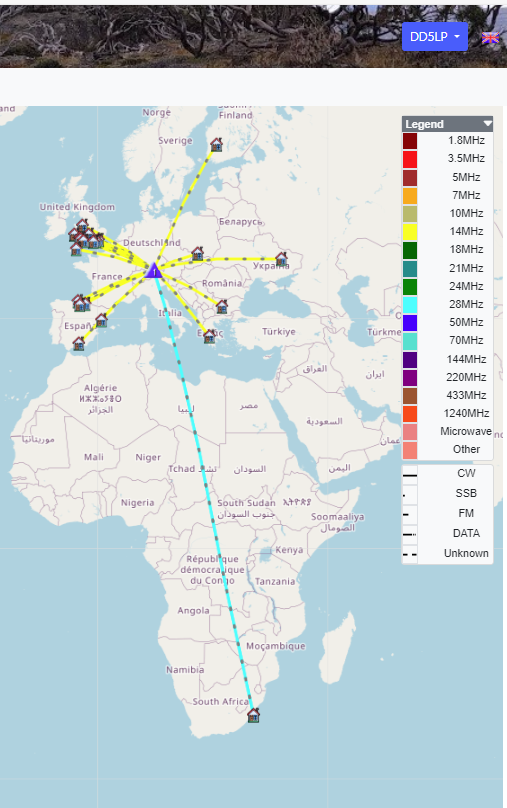
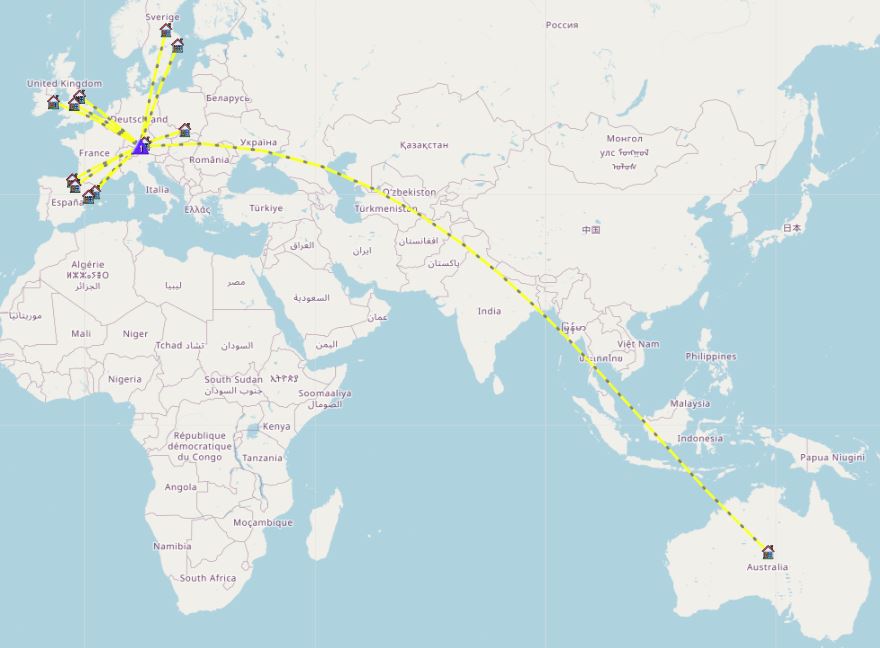
Contacts map
Conclusions:
The antenna worked well with between 1 & 2 S-points difference on weak signals depending upon the direction was switched to.
It would be nice to have a method to have a one-button direction setting action rather than the 4 actions needed at the moment. Perhaps I will need to try to get another model of relay board to which I could script commands.
The 10m section of the antenna did not perform very well. Whether that was because of propagation or whether the capacitor does need to be a different value can only be tested by switching between models of the antenna (i.e. with and without the traps).
With progress made on the 2-element wire beam and success at Peissenberg a week previously in the 10m only form, it was time to test the antenna this time with the trapped elements which should make the antenna a dual band antenna able to operate on the 10-metre and the 20-metre bands. This was not to be a test of the Bluetooth relay switching board but rather purely to test out the dual-band nature of the elements. Testing the full system with remote switchable direction will need to wait until another day.
After some days of rain showers, Monday had a good forecast with winds supposed to cease by 9 am and then the day to be sunny if not warm.
After a couple of tests in the muddy local field, the simple feed-point plate with the trapped elements had been trimmed to length, so everything was set for a test from a summit and so the surveyor’s tripod, the 7-metre mast, the antenna analyser and the antenna components were all loaded in the car on Sunday evening along with my 40-litre rucksack containing radio, battery and several antennas and masts, ready for an early start on Monday morning.
The chosen summit “Rentschen” is a plateau and as such a good summit for antenna testing with lots of space and few obstructions. This is a summit that is both in the HEMA and SOTA schemes and so is a “twofer” as POTA activators would say.
The Activation
The trip down was uneventful and I arrived at my usual car parking spot at around 8:15 am local time with my plan to be on the air before 9 am to catch the 20m long path into VK (I had set up a sked with Ernie VK3DET) and then to try the antenna also on 10 metres.
I chose a spot not far from the trig-point stone and I unpacked the mast, tripod and antenna first. These went up well, in the same way as I had installed them on the local field for the earlier tests and trimming. The four wires go out at 90° to each other and because of the combined length of the element and its cord extender (also acting as the guy cords for the mast), form a 56° angle with the vertical mast (the mast is a 7 metre mast but with the top section removed so that the feedpoint board sits at 5 metres above ground level).
Before unpacking the radio, I attached the antenna analyser to make sure that all still seemed OK with the antenna – it did. Then the Xiegu G90, headphones, battery and log book were unpacked and laid on my painter’s thick plastic sheet on the ground.
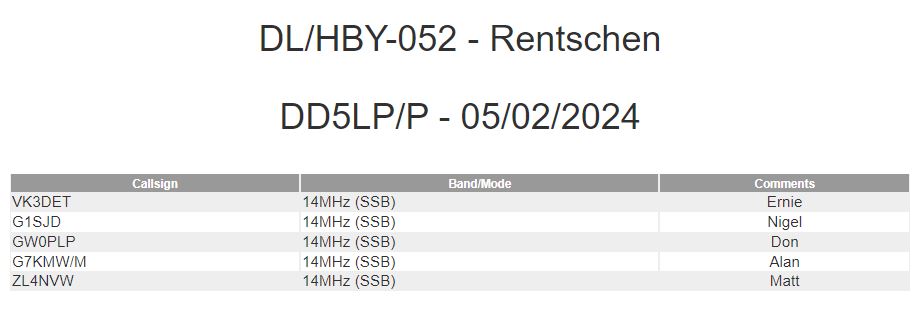
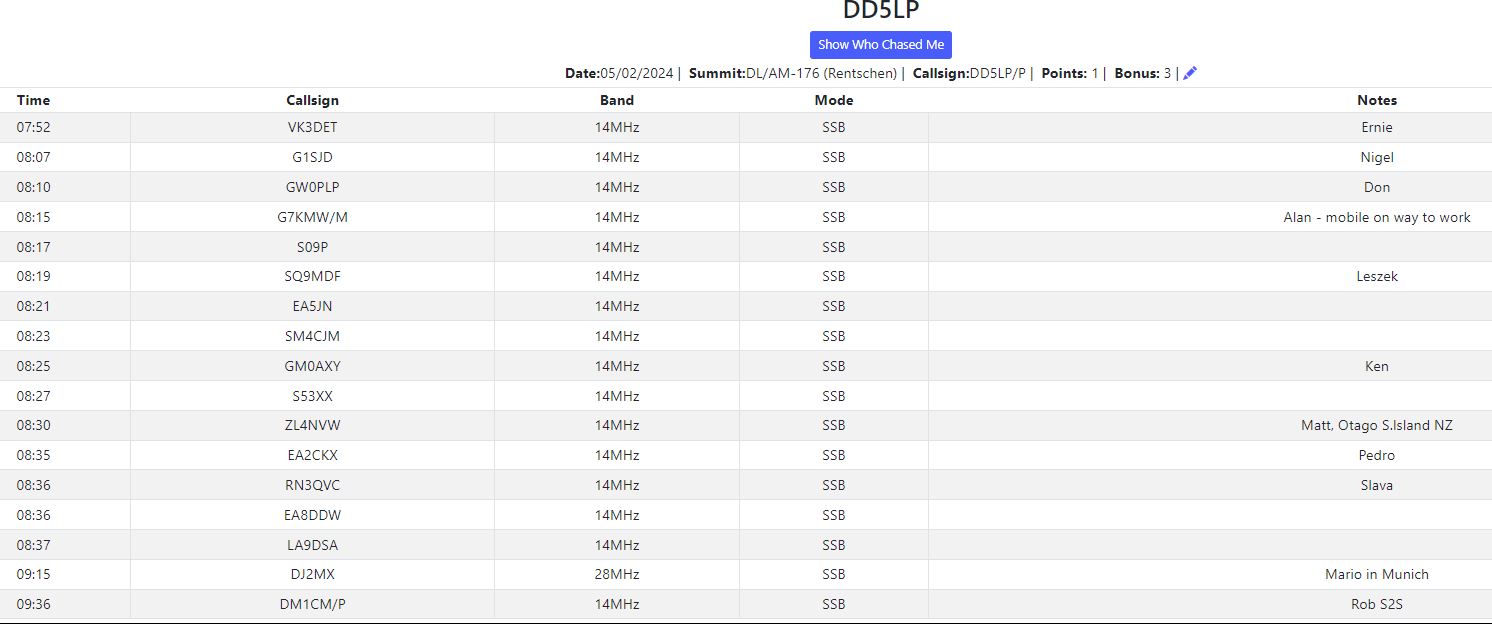
After sending a short Internet message to Ernie and agreeing on a 20m frequency that was free at both ends, I called Ernie and there he was – armchair copy, solid signal! I had the antenna “aimed” long-path (West from me) for this contact. When I needed to move to 10m, it would need to point short-path (East from me) so, rather than going straight on to 10m (a bad decision as it turned out), I decided to work more chasers (HEMA & SOTA) on 20m first.
In the middle of the SOTA callers on 20m, Matt ZL4NVW from Otago on the South Island of New Zealand called in. This suggests that 20m would have still been good for contacts into VK for another hour or so at least.
Another surprise contact was Alan G7KMW actually mobile while heading into work in the midlands of the UK. An easy copy so I think the antenna is definitely working.
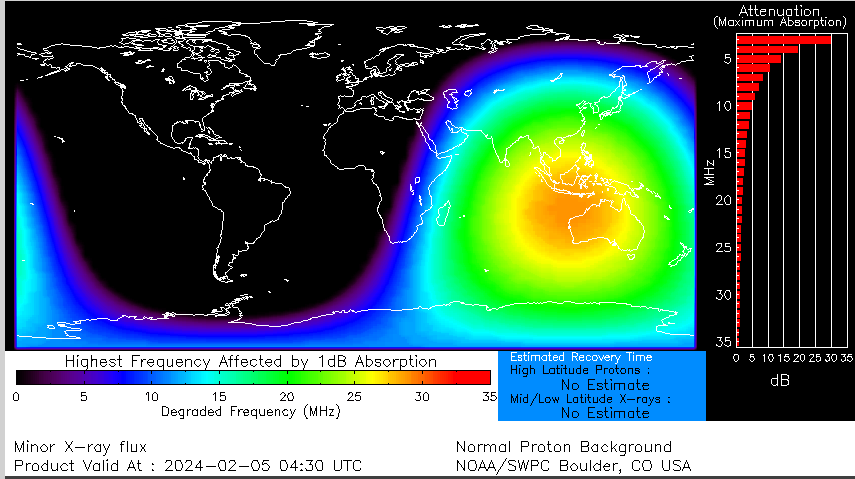
When I decided to switch to 10m it was getting close to 0900 UTC and after dropping the antenna, turning the feed-point board 180° so that the beam would be pointing short-path to VK and raising it again, Ernie VK2DET and I tried for a 10m contact but if I hadn’t known he was calling I would have mistaken it for just part of the noise. The signal was so weak that there was no chance of Ernie hearing me (but I did try). What was strange was that two VK2 stations VK2CPC and VK2GM were both booming great 59 signals on 10m. Initially, I had thought my antenna wasn’t working on 10m but later I found it was most likely a propagation problem with an X-ray flare hitting the Ionosphere over Australia and pushing the MUF down over VKs 3,5,6 & 8 but not affecting VK2.
I only got one contact on 10 metres and that was off the side of the beam with Mario in Munich.
The next test will be to fit the Bluetooth-switched top board, to see if I can hear any difference in signal strengths as I “rotate” the static antenna electrically. I also want to see if I can support the mast with just a ground peg rather than using the surveyor’s tripod. On Rentschen at the start of the activation, there were only very light winds but when I went QRT, they had increased to a level where I may have had issues putting the antenna up so I had timed it right in that respect.
Photos:
This slideshow requires JavaScript.
Equipment taken:
Mountaintop travelling 40-litre rucksack.
Xiegu G90 radio.
Surveyor’s tripod.
7 metre fibreglass mast.
10/20-metre band 2-element trapped wire beam.
RigExpert AA-30 Antenna Analyser.
Komunica Power HF-Pro2-PLUS-T loaded vertical antenna and tripod (not used)
Lamdahalbe 5m mini-mast and new metal base peg (not used).
SotaBeams linked dipole (not used).
4 Ah Eremit LifePO4 battery.
4 Ah LiHV battery(not used).
Painter’s thick plastic sheet.
Gardener’s kneeling pad.
Lightweight headphones.
Smartphone for SOTA/HEMA spotting.
Log:
HEMA
SOTA
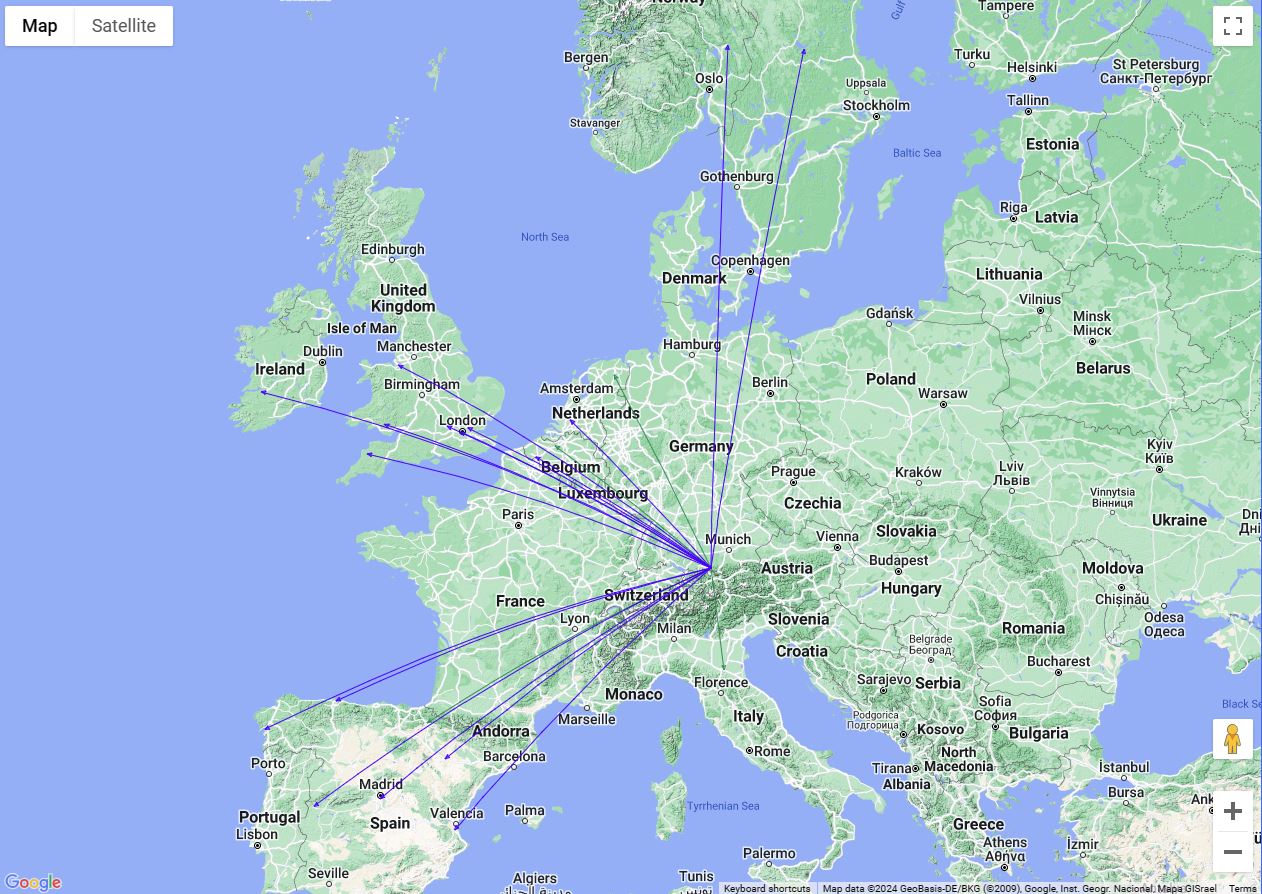
CONTACTS MAP
Conclusions:
The antenna worked well on 20 metres. The problem with getting through on 10 metres to VK3 was later found to be an X-ray flare hitting the atmosphere over part of Australia, explaining why VK2 and JAs were getting through but not VK3. Others in Europe experienced similar problems.
Once the band is open and DX stations are coming in, the “search & pounce” approach can be forgotten as there are too many high-powered stations with large beam antennas that believe it is their right to get in contact with the DX station and if they hear someone else calling ahead of them, they repeat their call after the portable station finishes to make sure that if the DX station goes back to the portable station, he/she can no longer hear the DX station because of the DQRM they are causing. Hardly in the spirit of ham radio!
The saga of the 2 element wire beam has continued for some time (months in fact). First with physical feed point board mounting problems, then apparent electronic problems with the Bluetooth relay switching board, then I managed to blow that board by connecting the supply in reverse and when I got what I thought was an exact replacement it wasn’t, meaning that my direction switching scripts on my smartphone no longer worked and had to be replaced by single button switches in the app.
Then along came gale force winds, 30cm of snow and heavy rains in several different sequences delaying testing of the “fixed” electronics on the local field. While stuck inside not able to test the complete solution, I built up an elementary (no electronics) feed-point board, so that I could test out the straight elements and the elements with HF-Kits traps in them (making them suitable for 10 & 20m usage), without having to worry about electronics, Bluetooth or Smartphone issues. In this configuration, it is not possible to switch the direction of the beam, it points in the direction that it is erected for
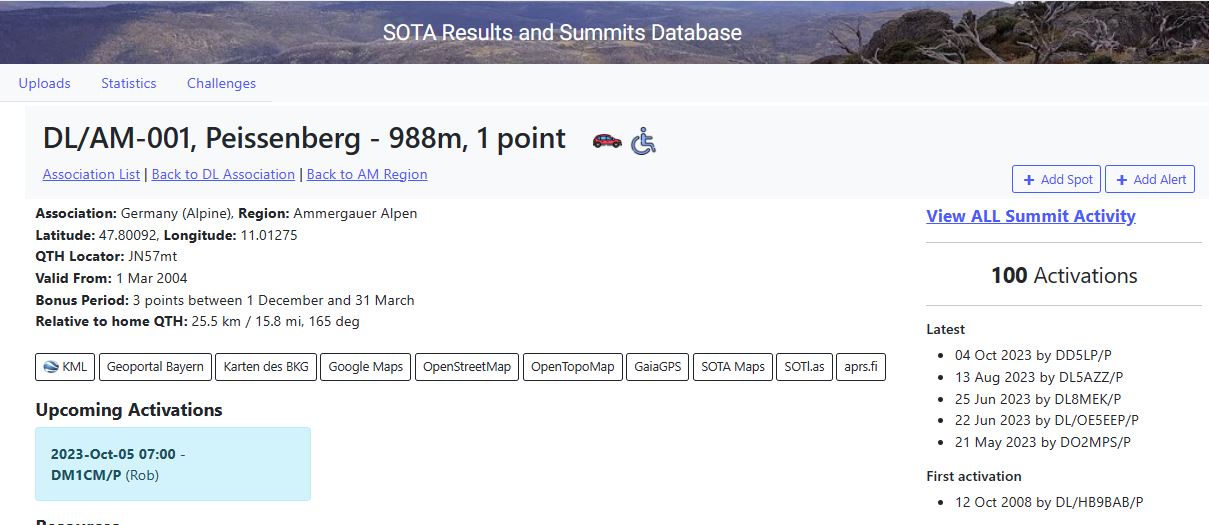
After a couple of tests in the local field (still rather muddy, but with only three days of dry weather forecast I had to put up with that) the simple antenna was ready for use from a summit for which Peissenberg was chosen, being one of the closest that had room for my surveyor’s tripod, 7m mast and the wire beam. After a further test before lunch, where the trapped elements proved to still need some trimming but the simple 10 metre elements were spot-on, I decided to make this a 10-metre-only activation (even though a CME had just hit the Ionosphere, the MUF was still up above 30MHz) in the late afternoon when 10 metres had been opening up to North America.
The Activation
DL/AM-001 Peissenberg
On arriving at the car park for the summit, it was obvious that others were there, waiting (I believe) to watch the sunset while having a light meal.
I unpacked the antenna, mast and Tripod first before returning to the car for the radio later. I luckily had also brought my antenna analyser along that I had used during my tests in the morning, as after setting the antenna up, the 10 metre band sounded rather quiet and the ATU in the radio took some time to match it to the radio – a sign that something was wrong. I could have then tried the SWR scan feature in the G90 but while I had the Rigexpert AA-30 with me, I put that on and it was obvious that the antenna was not connected. I checked the PL-259 plug at ground level but it quickly became obvious that the problem lay on the feed point board up at 6 metres in the air, so down it had to come down.
The connection problem was traced to the BNC end of the RG-213 coax cable where it plugged into the BNC socket on the simplified feed point board. Once I detached and reattached the BNC plug to the socket on the feed-point board all worked OK for the whole of the activation. I need to find a better solution and indeed after returning home I have been able to make this connection a far more solid “match”. Should the problem re-occur I will solder the co-ax straight to the antenna element connectors.
Once I had sorted out the connection, 10m sounded a lot more like it should on receive, but despite that and having spotted myself several times on the SOTA cluster, I was not getting calls that I had hoped for, that was until I heard ZS5APT calling me! This was Adele and after exchanging reports she said -please wait I have another South African ham that wants to call you – who was ZS5AYC – Sid (her husband). So my first two contacts on the new antenna were in South Africa! I should be happy at that except … the wire beam was pointing at the US (which is West of me), not South Africa (which is South of me). This simple (one direction) antenna would be receiving Adele and Sid off the side of the beam, they were both 5-6 and gave me 5-8/5-9 – not bad for 20w and a wire antenna.
But it left me thinking – would the signal have been better with a simple dipole? I obviously need to do some more testing to prove the directional properties of this antenna.
The next three-quarters of an hour were difficult, I was not getting calls and when I tried to call other stations which I could hear well from the US and Canada, I’d get hammered in their pile-ups.
Two semi-local German stations (DA20XOTA and DJ0AL/P) did persevere through the QRM and QSB, but after that, I could not seem to get any more contacts. Other SOTA activators who were out in the area were too close for me to get S2S contacts, I could hear people chasing them but not the activators themselves.
I had just about decided to pack up as it was getting towards sunset and more campers were turning up so I used the magic words “LAST CALLS” – and who comes back to me? Gary K3TCU, from Pennsylvania. He was 5-8 and gave me 4-4 which sounds like an honest report. He kindly ventured from his normal CW to SSB to give me a call.
Photos:
DL/AM-001 Peissenberg:
This slideshow requires JavaScript.
Equipment taken:
Mountaintop travelling 40-litre rucksack.
Xiegu G90 radio.
Surveyor’s tripod.
7 metre fibreglass mast.
!0-metre band 2-element wire beam.
RigExpert AA-30 Antenna Analyser.
Komunica Power HF-Pro2-PLUS-T loaded vertical antenna and tripod (not used)
Lamdahalbe 5m mini-mast and new metal base peg (not used).
SotaBeams linked dipole (not used).
4 Ah Eremit LifePO4 battery.
4 Ah LiHV battery(not used).
Painter’s thick plastic sheet.
Gardener’s kneeling pad (not used).
Lightweight headphones.
Smartphone for SOTA spotting.
Log:
DL/AM-001 Peissenberg
Conclusions:
The antenna definitely works. It can be set up on a summit without too many problems but this time I used the surveyor’s tripod for support, next time I’ll try just the ground peg and the 6m mast rather than the 7m one.
If the feed cable issue re-occurs I have enough RG-316 coax (that’s the thin, lightweight stuff), so I will simply solder a length onto the feed plate element connectors and put a PL259 plug on the other end.
A short 3-night break with the family to Füssen near the Austrian/German border brought the chance of some portable radio activations. The problem of planning ahead with this trip was the uncertainty of the weather and indeed two of the days were ruled out due to high winds or constant rain but a POTA activation and a combined HEMA/SOTA activation could take place. See previous reports to explain how a summit can be in both HEMA and SOTA. As my new wire beam has, because of long-term sub-zero temperatures and snow cover, not been able to be tuned as yet (and its supporting surveyor’s tripod could not be taken along due to lack of space in the car), the good old 6m telescopic fishing pole with a linked dipole would be the antenna of choice on any summits and the Komunica HF-Pro2-Plus-T on a mag mount on the car roof for the POTA activation which would be again a PLOTA (Parking Lot on the air) from a car park, just within the boundaries of the park.
The Activations
Monday 22nd January – POTA DA-0003 Ammergauer Alps NP.
This POTA park is quite large and the last time I activated this, it was a joint activation with the SOTA “Laber” summit which is in the East of the park. This time I would be activating from the western edge of the park.
After checking into our hotel and dropping off my wife at the Spa, our dog Bonnie and I drove to the parking area that I had found on the map to be within the park’s boundaries. Of course, before starting operating, a higher priority was to take the dog for a walk up into the forest on the side of the hill. Once this was taken care of I could set up the station in the car. The G90 radio and its battery were put on the front passenger seat and the antenna was located on the magnetic mount on the roof.
I had decided to start on 40 metres as normally this is a sure way to get a few contacts in the log and with POTA 10 contacts are needed to qualify the park. This was more difficult than expected with the spot on the POTA site not bringing the expected flood of calls. I tried a different frequency in case there was someone, that I could not hear on my chosen frequency and after a little while longer I managed four contacts but then the calls dried up. It was about noon and perhaps this is not a good time for 40 metres?
So after a switch to 20m and re-adjusting the antenna, we had a totally different story with lots of calls getting into the log. Indeed the final count was 23 contacts in 45 minutes, with a few of those being a little longer than the usual report exchange.
Tuesday 23rd January – HEMA/SOTA DL/HBY-036 Eisenberg / DL/AL-171 Eisenberg.
I had considered activating some summits closer to Füssen, that I had not activated before, however as most tracks were still snow-blocked and some others simply dangerous at this time of year, I decided to drive a little further and activate a summit that I know well and have activated several times over the last few years. Eisenberg has a publicly accessible castle ruins on its summit with a wooden platform added to one end, where I normally set up.
En route the rain that had started soon after I left the hotel stopped just as I was arriving at the starting point for the climb. The walk up from the (unfortunately closed) Schlossalm Zell restaurant needed me to fit my shoe spikes as the path was thick ice and as I got closer to the summit, the winds were increasing.
I was not worried as I knew I had a good strong point to strap the mast to and could shelter alongside the wall on the platform. On arriving at the platform, I was surprised to see a new fence across it as it seems half of the platform has rotted away and is awaiting repair. This messed up the idea of setting up on the platform so I searched around in the ruins in the hope of finding a large enough area to string out the antenna and at the same time have some shelter from the winds.
No such spot was to be found but I did find a sheltered spot with enough room to put up my backup antenna, the Komunica HF-PRO2-Plus-T on its tripod with radial wires. This was going to have to be the option and as I could see further clouds heading towards me, I wanted to make a fairly quick activation (for both HEMA and SOTA only 4 contacts are needed to qualify the summit)
Learning from the previous day’s experience I decided to start on 20 metres rather than 40 metres and given the incoming weather, this was going to be a single-band activation.
This activation racked up 17 contacts in 14 minutes (several of these regular chasers who I had not yet talked to in 2024) before I packed up and headed back to the car at which point the incoming rain started – I had been lucky with the weather.
At this point, an activation of Falkenstein (another summit with castle ruins on it), had been planned for either Wednesday or Thursday but very strong winds on Wednesday and constant rain on Thursday, meant that activation never took place.
Photos:
POTA DA-0003 Ammergauer Alps National Park
This slideshow requires JavaScript.
HEMA DL/HBY-036 / SOTA DL/AL-171 Eisenberg
This slideshow requires JavaScript.
Equipment taken:
MountainTop 40-litre rucksack.
Xiegu G90.
Komunica Power HF-Pro2-PLUS-T loaded vertical antenna. (used with magnetic mount for the first activation and on a tripod with radials for the second activation).
Three-magnet car roof antenna mount.
Modified mini photo tripod with clip-on radials
Lamdahalbe 6m mini-mast (not used).
SotaBeams linked dipole (not used).
4 Ah LifePO4 Eremit battery.
4.5 Ah LiHV battery.
Painter’s thick plastic sheet and gardener’s kneeling pad.
Lightweight headphones.
Smartphone to spot and back-channel comms.
Logs:
POTA DA-0003 Ammergauer Alpen NP
POTA Contacts Map
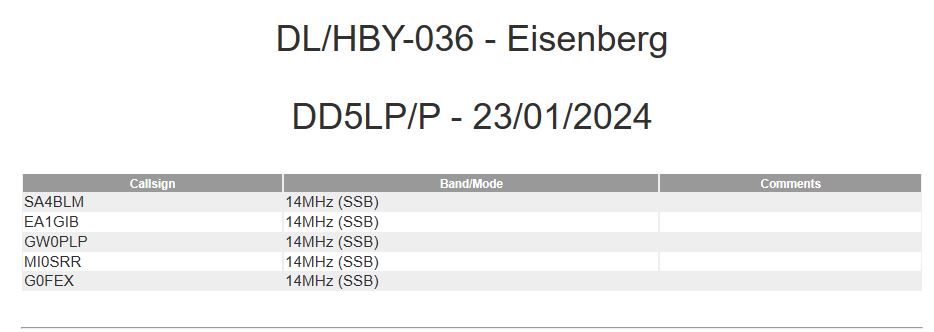
HEMA DL/HBY-036 Eisenberg
SOTA DL/AL-171 Eisenberg
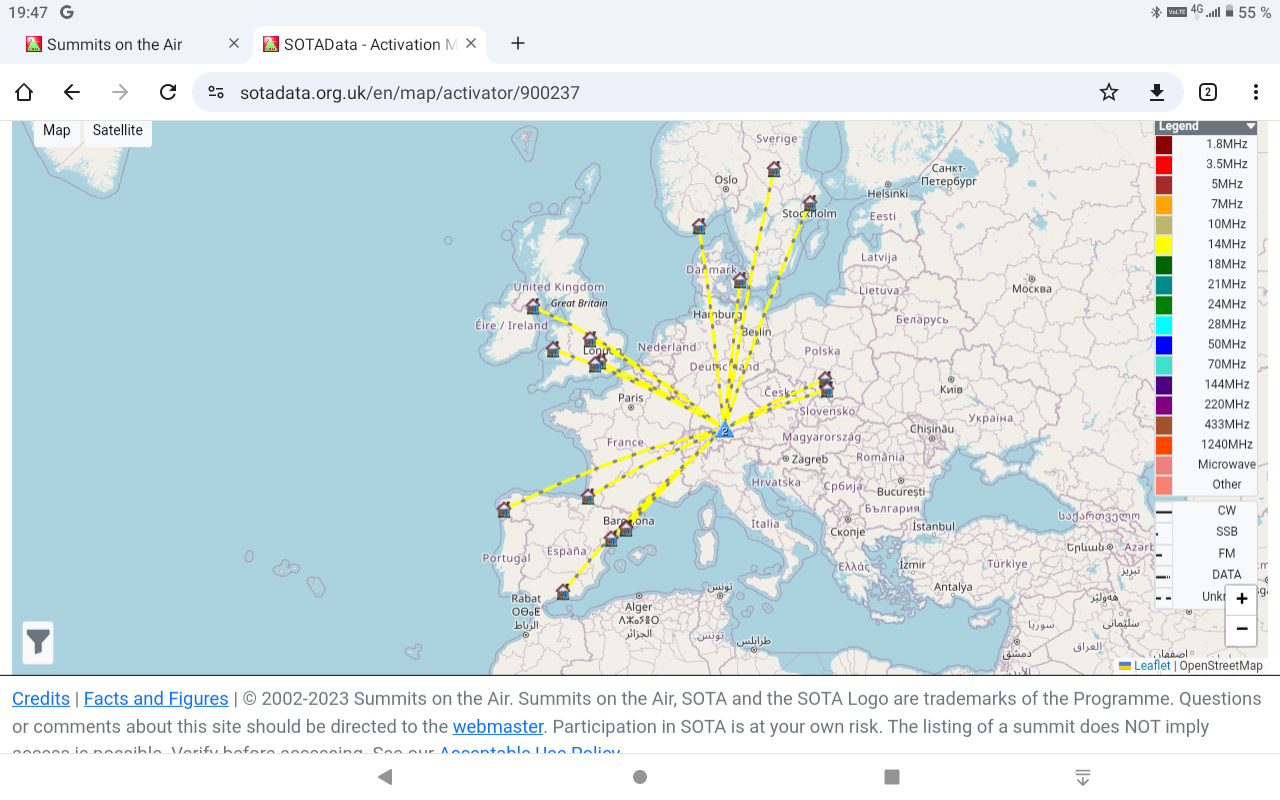
SOTA Contacts map:
Conclusions:
The weather was a problem mainly on the second two days, stopping the hoped-for third activation.
The Xiegu G90 continues to work reliably.
Again the Komunica Power HF-PRO-2-Plus-T – again saved the day on the summit activation.
As part of a family day out I wanted to do some radio and I have had this park on my list of “close-by” locations for some time and as my wife wished to visit a Museum just 20 minutes away, this all got planned together with two dog walks for our dog, Bonnie.
Checking the maps, I found that the “Wanderparkplatz” was in the park boundaries and while the other two parking areas in the park shown are off the road next to private businesses, this patch of muddy ground would have to do.
I would operate from the car, as I have done for all of my POTA activations so far and that means the G90 radio on the passenger seat and the Komunica HF-PRO-2 on the three-magnet roof mount.
The plan was to operate for between an hour and 90 minutes while fitting in the drive to and from the spot from the Museum and two dog walks.
This would be the very first activation of this park within the POTA award scheme although it is also in the WWFF scheme, where it has been activated before.
The Activation
POTA DA-0458 (WWFF DLFF-0441)
The walker’s parking spot is just a few hundred metres outside of the small town of Seeshaupt on the Southern end of Lake Starnberg. When I arrived there was no one there so I parked up next to the map of the area and took Boonie for her first walk, down into the forest, across the railway line and then over towards the lake. On our return, another car had joined us in the parking area and the couple with the car were getting ready to start the walk around the lake. It was dry and sunny but still cold, so everyone was wrapped up well.
Now it was time for some radio!
Bonnie was put back in her area at the back of the car and she settled down. The antenna was adjusted for 20 metres and then put on the roof and the radio was set up on the passenger’s seat. To start with there was very little on the band except for two very strong Spanish stations who I heard were returning calls from European stations even though they were calling CQ DX, so the band was obviously not open. I called the stations and with my little 20 watts and loaded whip antenna got them with no problem at all (obviously their antennas were pointed in my direction). Both were running 1 kW output.
I then chose a frequency, checked it was free and then spotted myself on the POTA website and it wasn’t long before I got a stream of calls coming in. There seems to be a lot of people in Europe willing to chase POTA stations but far, far fewer activators active than in the SOTA system for example. I know this is not the situation in the US, so it seems the POTA scheme is still finding its feet in Europe.
With 19 contacts in 29 minutes on 20m, I was happy but also surprised that despite this number of contacts, the majority were more than just signal report exchanges and all exchanged greetings for Christmas and New Year. Contacts were from all around Western Europe, from Italy and Spain in the south to Sweden and the Shetland Islands in the north.
When I decided to move over to forty meters, I only managed three contacts before giving up with all of the QRM but one of those was with a French amateur activating a 10-point SOTA summit in Germany. I think I was his last contact before he packed up to head back down the mountain.
Before heading back to pick my wife up from the museum Bonnie got her second dog walk of the day.
All in all, this was a nice use of a couple of hours, in the fresh air and it turned out to be another FIRST-TIME POTA activation for the park.
Photos:
This slideshow requires JavaScript.
POTA DA-0458:
Equipment taken:
Xiegu G-90 radio.
Komunica Power HF-Pro2 loaded vertical antenna with a three-magnet car roof mount base.
4Ah Eremit LifePO4 battery.
2.5 Ah 3S LiPO battery.
Lightweight headphones.
Smartphone for spotting.
Log:
DA-0458 Osterseen Nature Reserve
Conclusions:
Once I finally got some POTA hunters calling me, it was fine although to start with I thought I would be hunting down the needed 10 contacts simply from stations on the 20m band.
Forty metres was an uneven battle – so many stations on and not enough space. I’m glad that I got so many contacts on 20m and didn’t need to rely on 40m.
Interestingly the majority of the contacts that I had were longer than the usual callsign and signal report exchanges and several stations waited until I had finished before trying to get through to me again. This was like the bands 10 years ago – a big improvement on more recent experiences. Perhaps there was still a little “Christmas Spirit” around?
After being unable to activate for some time due to a long bout of Influenza followed by Covid (thanks to the thoughlesss person who decided it was more important to go and buy their coco pops or whatever from the supermarket rather than to self-isolate and in the supermarket, not even wearing a mask to protect others!), followed by a week where we had one metre of snow to block everyone in, I was ready to get out and do a simple activation.
I chose Weichberg as it is one of the closest SOTA summits at about 30 30-minute drive away from home. It also turns out that the last time that I activated it was April this year, it was after the Winter Bonus had finished, so while I wouldn’t get the 1 normal activation point for the summit, this time I would get the 3 Winter bonus points.
As often is the case, I decided to try some new equipment. Not the 20 & 10m wire beam that I have been working on but simply a new mast base spike after my previous two from DECATHLON failed on me. The last one on my Cyprus “mini.DXpedition”. I have bought two meal peg bases but as they are meant for the thinner carbon-fibre masts, I also made an adapter arrangement consisting of half a broom handle that pushes up inside my small 5-metre fibreglass mast.
Apart from the new base (I also packed the old sun umbrella screw-in base as well) the rest of the equipment would be the tried and tested Xiegu G90 radio and the SOTABeams linked dipole (with a couple of backup antennas as well of course).
I spotted for a 0830 UTC ():30 am local) start in the hope of catching the Long Path on 20 metres down into VK. This meant I would need to get up at about 6:30 am local to be on the summit on time.
The previous 4 days, the bands had been terrible due to one of the largest CMEs of the last 20 years hitting the Ionosphere but I was hoping it would have cleared by Monday morning.
I alerted on SOTAWatch and checked with Mike (2E0YYY) and Ernie (VK3DET) to see if they would be around and indeed Mike agreed to go up to his local HEMA Summit – G/HSP-020 Old Man of Mow.
The Activation
DL/AL-179 Weichberg
Well, I was up long before the alarm went off and rose at 5:30 am rather than 6:30 am, despite taking my time, this still meant that after an uneventful drive down, I was set up and calling CQ by 07:48 UTC. I started on 40 metres hoping that I might catch some DX via the Greyline but I think I was probably about 30 minutes too late.
I did however get a good pile-up of European chasers and despite the mast on the new peg almost falling over at one point (ground problem not a peg problem – once I moved it, it was fine), I managed twelve contacts in fourteen minutes.
At this point, Ernie and Mike sent me messages to say they were almost ready so I lowered the mast, unlinked the 20m links in the antenna and put it back up. Initially, the 20m band was empty but despite that, Ernie put out a call and I could hear him at around 5-3 to 5-4 level – unfortunately, he could not hear me strong enough to work. The difference between an S0-S1 noise level at my end and an S4-5 level at Ernie’s end along with the fact that Ernie was running 400w and I was only running 20w added up to a believable reason but what was to turn out to be the biggest problem was that the propagation skip distance was short (probably as the Ionosphere hadn’t yet recovered from its battering over the last four days). Signals from the UK and even local signals within Germany were 5-9+. Normally on 20m, I struggle to hear stations in the UK, but when I called John M0JWK, we exchanged 59+ reports despite his beam pointing Stateside!
Now I tried for a QSO with Mike 2E0YYY/P and to my surprise he was only about a 53 signal but gave me a 59 report. We wondered how that was possible. Due to high winds, his antenna was lower than usual but that should not make a great difference (if at all, as we both have height through being on top of hills). Mike runs 50w portable to my 20w so if anything Mike should be putting a stronger signal into me than I do into him – and usually he does.
Only later did Mike realise that he was not putting out the normal power level – indeed he could see almost nothing on the output meter. After getting home, Mike investigated further and it turned out to be a faulty cable between the microphone and the radio (we were both running SSB) – so very little audio equates to very little power output.
Overall, for my first activation after Covid, I was happy with the results but I could have done without the icy winds that gave a chill factor taking temps down to -2 or -3°C.
Photos:
DL/AL-179 Weichberg:
This slideshow requires JavaScript.
Equipment taken:
Mountaintop travelling 40-litre rucksack.
Xiegu G90 radio.
Komunica Power HF-Pro2-PLUS-T loaded vertical antenna and tripod (not used)
Lamdahalbe 5m mini-mast and new metal base peg.
SotaBeams linked dipole.
4 Ah Eremit LifePO4 battery.
4 Ah LiHV battery(not used).
Painter’s thick plastic sheet (not used).
Gardener’s kneeling pad.
Lightweight headphones (x2).
Smartphone for SOTA spotting.
Log:
DL/AL-179 Weichberg
Conclusions:
The radio conditions on 20m were short skip due to recent disturbences so although I could hear Ernie, VK3DET, a two-way contact was not possible.
All equipment (including the new mast spike) worked well.
I’m glad I went out despite the cold weather – after all, “Wintertime is SOTA activation time” Right?
To be clear, this was not to be my 100th activation of this summit, but rather the activation by many different SOTA activators to get to the “Magic 100”. This would be my 30th activation of the summit, which is the second closest to where I live.
The activation was also to serve as a comparison of radio gear. As I would be travelling to the UK, the following week, I needed to see how effective a 5w radio and simple loaded vertical antenna would be compared to the 20 watts from the G90 into the linked-dipole on a 6-metre mast.
Preparation was easy, in that I had both sets of equipment already in separate bags, ready to go. I only added the Surveyor’s tripod to the equipment to make it simple to put up the dipole.
Ernie VK3DET had said he would be available to listen for me from Australia, so this would be an early action in order to be on this (Drive-up) summit before the long path closes to Australia.
The Activation
DL/AM-001 Peißenberg
The drive down is a route I have taken many times before. On arriving, I went to the large car park, where I could back up the car to the edge of the field and next to the seat. (they don’t get more “drive-up” than this summit). This car park is within the 25m vertical activation zone and provides space for larger antennas than would be possible on the very summit which has a large church sitting on it.
I first set up the large tripod and mast, followed by the linked dipole and then laid out the new development, an “EMF Screen” or “Faraday Screen” copper and nickel coated material and sat my HF-PRO2 loaded whip on a magnetic base on top of it. I had tested this configuration on the antenna analyser at home with good results so I was now hoping to try it out on-air.
For transmitters, I unpacked both the G90 (20w) and G106 (5w) radios and attached each to their antennas -the QRP radio with the simple loaded whip and the G90 with the linked dipole.
A short message to Ernie and he was on frequency and we exchanged 54 7 53 reports on the “large station”. This was not going to be strong enough to be able to switch to the other system although it was receiving fairly well the same stations as the large antenna was.
We decided to give propagation 30 minutes to improve and in the meantime I spotted myself and got calls from ZL4NVW from New Zealand and 4Z4DX from Israel but no other calls from around Europe so the skip was long but signals were low – not the best environment to be comparing antennas and radios under.
After 30 minutes, I called Ernie VK3DET again and the signals in both directions were the same as earlier, so the band was not improving and with time marching on, the QRM from stations close to the frequency was getting worse.
So I decided to call it a day on the testing and said 73 to Ernie and then moved over to 40m to get the needed 4th contact to qualify the summit for its 100th time.
Once people found me of course there were lots more than the one needed contact and after half an hour, there were 22 contacts in the log.
All of this time, the temperatures were below 10°C and so as testing on 40m would also not be practical with the overloaded nature of the band, I decided to call it a day and plan to go out just with the simple system and the QRP radio on one of the following days before making my mind up as to what equipment I will need to take on the plane.
Photos:
DL/AM-001 Peißenberg:
This slideshow requires JavaScript.
Equipment taken:
Mountaintop travelling 40-litre rucksack.
Xiegu G90 radio.
Xiegu G106 radio (only used on Rx).
Komunica Power HF-Pro2-PLUS-T loaded vertical antenna with a Faraday screen as the ground plane under a mag mount. (not used)
Lamdahalbe 6m mini-mast and Surveyors tripod.
SotaBeams linked dipole.
4 Ah & 2Ah Eremit LifePO4 batteries.
4 Ah LiHV battery(not used).
Painter’s thick plastic sheet.
Gardener’s kneeling pad.
Lightweight headphones (x2).
Smartphone for SOTA spotting.
Log:
DL/AM-001 Peißenberg
100th activation !!!
Conclusion:
The radio conditions although good on 20m, were not good enough to be able to do radio and antenna tests between DL and VK and trying to test on 40m with so many stations on was also not practical.
I accepted an invitation to the wedding of a radio amateur I have known since my time in Australia and as he was marrying his English lady on the Island of Cyprus. I, of course, could not miss this opportunity to operate a portable radio station from the island in the Mediterranean Sea where I had never been before. I decided this would be a series of activations in HEMA, POTA and SOTA (I suppose I could also have classified this as an IOTA expedition as well as the Island has its own IOTA number (AS-004)). Interestingly in contests, it counts as being part of Asia, a point that makes it attractive to European contest stations who often operate from Cyprus to get continental multipliers for the easy European contacts.
I would be on Cyprus for exactly a week, so I planned 2 activations every couple of days around some other holiday activities and of course the wedding!
I arrived and left on Sunday, so those days were out but Monday was planned for POTA, Wednesday for HEMA and Friday for SOTA with Saturday left initially free for a possible POTA “2-Fer” activation in the town of Paphos where I was staying.
The Activations
Monday 11th September – POTA.
Firstly a POTA park to the northwest of Paphos – 5B-0114 Tombs of the Kings.
This park was literally 15 minutes drive from where I was staying and as the car park is officially within the park grounds, this was a simple, from-the-car, activation using the HF-PRO2 loaded whip on a small magnetic mount on top of the hire car.
Upon unpacking the equipment from my small rucksack to set up in the car I found that one side of my small transportable JVC headphones had come apart with the foam rubber pushing through the fake leather-looking plastic on the headphones. So the first repair was made using electrician’s tape even before the first contact on the holiday was made.
That first contact though was a good one – Ernie VK3DET was there for me again as he had promised to try to be and a contact with 20W of SSB on 20 metres using a multiband loaded whip on a magnetic mount received a 3-3 report from the land down-under. Ernie was about a 5-4 signal. Surprisingly this was not to be the only contact from VK3 – 25 minutes later David VK3BY from Melbourne replied to my CQ calls and we exchanged 5-3 signal reports. Other countries making up the rest of the twelve contacts (10 contacts are needed to qualify a POTA park) were made up of Italy, Poland, Belgium, Spain, Romania and France.
Radio operation started at 08:45 local time (05:45 UTC) and ran for an hour. By the end of the hour – even with the shade within the car I was feeling the heat, so I packed up and went to walk around the park. For just €2.50 it’s a vast area to look into the various excavated tombs but also as this is on a promontory, to look out to sea with the clear blue waters. I know I only saw possibly half of the park but after about an hour of walking in the heat (wearing my wide-brimmed “Tilley” hat), it was enough, so I headed back to the car and then to the large supermarket for supplies as I was staying in a self-catering apartment,
After the mid-day heat, the afternoon brought another planned POTA park activation. This one needed a 20 km drive to the southeast of Paphos to the Aprrodites Rocks where the forest is a national park and number 5B-0005 Aprodites Rock Forest. The car park for the beach by the rocks is within the forest park area, so this again would be a car-based activation using the same loaded whip on the car roof and 20 watts on 20 metres.
The difference with this activation was that the car was already hot even though it was 3 pm local time, the heat sat in the air and getting the needed number of contacts was more difficult. Add to that an extra complication that the 4AH LifePo battery’s built-in management system decided to cut the power to my radio about halfway through the activation resetting all defaults in the Xiegu G90 radio (which doesn’t like power to be cut without warning).
The black case on the radio is not an advantage in mid-30s (Centigrade) temperatures even though I have covered the top side of the radio with white sticky-backed plastic after a POTA activation in 5B – the case is too hot to touch!
The battery problem was easily resolved in that I have a backup 2AH LifePO battery and once that was connected, I was back on the air to collect more needed contacts.
This time there were no VKs in the log (it would be the middle of the night with them and the long path had long ago closed). Calls came in however from Sweden, Spain, Greece, Italy, France and North Macedonia.
Again this was an hour-long activation from 12:00 – 13:00 UTC and after completing the last call, I packed away the radio gear and headed down to the beach to see what all the fuss about the rocks was – as you will see from the pictures – they are impressive!
It was about a 40-minute drive back to my apartment and time to meet up with the other wedding guests for a meal. After that, I was able to enter my logs into POTA, so that those chasers would already see the contacts logged (in POTA only the activator does the logging work, unlike HEMA and SOTA where both the activator and the chaser have to log the contact).
Wednesday 13th. September – HEMA.
After Tuesday was taken up with a tourist bus tour, Wednesday was planned as a HEMA day with two first activations of summits. Indeed this expedition was the first time ANY HEMA summits have been activated on Cyprus!
The first summit was 5B/HCY-011 Axylon near the village of Aksylou about 20 km northeast of Paphos.
The drive was fairly straightforward however the access track towards the summit quickly gets difficult for a small rental car and with only limited parking possibilities, I decided to park by the village water tower which is within the 25-metre activation zone and with some space to put up the mast and linked dipole antenna this time.
It was 9:15 am local time (06:15 UTC) by the time I had got set up and there he was again – Ernie VK3DET, first into this log as well – making also the first VK – 5B HEMA contact as well as the first contact to an, up to this point, never-activated HEMA summit. From here, with the better antenna, Ernie was 5-8 with me and he gave me a 5-6 report. It’s still quite amazing what can be done with low power and a simple antenna when you are on the air at the right time and propagation is on your side!
The following contact was also a surprise, Andy M7FTM was on his way to work in Dorset, mobile from his car running 10 watts to a whip antenna and coming in at about 5-4 with some QSB.
The following calls were from all over Europe – France, Macedonia, Georgia (country not US state), Russia, Slovenia, Italy and Poland.
I had planned to activate my second HEMA late in the afternoon but as the bridegroom’s stag night was planned for the evening, I decided to head to the 2nd summit from the first hoping that Google Maps on my phone would find the way for me.
It did and by 11:00 am local time (0800 UTC), I arrived at 5B/HCY-001 Trachonas (to find this summit look for Villa Breeze on the map and follow the track past the water tower behind it). The views from this summit are fantastic – the blue Mediterranean Sea and the rolling hills down to it as well as the countryside around are truly beautiful. One thing to beware of however is the undergrowth which consists of mostly prickly weeds. The ground is also very hard and I had to search around to find a spot to put the mast base spike in the ground. Once I had done this I ran out the linked dipole wires across the ground, trying not to tangle them in the spikey plants. I raised the 6m mast up and went back to peg out the antenna elements which also act as guy ropes. In the meantime what had been a nice cooling breeze in the hot sunshine turned into a light wind but even that light wind was enough to blow the mast over. As I went back to the mast, I could see that the mast was fine but the Decathalon peg-based (or De_crap-a-lot as I am now calling equipment from this company) had broken the base support in that the nut, which is only set in plastic with no strengthening, had bent over and could not be simply pushed back as the plastic had broken. This is a horrible design. This same problem has happened to me before but on the advice from several SOTA activators, they said I must have simply got “a bad one” last time, I bought a new one and this is what happened. The design is simply not thought through. De_crap-a-lot, I will not buy from you again!
Of course, I have a backup for such let-downs. I packed the mast and Linked Dipole away and took out the Komunica Power HF-PRO-2-Plus-T loaded whip and my converted photo tripod and radials. Once that was all set up, I could hear a VK6 station still on 20m but with the now limited antenna and late time for the propagation, he could not hear me.
I spotted myself on the HEMA site and the DX-Cluster in the hope of making 4 contacts to make the journey out to this summit worthwhile. After a lot of effort, I managed one WWFF contact and two HEMA-to-SOTA contacts in Greece, Italy (x2), and Austria.
At 12:15 local time, I decided to pack up and head back to the apartment to get something to eat, rest and then prepare for the evening.
Friday 15th September – SOTA
With the wedding now having taken place (a great success, where everything went very well and all were happy if a little drunk later on), Friday would be a SOTA day. I knew that getting contacts would be easier due to the number of chasers that monitor SOTAWatch compared to HEMA and POTA however I would have to rely upon the HF-PRO-2 loaded whip as the antenna. As it was to turn out, it did a great job!
The first SOTA summit of this “Mini-DXpedition” was one with no name 5B/CY-042, which I chose to call Chapel of Agiou Mama as that is a little further down the track, so following signs to the chapel take you to this No-Name summit just south of the village of Koili which is about a 20-minute drive north of Paphos.
It seems that in Cyprus, every summit near a village has a water tower on it as several have and this one also had one. Similar to the ground covering that I found on Wednesday this location also had a lot of prickly plants and the ground was again rock-hard so there was no way that the now fragile, damaged Decathlon mast spike would work here, so I set up the HF-Pro and tripod next to what I think is the pump building, which provided me with a little shade from the sun.
So how well, did this “compromise” antenna work from this small summit? How about a call from Paul VK5PAS in South Australia as the second contact? That, with true 59 / 55 signal reports!
I even managed an S2S contact with Andrew VK1AD/P on his SOTA summit VK1/AC-043 in the Australian Capital Territory.
For all of those who say Life’s too short for QRP – look how just 20 watts of SSB to a loaded vertical whip has performed this week from Cyprus. OK, these were not 59+20 dB reports each way but those reports indicate the stations are breaking their licence rules which clearly state “only use sufficient power to make the contact”. Here 20 watts is getting 55->59 reports from around Europe and 52->55 reports from the other side of the globe!
This set-up provided 17 contacts in 20 minutes from this summit. see the log below for the full details.
Rather than heading back to Paphos and going to my second SOTA summit in the cooler, late afternoon, I decided to head straight on to the SOTA Summit 5B/CY-035 Mazi relying again on the Google Maps app playing through Android Auto in the rental car to get me there.
This time, things did NOT go to plan … The directions were fine until it told me to turn off the main road onto a stone track which was a little wider than the car itself. I did not turn that way thinking that it was wrong and that even if I should have done it, I would be brought back via another route. I carried on and the app kept giving me directions, in this case, it took me onto smaller and smaller roads and eventually after it took obvious “short-cuts” between the more “normal” roads, I knew this was really taking too long for the relatively short distance between the summits. There was no way to turn around, so I decided to follow the first sign that directed me back to Paphos and my apartment and then to “re-group” after something to eat. The route back to Paphos was also “interesting” with the road full of goats with no shepherd to be seen and another place where there were tens of quad bikes heading to some waterfalls. Eventually, I reached Coral Bay, which I knew was up the coast from Paphos. So I eventually found my way back onto known roads after a nearly 2-hour detour.
What had happened was that the phone had lost cell coverage (and hence access to the Internet) just after the track where it wanted me to turn off and although I had downloaded the local region map to the phone, something was not working correctly with that map it seems.
After some food and rest, I decided to try again and this time when I reached the small track (which actually had a sign pointing down it with a road number on it!) – I took it and this was a road NOT to take a hire car down (even the cross-over model – that the rental companies call a mini-SUV, which I had). Part of the route is concreted, part of it is pure stones and part is a mixture of surfaces with potholes everywhere. Steep climbs and drops and bushes sticking out to scratch the car along the route test the driver. Google Maps likes to take short-cuts it seems, which means that you use even smaller roads – at Mazi, it is best to head towards the couple of houses there and then head back along and up to the summit (as I found on the return route back to the main road). In any case, upon arriving, I realised there was NO space to park off the road in what looked like olive plant fields. I did find a road junction and was able to position the car in the corner so that anyone coming along with a smaller vehicle would be able to get past. I hoped that no tractors or larger trucks would arrive while I was operating – luckily no one came by.
I clambered up the soil wall at the side of the road and found a spot where I could put down my painter’s sheet to sit on and again set up the tripod and HF-PRO-2. Even with a working mast peg, this would not have been the place to put up the linked dipole antenna because of lack of space.
Once set up and self-spotted on SOTAWatch, I had a constant flow of calls (24 in 14 minutes) – no Intercontinental DX this time but calls from all around Europe and two SOTA S2S contacts – see the log below for details.
Getting to this summit took some doing. Going there again, if I ever get a chance to return to Cyprus, would of course be easier – for those reading this report while planning your activation of Mazi, I hope these tips will help.
At the end of the day, this activation again amazed me as to what is possible with low power and a simple antenna system. I was glad to get back to the apartment that evening for a rest.
That was supposed to be the last activation of the holiday but as the bridegroom wanted to work some HF and I had a “backup” POTA “2-fer” ready to cover if the others had not worked out, we decided to play some radio on Saturday…
Saturday 16th September – POTA 2-Fer?
After a late breakfast, Adrian M0GLJ and I headed over to the Paphos Archaeological Reserve POTA 5B-0113 and after paying the €4.50 entrance fee headed through the park towards the Paphos Liighthouse POTA 5B-0067 and found a shaded area in the lighthouse area.
This was to be the same set-up as on the previous activation, the HF-PRO2 antenna on the tripod with the radial wires laid out roughly around the base. I set the slider on the antenna to the position for 20 metres, connected everything up and tuned the band. It was very quiet. I checked all connections and even ran the ATU in the radio, no difference. I did find one Italian station and called him but while he could hear me, we could not make a full contact. This was a Saturday morning, the band would normally be full of stations. Tuning up and down the band, I could hear blips at irregular intervals but no more stations.
I decided to switch to 40 metres reset the antenna and tuned around there – nothing, not one station!
I wondered whether the radio was faulty in some way but all seemed fine – I changed AGC settings pre-amp settings and all made no difference. This demonstration activation of HF radio was certainly not going the way I had hoped. Adrian had his Yaesu HT along and had found the local FM repeater. He put a call through there but no one came back.
Then I thought I might know what had happened. On Cyprus there is a UK Royal Airforce base which has a Megawatt over-the-horizon radar (OTHR) station – if that was operating, it could flatten all receivers in a several hundred kilometres radius and we were probably 45 km away, from where we were.
I decided if that was the case, we had no chance and we both decided to call it a day with the radio, take a look at some of the excurvations on the way out and then head for Coral Bay for lunch.
As it turned out, checking the propagation reports that evening, there had been a series of HF radio blackouts at around the time we were trying to operate. While conditions during the week had been so good up to that point, it hadn’t crossed my mind that what we had was, in fact, a radio blackout, which it seems was in fact the case. Just unlucky timing on our part!
It would have been nice to have activated the “two parks in one” 2-Fer POTA location but I can only say that the rest of the activations went off very well despite a couple of problems and Saturday was just “one of those things”.
Sunday, I flew back home to Germany.
Photos:
POTA 5B-0114 Tombs of the Kings
This slideshow requires JavaScript.
POTA 5B-0005 Aphrodites Rock forest
This slideshow requires JavaScript.
HEMA 5B/HCY-011 Axylon
This slideshow requires JavaScript.
HEMA 5B/HCY-001 Trachonas
This slideshow requires JavaScript.
SOTA 5B/CY-042 NoName (in Koili village)
This slideshow requires JavaScript.
SOTA 5B/CY-035 Mazi
This slideshow requires JavaScript.
POTA 5B-0067 and 0113 Lighthouse in Archaeological Reserve
This slideshow requires JavaScript.
Equipment taken:
Raddy 20-litre mini-rucksack.
Xiegu G90.
Komunica Power HF-Pro2-PLUS-T loaded vertical antenna. (used with mag mount for the first two activations or on a tripod with radials for the later activations).
Single-magnet car roof antenna mount (used for both POTA activations).
Modified mini photo tripod with clip-on radials
Lamdahalbe 6m mini-mast.
SotaBeams linked dipole.
De_crap-a-lot mast base peg (until it broke).
4 Ah LifePO4 Eremit battery.
2 Ah LifePO4 Eremit battery.
Painter’s thick plastic sheet and gardener’s kneeling pad.
Lightweight headphones.
Smartphone to spot and back-channel comms.
Logs:
POTA 5B-0114 Tombs of the Kings
POTA 5B-0005 Aphrodites Rock forest
HEMA 5B/HCY-011 Axylon
HEMA 5B/HCY-001 Trachonas
SOTA 5B/CY-042 NoName (in Koili village)
SOTA 5B/CY-035 Mazi
Conclusions:
The weather was never a problem on any of these activations but a wide-brimmed “Tilley” hat and lots of sunscreen definitely helped.
The Xiegu G90 worked reliably although it got a little too hot on some of the activations.
The surprise top performer turned out to be the Komunica Power HF-PRO-2-Plus-T – that loaded antenna works better than it should. The linked dipole when I had it up worked well as well but of course, the failure of the Decathalon mast mount meant I could not use that on the summits that I had planned to.
It is very hard at times to get the needed contacts in the POTA and HEMA schemes but you are fighting off the callers when operating SOTA.
When you think all is going fantastically, the Sun can hiccup and spoil what should have been a simple activation on the Saturday, by causing a total radio blackout!
The idea of World HEMA Day is to get as many HEMA activators out as possible to try for H2H contacts. With the recent expansion of HEMA into Malaysia (West & East) and Canada as well as across Europe, with good propagation and good timing, someone may manage some good DX H2H contacts. For me with the times I could get out, my target was around Europe but as you’ll read surprisingly there was some DX around (if chaser stations, not activator ones).
My original plan was to activate two summits on Friday afternoon and one on Saturday but when the one on Saturday became difficult to reach as roads were closed for re-surfacing and I decided on a different summit, this became a possibility for a “family day out” with my wife and dog. Seeing some countryside that we have never been to, having a nice outing in the good weather and topping it off with a nice meal at a country restaurant.
So with that extra work on Saturday, I decided to keep the Friday activation down to my most local HEMA summit and as it turned out that was a good decision with additional road-closed delays affecting that activation.
As I will be heading to Cyprus in just over a week, for a week (including some radio activations), these two activations were also to serve as equipment tests. The first just using my normal radio station in a 40L rucksack set-up and the second trying to operate with a smaller (5 metre) mast and a smaller ground peg.
The Activation
Friday 1st September 2023 DL/HBY-064 Berndorfer Buchet
The usually simple drive to this HEMA/SOTA summit was complicated by a main road being closed the day before. While there was an alternate route, the fact the normal route was closed was not shown on the road until after I got past the exit for that other route. Indeed I only knew that I could not turn right as normal in Fischen until I got to the roadworks themselves. I had to turn around a head back about 3 kilometres to the alternate exit – this added about 20-25 minutes to what is normally a 35-40 minute run. Luckily I had set off early and was able to be set up on the summit to activate as planned for the start of “World HEMA Day” which ran from 1200 UTC (2 pm local time) on Friday, September 1st to 1200 UTC on Saturday, September 2nd.
The activation brought in contacts from around Europe. I started on 40m and there were several strong Italian stations on the band to start with then I suspect the critical frequency rose over 7 MHz as propagation became very NVIS-like and the second part of the hour that I activated was almost all stations from within Germany. It was a pleasant time chatting with other amateurs but as I had alerted to operate on 20m as well, after about an hour I decided to move to that band and re-spot myself using the new “HEMA Assistant” Smartphone app. This app appeared to be very slow in refreshing its list of spotted stations but even with the slow response (which wasn’t a problem on Saturday. It was some kind of temporary problem – possibly with my internet access from the summit). The app did show however that I was the only HEMA activator out at the time I was on my summit. Among the 40m contacts I did have a summit-to-summit contact however and that was with Ben DL2DXA on GMA Summit DA/SX-224 near Dresden.
After switching to 20m and hitting the tune button on the radio, the Linked dipole which would normally tune straight away was causing issues. I lowered the mast again and found that the 17m link had come open. Looking at this, I could see that the wires were taught and the solder joints were looking a little “aged” so one maintenance task when I got home was to adjust where all wires were tied into the links and to resolder all joints to the 2mm power connectors which I use for these links. This was exactly the kind of thing that I wanted to find before my trip to Cyprus.
Back to 20m – after reconnecting the 17m link and raising the 6 metre mast again. the G90 tuned the antenna quickly – actually with this (resonant) antenna I could turn the internal tuner off but it does help to spot these kinds of problems. I decided to tune around on 20m and while there was not a lot of activity – this was about 13:15 UTC, I came across Tony VK5KI on Kangaroo Island in South Australia working an XE station (who I could not hear) – unfortunately I waited too long to call Tony as I wasn’t sure when the other station signed off. Tony was about an S7 so a contact might have been possible. I suspect Tony may have been going QRT in any case as it would have been approaching midnight with him.
Further searching on 20m brought some Eastern European stations in a net but apart from that the band was very quiet, so I found a free frequency and spotted myself both on HEMA and on the DX Cluster. Unfortunately about a quarter of an hour of CQing brought no responses. As it now started to get colder and there was a possibility of showers forecast, I decided to call it a day, knowing my home route would be slightly longer given the road closure, so that was my first activation for World HEMA Day completed.
Saturday 2nd September DL/HBY-038 Staufenberg
I had planned the summit Rentschen (DL/HBY-052), which is a 45 minute’s drive to my south for my Saturday summit but for that one, I was forewarned of the road closure and so for an extra 5-minute drive, this time north from where I live, I decided to do the first activation of Staufenberg (DL/HBY-038). This is a literal drive-up summit (as is Rentschen) and for anyone looking for a really easy summit to activate in a beautiful country area, this might be a good choice.
We set off at 9 a.m. only to hear that part of our route on the Autobahn was down to one lane from three following an accident and to expect a delay of at least 20 minutes filtering through the one, still open lane. So, we told our GPS to seek a different route and we went cross country. Unfortunately, this route was to cost me. While going through the industrial outskirts of a town with minimal traffic I sped up to get through some lights before they changed only to find a speed camera waiting to trap people on the other side just before the speed limit increased from 50 to 60 km/h – flash … I now wait to see what the financial damage will be!
Soon after I had set up the station, the air-raid sirens went off in the area for about 10 minutes. As this was at exactly 10:30 a.m. local time, I presume it was a test of the emergency alarm system in the area and not that my mighty 20W of RF had triggered some alarm HI.
As well as the normal equipment in the car, for this activation I had brought along my 5-metre squid pole, which will be light to carry for the Cyprus trip. Along with that, I intended to use the decathlon base spike to support the base and the normal sun Umbrella screw-in base is not practical for the trip. The first obvious limitation was that the thin 5-metre pole was very loose in the base but after searching around for some cord in my rucksack, this limitation was addressed and the cord is now packed within the base so that it stays with it. I was of course unable to use the top section of the pole so the antenna’s feedpoint was at around 4m AGL meaning that the end cords needed to go out a fair distance and that the 40 metre end sections of the linked dipole were quite close to the ground. Use of this antenna with with my 60 or 80m extensions would not work with such a low mast however as I rarely use those bands that is not such a great loss.
Once the antenna was set up in the grassed area alongside the small chapel on this summit, the radio was unpacked and set up on my normal plastic sheet and I was ready to start on 40m to see who I could find.
Before spotting I took a tune around and found Peter in Dusseldorf with a strong signal calling CQ and getting no replies despite his special event callsign of DQ23IVG for the Invicta games being run in Dusseldorf this year. (The Invicta games are for injured soldiers – from any nation – to compete in sport despite their injuries and form part of their recovery and return to as normal a life as possible).
Next, I checked the HEMA Assistant app (which worked with little delay on this activation) to see that Dave G8XDD was out on the G/HSE-019 HEMA summit in the UK. After a couple of tries, I managed to break into his pile-up and got the first H2H into the log.
I then found a clear frequency and spotted myself via the app. 40m was terrible with QRM from multiple contests that were in progress (which is the main reason I rarely activate on a Saturday). There were callers but they were crushed by splatter from the station who started up a kc or so away from the frequency I was using without checking first. Bad operating? Yes, but these are crocodile contesters – most don’t listen for stations under an S9 signal level – perhaps their radios aren’t capable of it from all the stray RF coming back into the front end from their own linear amplifiers? As I have said before there are good contesters but unfortunately they are the exception, the majority don’t care about other spectrum users.
After fighting to get contacts on 40m I decided to move to 20 metres to try my luck there. At this point I found another advantage of the lower mast – I was able to un-clip the 20m links in the antenna without lowering the mast. while this is just a small point it does make the operation simpler. Once on 20m, I wished I had moved there earlier. The contesters had not yet arrived in their hoards and the band was relatively quiet, enabling me to find a good frequency, spot myself on HEMA and start calling CQ.
The first station who called was Uwe as IK7/DF3DAD a solid 59 signal from Ginosa down in the “heel of the Italian boot”. Following Uwe was Don G0RQL from Cornwall England who had tried on 40m but on 20m this was a 59/58 easy contact.
There then followed a nice stream of chasers from Poland and the UK. One Karl 2E0FEH told me he had just worked a HEMA activator, Bill M0DXT, but he was not spotted on the HEMA list so Karl agreed to do that. Of course, Bill was back on the QRM-band 40m but I would try after all the aim of World HEMA Day was to get as many H2H contacts as possible. As soon as I announced that I was moving to 40m of course I got more calls on 20m, so with those logged and happy, I then switched back over to 40m to go and hunt Bill. Again the lower antenna meant a quick change of bands was possible and I found Bill on the frequency that Karl had told me he was on but unfortunately, two Italian stations were also having a long chat on the same frequency – I suspect neither Bill in the UK nor the two Italians could hear each other but unfortunately with me being in the middle I could hear both. In any case, I battled on and in the gaps in the Italian’s transmissions, I managed to get the H2H contact in with Bill M0DXTT on G/HLD-043 for my second WHD H2H contact.
All of this time my wife had been walking the dog along several of the clearly marked walking tracks that go off from the summit and I decided that after an hour of operation, it was time to pack up and head off to the beer garden restaurant in the Bonstetten village for lunch.
This had been ideal activating weather and the sunshine through the trees and some very good food for a reasonable price in the beer garden just made it a perfect day – well actually only half a day as it was altogether a 4-hour round trip. None of us were eager to do too much more however when we got home. Some good weather, fresh air and good food made this an ideal day for all three of us!
Photos:
DL/HBY-064 Berndorfer Buchet:
This slideshow requires JavaScript.
DL/HBY-038 Staufenberg:
This slideshow requires JavaScript.
Equipment taken:
Mountaintop travelling 40-litre rucksack.
Xiegu G90 radio.
Komunica Power HF-Pro2-PLUS-T loaded vertical antenna with a modified mini photo tripod with clip-on radials. (not used)
Let’s hope that more HEMA H2H contacts were made on Saturday. On Friday, I was the only HEMA Spotted station on! The problem on Saturday was as always, the contest stations.
The equipment tested on the Friday activation had me repairing and adjusting the linked dipole so that the links no longer jump out. The smaller mast and mast base tested on the Saturday activation worked fine and in fact with the antenna wire a little lower I was able to switch between 40m and 20m without lowering the mast, however, this set-up will not let me use the 60 or 80m extensions to the antenna.
Each year I try to take part in the International Lighthouse and Lightship weekend (www.illw.net) however over the COVID years was not able to and although last year I was staying in Lindau (where the only two lighthouses within a reasonable distance from my home are) I got food poisoning and had to return home before I could even set-up in the park. This year I decided not to risk the expense of a hotel room and rather drive the 1.5-2 hours down on either the Saturday or the Sunday of the event – depending upon what the weather did (which has been very unpredictable of late).
Since last year, the large car park on Lindau Island where I would normally park, has been closed. Street parking is limited to 30 minutes in most places and in a few up to 90 minutes. I expected to need 3-4 hours of parking time. This is a deliberate action by the council as they want to reduce the number of visitors on the island in cars and rather have them park on the mainland and take a bus (not free in either case). There is however one multi-storey, public car park belonging to the Sports Centre. This of course fills quickly and is not located close to the park between the two lighthouses where I wanted to set up to activate.
Searching around, I found another option – the station car park, while small (and with 70% of the spots reserved for long-term renters as it turned out) but is relatively close to “my” park. The best way to use this is to check in on arrival using a smartphone App and at €2.50 / hour, the price is “OK” – cheaper than the sports centre. It also has the advantage that as the end of your booked time approaches you are sent an alert with an invitation to extend for another hour (or more).
So my plan was set – drive down early to avoid traffic on the Autobahn, hope to get a spot in the Railway station car park with a fall-back of the Sports Centre and pack all of the radio gear as usual into my 40L rucksack, but then mount this on my shopping trolley frame so that I can pull everything behind me.
To make sure I had everything packed that was needed I went out on Friday morning, just to a spot in the fields where I can park the car outside of the village where I live.
Rather than taking some extra support such as a screw-in base or a tripod, I wanted to use the shopping trolley as the mast support. My original plan was to use it with my 10 metre mast but the tests on Friday morning showed that was not going to work with it falling over before I could get the Inverted-V antenna pinned out. So a switch to one of my old reliable 6-metre masts was made and that was supported well by the trolley.
After the test run, the gear was packed up and taken home, the LifePO battery “topped off” and everything was packed in the back of the car ready for a 5:30am start on Saturday morning!
The Activation
ILLW DE-0138 and DE-0140
After having a good drive down to Lindau, arriving 20 minutes earlier than expected, I managed to get one of the only three empty parking spots at the railway station. It’s strange not putting a paper ticket on the windscreen but I went through the steps in the app as advised and it all functioned as it should. From the GPS in my phone, it knew which car park I was at and I booked 4 hours (I expected to need about 3.5 hours, so a little more to cover any problems, was probably wise).
The walk around the harbour to Römerschanze Park pulling my little trolley only took about 10 minutes but in that time the trolley lost one of its mudguards never to be seen again (I checked on the way back but I think the street cleaners will have cleaned it up in the meantime).
On arriving in the park apart from a couple of lads in one corner chatting away, it was empty – which, apart from visiting dogs (and their owners) was the story of my stay. Although there were some tourists later, none of them were brave enough to come and ask what I was doing.
I had also brought along a small fisherman’s tent (more of a sunshade) which as the weather looked like it was going to be a hot and sunny day could give me protection if needed. I decided to leave that until I had set up my antenna and radio and as it happened, I was able to get enough shade from the trees above me that I never unpacked the tent.
The antenna (a linked dipole in an Inverted-V configuration) went up without any problems, with the mast supported by the shopping trolley and I managed to peg the ends of the cords without going outside of the grassed area. This is where with the 10 metre mast, I would have needed less space but in the whole time I was there, I only had to call out once to warn someone before they almost walked into the antenna.
It was still early enough for the 20m long path into Australia and New Zealand and indeed I heard one ZL and several VK stations but trying to call them with just 20w and a wire at 5 metres above ground was difficult. I could not get a chance of a contact due to the QRO home stations with their beams. It was obvious that my signal was able to get to VK however as I had done so on my trial run on Friday morning and there were a couple of QRO UK stations who would deliberately call at the end of my call so that, they knew I was calling and if I were to get a response from the VK station I would not hear it. This used to be the behaviour of some Continental hams, now it seems the M and even the G calls are the worst. Shame on you UK Hams – you know who you are!
Indeed high power stations either calling over the top, splattering nearby or simply calling CQ on top of a frequency where I was working a station became the norm during the day. This often happens when a major contest is on however it seems now that even without a major contest, so many stations simply behave badly on a weekend. It may be a reflection on the times that we live in rather than only being a problem in the Ham radio community but it’s there. It may only be a small percentage of hams but it seems to be spreading, like their over-modulated signals.
My best DX was W1AW/1 in Vermont, where I believe there may have been a QSO party (contest) going on – he gave me a 59 report but I suspect I was nothing like that. Other than that in the three hours of operation, I got many contacts from around Europe on both 20 and 40 metres. Of those however only four were lighthouse-to-lighthouse contacts – I heard and tried to call over 10 different lighthouse stations but again we got the “I don’t care about you low power portable stations, I WANT this contact” attitude from many home QRO stations.
When I managed to find a free frequency (which was not easy), I would listen specifically for other lighthouse stations to give them priority. Unfortunately, it seems most of the operators at the Lighthouse stations just considered the field-day station as a special event station to work lots of stations from and did not think so much about the Lighthouse-to-Lighthouse contact component of the event.
I will ask for something to be put on the ILLW website requesting lighthouse stations to specifically listen every 15 or 20 minutes for other lighthouse stations, rather than just going back to the strongest station in the “rabble”. Such L2L-like actions are common in SOTA, WWFF, HEMA, POTA and GMA so why not in ILLW?
After three hours and about two pages of contacts (and the need for a bathroom visit), I decided to call it a day and pack up and head back to the car.
The use of the shopping trolley/rucksack combination works well when wanting to pack up as well as when setting up and it took no time at all to get everything packed and leave the park. As I said earlier, I looked for the missing mudflap on my way back to the car but it had gone. A shame as it stopped the trolley wheel from rubbing on the rucksack.
As I left the car park, there was a VERY HAPPY driver there to take up the now one available parking spot in the railway station car park!
Photos:
This slideshow requires JavaScript.
Equipment taken:
Xiegu G-90 20w HF radio.
Lambdahalbe 6m mast.
SOTABeams linked dipole antenna (modified).
Komunica Power HF-Pro2 loaded vertical antenna and tripod (not used).
4Ah Eremit LifePO4 battery.
4 Ah 3S LiHV battery (not used).
Lightweight headphones.
Smartphone for spotting.
Shopping trolley with 40L rucksack.
Conclusions:
The shopping trolley as a method of transporting all equipment in one go is a good solution – now that it lacks one mudguard it will need to be modified to lift the rucksack up a little.
For a single-person activation of two lighthouses, I think I did well, however, it could have been a lot better had the lighthouse stations specifically listened for other lighthouse stations. The abuse of the bands by the QRO stations is not going to go away, so if an event must be on a weekend when there are many more of these animals around, some process needs to be put in place to allow the contacts that the event is set up to promote (in this case Lighthouse-to-Lighthouse) to take place.
You must be logged in to post a comment.