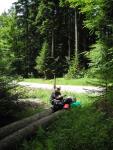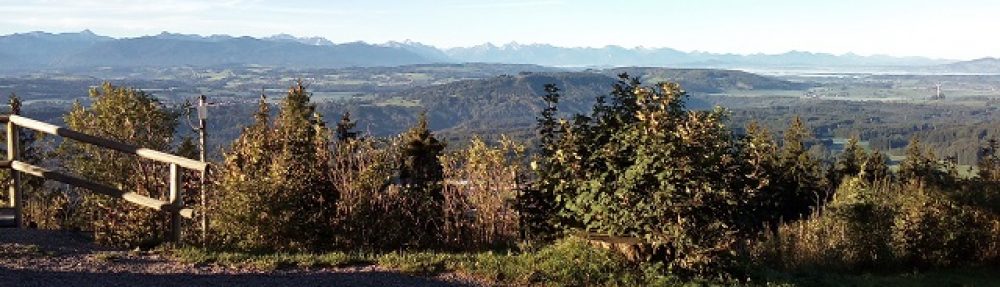
G8GLM/P – October 29th. 2015 – G/TW-002 Drake Howe.

Preparation:

All equipment had been tested and used on Laber (DL/AM-060) a week before my trip to the UK to visit my brother and sister, so I was hoping all would go well, so that I could perhaps convince my brother Jim, G8DCD to take part in SOTA both as a chaser and activator.

On hearing I was coming over Phil G4OBK kindly set-up a “TW region SOTA fun day” and managed to get activators to commit to activate all of the five TW summits on the same day, some being activated twice. My original plan to activate three of the summits, was soon adjusted to just two G/TW-002 and G/TW-001.

My brother would be acting as driver as well as accompanying me to the summits. The weather forecast at the beginning of the week was for a nice, dry, sunny day on Thursday (the 29th.) but by the Wednesday, the forecast had been adjusted to “some” showers in the morning, but a bright, dry afternoon. As it turned out it rained most of the day with fog and high winds!

The Location:

Drake Howe on Cringle Moor has a relatively easy access with the Cleveland Way leading from the car park of the Lord Stones cafe (where we planned to have lunch on the way back) up to near the summit with the final 500m or so being across the moor to a cairn someone has built.

The plan was after we had activated Drake Howe, we would have lunch and then make the 25 minute drive to the Clay Bank car park from where one can climb (again using part of the Cleveland Way) up to G/TW-001 Round Hill on Urra Moor.

The Activation:

Thursday 29th. October found myself and my brother heading to the North Yorkshire hills for the SOTA TW fun day.
Thanks to those chasers who managed to scrape my signal out of the noise. We had “less than ideal” conditions with winds so strong that you could hardly stand up, constant rain and very reduced visibility. When we managed to get to the summit and get set up my vertical trapped antenna refused to tune to a reasonable VSWR, possibly due to the constant rain running down it. The fact that it blew down a few times also did not help either! That we managed to accrue the number of contacts that we did on G/TW-002 was amazing! Unfortunately in the conditions I was not able to let Jim get onto the station as he was helping keep the antenna vertical and doing some of the log keeping in the very quickly well sodden log book.

I started by trying to get S2S contacts with the other G/TW-xxx stations that were on at the time and it was soon obvious by the reports that I received that things were not operating very well. Despite further efforts to get the antenna tuned, I could not improve it. Even on receive there was no peak in incoming signals so the antenna was not at all happy. I then tried three different clear frequencies before getting one that someone didn’t simply jump on top of me without even asking if the frequency was clear (mind you, I doubt these stations would have heard me if I had told them I was using the frequency). A total of 11 contacts were made from G/TW-002.

Two very wet amateurs then went back down the summit to the Lord Stones cafe to dry off and have some nice food:

IMG_20151029_141713We considered after the delays and the hard work already exerted and the possibly faulty antenna whether we should bother with G/TW-001 but as we had the time (we thought), we decided to give it a go.

The planned G/TW-001 activation ended up as a non event due to late arrival following the problems on TW-002 and some bad navigation on my part taking us up the wrong path and not leaving enough time to get up the summit, operate and get back down before it got dark. At least there had been two other teams on this summit before us.

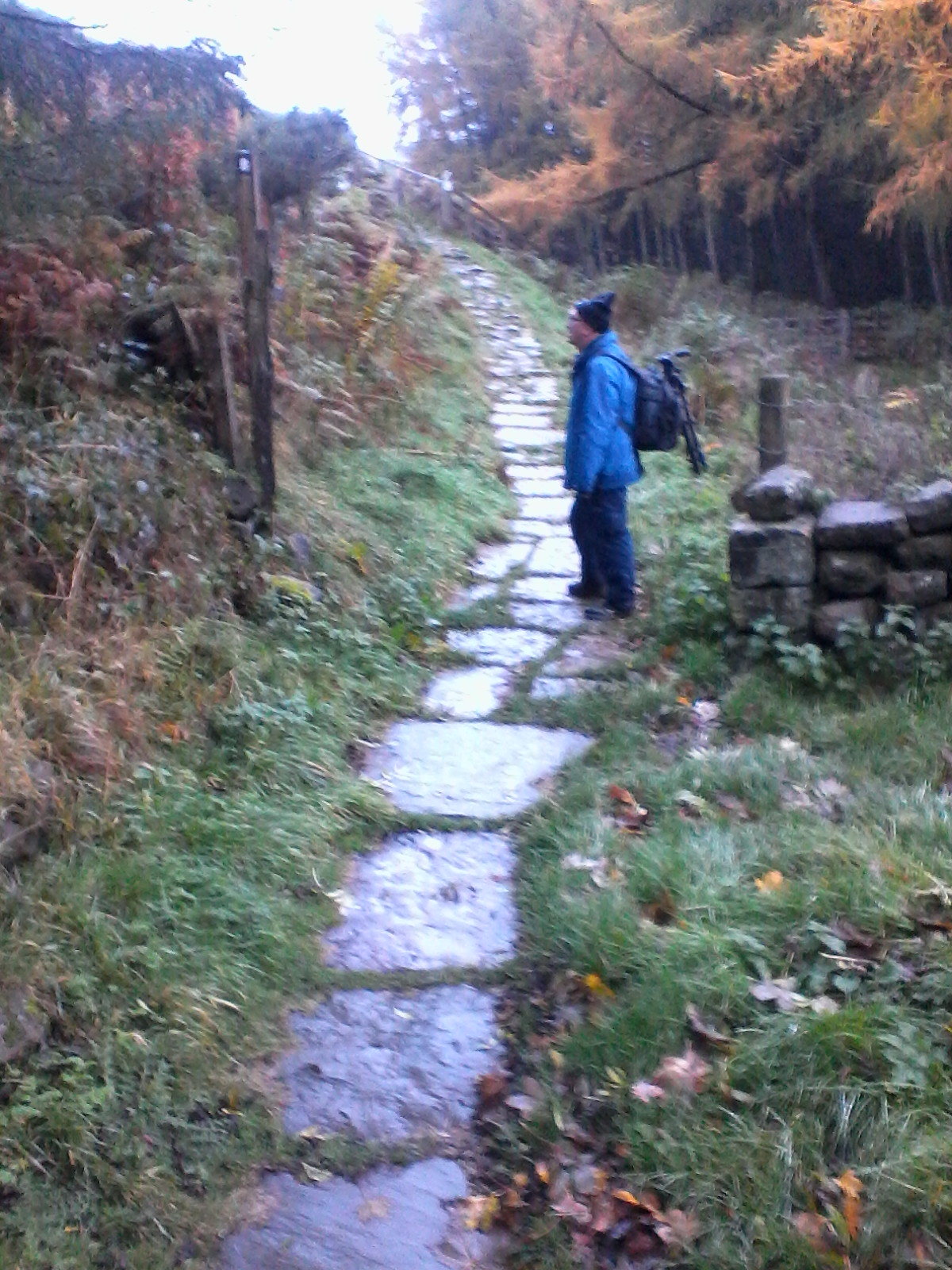
For reference where Google and OS maps show what appears to be a track splitting is in fact two separate tracks with a stone wall between then, If you start up the track on the left of the wall (from where the other track is not visible) you will have gone quite a way before you realise the error and cutting back across is simply not an option as there is no easy way across. So for future activators of G/TW-001, leave the Clay Bank car park, head back across the side road and PAST the large gate and over the brow you will see the small track going up to the left directly from the road – here is a picture for absolute clarity (that’s Jim G8DCD in the picture):
IMG_20151029_160128The day ended nicely though with the TW fun day supper. Thanks to Phil G4OBK for organising the day and the meet-up.

IMG_2686 TW Funday supper 1

G/TW-002 Photos:

This slideshow requires JavaScript.

Equipment:

Yaesu FT817ND.

RHM-8B loaded vertical whip with extensions and counterpoise.

Hama photographic tripod modified to take antenna.

Thick plastic painters sheet

Log:
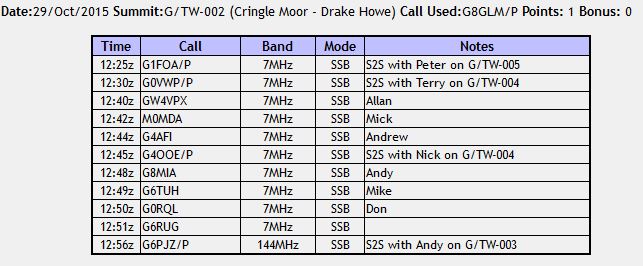
Activator Log

Conclusions:

No matter how well prepared you think you are, something can always go wrong. The weather was terrible and totally different to the forecast. The constant rain running down the antenna could be what made it impossible to tune, or something could have been damaged in the trip from Germany.

Trying to use a smart phones touch screen in pouring rain is just as bad as trying to read one in bright sunlight. These are far from perfect devices for use on SOTA summits.

73 ’til the next Summit!
DD5LP – October 13th. 2015 – DL/AM-060 Laber.

Preparation:

As I am planning a trip over to the UK and I also want to activate some German summits where space is limited and some walking distance is required, I have been trying to sort out a simplified kit to take. The first thing that I removed from my usual 10Kg+ two bags set-up was my Ramsey Amplifier. While I know the 25w on 40m or 15w on 20m does make a difference compared to the basic 5w from the FT-817, the extra size and weight of the amplifier, its cables and the two 5000 maH LIPO batteries with a battery booster unit (to take the 11v from the LIPOs up to 13.8v), simply can’t be justified in a basic kit. The next issue was the antenna. I have a linked, Inverted-V dipole from SOTABeams and an OCF from Aerial-51 (Spiderbeam) I usually pack both of these and the Aerial-51 with its 4:1 balun does account for some weight and size, as does either the 6m or 10m “Squid-pole” (telescopic fibre-glass pole) that I need to support them.

So if I take the FT-817 with an internal 2500 maH LIPO battery and a spare 2500 maH LIPO, what do I run this into for an aerial? Some time ago I bought a Diamond RHM-8B loaded vertical whip which is designed to fit directly onto the BNC socket on the FT-817. Apart from the fact that using this puts stress on the FT-817 front panel, it also doesn’t radiate very well (receive is fine). About 6 months ago I looked at moving the antenna from the rig to a camera tripod (even though Diamond say not to do this). I bought a second-hand HAMA camera tripod which is strong but also light and folds down to a small size. To this I added an SO-239 base and coax cable. With the help of a BNC to PL-259 adapter, the diamond sits on top of the tripod. Early tests showed this worked and worked better with a random length of wire acting as a counterpoise radial. It had the problem however that the tuning on the slide-able coil under the telescopic antenna (the type that we used to see on transistor radios) was now very compressed at one end of the range and very difficult to get the SWR down.

The latest modifications have been to add a horizontal extension wire to the top of the telescopic whip (one of two lengths, one for 40m and one for 20m and above) and to add 4 not just one wire as a counterpoise. These wires being of different lengths. One would expect that these wire must be spread out in different directions not to affect each other, however I have found that leaving the wires wound together in one direction works equally as well. Initially I used the teflon strengthened antenna wire but this proved to be too heavy, tipping the antenna over, so I replaced this wire with very thin and light PCB hook-up wire (AWG 28 if I remember correctly).

Last weekend, I put this antenna together INSIDE the house to just see how well it works on receive compared to my external wire antenna (a 40m loop). I was amazed to find that OH0Z (on an island between Sweden and Finland) was booming in at S9+ on both antennas, so I gave him a call from the 5w, internal antenna, set-up and he actually came straight back to me! He gave me a 5-9 report, however as he was in a contest he would give everyone a 5-9 report and I didn’t want to delay him by asking for a real signal report. The key point was he copied my complete over without asking for anything to be repeated, so the antenna was working!

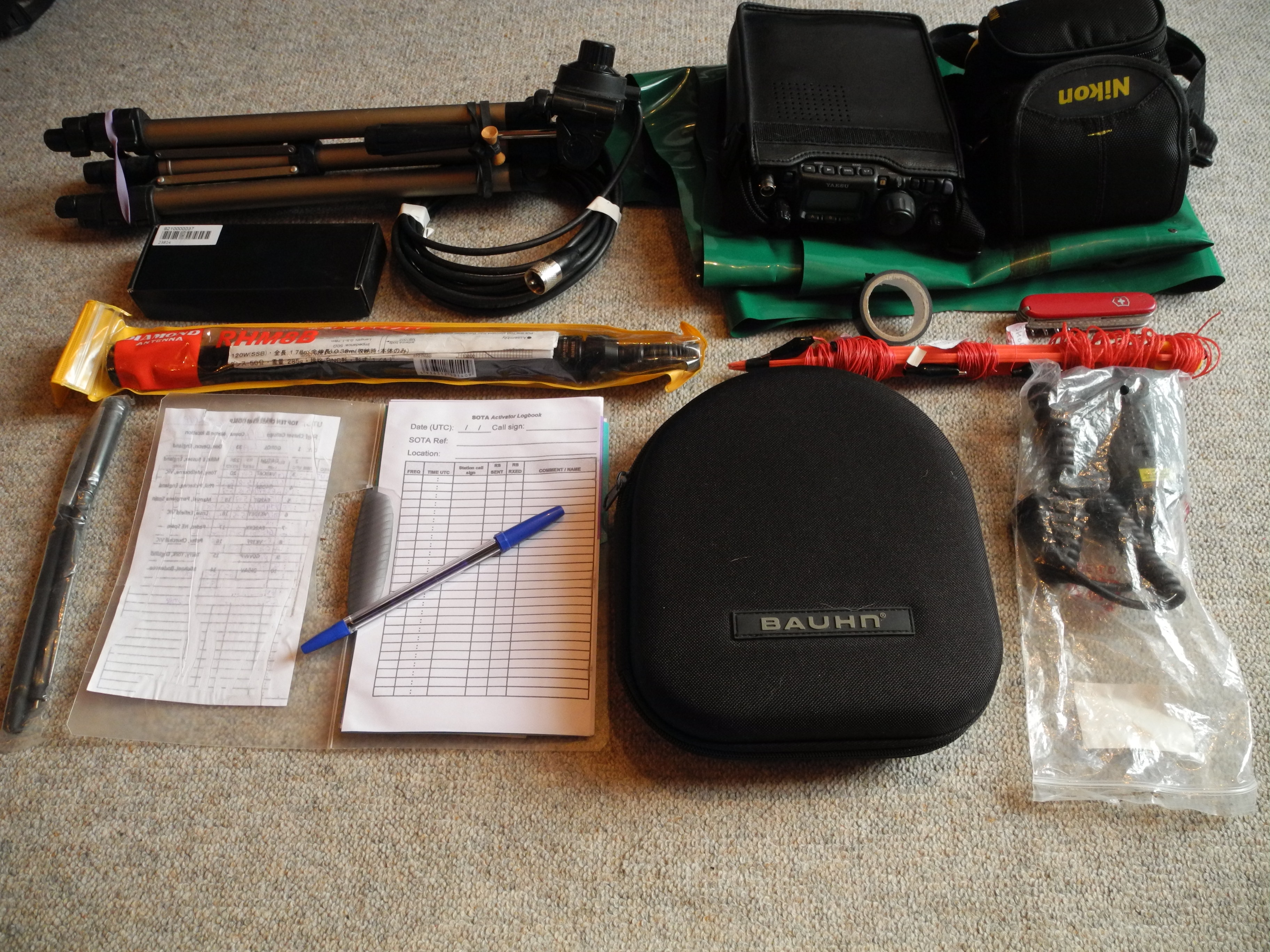
Now time for a test – to see if the antenna would work as well from a summit and to see if I had removed too much from the pack. Here are the contents and the small rucksack that it all packs into and weighs under 6 kilos.

DSCN3115

Top row left to right: Tripod with SO239 mount, spare 2500 maH battery below it, FT-817 and Nikon camera sitting on top of painters sheet (thick plastic).

Middle row, left to right: Diamond RHM-8B antenna, Plastic stake with radial and extension wires wound on it (PVC tape and penknife above it).

Bottom row, left to right: FT-817 6m, 2m & 70cm rubber-duck antennas, Log book and pen, Headphones, FT817-microphone.

DSCN3117

The Location:

Laber is a very easy access site with one of the oldest gondola lifts still working taking you right to the summit (and a restaurant of course). The mountain overlooks the village of Oberammergau where the famous religious play happens every ten years. The last time I activated Laber in 2014 I got soaking wet and the views were often blocked by clouds. Guess what … the same happened this time! I had planned to go on Monday however the weather here was terrible (I only later found out that Laber had been above the clouds in lovely sunshine all day), so I delayed the activation by a day. Oberammegau is about 1hr and 15min from where I live, so not the closest of summits but a good one to try the small kit out on as it has limited space to set-up.

The Activation:

The trip down was uneventful except that it started to rain – something that would be a constant parrt of the day. The “Laberbahn” cable car, has only 4 cars on it and runs to a specific schedule, meaning that you can only ascend or descend every 30 minutes. As I was ahead of my planned schedule when I got to the lower station, I was not worried that I’d have to wait a while for the lift. As it happened I was the only person going up in this car and I took several photos – shown below – of the view from the lift. As it turned out this was a good idea as the journey back down later in the afternoon had 12 people packed into the car and for most of the 15 minutes trip, nothing could be seen through the windows as we were mostly in the clouds.

Once I got to the summit, I decided to get out and take a few more pictures and then set up the station, rather than sampling the delights of the restaurant. I expected there may be some issues with the set-up as I had not used this approach on a summit before, I thought it better to start, just at the point that the rain got heavier. In fact apart from a little tangling of the counterpoise wires, the set-up went together without any real issues. I started on 20m and the set the coil to the noted reading I had used in the house. When then checking the SWR from a little way below where I had the antenna, it was fine (this was not to be the case when I later went onto 40m where some adjustment was needed and the new value is now noted for the future). I checked to see if I could hear any of the recently spotted activators – I could not. The HF conditions over the last month have been the worst I have experienced since starting on HF about 4 years ago and it looked like today was going to be an extension of those propagation conditions. Undeterred I found 14.285 KHz free, and started calling CQ SOTA while typing in a spot through the rain globules on the front of the smart phone, After a couple of attempts, I managed to get the spot out and kept calling CQ SOTA. I was very happy to have Gomes from Portugal (CT1HIX) come back to me and give me a 5-1 report, he was then followed by Pedro EA2CKX with a 5-2 report. I then was amazed at the signal from Alexi RA1AVP/1 about 1850 kilometres away and gave me a 5-7 report. At this point I was happy, the antenna set-up was definitely working, but then came the best call of the day from Phil VE1WT in Nova Scotia, Canada at about 5500 kilometres and a 5-3 report. I am sure all four of these chasers have fantastic antennas and receivers, but the fact was that they were receiving me in some of the worst propagation conditions for years and that with my lightweight set-up.

As I had no more calls on 20m, I once again checked to see what other activators were on and switched to 40m to call Hajo DJ9MH who was up on Ebersberg DM/BM-115 after a couple of calls I git him and we booked an S2S for the day. After that I found 7.150MHz to be free and spotted myself there calling and managed a further eleven contacts. The activation stopped when the log book had got so wet that I could not write to it and I was feeling rather wet and cold but happy that everything had gone so well. So it only remained then to pack-up head into the restaurant for a hot Chocolate drink and then wait for the gondola to take me back down the mountain after a very successful day.

Photos:


This slideshow requires JavaScript.

Equipment:

Yaesu FT817ND.

RHM-8B loaded vertical whip.

Hama photographic tripod.

Thick plastic painters sheet

Log:

activator log

Conclusions:

The minimum configuration worked exceptionally well. Even with just 5w and a limited antenna in bad propagation conditions amazing things are possible on the HF amateur bands, if you can spot yourself.

73 ’til the next Summit!

DD5LP – September 17th. 2015 – DL/AM-058 Hinteres Hörnele.

Preparation:

I had been scheduling and rescheduling an activation over the last couple of weeks, between Hinteres Hörnle and Laber. I had not activated Hinteres Hörnele despite the fact that the bottom of the chairlift that takes you part of the way is less than an hour away from where I now live.  Hinteres Hörnele was equal first in the number of activations in the DL/AM region (now with my activation it will be the most activated). The inference is therefore that it’s an easy activation. It isn’t! The other top activated DL/AM is Peissenberg is literally a drive up to the car park, walk up past the church and set-up activation.

In past activations I had been trying to get a lightweight pack with a simple vertical antenna, partially as I was planning to activate this summit as I knew some amount of walking was going to be required. I did not have very much success with my lightweight antenna and pack tests and as band propagation continues to be bad, I decided to take the full standard (2 packs), including the OCF inverted-V dipole and fibreglass squid pole. Over 12 kilos in all, probably nearer 15 when food and water was added.

The Location:

Access to Hinteres Hörnele starts with a ride up on a rickety old chair lift for 20 minutes, from Bad Kohlgrub, rattling over each pylon as you go up – or you can take about 2 hours to walk up the 5Km track if you prefer. This then gets you to ZeitBerg or Vorderer Hornele from there it’s indicated as a 45 minute hike to the Hinterer Hornele, passing Mitlerere Hornele and its restaurant HörnleAlm on the way.

The Activation:

This summit is one of those that as you get closer, it appears further away because the track weaves around the hills. I don’t walk at the same speed as the sign posters calculated this walk, so for me I was there in under 30 minutes, but totally exhausted! This walk included moving several cows that were blocking the track. No danger, they’re used to the public – so much so that there are signs up asking you not to stroke them!

Once at the top, the views were brilliant and being enjoyed by about eight other people at the same time. A constant flow of walkers were approaching from the distance. So there was no way I could set up a fibre glass mast and the Inverted-V OCF dipole at the cross on the summit. The wind on the top was also blowing heftily, so if I had set up there, I suspect no one would have been able to hear me for the wind in any case!

So I headed back into a more sheltered wooded area, just below the summit and found a great little closed in hut with a bench – ideal for the station – out of the wind and away from the public. I then took 20 minutes to get the antenna up in between all the tree branches. Not ideal but all I could manage. I connected the FT817 directly to the antenna to hear lots of strong (read QRO) stations on the QRP calling frequency – why did I expect anything else?   So I searched around and found what sounded to be a clear frequency, started calling and also put up a spot, after a little while I managed two contacts but both with low signal reports for my signal, so I decided to pull out the Ramsey amp to boost my signal from 5W to about 25W, connected it all in, the fan started, the noise level on the rig went up and I hit the PTT key at which point the fan stopped telling me that the supply had been broken. This has happened several times before and it is usually a sign that one or both of the transistors in the amp have gone short and blown the fuse. So no “QRO” for me today! I continued on 40m for a while with just the 5w from the FT817 for a further six contacts before heading up to 20m and there Phil OBK and Don RQL came booming in. It seems that 40m conditions were not as good as I had first thought and 20m is still a better option at the moment. I then saw Hermann DL/OE5HFM/P spotted. Unfortunately despite several calls and others telling Hermann that he had an S2S calling, he couldn’t hear me, whereas Hermann was probably 5-4 with me. I guess this reflects my power and antenna again.

As it was, I was now running a little late and as well as the winds the sky was getting more and more black, so it was time to pack up and head back. The walk back seemed a lot shorter (OK for the most part it was down hill), probably 20 minutes. On the way I stopped twice, once to take my light weatherproof jacket off as the sun came out and then once to put it back on as the wind got up and some rain started.

I was a little afraid that the seat lift might be out of service or at least provide a worrying ride down in the winds but as it turned out, that side of the mountain is protected from the winds and all went well with the 20 minute ride back down.

A little unwelcome surprise was waiting for me when I got back to my car – a parking ticket. Normally at a ski lift the car park is owned by the company running the lift and the parking fee is part of the lift ticket. In Bad Kohlgrub it seems the local council own the car park at the ski lift and I missed the one ticket machine that was there. Oh well, it’s only a 10 Euro fine – could have been worse.

Photos:


This slideshow requires JavaScript.

Equipment:

Yaesu FT817ND.

Aerial-51 OCF Inverted-V antenna.

6 metre squid pole.

Log:

Activator_log

Conclusions:

The Ramsey amplifier let me down again. At times where either propagation isn’t good or there are many stations on the band activating a summit with only 5 Watts is difficult. Without being able to self spot it would be impossible.

Trees seem to be becoming my enemy absorbing what little power I am emitting. Some summits really need a self supporting solution that is light and packs easily into one rucksack along with all the other gear.

73 ’til the next Summit!

DD5LP – August 13th. 2015 – DL/BE-093 Buchberg.

Preparation:

  With the 10m/6m challenge coming to an end, my score as an activator (only on 10m as 6m portable operation is not allowed in Germany), was looking a little “sad”, so I decided to activate another summit to get some 10m contacts. I had originally intended activating Zwieselberg above Bad Tölz however after my problems on Breitenberg the previous weekend, with the heat over midday, I didn’t want to repeat the same problems, rather chosing an easier summit where I could carry both bags of equipment to cover all needs.

During the previous week, I had been doing some testing using my existing Sotabeams linked dipole, using it set to 30m with some extensions to operate on 10m. Indeed I had tried this configuration out first at a local GMA summit DA/AV-071 Gagl-Berg and later in my garden, to get the extension lengths correct. So my intention was to take this configuration to Buchberg, but also have the Aerial-51 404-UL (OCF) dipole antenna along as a back-up.

I had planned on taking a set of end-fed half wave wire antennas along as well, as these are very light and pack up into a very small space, however I got so many different readings from the antenna analyser, I decided to leave them at home, until I can find what’s going on.

The Location:

Buchberg is also located near to Bad Tölz and hence an over 90 minutes drive from my home QTH. The route I knew from the last time I activated the summit in 2014, however this time rather than taking the shortest route suggested by Google (which required me to travel along a road displaying signs saying access only for forestry and farm vehicles), I decided to take the route that I had previously left the site by – via Bad Tölz, past the golf club. While this route is longer, it is a tarmacced (although only wide enough for one car for much of the route) road.

The Activation:

The activation went well. I found the location easily and managed to park off the (single track) road to avoid any issues with traffic. When I went across to the field, I say a path went directly across the field to the cross. I had expected to have to walk around the edge of the field as one normally does to avoid damaging any crops, however as there was a well worn track in place I took this to the summit cross. I suspect this track has been created by the mountain bikers that the farmer had complained to the previous activator about. Indeed during my activation a mountain biker, came up to the cross using this track. I suspect someone has created a cycling tour route via the cross. I can understand the farmers displeasure at this. At the moment the field is fallow, however when he wishes to grow a crop in it again, what will happen then? I had no visit from the farmer this year, I had met him last year when I activated the summit.

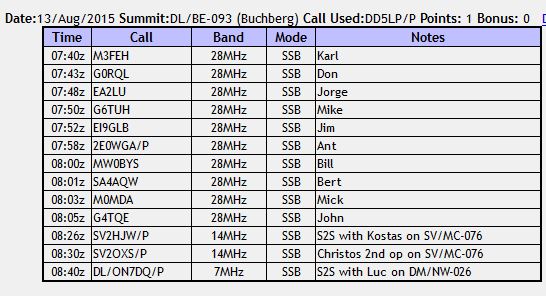
I deliberately started on 10 metres and as I checked my alerted frequency to make sure it wasn’t already in use, back came Karl M3FEH before I had even spotted myself. Karl was a booming signal, conditions on 10m were good. I managed to work 10 stations on 10m, the latter ones with some QSB coming in. Once the contacts on 10 metres ran out, I saw Kostas (SV2HJW/P on SV/MC-076) spotted on 20m, so went there and got a summit-to-summit contact with him and Christos(SV2OXS/P) who was on the same summit. I was just about ready to pack up when I saw that Luc (DL/ON7DQ/P) was up on DM/NW-026 on 40m, so down came the antenna again – in went the links and back up it went for another S2S. One last check on 10m – no more contacts but Jim EI9GLB kindly let me know that my 5w was still getting out well into Ireland, so conditions were still.OK and then I decided to pack up as I had chores to complete at home.

This turned out to be a very pleasant and satisfying activation. Nothing rushed, good conditions and all the equipment working as it should. I was especially happy with how well the 30 metre dipole with extensions worked on 10 metres.


Photos:


This slideshow requires JavaScript.


Equipment:

Yaesu FT817ND.

SotaBeams Linked dipole, 30m secton modified for 3rd harmonic use on 10m.

Ramsey QAMP linear amplifier on 20 & 40m.

10 metre squid pole.

Log:

activator_log

Conclusions:

While this was not a lightweight activation, I still need to sort out the EFHW antennas so that I can use them on future activations where there is a lot of walking involved. In all this was a pleasant activation, with a good set of contacts on 10m and no stress. All went to plan.

73 ’til the next Summit!

DD5LP – August 14th. 2015 – DL/AM-180 Burndorfer Buchet.

Preparation:

  Following my activation of Buchberg the previous day where there were many 10m contacts, all easy to hear and work, I decided to fit in another activation before the 10m challenge finished. I would only need one 10m contact from this summit to increase my multiplier and overtake my friend  Martin DF3MC, who was currently at the top of the DL activators table in the challenge. At the start of the day, I had more 10m contacts than Martin but as he had made his contacts from more summits, he has a higher multiplier and hence more overall points.

For HF contests if you don’t run a system around the various multipliers you can get you will never be in the top 100 in the contest! I’d prefer contests (and challenges) to be scored on the number of contacts and possibly the distance of the contact (if VHF/UHF/SHF) and not have the tricks that come with scoring multipliers.

As this was going to be a known summit, I did not have to set up a cut-down pack – rather I decided to take my two standard bags (one photo bag & one small rucksack). I would also take both squid poles and decide when I arrive at the car park which to take up the hill.

The Location:

Berndorfer Buchet is located above the village of Pähl, about 30-45 minutes away from where I currently live – the closest SOTA summit to my home QTH. I had already activated the summit, in the snow earlier in the year, so I would get no activator points for it, but this was just to get a point increment on my challenge multiplier so the one activator point was not so important for me.

The Activation:

The activation this morning wasn’t as simple as I expected it to be. I arrived at the car park probably 15 minutes earlier than I expected and started the walk up the track into the forest. What I didn’t realise was that the relatively large track that I have taken three times before, is now somewhat overgrown and I missed it! No matter I thought as I kept heading higher – this track will take me up the back side of the hill – it did to a certain extent but then there was no way through to the summit and the path started to go down the other side of the hill. I didn’t want to go all the way back down and start the climb again so I headed back to an area where it looked like I might be able to “bush bash” a way through to the summit. There I was, not in boots, rather just in training shoes, and in shorts with bare legs, fighting my way through brambles and nettles. Part of the way in, I wasn’t sure of direction, but always to head upwards was the best idea and eventually I came to the track that I had used on previous activations.

My intent was to get some contacts on 10m so I set up the same modified linked dipole, with the short extension on the 30m section. I self spotted and then called CQ. No response, then I saw Matt was spotted in VK1 on 20m, so I  took a listen with the antenna still set up for 10m and I could hear him quite well, so down came the mast, links were changed in the antenna and the mast put up again. I installed the Ramsey amp in circuit to get me up to about 15W output instead of the 5W from the 817 and called and called and called and eventually after all the super strong Italian, Russian and other European chasers finished Matt heard me and we had a short contact.  Then it was time to head back to 10m. Down came the mast, out of circuit came the amp, spotted again and started calling CQ with no response until Martin DF3MC called me. Martin is the amateur who is currently in first place in the DL 10m activating section of the Challenge. I felt a little bad that it would be the contact with Martin that would mean that I would go into the lead in the challenge before the break until November when it starts again however Martin said he was going out in the afternoon, which he did and bagged five new 10m contacts in bad conditions and ended up deservedly in the lead in the challenge as we go into the break.

After Martin I heard Jorge EA2LU call me but unfortunately we didn’t make the contact – I thought it was simply that my 5W wouldn’t make the distance, but later in a contact on 20m he told me that there was heavy QSB plus other stations from Italy and Russia (them again!) on the same 10m frequency that I was on, so a contact may have been possible had I switched to another frequency. After calling and calling and getting no response I decided to rotate the dipole from it’s N-S orientation to E-W and tried again. Still no calls and I was running out of time. I then decided to go onto 20m and spotted myself and picked up calls from Jorge EA2LU and Vladimir EU2MM before having to pack up to leave.

During the last session on 20m, I realised that the fan in the QAMP was not running and I could not hear the relays going over. I had also started to get some receive noise when I power the amp on – which on low signals can be annoying, although I can turn off the amp by hand when on receive. The signal level on receive even with the amp turned off has also started “crackling”, so I suspect the Phono-BNC adapter connection on the input to the QAMP has gone faulty. So all in all, I need to do some investigation and repair work on the small portable amplifier.

I took my normal path back down the hill and then saw why I had not seen the track on the way up – while passable on foot, it was nothing like it was last year when I suspect it was regularly used by the forestry people with their trucks

Photos:


This slideshow requires JavaScript.

Equipment:

Yaesu FT817ND.

SotaBeams Linked dipole, modified for 3rd harmonic use on 10m.

Ramsey QAMP linear amplifier.

6 metre squid pole.

Plastic painters sheet.

Log: activator log

Conclusions:

The aim to take over the lead from Martin in the DL section of the 10m activator challenge was not met, but without the contact from Martin, I would not have been in the lead for the few hours that I was – it’s all in fun in any case!

I shouldn’t complain – although I only had 4 contacts, one of those was an S2S with Australia, one a contact on a totally dead at the time, 10m band and two good contacts on 20m with Spain and Belarus!

One can forget how amazing it is to work around the world on just 5W and a wire antenna and that on SSB.

The Ramsey amplifier will need a major service before it’s next outing and I am still seeking that lighter, simpler set of equipment that I can take to more difficult summits than this one.

73 ’til the next Summit!

DD5LP – August 5th. 2015 – DL/AL-158 Breitenberg.

Preparation:

As the first part of the 10m challenge is coming to a close in 10 days time, I thought I’d try to get my 10m activator scores up a little and found this rather nice 8 point summit that I had not yet activated.

The summit has a longish walk after taking both a cable car and a seat lift to get to the summit. I normally have all of my SOTA gear in two bags – a camera bag and a small rucksack. These were not to be a suitable option for this summit, so I set to, to reduce down what I would take to pack within just the one small rucksack. I decided that going back to using the Diamond RHM-8B vertical antenna, which connects directly to the top of the FT817 on the BNC connector could be one option to remove the need to take the OCF dipole, balun and fibreglass pole. I had used the Diamond once before on Wallberg when there was nowhere to get the dipole out.

On Monday the 3rd. of August, I put all the equipment together in the racksack and went out into the countryside to simulate an activation. The antenna received brilliantly but no one I called came back to me – they could not hear me. I had intended doing more tests on the Tuesday but then decided to go with the known working Aerial-51 404-UL OCF dipole configuration with fibreglass pole etc.

Some more repacking and I was down to one (rather heavy) rucksack, that got a bottle of water and some food added to it before putting it in the car for the 1.25 hour drive down to the bottom of the cable car. I also packed the 6m fibreglass pole and my two telescopic walking poles into the side pockets of the rucksack.

The Location:

mapThe Breitenberg Cabinbahn starts from just outside of Pfronten – a town I had driven into previously while trying to find the road up to Falkenberg, so the majority of the route from home I knew. The car had stopped without warning a couple of times with the wife on Monday so I was hoping for no repeats on this relatively long journey – and luckily there were none.

The Activation:

Even with the gear cut down to one rucksack – it is too heavy, especially with what was a hard climb from the top of the seat lift to the actual summit. I had to stop I think 4 times as I was totally out of breath. It just took me 20 minutes to get up there, not the written 30 or 45 though, so perhaps I was being too eager. I had expected to use the walking poles but I couldn’t seem to get them to extend correctly without falling apart! I later found I was turning the rong part to release each section – of curse I hadn’t tried these out before so now I ended up carrying the extra weight up and down the hill!

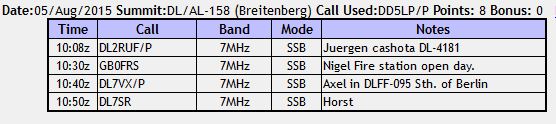
Once at the summit the “Ostler Hutte”, a restaurant, takes up most of the top with a little space left where the holy cross stands. At 11:30 local time, when I got there, there were already quite a few people mulling around, so I couldn’t set up near the cross.  I then found a path around the back of the restaurant where there was a little open land with (at the time) no one there. So I set up the OCF Inverted-V there and sat down to operate. As usual the first thing I do is check to see if there are any other activators out. When I looked at my phone though I had messages from both cell phone companies (it’s a dual-SIM phone) that since I am roaming in Europe and I am no longer in Germany, rather in Austria (which of course I wasn’t, but from up there the nearest phone cell is in Austria) there will be extra charges for data usage. What they should have said was that it simply would not work! I was surprised somewhat as behind the restaurant is a hut with that looks like a mobile phone cell antena on it, so it should have been booming in. Thinking later about this, I guess this wasn’t a mobile cell transmitter but as I was located probably only 20 metres away from it, it could have been blocking the cell signals. With the Internet connectivity not working I had no way to see whether there were any other SOTA stations on and also self spotting would be difficult and might only be possible via SMS and then definitely NOT using the Vodaphone network!  Looking back through SOTAWatch, of the probably 10 spots I sent – ONE got through.

Sufficient to say, the idea of making some 10m contacts from the summit came to nothing. I called several times on my alert posted frequency (the 10m QRP SSB calling frequency of 28.360) – no replies – I then tried my 40m (Alert) posted frequency of 7.090 – again nothing. I was a lot earlier than my alerted time, so perhaps that was part of the reason.

So I was down to hunting other stations – any other station and then my 5W signal was fighting against 1 KW stations, so it wasn’t at all easy and once I managed 4, I decided to pack up. I did get one Castle & Stately Home on the air (CASHOTA), a special event station and a DL/WWFF station in the four however.

As I went back past the wooden cross and down the path from the summit, suddenly my phone started beeping (I had left Rucksack Radio Tool on) and then there was the list of other activators. For me to unpack and set up somehow at this point (still around 25m down from the summit so in the AZ), was not an option as I was feeling rather unwell (probably from too much sun) and wanted just to get down the mountain and back home. If I ever activate this summit again, I now know to set up on the other side of the mountain to get Internet access and he able to spot!

The other MAJOR MAJOR problem was that after a while I was unable to read the FT817 display to see what frequency I was on. This problem got worse as the sun got brighter and also meant I could not read the smart phone either. The FT817 itself got VERY hot in the sun. When in Australia I had added some white “fabulon” sticky backed plastic to the top of the radio but just this last week, as it was starting to look a little tatty, I removed it! In summer on an alp, all possible protection against the sun and heat is needed.

Photos:


This slideshow requires JavaScript.

Equipment:

Yaesu FT817ND,

Aerial-51 model 404-UL asymmetric dipole.

6 metre squid pole.

Log:

Activator-log

Conclusions:

For such summits, I need to reduce the pack weight further. A reccie of the site beforehand (where I check things like Cell phone coverage) would have been very valuable. Without spotting, 5W just isn’t enough to get contacts, so having the 25W amp might have been a good idea, despite it’s extra weight and that of its batteries. If I do go back to this summit, I might risk just taking my very-lightweight end-fed half wave antenna as there were plenty of trees to run the wire through (no need to take a fibreglass pole).

73 ’til the next Summit!

DD5LP – July 30th. 2015 – DL/AL-170 Zweiselberg

On this summit I first did a reccie to see what access was like, documented it, and then eventually went back to activate it.

Reccie Notes – Monday 27th. October 2014


Summit also known as “Am Buch”.

Wx foggy – visibility down to 50m in places.

Access from Roßhaupten – at end is a private road – use at own risk.

Track from end of tarmaced road VERY, Very muddy – not driveable and in fact hard to walk up without good hiking shoes!

According to the coordinates in the SOTA DB the actual summit is within the forest, but the location of the cross (that looks down onto the forest) is certainly within 25 vertical metres of the DB point.

The area at the Cross has room for antennas and supports for squid pole and a useful seating bench.

Time to walk from car to summit (without equipment) – 10 minutes – allow 20 minutes with equipment.

Time from home to parking spot – 1hr. 15Min. (return 1 Hr.).

Good cellphone coverage – 4 bars for Telekom & Vodaphone. Internet connectivity is fine.

No apparent RF noise at the time I was there (around 10:30/11 am).

THIS SUMMIT WILL BE DIFFICULT TO ACTIVATE IF THERE IS SNOW COVER.

The Location:

wander-karte

Preparation:

While I was looking for a summit to activate that I hadn’t activated yet, I remembered that I had done a “Reccie” on Zwieselberg and while the heat wave had ceased for a few days, I decided to take a shot at this summit, early morning, to perhaps catch the end of the long path opening to VK. Karl M3FEH was also planning to be out in Cornwall on his FIRST SOTA activation, so I was hoping for an S2S with him.

The equipment was all, ready and packed. The modified QAMP (now with a 12v fan added to cool the transistors) had been tested in the workshop to make sure the issue with one of the BNC connectors had been solved and that neither of the two transistors had actually failed in the last activation. The coax on the Aerial-51 404-UL OCF dipole had, had it’s PL259 plug changed to a BNC plug to reduce the number of adapters required. So everything was prepared. I printed out the road route from Google Maps and then went through and wrote a list of the major junctions and villages that I needed to look out for en-route to Zwieselberg.

All set for an 7:30am local, departure.

The Activation:

Everything was packed into the car and I set off in direction of Zwiselberg, already at 7:15am only to notice that the diesel in the car was nearly out, so a small diversion and delay was needed to fill the tank. Some of the route ran along nicely while on other sections I was stuck behind tractors or trucks or simply cars that thought 60 not 100 Km/h was the speed limit.

In any case I arrived and parked at the same parking spot as I did for the reccie. It was about 8:30am and still cold – I was glad I had brought my light jacket. The climb with all the radio gear, food and water started and that was when I realised how steep this route is. It would definitely not have been possible without good hiking shoes and probably not at all in the snow! I forced my way on and eventually reached the summit totally out of breath but greeted with a beautiful view across the valley and the large lake (Forggensee) – a real contrast to what I could see from here the last time I was here!

I quickly unpacked and installed the squid pole and antenna, then set up the rest of the equipment on the bench in front of the cross and was on-air before 9am local (0700 UTC).

A quick look on SOTAWatch via RRT and a tune around found no SOTA stations, so I self spotted and called. I got a call back from Dinos SV3IEG. I then saw a spot for Karl M3FEH/p on Kitt hill and found him just finishing with Paul VK5PAS. I called him for an S2S contact and for a moment, I wasn’t sure whether it was Paul or Karl who had come back to me as the signal had increased dramatically. It was Karl and this would be the story of 20m on this activation – signals going from almost nothing to 5-9 and back again within less than a minute.

After working Karl, I went back to my spotted frequency and started calling CQ again – it took some work but I managed two more contacts on 20m – an S2S with Mike 2E0YYY on Gun and then Paul VK5PAS out of South Australia. Then it went quiet, so I decided to try 10 metres – DJ5AV Michael, located on Lake Constance (not far away) came back to give me a 10m contact but that was to be the only 10m contact for the day, despite trying an arranged contact with Jorge EA2LU. His 1 KW signal was coming in probably about S4 or S5 but my puny 5W was not making the trip back.

After a couple more contacts on 20m, I switched to 40m and was flooded with contacts. It seems 40m was the best band for this activation, logging 13 contacts in 16 minutes.

The full log is shown below. Towards the end of the activation, I got a visit from a cyclist who hung around for a chat and to find out what I was doing. Her son and husband are both interested in technology, so she got one of the DARC introduction to Amateur Radio brochures from me and hopefully that might lead somewhere. This lady also told me that there was a less steep access path from the rear of the summit with reasonable car access to not far away. Perhaps worth checking out next year as the trip back down the track to the car was probably more precarious than the one up with loose gravel, stones and soil on a very steep track.

Slide Show

1- From Reccie.


This slideshow requires JavaScript.

2- From Activation.

This slideshow requires JavaScript.

Equipment:

Yaesu FT817ND,

Aerial-51 model 404-UL asymetric dipole.

Ramsey QAMP amplifier.

6 metre squid pole.

Log:

activator_log

Conclusions:

This was an enjoyable activation, not just for the couple of SOTA points, but also for the fact that I managed to contact Karl on his first SOTA activation. It is of course always a pleasure to catch up with Mike 2E0YYY on a summit and the contact with Paul (nearly always a strong signal) from Australia, also fitted this relatively easy going day. The visit of the lady cyclist allowed me to promote the hobby and the weather stayed clear and dry to give me some wonderful views of the area.

Oh and yes all the equipment worked perfectly. All in all a very enjoyable activation.

73 ’til the next Summit!

DD5LP – July 19th. 2015 – DL/BE-094 Irschenhausen.

Preparation:

After several planned activations being aborted for different reasons, I decided to activate the one semi-local summit that I have not yet activated in 2015 in order to test out both my now modified again (addition of cooling fan) Ramsey QRP Amplifier and the SOTALogger Android app, spotting function.

I had activated Irschenhausen in April of 2014 while I still lived in Andechs where we had rented a flat while looking for a house to buy. The summit is now almost exactly an hours drive away (if there are no road delays) to where we now live as opposed to 30-35 minutes. Interestingly my planned route would take me directly past my other local summit Berndorfer Buchet (DL/AM-180) but I have already activated that summit this year. Irschenhausen has good memories as last year after tramping up it through the remainder of snow and mud, early in the morning, I managed to activate it with 4 contacts back into VK (two of which, were Summit to Summit contacts). That would not be the case again however as the activation was planned for the afternoon, so just local European contacts this time.

Both Irschenhausen and Berndorfer Buchet are located in forests with limited views and both are possible removals from the SOTA scheme in February 2016. Despite being “interesting” to reach in winter, neither have a winter bonus as they are relatively low in height.

The Location:

map The Irschenhausen “summit” is in the cente of the forest alongside the village of Irschenhausen which in turn lies just off the B11 south of Ebenhausen-Schäftlam. Simply turn off the road in the centre of Irschenhusen to the right (signposted to some Hof) and then keep taking the road that climbs higher until you come to a fork where the left hand side is restriced motor access and the right hand fork has a “dead end road” sign. Directly between these two roads is a parking place (next to the doggy plastic bag dispenser) for two cars. Park there are walk up the left hand road and take the left fork off it up into the forest. Keep right in the forest, taking the tracks that take you always higher until you reach the “summit”.

If you could see it through the trees, you would see that Irschenhausen overlooks the Autobahn 95 that runs from Munich to Garmish-Partenkirchen and the easiest route to Irschenhausen is by taking exit number 5 to Schäftlam from the A95, go through Schäftlam over the railway, turn right and then after about 2 km turn right again, back over the railway line and into the village of Irschenhausen.

The Activation:

Expecting delays on the roads as the holiday season is starting, I actually got a good run through, taking almost exactly an hour which was 30 mins ahead of my allocated time. Once I had parked up, the walk up and into the forest was pleasant however I had the feeling that I may have taken the wrong route as the track seemed better than in the previous year. However I kept going always taking the track that seemeed to take me higher. At one point I decided to leave the main track to head up a smaller one towards what I though was the summit (and later trned out indeed to be the summit as I actually found the trig Point when I was packing my equipment up. I believe I did end up at the same point as the previous time and simply the fact that there was no snow or mud around made the route look different. On my way back down after the activation, I realised I had taken a different route and this might have been the route I used on the previous activation.

Band conditions have been difficult for some time and this day was no different. After I got set-up I took a tune around and could hear plenty of stations on 40m but only a few on 20m. I decided to start on 40m and after spotting myself, the chasers flooded in as usual. Once I had worked all the chasers I could hear on 40m, I switched to 20m – tried out the spotting function in the Android SOTALogger app – in the process typing in 14.085 instead of 14.285MHz (thanks Mike G6TUH for picking this upand putting out a corrected spot). The amp had also been operating fine up to this point, the only issue being that I lost the label off the switch I have to switch low pass filters, so I had to best guess that. On 20m, I was getting a very limited response, which later I realised was just bad band conditions howeer in my investigations, I also found a bad contact on the coax. The Aerial-51 404-UL OCF dipole has a PL-259 plug supplied on the cable, so that I have to go through a SO-239 to BNC adapte before I can connect it to the amp or directly to the FT817 (I use the front connector on the 817). To make things worde, the Ramsey Amp uses Phono/RCA plugs (!!) for RF in and out, so I have Phono to BNC adapters on these to be able to use standard cables. Somewhere on the output side of the amp there was a intermittent connection affecting receive (and no doubt tranmit). I managed to locate the cables so that the connection was good but I will need to look into this. Most likely I will cut the 259 plug off the Aerial-51 antenna lead and add a BNC plug and then I will try to replace the Phono sockets with BNC ones, if I can find PC board mountable sockets at a reasonable price otherwise I may simply solder the Phono-BNC adapters to the Phono sockets.

The day so far had been very pleasant, well shaded from the hot sun in the forest and no sign of rain (although a shower or two was forecast). It then got cold and a wind started up. I decided to give 10 metres a quick try (for the new 6/10m challenge) and then pack up. 10m was dead but Manuel EA2DT managed a contact with me and then I decided it was time to pack up and get back to the car before the rain. It was when I was reeing in one side of the dipole, that I saw a stome on the ground witth TP on the side of it. Of course I thought TP – Trig Point but then I thought, hang on, that would be in the UK not in Germany. After clearing small braches from around the bottom of it I took several pictures of the stone (see below) one side does have a tri-angle on it and after researching when I got home, I found Trig Point or to give it, it’s correct name “Triangulation Point” in english is “Triangulation Punkt” in German, so that was indeed the top of Irschenhausen – I was at the exact summit.

On returning to the car, the wind stopped the temperature went up and no rain came – typical. In any case the purpose of the actication had been met, the amp works, but needs some work now on its connectors. The latest version of SOTALogger’s spotting function works OK.

Photos:

This slideshow requires JavaScript.

Equipment:

Yaesu FT817ND.

Aerial-51 model 404-UL asymmetric dipole.

Ramsey QAMP linear amplifier.

6 metre squid pole.

Plastic painters sheet.

Log: Activator logConclusions:

The replacement transistor and addition to a fan in the amp, seems to have successfully got the amp through this activation. There was some “medical” smell for the first 5 minutes of so. I suspect this was the heatsink heat transfer compound that I used (meant for PC CPU chips) “burning in”. I will need to look at finding a better solution to reduce the number of adapters in the coax or atleast resolve the bad connections.

The SOTALogger spotting via 3G function worked fine but I forgot to try it’s SMS option, so that still need to be tested.

73 ’til the next Summit!

DD5LP – June 25th. 2015 – DM/BW-348 Gehrenberg.

Preparation:

As I was picking up Colin M6BOY from Munich Airport and travelling down on the Thursday to Friedrichshafen for the “HAM RADIO” event which started on the Friday we had a little spare time on Thursday afternoon, so I offered to show Colin a SOTA activation, which he accepted. So the plan was set. I originally was going to activate DM/BW-350 Rinkenberg, by heading cross-country from the Autobahn but in order to handle any delays, I decided it was better to go for the nearest summit to Friedrichshafen so that activation could be cancelled to allow arrival at the appartment at the correct time to pick up the keys. As it turned out, despite getting stuck in one traffic jam for an hour, I did manage to get back on schedule and the SOTA activation took place.

The Location:

Gehrenberg mapGehrenberg is easy to find at the end of a road off the K7750 road from Markdorf to Harresheim, just before Harresheim.

The Activation:

After a delay getting to the airport, the run down went very well with us arriving near to the summit around the expected time. It was about a 5 minute walk up the track into the forest to near where the radio tower is located.

Once I was at my activation spot, I slowly unloaded the equipment onto a couple of fallen tree trunks and had Colin help me set-up. I only took the 6 metre telescopic squid pole from the car rather than the 10m one as it was easier to carry and set up, strapped to a marker post. The Aerial-51 OCF was run out and pegged to the ground. To show the value and effectiveness of the SOTA spotting system, I first put out calls on 20 & 40m with no replies. I then spotted myself on 40m and called again. The result was impressive – instant pile-up. As Colin is currently only a UK foundation licence holder, he was unable to operate as there is no reciprocal arrangement except for full licencees. After a while working the 40m chasers, we both smelt something burning and indeed my little Ramsey QRP amp, which gives me 25W on 40m had decided to cook one of its transistors again. I ran the last couple of contacts on the basic 5W from the FT-817. As time was now pressing for us to go and collect the keys for the apartment, I packed up and we headed back into Friedrichshafen. A total of 17 stations were worked with one SOTA S2S contact, one GMA S2S contact and one special event station in the log.

Photos:

Equipment:

Yaesu FT817ND.

Aerial-51 model 404-UL asymmetric dipole.

Ramsey QAMP linear amplifier.

6 metre squid pole.

Log:

activation-log

Conclusions:

The simple replacement of the transistor in the amp, when it failed on the last activation, was not enough. Although there was no smoke this time, the amp needs to be more reliable again – as it has been for the preceding 6 months.

73 ’til the next Summit!

DD5LP – June 11th. 2015 – DM/BW-088 Rangenberg.

Preparation:

As there had been several Long Path contacts between Europe and Australia over the previous few days, I decided to make the effort to get up and out in time for the Long path window. This meant rising before 6am local time to drive to, walk up and set up my station in time. I considered closer summits than this one however they were at best only 15 minutes closer and only 1 pointers, where Rangenberg is an 8 point summit, which I activated last year. The planned equipment was already prepared, batteries changed and everything packed after the last activation. I printed out the route which was 90% Autobahn and then 10 minutes on country roads. I planned to try a different walk-in approach from the village, which looked tp be shorter than the route I took last time.

The Location:

access-from-Ratzenhofen-to-RangengergRangenberg is located near to the village of Ratzenhofen and for me the easiest, and quickest approach was to drive down the A96 autobahn to exit 8 and then follow signs for Isny and then turn off into Rohrdorf, go through the village and out alongside the hill before turning into Ratzenhofen.

The Activation:

The run down went well with me arriving near to the summit on-time. I actually decided not to try the route from Ratzenhofen (may be next time), I parked where I had the previous time but then took the low track followed by the steps rather than the longer, constantly climbing route. This new route is shorter however some of the turnstiles are hard to get through with my two backpacks. In one field (while still on the track) I was greeted by a rather large, four-legged resident. A lovely grey coloured cow with the largest cow bell I have ever seen around her neck. luckily there was no bull in the field! While the route around to the steps only went up a little, the long climb up the steps had me stopping twice to catch my breath. I really do need to reduce the weight of my packs and get fitter!

Once I was at my activation spot, I slowly unloaded the equipment onto the very convenient solid wood picnic table, then went over to the fence to put up the aerial-51 OCF dipole on my 6 metre telescopic squid pole. The antenna is probably only at about 4.5m AGL in the centre as the 4:1 balun in this antenna has to sit further down the pole where there is some strength.

Once the antenna was up (and I avoided stepping on the giant snail a few times – see pictures), I went back to the table to connect up the gear. As I was hoping for a SSB Long Path contact into VK, I had brought my Ramsey QAMP amplifier, which pushes up the output from the FT817 from 5W to about 15w. Not a big difference but has proved to be useful on other activations.

Well as I was laying out my logbook, I smelt something burning and looking around I saw white smoke coming from the cable from the amplifier as it went into the cloth bag that holds the 3S LIPO battery and inverter that I use to bump the 11v up to 13.8V. No need to say some quick disconnecting took place and I assessed the damage. This had happened before and had been a problem with the cigarette lighter socket output on the battery bag. I had a spare cable to allow me to feed the linear amp directly from the 3S LIPO (albeit at the lower voltage). Witth this in place however I could hear the relays in the amplifier were not going over and later investigation at home showed that in fact the fuse inside the amplifier and one of the two power transistors had blown.

So, it was back to just running the FT817 at its 5W output, which normally has been enough to capture contacts however this time I called and called and tried different bands (20, 40, 15 & 10m). Eventually I got enough contacts on 40m to qualify the summit (one was a summit-to-summit contact with Negro S55KM on S5/KS-025 which was the highlight of the activation).  I found out later that a CME from the Sun had created bad radio conditions, which had improved after I left the summit.

Photos:

This slideshow requires JavaScript.

Equipment:

Yaesu FT817ND,

Aerial-51 model 404-UL asymmetric dipole.

6 metre squid pole.

Log:

activator-log

Conclusions:

Just because equipment has worked fine for months, it doesn’t mean it will work when you take it again up onto a summit and you always have to be prepared to work around problems.

73 ’til the next Summit!