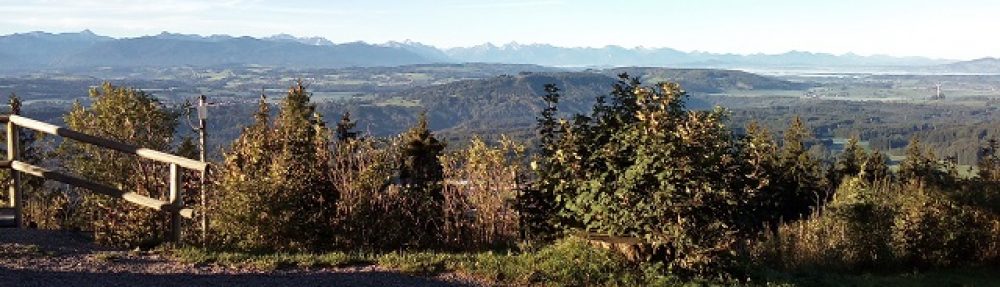
DD5LP/P – February 5th. 2018 5 summits in a day DL/AL-169 & 179, DL/AM-001,176 & 177.

Preparation:

As it’s now a new year and we still have the winter bonus of three extra points to the activator in force, I decided to put together the well tried and tested gear and head off to five local, easy access summits. Originally I had though of including a sixth – DL/AM-178 Ammerleite however since the easy access road has been made private, there is a long walk of about 2 kilometres from another road and the last part of that route is not on a prepared track, rather across a field up to the summit cross. this last part can be problemsome. I have been up to my knees in snow on this last part of the ascent and even if the snow has cleared the ground will almost certainly be very muddy. Not a good candidate for a “quick” activation.

Equipment would be the “tried and tested” Yaesu FT-817ND plus modified Ramsey HF amplifier, the SotaBeams band-hopper linked dipole and my 6 metre fishing pole plus this time a screw-in Sun umbrella base.

The Locations:

Auerberg is accessed from the church and restaurant’s car park and then a walk of about 50 metres up the side of the church (quite a steep climb but not long). Around the back of the church this is a bench seat to sit on and fence posts to attach the antenna mast to.
Weichberg is accessed from a forest car park and then walking up through the forest about 150 metres to the Chapel with table and bench seats outside.
Rentschen is a drive up summit formed by a plateau. Once there I walk across to the trig-point stone and set up. No bench at this one, take something to sit on.
Kirnberg has no car park so I drive to the farmers gate and then walk up alongside his fence to the cross (this farmer is really cool, he towed me out when I got bogged once – typical country guy). There’s a bench at the cross here as well.
(Hoehen-)Peissenberg is the easiest of all, you drive to the car park and then walk up the concrete steps and path to the other side of the church and set up on the bench there.

My plan was to activate DL/AL-169 Auerberg, DL/AL-179 Weichberg, DL/AM-176 Rentschen, DL/AM-177 Kirnberg and DL/AM-001 Peissenberg in that order. The order seemed reasonable however as I later found out, it would have made more sense to reverse the first two as the route from DL/AL-179 to DL/AM-176 took me back through the village underneath DL/AL-169. Oh well, next time I should know better. In the same way the route from Auerberg to Weichberg could be along main roads but leaving my GPS Navi to do the route planning it took me along single track country roads, in at least two places these went THROUGH farm yards on their route! Oh the fun of GPS-Navis!

The Activations:

The weather at home although cold there was no snow to be seen. Surprise, surprise all summits were still snow covered from snow that came down a couple of weeks ago! Temperatures varied from -9C on Auerberg “up” to -4.5C on the last summit Peissenberg. I was glad of taking my thick winter jacket but despite that, the way I felt when I arrived home, I believe I suffered some Hypothermia.

Apart from the realisation that I should have done the first two summits in the opposite order, the drives to the summits were uneventful.

Auerberg (my first summit) has a surprise for me when I arrived apart from the horribly cold temperature (-9°C) access to the summit had been closed as renovation work on the church building that sits on the actual summit has started and everything was fenced off. At this summit, even down to the car park is part of the Activation Zone so I set up on the short track up to the church. Of course now I had no bench seat, so I put out my painters sheet which kept sliding down the slope on top of the hard packed but also frosty snow. This was not starting off the day well! After spotting and calling for some time I did manage to get 5 contacts despite at one point, my smart phone being so cold that it stopped working actually “froze up” and then rebooted. This was cold. So as soon as I didn’t hear any more calls I packed everything up and headed back to the warmth of the car. Even folding the painters sheet was difficult in the cold and several items simply got pushed untidily into the rucksack.

After a scenic run along single lane country roads, I got to Weichberg. While there was still the bench seats and table here, a small tree that I used to strap the antenna mast to was no longer there and I had to use a fence post some distance further away. The end result was that the coax from the antenna was not long enough, so I had to put the station on the painters sheet on the ground again. That new antenna location can’t be very good as I had difficulty getting contacts just managing the minimum four required before packing up. Even though the temperature had now risen to -6°C the small rubber reels that I wind the antenna leads onto was really stiff and that combined with the, mandatory in these temperatures, gloves meant winding up the antenna took longer than normal. Everything takes longer than planned in such cold temperatures. To add to the fun, the antenna wire broke when I was taking it down and so got a quick repair so that it could be used on the next summit.

It was while driving to Rentschen, I realised that I was driving back past Auerberg and could have activated the two Algaeu summits in the reverse order. Apart from that the drive was uneventful. On arriving at Rentschen I decided to park just half off the road to avoid getting bogged, took the usual two packs plus my sun umbrella screw-in base as I knew at this location, there is no where to strap the mast to. I set up about half way between the road and the trig point stone (the whole plateau here is in the activation zone). By now the temperature had risen to -5°C and a lot more chasers were active. I managed 15 contacts on this summit in 12 minutes and then started the pack-up again. While I could have tried 20 metres for more contacts, I was already running late on my planned schedule, so I only operated 40m SSB on each summit.

The next summit about 30 minutes drive away was Kirnberg and I here I left the car parked on the road (I learnt my lesson getting bogged once before here). The wind had increased and the temperature had fallen one degree down to -6 again. Once I walked up to the summit cross and put the gear on the bench seat, I again used the screw-in base to support the mast. I have strapped it in the past to the fence posts but it has often tilted over a lot, so while I had the base with me, I decided to use that. This summit brought me eight contacts in five minutes before I packed everything up again and headed back down to the car. Just one more summit to go.

The drive over to Peissenberg was probably the longest and went past the point where I would have turned off to do Ammerleite but the overall direction was heading towards my home now. I grabbed a little lunch (I had brought a pack-up with me) before setting up at my normal spot on the bench overlooking the valley from the side of the church. This time 15 minutes brought 12 contacts and an interested visitor who I talked to for five minutes. Now that I had enough contacts on 40m, any thoughts of perhaps activating 20m were curtailed by the fact that my Smart Phone (which had been running 4G comms for watching and spotting all day and Bluetooth for hands-free while in the car) had 100% drained its battery. Without being able to self spot, no one would know that I was on 20m looking for contacts. So it was definitely time to pack up and while packing away one of the link connectors in the antenna broke away from the wire  – another thing to fix at home (along with the broken wire, which was now wound together and taped). Peissenberg was a “warm” -4.5°C by the time I left for the well used by me, country back roads route to my home.

Photos:

   1. DL/AL-169 Auerberg.

This slideshow requires JavaScript.

  2. DL/AL-179 Weichberg.

This slideshow requires JavaScript.

  3. DL/AM-176 Rentschen.

This slideshow requires JavaScript.

  4. DL/AM-177 Kirnberg.

This slideshow requires JavaScript.

  5. DL/AM-001 Peissenberg.

This slideshow requires JavaScript.

Equipment:

Yaesu FT817ND.

SOTABeams “Band-Hopper” linked Dipole.

LambdaHalbe 6m telescopic fishing pole.

Screw-in Sun Umbrella base.

Modified Ramsey QAMP amplifier (30-35W on 40m).

Logs:

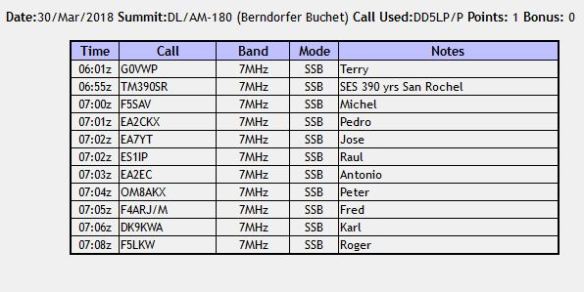
   1. DL/AL-169 Auerberg.  2. DL/AL-179 Weichberg.  3. DL/AM-176 Rentschen.  4. DL/AM-177 Kirnberg.  5. DL/AM-001 Peissenberg.Conclusions:

I was surprised by the fact that there was still snow on these low summits (at home it had melted 10 days earlier) and especially the wind that I found made the low temperatures even worse. It took longer than normal to get anything done.

I am glad I didn’t try for the sixth summit, it could have ended with me being very ill by the end of the day. Do not under-estimate the effect of cold on the human body.

I decided to stay with the same equipment on each summit. Had I used my Aerial-51 OCF dipole instead of the SOTABeams band hopper, I could have switched to 20m without having to take the aerial down but it probably was wise to stay just on 40 metres when I had limited time available for each summit.

73 ’til the next Summit!

DD5LP/P – January 22nd. 2018 DM/BM-286 Ebersberg.

Preparation:

As I was in Lower Bavaria (Niederbayern) I decided to plan a visit to and activate what looked like a very straight forward summit in DM/BM-386 Enbersberg. At the same time I could test my wide-band vertical antenna with NVIS wire added at the same time. The mobile antenna – a Komunica Bazoka Pro from Spain has been used on previous activations with varying results. Mounted on a camera tripod, it has worked well on 40 metres but not so well on 20m. A discussion on the SOTA reflector alerted me to an antenna from the US that claimed to be wide-band AND good for both close in and DX contacts. The initial reaction was I can’t belive that, but looking at eHam reports the antenna from “Alpha Antennas” was getting some good reviews. Reading the online available, handbook for the antenna, it consists of a tripod with an earthing lead, an UNUN matching piece, a vertical whip and from the same connection above the UNUN, a 7.62m long wire, that should slope down to form half of an inverted-V configuration antenna for close in (up to 300 miles) communications. The vertical whip with its low angle of radiation adds the DX capabilities to the antenna. Looking at my Bazoka Pro configuration, I could easily emulate this antenna and indeed two tests, one in the garden at home and one at a portable location outside of the village, both showed that the antenna worked better with this extra wire connected to a conveniently already there hole at the top of the Bazoka’s UNUN, than without the wire. The Antenna analyser trace also showed a flatter SWR reading with the wire added than without.

I have all of the DM & DL summits programmed into my car GPS Navi but I also printed out a Google map and the instruction of how to get as close to the summit as possible. It looked like a short walk from a rough car park up to the look-out tower on the summit.

The Location:

Ebersberg is near Kirchberg and following directions to Kirchberg will get you in the general area until you see road signs for Ebersberg. The summit is located on a range of hills that run along the northern banks of the Danube river, so views should be great on a clear day. There is in fact a Hamlet called Ebersberg that “should” be at the start of the track up to the summit (see report below, why I say “should”). The lookout tower should be a great location for a VHF activation with contacts likely possible into Austria and the Czech Republic as well as Germany if conditions are good. As I would have my dog Bonnie along, the tracks up to the summit through the forest should also be enjoyable for her as well. This is only the third time I have had Bonnie on an activation and the previous two times my wife was along and could take care of Bonnie if needed. This time it was just Bonnie and I.

The Activation:

The weather the two weeks prior to my planned visit was cold with snow and ice in Upper Bavaria (Oberbayern) where I live but there had been no snow, just a little drizzle and grey days in Lower Bavaria. That was until the day I travelled over when they had several centimeters of snow along with sleet and high winds. They were simply not ready for the weather, meaning when I set off from where I was staying about 40 minutes drive south of Ebersberg and the Danube valley, I was challenged with some “interesting” road conditions. Luckily as I got about 15 minutes north of my starting point the snow ploughs and gritting machines had been out and done a good job of clearing the roads. With temperatures around -1.5C and a lot of water on the road, along with one snow blizzard I still needed to take care and the 40 minute drive took just under an hour.

My Navi tried to take me via the autobahn but as I was hearing on the radio of many accidents causing blockages and delays on the Autobahns, I wanted to take the more direct, country roads route, which were actually quite good roads. After a while and a couple of “recalculating route” announcements, the Navi recognised the route I wanted to take and brought me nicely to the location. Well actually, that’s not 100% correct. At what I later realised was the very end of the journey, the Navi told me, “take a right turn in 100m”, “take the next right turn”. There was no right turn! I kept driving and got the “recalculating route” message again. The recalculated route, was to take me to the next village, turn me around and come back to the point where it had said make a right turn but this time it wanted me to take a left turn into this non-existent road. Then the penny dropped! The road was under 15cm of Snow drift and hadn’t been cleared. I could see a half-submerged information board at the end of what I guess was the rough car park, I had seen on Google Earth. So I parked the best I could half off the main (country) road, hoping that afterwards I would be able to get back onto the road! I picked up my bags, put a lead on the dog and we headed back up the road to where the turn-off should have been…

From that point I saw a metal archway, which appears to be over a track, as I could see some dog and owner tracks going up into the forest. Winter may stop the road clearers but when a dog needs to go out for its morning walk not even deep snow can stop it! Indeed this was the track and it isn’t very far at all up the track into the forest before one see’s the lookout tower and a flat round area in front of it. What I found interesting was, that there were a series of huts around the edge of this clearing. I wonder if these are still there from before Christmas and they were the sales huts for the Christmas market? Alternatively perhaps the locals hold events up here – the lookout tour was built by the local forestry club, so it could be that (when there’s not so much snow) they use the area for outside events. I had let Bonnie, my dog off the lead as we went under the archway and she seemed to be very obedient and that was one of the successes of this activation, that I could let the dog wander and investigate wherever she wanted but she came back every time I called her. This is a big thing as it means I can take her with me on future activations. She showed some interest while I was putting together the radio equipment and setting up the tripod mounted antenna but the woods and the huts around the area where far more interesting. I think we both enjoyed the morning out!

From a radio point of view, I was surprised to find a contest going on, on 40 metres. This was a Monday, contests are usually only on weekends. It seemed to be mostly Italian stations on the band, so perhaps an Italian national contest? The other thing I noticed after setting up, was, when tuned away from the loud contest stations, the atmospheric noise seemed very low. This was both on 40 metres and 20 metres. Later I checked and the K Index was only 1, which could be part of the reason but I suspect something else – perhaps the antenna, – perhaps the (IPO) pre-amp was turned off on these bands, perhaps I had turned the attenuator on by mistake? I checked at home and while I can’t be 100% sure, I think these settings were not wrong. In fact the problem may have been the multitude of strong stations, de-sensing the receiver and it would perhaps have been good to turn the IPO function off? From the reception reports that I got, I seemed to be getting out, despite the small antenna and the closeness of the trees. I’ll need to check this on the next activation.

My activation was a constant battle against the contest stations. as soon as I found a free frequency and started calling CQ, a station would start-up either on my frequency or so close to it that they splattered over it (again, had I thought of turning off IPO this may have helped). In any case it took some time to get the minimum 4 contacts required and I know there were others calling me but as soon as I heard part of a call sign, the QRM wiped out all but the very, very strong stations.


the temperature was “warm” for most of the time at around +2C but despite that after about an hour, my hands were starting to feel very cold and I was aware that at some point the dog would get bored or perhaps walk off and get lost. So after my 5th. contact I packed up and we left. All of the contacts were on 40 metres. I did try 20 metres for a short time but with no response to my spot and CQ call.

The drive back to where I was staying me the road clearers just starting to clear the roads around the village at about 12:30. All in all a nice outing and an area where I’d like to activate more summits but as the closest summit is at least 3 hours drive from my home QTH in good weather, I think any activations will have to wait until Summer.

Photos:

This slideshow requires JavaScript.

Equipment:

Yaesu FT817ND.

Komunica Bazoka Pro plus “NVIS wire”.

Photo tripod.

Modified Ramsey QAMP amplifier (30-35W on 40m).

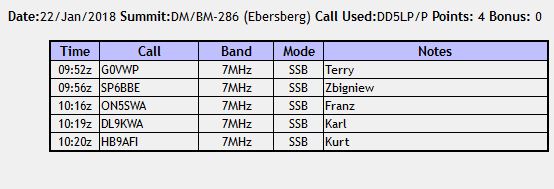
Log:

Conclusions:

A great trip out, especially as regards how well the dog behaved but I am a little worried about the low noise level on the FT817 using the Bazoka antenna – more tests are needed.

73 ’til the next Summit!

DD5LP/P – December 26th. 2017 DL/AM-060 Laber.

Preparation:

As my brother was visiting, I wanted to take him to an easy summit and while (although he still holds a call) he is far more interested in photography than radio these days, I wanted to have a quick deployment activation, with the minimum of equipment. I have a Diamond RHM-8B 40-10m loaded vertical that fastens directly to the top of the FT-817, that I have used on an earlier activation, so that is what I built this activation around. One small bag (rather than the usual two), no mast, no amplifier just 5 watts to the whip antenna “Handy Talkie” style. To improve the antenna somewhat I have created a set of counterpoise wires (different lengths for different bands) that clip as one unit to the case of the FT-817, this would hopefully help a little in the activation.

As the cable car up to the Laber mountain above Oberammergau had started running again a couple of days earlier after its annual maintenance (it is the oldest cable car in Bavaria after all), I could fit this activation together with a visit to the beautiful village of Oberammergau, famous for its “Passion Play” that it puts on every 10 years.

The Location:

Oberammergau and the valley station of the cable car is less than an hours drive away from where I live. It is in the foothills of the Alps (the village at around 800m ASL and the summit around 1600m ASL). The drive down I had done many times before.

The Activation:

The weather was fine if cold. There was still snow in Oberammergau and a LOT of snow on the Laber summit. So much in fact, that my normal operating position was under snow and not reachable. A lot of people (and their dogs) were on the summit and a few (very brave people) were actually skiing down from this mountain (this is really one of the most difficult “black” runs in the area, especially with limited snow in the lower parts of the run). This meant that, as the ski slope was open, the path down the mountain was closed and a lot of the people on the summit who would normally taken a nice leisurely walk down to the valley were “stuck” viewing from the summit. All of this reduced the available space, so that if I had brought my normal mast and Inverted-V antenna, I would have had problems deploying it. As it was I was unable to fully deploy the counterpoise wires.

What became very apparent when I connected up the antenna to the rig was the noise from the microwave link station on this summit. With my horizontal antenna from my normal operating position this has not given me any problems but the vertical antenna picked up this noise very well! The way that the RHB-8B works, is that you slide the coil up and down the base of the antenna, adjusting for maximum received signal and then put out a low power carrier and trim for least SWR. On the FT-817, there are 4 power levels which can be selected and selecting the lowest and then going back to the highest before putting out the CQ had its own problems. Add to this the fact that the antenna is not stable on the FT-817’s BNC connector and was affected by nearness to both the snow and my body and adjusting first for a frequency on 40m and then 20m and finally 17m was a challenge. 40m was quite busy with a contest on, so the usual issue of finding a free frequency was there and of course keeping the frequency was even harder! It took quite some effort to bag 4 contacts over about 30 minutes. THANK YOU to those 4 chasers that managed to get through. Try as I did, I couldn’t manage an S2S contact with another activator that I could hear quite well on 40m. The fact that he was giving low signal reports to chasers that with me were booming in, suggests he may also have been having local QRM affecting his receive capabilities.

I went into this activation looking at it as an experiment and indeed, I have some actions to do before I try again. All in all however we both (my brother and I) enjoyed a nice (if a little cold) day out.

Photos:

This slideshow requires JavaScript.

Equipment:

Yaesu FT817ND.

Diamond RHM-8B rig mounted antenna.

Counterpoise wire.

Log:

Conclusions:

It would have been better to test everything out before heading out, however with other “tourist guide” duties in the days running up to the activation, I simply had no time.

The Diamond RHM-8B antenna needs to have some non-metal attachment added to it to give it far more stability while connected to the FT-817.

I need to change the counterpoise wire from being wound on a plastic stake to something larger to make deployment and recovery quicker and easier.

73 ’til the next Summit!

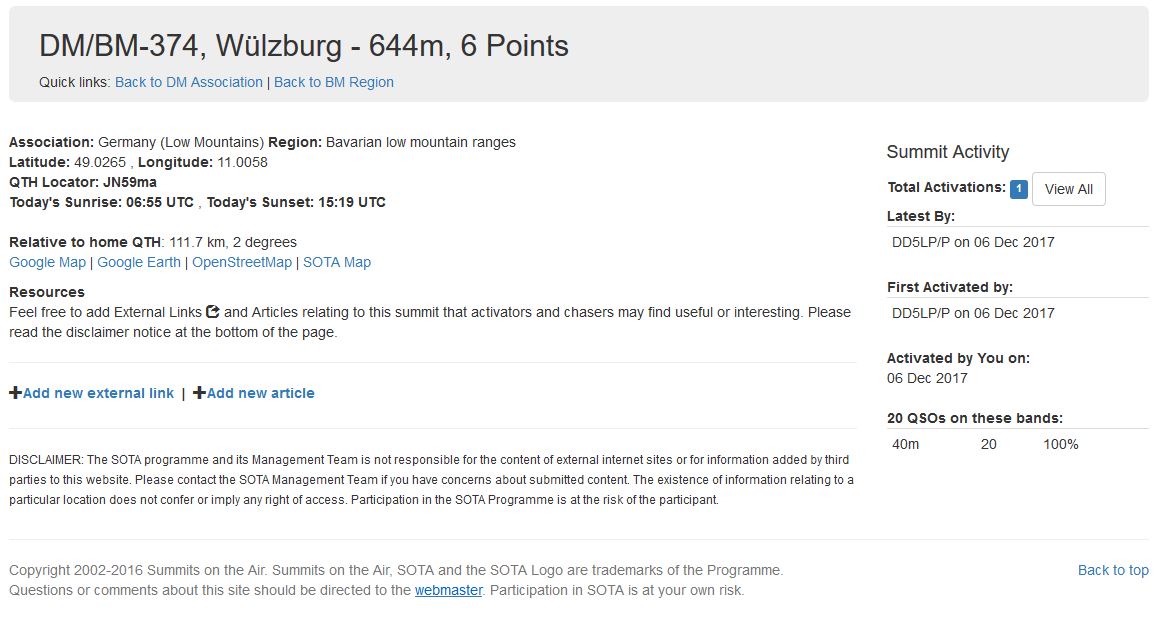
DD5LP/P – December 6th. 2017 DM/BM-374 Wuelzburg (first activation).

Preparation:

As the title states, this was the first activation of this summit. A few summits were added to the DM association on December 1st. 2017 and while this was a surprise, I took a look at them all and realised that Wuelzburg would be well within my capabilities to activate (others were a lot further away or difficult to access or were wooded summits, which can cause transmission problems). I have been the “first activator” of a new summit in VK2, Australia (VK2/HU-093 Mt Elliot)  and had a chance to activate a new Austrian summit about a year ago but I waited too long and another activator got there first!

With this summit, I was unable to get there in the first few days due to bad weather conditions. I kept an eye on SOTAWatch spots and alerts and luckily no one decided to activate Wuelzburg, so as the weather improved, I decided that December 6th. (St. Nikolas day) was going to be “THE DAY”. I planned my route, programmed the GPS and loaded all the usual equipment into the car the night before, so that I could get an early start.

The Location:

Wuelzburg (Burg meaning castle or fortification in German), sits on a steep-sided hill above the town of Weissenberg about 1 3/4 hours drive away from my home QTH. So in no means a “local” summit for me – however in this case the route was all major roads. Only the last 3 km or so was up country roads. The “fortress” itself is open for public tours during the summer and has a car park near to the gate to the castle. The castle and car park sit on the flat-topped hill and so anywhere you go along the walking track around the castle walls or within the castle walls, is well within the SOTA activation zone.

The Activation:

The weather forecast from the previous day was for some sunshine and the temperature warming up however on the morning this was revised to be cloudy with drizzle but at least with temperatures above the freezing point. So no ice on the roads thankfully. The journey up was uneventful and went at a good pace except on approaching Augsburg from the south where the traffic slowed to a crawl. This was not an accident, simply the normal morning traffic overloading the road’s capacity. Once past Augsburg it was possible to cruise at around 100 km/h again. There were some delays on the two lane part of the B2 highway with trucks limited to 80 km/h and no safe places to pass and road works where a bridge has been in repair mode for the last 6 months but all in all a good run. I made only one mistake, taking an exit too soon from the B2 road at Weissenberg and the GPS constantly wanted to re-plan the route. Once I realised what was wrong, I got back onto the B2 and then took the next exit (which was already signposted to Wuelzburg!).

On arriving at the castle, I was surprised to find the car park almost full but not a lot of people around. My guess is that some kind of course was being held using the buildings within the castle walls. When there’s little public interest in winter, it makes sense that they use the facility for something else.

From the car park, I could see some seating, which turned out to be a platform overlooking the drop down into the Altmuhltal valley. This was probably about 100 metres from the car park and the route up there could be made with a little difficulty by a disabled activator in a wheelchair if required. There are also other green areas around the castle that would also be suitable for activations without any large hindrances in the way.

As you’ll see from the pictures, it was still quite misty when I arrived and stayed that way until I left. My feeling is that it was only a degree or two above zero and there was a wind meaning it felt cold (which in the end limited how long I stayed).

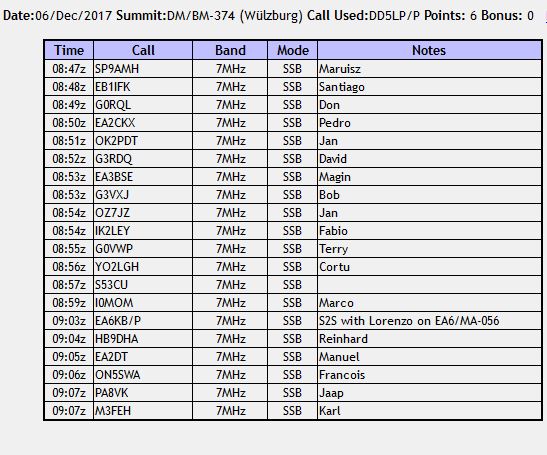
After setting up the linked dipole on the 6 metre fishing pole at the wooden lookout platform, I was surprised to find lots of stations on 40 metres. There wasn’t a contest as far as I know, so I can only assume that several people have already started their Christmas holidays and were on the air. I tuned around and found 7.130 clear and so spotted myself and started calling CQ SOTA. At 08:47 UTC Mariusz SP9AMH was the first to come back and told me something was wrong with my audio. I turned off the RF compressor that is built into the microphone and he then said all was fine. Of course with the compressor off I lose 50% of my signal “punch” so I need to look at what has happened there – perhaps the cold has affected the electronics? I ran the complete activation with the compressor off in any case.

In total I had 20 contacts, the best being an S2S into Mallorca. As I expected, I was getting worse reports than normal but I was getting out, which was the main thing. As time went on I was getting colder and colder, so when the calls eventually dried up at around 09:07 UTC, I decided to call it a day and pack everything up.

The run home had less delays from traffic but strangely seemed to take longer (which it didn’t). I was home just after Noon local time.

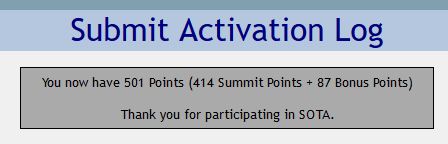
I had achieved what I set out to do – to be the first station to activate a new summit and in the process I also broke the 500 activator points, something I have been trying to do over my last few activations.


Cell phone coverage at this summit at first looked to only be “Edge” (2G) from the car park however from the lookout platform, Vodaphone got a 4G link so that was fine.

Band conditions were very average but there is no QRM at this location, so signals down to S1 were audible. Given that this summit has no winter bonus, it would make a nice summit to visit in summer, to be combined with a tour around the fortress perhaps?

Photos:

This slideshow requires JavaScript.

Equipment:

Yaesu FT817ND.

SOTABeams Bandhopper linked dipole.

Lambdahalbe 6m fibreglass mast.

Modified QAMP amplifier (30-35W on 40m).

Log:

Conclusions:

Although there are no extra points for being the first activator of a summit, it’s nice to have one’s name at the top of the list. The 6 points from this summit were also nice to break that “HALF-GOAT” 500 point barrier.

On the equipment side, I need to look into what is wrong with the in microphone RF-Clipper as the extra punch is very important when one has a weak signal. I also need to service the much suffering SOTABeams band hopper linked dipole. The tape I used to keep the coax coiled refused to come off without splitting, so I need to use a different type next time. The cloth type doesn’t dry up or crack in the heat or cold but if it wont come off and re-stick easily when I need it to with my cold fingers, I will have to find something better. Perhaps a Velcro tie?

73 ’til the next Summit!

DD5LP/P – November 18th. 2017 3rd. annual EU-NA S2S event – DL/AL-167 Falkenstein.

Preparation:

The third annual, NA – EU/UK S2S event, was set for this date a couple of months ago, before we could know how either weather or radio conditions would be. My initial plan was to make this interesting for chasers by activating DM/BW-064 Heersberg, a 10 pointer south of Stuttgart and towards the French border. When it became obvious that the weather may be fairly bad and that with my nearly 3 hour drive each way, I could not be on the summit at the same time as the North American activators, I decided to change the summit and after looking around for one with at least a few points which didn’t need a lift for access (all mountain lifts in southern Germany close around November 5th. until just before Christmas for maintenance, upgrades and repairs before the Ski season starts) I settled on the 4 pointer DL/AL-167 Falkenstein which I have activated twice before, but not yet in 2017.

After my tests with new antennas over the last few activations, I decided to take the new Lambdahalbe J-pole antenna for 20m with the 10m mast and the Komunica Bazoka Pro mobile whip on my tripod for 40 metres. The rest of the set-up would be my FT-817, and home-modified 25w amplifier.

The Location:

Falkenstein has the highest castle ruin in Germany on top of it at 1267m ASL summit. This castle was intended to become another of King Ludwig’s residences but his death under suspicious circumstances drowning in the Starnberg Lake occurred before the work on Falkenstein could commence. The mountain lies above the town of Pfronten, close to the Germany/Austria border. Access to the summit car park from where it’s about a 15 minute walk to the castle ruins and summit is via a one-way toll road. This road really is one-way with no passing points and sheer drops off the side of the road in places. Road use is controlled with lights and cars are allowed up the road (fee € 4) between quarter past the hour and 5 minutes before the full hour. Cars coming down are allowed on the road between the full hour and 10 minutes past. It takes about 5 minutes to drive up the windy narrow road. An expensive hotel is located about 30 vertical metres below the summit but access to that car park is restricted to hotel guests and the public car park is a further 40 vertical metres below that. So after parking, there is a relatively steep climb both up to the hotel car park and then on up a set of stone steps to the summit. Located near the hotel is a communications tower – which made itself know during the activation!

The Activation:

Once I arrived at the summit, or more accurately at the top platform within the ruins on the summit, I found the table still present that I remember from last time although moved into a corner (which was fine). There was still some packed snow on the wooden floor of the platform and ice on the table and it was… COLD!

I first of all set up the 20m J-pole, winding it around the 10m mast as I raised it – the counterbalance 1/4 wavelength stub and feed coax ran nicely across to the table. Once that was up, putting up the tripod was simple and quick, the most time being needed to run out the counterpoise wire so that it wouldn’t be in the way of visitors who came up occasionally. The Komunica Bazoka Pro was then unpacked and the top element connected and the complete antenna screwed on to the SO-239 socket on the tripod.

Once the rig and amplifier were unpacked and cabled up, the station was ready to go. I took my usual set of photos to document the (somewhat overcast) conditions.

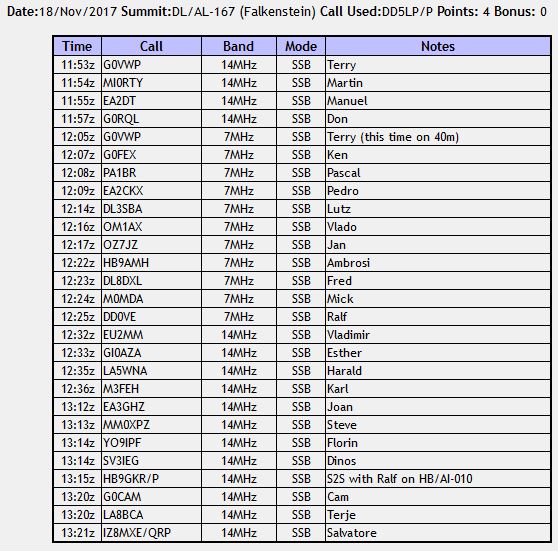
I started on 20 metres as this was the intention of the activation. Tuning around the band sounded good and not too busy. It was 11:53 UTC a little early for the other activators so I decided to make sure everything was working by making some chaser contacts and I was rewarded with contacts from the UK and Spain. When these calls ran out I decided to give 40m a try. As soon as I switched over antennas and band – I realised I was going to be in for a difficult time. The last time I activated Falkenstein I noted QRM from the radio tower at the side of the hotel. I had thought that had been VHF interference – wrong! This tower produces S8-S9 noise all across the whole of 40 metres (and presumably beyond). This of course meant any chasers calling me on 40m would need to be at least S8 and better S9+ before I could easily hear them. I pulled my headphones out of my rucksack and concentrated to pull the stations through the noise. I was very surprised that 11 contacts from some very patient chasers came in from all around Europe!

It was now 12:30 (UTC) and as I had to be back at my car in time to drive down in the time window when the road was open, I would need to start packing up at 13:30 at the very latest. I switched back to the 20m antenna and looked for some of the now spotted other activators. There was no way that I would hear any of these it seemed as the LZ DX contest had started and the band was full of loud (and hence wide) stations – trying to hear a portable station through that noise would be difficult at the best of times but there was now another factor – QSB. Stations that came back to my CQ SOTA call were varying in strength 3-4 S-points (and I presume they were hearing the same thing with my signal). After a while I took a break and took down and packed away the 40m antenna to reduce the time I would need later to pack up. I also realised that the battery in the amplifier was almost drained and so attached my external battery ready for some more 20m contacts. Eight more contacts followed including one S2S with Ralf HB9GKR on HB/AI-010 – I believe  this must have been a ground wave contact. My several attempts to call Sylvia OE5YYN/P came to nought, I was obviously too weak a signal – Sylvia was at best 3-3 with me so I was not surprised that my signal (which would have been a ground wave contact again) didn’t get through. At 13:30 UTC it was time to pull down and pack up the 20m antenna and mast and pack all equipment away into my small rucksack and photo bag and head down to the car – where I arrived about 5 minutes before the hour and was the first through the lights to head down the mountain and then knock 15 minutes off the time I had needed driving there, arriving home just before a heavy storm came over.

Photos:

This slideshow requires JavaScript.

Equipment:

Yaesu FT817ND.

LambdaHalbe 20m J-Pole antenna.

Komunica Bazoka Pro loaded Mobile antenna (40m).

DX-wire 10m fibreglass mast.

Hama camera tripod (modified with SO-239 socket) and counterpoise.

Modified QAMP amplifier (30-35W on 40m, 20-25W on 20m).

Log:

Conclusions:

Band conditions were marginal at best on 20m and when the contest stations came on they flattened what SOTA stations that were on. I think I was lucky to get the number of contacts that I did on the day. On 40 metres that S8-S9 interference from the communications tower right across the band made things REALLY difficult and the headphones certainly came into their own on this activation!  Both antennas worked well in the conditions and the Bazoka Pro certainly sets up very quickly. It’s a shame it doesn’t perform as well on 20m as it does on 40m (it’s supposed to be a wideband 40-10m antenna). The schedule of the one-way road closing meant that I had to leave quite early to get home before it got too dark. If I had been able to stay longer I still don’t think I would have achieved a North American S2S this year in any case.

73 ’til the next Summit!

DD5LP/P – November 15th. 2017 – DM/BM-135 Hesselberg.

Preparation:

With the big EU-NA S2S event approaching on the 18th. I had been trying to get out to a summit to do some more preparation and testing for the last week but weather and other commitments had stopped me up until this Wednesday opportunity. I could have gone to one of my semi-local summits but as well as testing a new antenna (more later on that), I also wanted to get at least 6 activator points, so that the activation on Saturday the 18th. with its 10 activator points, would break the 500 level as an activator (half a goat if you wish). All of the semi-local summits that could supply the needed 6 points or more were now off-limits as a part of the trip up these mountains needed the use of a lift and in Bavaria all Alpen lifts go out of service around November the 5th. until just before Christmas for maintenance and inspection work prior to the Ski season and their heavy usage.

Looking around, I realised I hadn’t activated either Duerremberg or Hesselberg this year, each of which are about 2 hours drive away from my home QTH and both are worth 6 points. Initially I thought I might activate both but later decided to concentrate on the easier access Hesselberg and get to see the views from the summit. Duerremberg is a forested summit and hence has limited views and also impacts the use of vertical antennas – which is what I wanted to test.

From previous blog entries and construction pages on this vk2ji.com website, you’ll know that I built a combined 20m, 17m and 15m J-pole antenna by using a loading coil at the bottom for 17m and 20m. This was the antenna that I tried to use as a sloper antenna on my last antenna testing activation at Peissenberg. Using that antenna as a sloper, especially relatively close to the church building did not work out very well. In the meantime, Christos SV2OXS tipped me off about a commercially built vertical antenna, from LambdaHalbe (the same company who supply the lightweight 6m portable masts). Although sold as an end-fed halfwave it is indeed a J-pole of the same design as I had used for my home-made antennas. I bought the 20m QRP version of this antenna and I decided to test that against the home-made tri-band one at Hesselberg to decide what to use for the NA-EU S2S event on the 18th.

The Location:

Hesselberg is located north of Augsberg and about half way between Ingolstadt and Stuttgart. It has the advantage that having a Radio transmitter mast on top of it, there’s a road almost all the way to the top. this is also a health resort area and hence access to the summit for walkers is well-defined. There are even disabled persons spots in the car park, making this summit a possible for disabled operators although some help getting up the last few metres to the summit would be needed as it’s a rough track.

At the summit, as well as the standard cross, there is also a mini-cross and a trig point stone along with an information board and a table with bench seats at each side of it.

The Activation:

The drive across was uneventful and the weather was clear. That was until,   …. I go to about 500 metres down the road from the summit. At this point visibility dropped drastically and I was in a combination of freezing fog and low cloud. Guess what – I couldn’t see any of the views from the summit AGAIN – like my last visit! What is it with this mountain?

In any case, once I arrived at the car park and unpacked, I was about 30 minutes ahead of schedule, which is always good and in this case, as I was setting up two masts rather than the usual one, the extra time was useful to have. Initially it didn’t feel so cold but as time went on during the activation, I started to feel the cold more and more and when I eventually packed up and took down the antennas, ice had actually formed on the top og the J-pole wire!

Anyway back to the tests and the contacts …

I set up the lambdaHalbe 20m J-pole on my DX-Wire 10m mast at the end of one of the bench seats (which of course collapsed into itself for two sections at the top just as I was pushing the last section from the bottom out and so had to be lowered and re-erected). I actually wound the mast as I put it up, so as to have enough space for the driven element to be still on the pole. I have tried this method before and having a J-pole’s driven (half wave) element in a spiral rather than true vertical configuration appears to make no difference to the antennas performance.

The home-made (loaded) J-pole antenna went onto my LambdaHalbe 6 metre mast at the opposite end of the other seating bank and both coaxes came back to the centre of the table, allowing a switch of antenna to be a simple unplug of the BNC connector from the amplifiers output socket and plug the other one on.

On 20 metres the amplifier outputs between 20 and 25 watts dependant upon the state of the battery.

Even just on receive, I could notice an immediate difference between the commercially made, single band 20m jpole on the 10m mast and my home-made, loaded version on the 6m mast of around 3-4 S-points. Transmission tests with Lars SA4BLM and Cam G0CAM confirmed a similar difference on transmit. Later contacts who had been listening gave reports of similar levels. After the two very clear tests however, it was obvious, that a combination of being a single band antenna, not having a loading coil in circuit and being a little higher (although I don’t think the height was critical) makes the LambdaHalbe, the clear choice for use in the S2S attempts between the US and EU.

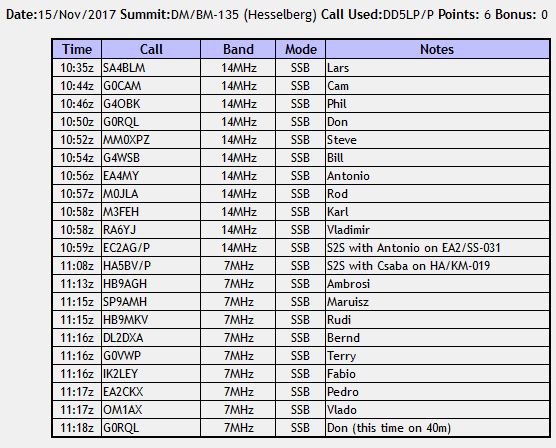
As you’ll see from the log below, I did manage several contacts on 20 metres and despite some very deep QSB, I was happy with the performance of the set-up completing 20m operations with a nice S2S with Antonio EC2AG. As I saw some other activators on 40 metres where an S2S contact may be possible, I took down the home-made antenna from the 6m mast and put up the SOTABeams linked dipole. Interestingly, this usually very effective and reliable antenna didn’t seem to perform as well as normal as I had some difficulty getting the S2S contact with Csaba HA5BV. While I worked several other stations on 40m before packing up, there were no more S2S contacts.

All in all, the activation completed the planned tasks of testing the new LambdaHalbe antenna and gaining 6 activator points but I was a little disappointed at the low visibility from the summit again. As I drove down the road, the air cleared, so I suspect this was possibly low cloud cover on the summit rather than fog or mist.

Photos:

This slideshow requires JavaScript.

Equipment:

Yaesu FT817ND.

SOTABeams Bandhopper linked dipole plus home-made loaded J-Pole for 20m and LambdaHalbe “End Fed Half wave” (J-pole) for 20m.

Lambdahalbe 6m fibreglass mast. DX-Wire 10m portable mast.

Modified QAMP amplifier (30-35W on 40m, 20-25W on 20m).

Log:

Conclusions:

The new LambdaHabe 20m J-pole is a success and will be the antenna I will use on the NA-EU S2S event. The DX-Wire 10m pole continues to give me problems but I will have to manage those as I need the full 10 metres for the antenna.

Lets hope band conditions improve by Saturday for the EU-NA S2S event!

73 ’til the next Summit!

DD5LP/P – October 28th. 2017 – DL/AM-001 Peissenberg (antenna comparison action).

Preparation:

Following the previous weeks participation in the VK-EU S2S event where I made no contacts into VK/ZL at all, I wanted to compare my J-Pole vertical antenna that I was planning to use for the EU-NA S2S event in a few weeks time against my standard linked dipole antenna. So as to have band conditions not affect the test too much, it was important to do these tests quickly and from the same summit.

The predicted weather forecast for the summit said that up to lunch time the weather would be cold but no rain or high winds, with the start of Hurricane Herbert arriving around noon (local time). The bigger problem might be the CQWW SSB contest which was on at the same time and as you’ll see from my report, this indeed turn out to be an issue.

Rather than put up two masts (I packed a second just in case), I decided to run the J-Pole in a sloper configuration from the top of the same mast that would hold up the Inverted-V dipole. During the week before the activation, I tested out this configuration in my garden and found no issues shown on my antenna analyser either by having the J-pole in a sloper configuration rather than helically wound around the mast and there appeared to be no interaction between the two antennas. In fact I hoped that perhaps the dipole might act as a sort of reflector for the J-Pole. To be sure I didn’t have any “live” cables on the unused antenna, I packed a BNC 50 ohm dummy load which would be connected to the end of the antenna cable that was not in use.

The Location:

Same location as the previous weekend – that meant the seating banks alongside the church on the top of Peissenberg. I wonder if the fact that the Church is roughly in the direction needed for long path to Australia would affect the J-Pole – it certainly doesn’t affect the dipole as I have worked VK & ZL from here before using that antenna.

The Activation:

The drive down was in mist or low cloud all the way and it certainly was COLD on arrival and during the complete activation!

My first contact was with John, ZL1BYZ in New Zealand but after that there were no more VK/ZL contacts – most likely due to all the QRM from the CQWW contest stations. There was literally NO room left on the whole of the 20 metre band. Why these animals can’t be caged into just 3/4 of the band (or less as is done in the WAG contest) I don’t understand. I do realise the CQWW is the biggest contest of the year however smaller contests have the same lack of respect for other users. Even emergency frequencies were being used by contest stations, not to mention frequencies reserved for QRP and digital stations. Being in breach of the IARU band plan should get a station excluded from the contest and with SDR radios with recording capabilities it’s VERY EASY to prove the offense.

One UAE based (but not listed in qrz.com so perhaps a pirate) amateur took some kind of pleasure of calling CQ on my frequency (I had checked it was clear before starting and have been there a while) just as I ended my CQ calls, so blocking anyone calling me. He must have been able to hear me or the timing would not have been so exact.

With long skip within Europe however I was able to manage 5-9+ signals both ways between myself and stations in Sweden, Finland, Northern Ireland and Greece, despite DQRM from contest stations!! Some of these SOTA chaser stations helped me test my two antennas which is why I went out – the J-pole vertical is 3 to 4 S points down on the simple linked Dipole. I now need to investigate why that is. It could be that the location was not conducive to good operation of the vertical antenna (church building too close and hence in the way) or the antenna doesn’t work well as a sloper and would be better back as a helical vertical. For the time being, the linked dipole will remain the “safe option” for activations and probably the antenna I will take out for the EU-NA S2S event in November.
I rounded out this activation with two S2S contacts on 40 metres, which was a nice bonus.

Photos:

This slideshow requires JavaScript.

Equipment:

Yaesu FT817ND.

SOTABeams Bandhopper linked dipole plus home made loaded J-Pole for 20m.

Lambdahalbe 6m fibreglass mast.

Modified QAMP amplifier (30-35W on 40m, 20-25W on 20m).

Log:

Conclusions:

I HATE UNRULY UNTHINKING CONTEST OPERATORS – Those animals need putting back in their cages! To be clear not all contest operators are idiots but it seems the CQWW brings out the worst of them. Seeing a positive side to the activity, I suppose it also proves that the Amateur radio hobby is NOT short of operators but where are these people when there’s no contest on and when did they last read their licence about using only as much power as needed to make the contact??

On the positive side, I DID complete my antenna comparison with several stations and getting a contact into New Zealand – especially as the first contact of the day may the trip worthwhile.

73 ’til the next Summit!

DD5LP/P – October 21st. 2017 VK-EU S2S event – DL/AM-001 Peissenberg.

Preparation:

The now becoming annual, VK/ZL/JA – EU/UK S2S event, was set for this date a couple of months ago before we could know how either weather or radio conditions would be. My initial plan was to make this interesting for chasers by activating DM/BW-002 Proeller in the Bavarian Forest region. As this can be a 3 hour drive from where I live there was no way that I could get there in time for the long path, Grey line window So my plan was to travel over on Friday afternoon and stay overnight in the “Gasthaus Hochproeller” that sits about 100 vertical metres below the summit and then walk up in about 30 minutes to the summit on Saturday morning.

Unfortunately the week before this activation, I wasn’t feeling so great and then I got the predicted weather forecast for the summit – rain and gusty winds of up to 53 Km/h were expected exactly at the time I would be trying to activate. So I had to make the decision to either cancel completely, as some other stations did based on the weather across Europe, or to head for a closer summit with some protection from the winds. I decided to take the latter option and to head to a summit that I know very well – Peissenberg. As well as only being 45 minutes drive from home it is a “drive’on”summit. The the car park is located on the summit from where I have a 5 minute walk to the seating banks near the Church, where I always set-up.

After my tests with new antennas over the last few activations, I decided to go with my known configuration of my FT-817, home-modified 25w amplifier, the SOTABeams band-hopper linked dipole and my short 6 metre portable squid pole. Given the ease of access to the site, I considered taking my ICOM IC-7300 rig but given the likelihood of rain, I decided against that.

The Location:

As mentioned above Peissenberg is an easy access summit about 45 minutes drive from home. It is the location of the local TV transmitter and also the local 10 metre amateur radio beacon. There is a good restaurant on the summit along with a large church. The complete name of the location is HohenPeissenberg and is well signposted. I have activated from this summit many times before and indeed made contacts into Australia from here.

The Activation:

The drive down was in rain until I got to about 10 Km from the summit where the roads where dry as they had not got any rain (yet). After setting up the station, the wind increased and the rain started. Luckily it only lasted 10 minutes. It stayed cold though for the whole of the 2 hour activation. To start with only a few stations were on the 20m band and several of those were too close for me to hear because of skip distance. Later with standard Nets, the scouts JOTA event and the number of SOTA activators out, the usual frequencies on the band became very busy.  I heard Andrew VK1AD/2 just above the noise level – whether I could have worked him, I’m not sure but I didn’t get the chance as another European SOTA activator started working stations on the same frequency!

At one point I had S5 QRN and it sounded like a storm was heading my way but luckily that never arrived.

A couple more points on the SFI and a point or 2 less on the K index (although that wasn’t that bad at about 3 I think) may have made some VK/ZL portable stations workable for me. Perhaps a better antenna (one with some gain) could have made some difference?

I don’t think anything would have been different if  I had taken my IC-7300 to the summit given that I was getting 5-9+ reports towards the end of the activation with my 817 and 25w amp (which had 0% charge in its battery when I went QRT – lucky timing!). As we all know – “it’s all about the radio conditions” and they were not with us today.

Photos:

This slideshow requires JavaScript.

Equipment:

Yaesu FT817ND.

SOTABeams Bandhopper linked dipole.

Lambdahalbe 6m fibreglass mast.

Modified QAMP amplifier (30-35W on 40m, 20-25W on 20m).

Log:

Conclusions:

Although I had a great time with seven S2S contacts unfortunately because of the radio conditions I managed no S2S contacts into VK/ZL and the only JA activators (who went out despite an oncoming cyclone!) were operating CW not SSB. I was surprised not to make any contacts with VK or ZL home station chasers as normally they seem to get though in all conditions

73 ’til the next Summit!

DD5LP/P – October 4th. and 5th. 2017 – DL/AL-276 Attensberg.

Preparation:

Apart from being a SOTA outing, this action had another non-radio related reason. We – Gabriele, my wife and I have a young dog “Bonnie” who has never been away with us on holiday. As I had found on my last activation of Attensberg that the Gasthaus (hotel) on the foot of the hill, was “Pet friendly”, we decided to take a short, two night, break to see how the dog copes with staying overnight in a strange environment. This area (about 1 hr 40 minutes drive away from my home QTH) has several SOTA summits that I haven’t as yet activated, so, if time permitted, I should be able to fit one or even two activations in.

The Location:

The hotel – the “Gasthaus am Paradies” in Berg near Oberstaufen is a wonderful, family run hotel and cafe in a very beautiful location in the southern most part of Allgau not far from the border between Germany and Austria. Even without the 10 or so SOTA summits in the area, if you wish to visit a really beautiful part of Bavaria this area is worth the visit. The highest and hence highest scoring, summit in the Area is DL/AL-132 Hochgrat and as a look at the SOTA database statistics will show you, this is a much visited 8 pointer summit (not only visited a lot by SOTA activators but also by the general public). The cable car takes you to within 125 vertical metres of the summit and then it’s a 30 minutes hike up a trail to get to the summit cross. So that was the plan, activate HochGrat on the main day that we were staying and then possibly fit in an activation of Attensberg again as it was literally a 5 minute climb up the hill outside the back door of the hotel!

The Activations:

The drive down I knew from my previous activation and the GPS Navi took us the same route. The journey was uneventful and thankfully the weather changed from pouring rain when we set off to sunshine as we arrived. This was a good omen!

The Tuesday that we travelled down was actually a public holiday “Tag der Deutsche Einheit” (Germany’s re-unification day) and as the weather was expected to be bad at least until mid afternoon, we did not plan any activities for the Tuesday and just concentrated on settling into the hotel with our dog and taking her for a long walk to get her accustomed to the area. She and we, had a bit of an unsettled night that first night, which meant we were all awake early and I decided to do an activation of Attensberg (aka Kapf) before breakfast was going to be served. This was combined with a morning walk for the dog up the hill escorted by my wife. This also coincided with when Andrew VK1AD and Mike 2E0YYY hoped to be out to catch the long path window between EU and VK. Unfortunately Andrew had to cancel and I could not even hear Mike at any time during my activation but the activation itself went VERY well – as you’ll hear below:

Wednesday 4th. October 2017.

Once the equipment was set up (I had carried my sun umbrella screw-in base up the hill as well but decided to simply strap the squid pole supporting the linked dipole to a fence post – which worked fine). I spotted and called CQ on 14.285MHz as it was clear. Nothing, no responses, so I tuned around the band and it was very quiet – even the background atmospheric noise level was low. Eventually I got a call at 05:55 UTC from Rainer DF4TD from some 35-40 km away (obviously just ground wave) this proved at least that I was getting out! Listening on 14.285, I could JUST hear some stations in the noise that sounded like they were Italian. This wasn’t looking too good. At this point my wife suggested she go back down to the hotel and I helped her down the steepest parts by taking the dog (who of course was having fun and pulling on the lead to run down the hill).

Upon returning to the station at about 0620 UTC, I realised immediately that the noise level was higher and those Italian stations that were in the noise were now 5-9+. It was as if someone had turned a switch on to make the band usable. Checking the MUF later, it was under 8MHz up to around 0615 and then shot up to above 14MHz, so I think this is what I experienced.

Mike had spotted himself on 14.325 MHz, I listened but there was no sign of him there. I gave a quick call – no response, so I decided to move to 14.310 (away from the Italians who were still chatting on 14.285), re-spotted and called CQ to be welcomed by a call from John ZL1BYZ in New Zealand! If that had been the only contact to the antipodes it would have made the activation. Once I finished a brief chat with John however it was followed by calls from Tony VK3CAT in Victoria Australia, Alexi RW3XZ in Russia, then another well-known VK chaser, Ernie VK3DET. Not to be beaten by the VKs, Warren ZL2AJ then called in, followed by Dinos SV3IEG from Greece and Jon VK7JON from Tasmania Australia. The activation was finished off after two more long distance EU contacts with George SV1PBC in Greece and Vadim R1BCE in Russia. The band went quiet again at 0650. As you can guess, I was really happy with this activation. I never expected to get so many contacts from down under and I’m fairly sure that was my first VK7 contact from Europe. But was this just a fluke? Or are we now back with a stable “Long Path” window to VK/ZL in the mornings? I decided I would try on Thursday morning before we leave to go home and see if something similar occurs – using the same equipment from the same location.

But first there was Hochgrat to be activated in the afternoon. Or was there? Actually I had to cancel. I simply didn’t feel fit enough even for the simple 30 minute hikes to and from the summit to the cable car. Perhaps this was caused by the sleepless night and the early rise. In any case, as I had now decided to do the second activation the next morning, I decided to have a relaxing afternoon with my wife and dog. Hochgrat won’t go away, it’ll be there for our next (longer) visit to this area or perhaps I might just drive down one day from my home QTH just to activate Hochgrat.

Thursday 5th. October 2017.

This mornings activation was Interesting – somewhat similar to yesterdays (using the same equipment from the same location at the same time). Signals were down a little on yesterday and the weather a lot colder but I still had the pleasure of calls from 3 stations in ZL. ZL1BYZ John, ZL2AJ Warren and ZL1WA, Jacky (being the new contact). In VK both Tony VK3CAT and Ernie VK3DET came on again so I had a good comparison between the two days for both ZL and VK stations. I should also mention that I also worked Ian VK5CZ in South Australia. Nice as I haven’t spoken to Ian for a long time.

In Europe I managed contacts with Jack, OH3GZ in Finland and Rainer DF4TD who had gone out static mobile to see if he could get some contacts into VK/ZL. It does look definitely like skip was long on both days.

I also noted a time when the band appeared to “turn on” – on Wednesday that was 0620 UTC, today it was about 0600 UTC. I saw very clearly the window move from east to west across NZ and then VK. It looks like from what Mike 2E0YYY reported that a similar thing was happening in Europe with Mike only getting the contacts probably about 30-40 minutes after they were loudest with me on Wednesday.

My conclusion (from this not very scientific test) is that we do have a good Long Path windows between EU and VK/ZL of about 30-40 minutes (after the MUF gets high enough) covering in turn ZL through VK5. The action then repeating for the UK after the Central EU stations, 35 minutes later. So as someone in Germany is in contact with someone in VK5, the UK stations may start getting the ZL stations.

The VK & ZL stations are well equipped with 400 watts or more and 3 element beams, whereas I was using just 25 watts and a dipole at 5 meters AGL. For any S2S contacts to work, I would suggest some more power would be good – perhaps 50 watts at each end and if one end has some kind of portable antenna with gain (perhaps phased verticals) the chance of a contact between two summit stations will be increased. It’s not going to be easy in this months VK<>EU S2S event on the 21st. but it seems it will be possible for contacts to be made at least between chasers and activators.


John ZL1BYZ was kind enough to record a little of my signal from his end and it shows what can be achieved with about 20 watts of SSB and a simple dipole antenna (as long as the other station has a nice beam and good receiver of course) – here is that audio clip:

Audio clip DD5LP heard in ZL.

Photos 4/10/2017:

This slideshow requires JavaScript.

Photos 5/10/2017:

This slideshow requires JavaScript.

Equipment:

Yaesu FT817ND.

SOTABeam band hopper linked dipole.

6 metre LamdaHalbe telescopic squid pole.

Modified QAMP amplifier (20-25W on 20m).

Painters sheet.

Sun umbrella screw-in base (not used).

Log 4/10/2017:

Log 5/10/2917:

Conclusions:

A very succesful pair of activations that showed consistency across the two days, so it appears that the Long Path window is now back for the Autumn/Winter season and this is just in time for the planned VK<>EU S2S event on the 21st. of October.

Using “tried and tested” equipment is always good. The new antennas need some more work before I can rely on them.

Most importantly, the first hotel trip with “Bonnie” our dog despite some early uncertainty on her part worked out to be VERY successful and opens up other holiday / SOTA possibilities for the future.

73 ’til the next Summit!
DD5LP/P – September 30th. 2017 – DL/AM-176 Rentschen.

Preparation:

Following the uncertainty whether the new Bazoka PRO loaded vertical antenna was working on 20m when tried at Attenberg, I needed another activation to test it and to see whether band conditions (which had now improved a little) had been the reason. The site had to allow me to erect the 20 metre dipole antenna alongside the Bazoka. Rentschen, being a large flat, grass fielded area (with little or no tree cover), not too far from my home QTH, made it a natural choice. As I had already activated it earlier in the year, so would not gain any points for the activation, but this was about testing equipment. At the same time, I wanted to try out the new digital mode (FT-8) from the summit and had prepared a windows tablet and interfaces for both audio and CAT commands to connect it to the FT-817.

The hope was, that if indeed the Bazoka PRO worked fairly well on 20m as well as 40m, it would make a great antenna to use for my trip to Hochgrat the following week where space is limited and tourist traffic is high.

So the full set of equipment would be used: the FT-817ND plus amplifier, the tripod and Bazoka PRO wideband vertical and the SOTABeams Band Hopper linked dipole with the 6m fishing pole. The screw-in base would also be taken along as there are no easy mast support structures at Rentschen.

On the digital (FT-8) side my windows 10 tablet with Bluetooth keyboard and mouse and interface cables would be packed.

The Location:

Rentschen is a one point, low summit. It is about a 50 minutes drive from my home and therefore one of my “local” summits. The actual summit is marked by a trig-point stone which is about 100m away from the road, where I would park my car as usual. The summit is between Rottenbuch and Steingaden villages.

The Activation:

The trip down I could do without any GPS Navigator or maps, I have driven the route many times and indeed after about 45 minutes, I was already parked and unpacking the car. I first set up the tripod with the Bazoka antenna and then followed by putting up the linked dipole and eventually setting out the FT-817 and computer equipment. All completed without issues and by 11:15 local time (45 minutes before my alerted time), I was ready to go. First of all I tuned around 20m on the Bazoka PRO and the dipole and straight away the difference was very obvious. The FT-817 on the dipole was lively as usual and I could hear several loud stations. On the Bazoka the band was very quiet and while I could hear some of the same stations, they were at least 4 S-points down on the dipole. I then repeated these tests on 40 metres and the Bazoka PRO performed a lot better, the band was popping and the difference in signal strengths was  only 1 or possibly 1.5 S-points. With the top of the vertical being about 2.5 metres off the ground and the centre of the dipole around 5 metres up, this difference is reasonable. So on receive at least, it seemed the Bazoka wasn’t going to perform well on 20 metres.

I decided to go back to the 20 metres dipole and put out some calls on 20m to get some SOTA contacts in the log and if the stations were loud asked them to listen for me on the vertical. Although I could still hear a couple of the chasers on the vertical, none of them could her me.

Once I had no more chasers waiting I connected up the tablet to try some FT-8. As soon as I started the software and selected the 20m frequency via the software a stream of decoded signals came in. I did have problems with using the software due to being outside. The sunlight on the screen made it difficult to see and to locate the mouse. I had three ways to move the mouse pointer – the tablet has a touchscreen but my big fingers made this difficult to use accurately. The bluetooth keyboard has a touchpad on it, which while it worked, moved the mouse around too quickly, when I could see where the mouse was. The best, albeit also not good, method was to use the bluetooth mouse. The problem here was once again, not being able to see where the mouse was on the screen in the sunlight but also finding an acceptable flat surface to run the mouse over. I will need to see if I can set the mouse pointer to be a lot bigger and darker and set it to move a lot slower. If I can make the WSJT-x program windows larger as well, this could help. All things learnt…

As regards FT-8 contacts – although I was receiving signals OK, after spotting on SOTAWatch I received no chaser calls, in fact no calls at all. Checking the PSK reporter, when I got home (log below), I was getting out fine with just the 5w running barefoot (no amplifier) from the FT-817, perhaps I needed to keep trying longer, however that was not to be as the farmer who owned the field came along to say he intended to mow the grass to make hay. He kindly offered me another field, still on the summit, but I decided I would pack up and leave as the time to disassemble, remove and reassemble probably wouldn’t warrant any addition contacts. I already had actions to do from my tests in any case. The vertical needs trying with an ATU and with a counterpoise, the tablet needs re-configuring to be more visible when in the open.

Photos:

This slideshow requires JavaScript.

Equipment:

Yaesu FT817ND.

SOTABEAMS band hopper linked dipole.

LambdaHalbe 6m Mini-mast.

Modified QAMP amplifier (25W on 20m, 35W on 40m).

Thick plastic painters sheet

Screw-in mast base

Windows 10 tablet with BT mouse and keyboard and interface to the FT-817.

Log:

PSK reporter Log (stations that heard my FT-8 transmissions):

Conclusions:

The Bazoka PRO is not performing well on 20 metres. An ATU may help (despite the fact that the antenna analyser indicates a reasonable impedance across the band) or perhaps adding my counterpoise wires to the bottom of the antenna could also help it to operate better.

Operating FT-8 from a summit, has the same difficulties as operating any digital mode from a summit operation of the computer (tablet in this case), is difficult in the sunlight and mouse operation was a pain however the Tablet to FT-817 Interface worked perfectly. Some kind of stand and shade would most likely help but then make the solution less portable and hence only possible on simple summits.

73 ’til the next Summit!