DD5LP/P – November 13th 2024 – Activation of POTA DE-0458 Osterseen Nature Reserve.

Preparation:

This activation was planned to coincide with my wife’s visit to the Buchheim Museum in Bernreid on Lake Starnberg. So, in addition to fitting her schedule, I also needed to have our dog along. Hence, this would be a simple activation from the car, interspersed with dog walks. The equipment therefore would be the ever-reliable Xiegu G90 and the Komunica HF-PRO2 antenna on a magnetic mount on the car roof. I planned to operate just on 10 metres which had been open of late, however, the propagation gods were not with me …

The Activation

POTA DE-0458

The weather was not particularly nice—cold and a little foggy. However, the location I found within the park, a carpark right on FohenSee on the outskirts of Iffledorf, was a nice spot despite the weather. In the tourist season, I suspect this will be a bustling spot with a caravan park, restaurant, and a narrow access road, but in November, I had the whole area to myself.

After dropping my wife off at the Museum, it was a 20-minute drive down to my activation spot.

On arrival, I paid my €2 for 2 hours, although I probably could have not bothered with no one to be seen for miles, but I felt the contribution was justified even if it only gets collected from the machine next spring. The first priority was the dog’s walk from which several of the pictures were taken. Had I wanted to set up away from the car, there is a nice lawned area with picnic tables and benches but in this case, I was limited for time and with temperatures around 0°C, I preferred to operate from the car! 

After the walk, I set up the radio and antenna and started searching 10 metres for contacts – I was somewhat disappointed and after spotting myself, getting only 2 contacts on 10m and seeing that most activators were on 20m, I decided to switch band and initially went hunting the Park-to-Park contacts. I “bagged” five in a row and after the fifth a chaser F5PYI called me to QSY 5 down to have a QSO, which I did and then stayed on this new frequency, spotting and calling CQ, this brought in 19 chasers contacts but the operation on 10 metres had taken some time and hence I had to pull the plug before heading back to the museum.

All in All, I managed 26 contacts in an hour, which is quite good and shows that the number of POTA chasers on a weekday (this was a Wednesday) is increasing, almost to the level of SOTA chasers.

Photos:

This slideshow requires JavaScript.

Equipment taken:

  • Xiegu G-90 radio.
  • 6-metre mast and linked dipole (not used).
  • Komunica Power HF-PRO2-PLUS-T loaded vertical antenna.
  • Three magnets, car roof antenna mount.
  • 12 Ah LifePO4 battery.
  • 4Ah Eremit LifePO4 battery (not used).
  • Plastic painter’s sheet (used) and seat pad (not used).
  • Lightweight headphones.
  • Smartphone for spotting.

Log:

DE-0458 Osterseen Nature Reserve

Conclusions:

  • The activation went well. It didn’t start well but later I had to apologise to callers as I had to pack up and leave to collect my wife from the Museum. I had only one DX call but plenty of European activity on 20m. The simple car set-up worked out well.

73 ’til the next activation!


DD5LP/P – October 21st 2024 – Activation of POTA DE-0663 Lechpark Pössinger Au.

Preparation:

This activation was planned for Sunday the 20th of October to coincide with the “Support your parks” weekend and to test out my 2-element wire beam with its elements now extended to cover 40 metres.

The weather was not as forecast, in fact, Sunday was a cold and wet day where the grass never dried out from the heavy morning dew in it.

Monday’s weather however looked better, so the cancelled activation became a postponed one and took place on Monday the 21st of October.

The Activation

POTA DE-0663

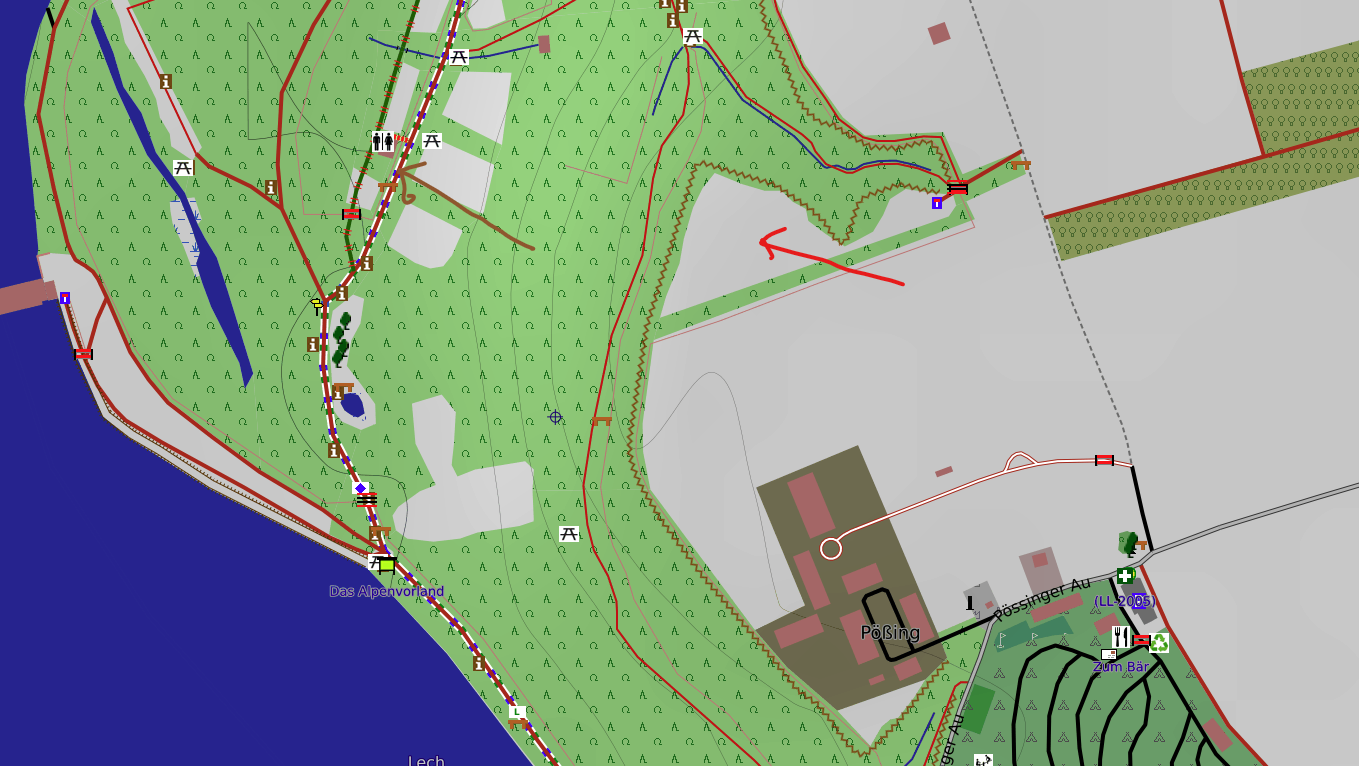
This is my closest park, a 15-minute drive away from home and while the park covers a large area along the side of the River Lech and encompasses an animal park, there are many locations where an activation is possible. I have found a field within the park, where deer often graze and is close to the road named “Pössinger Au”. As you can see from the picture below, (indicated by the red arrow) the area is bounded by trees but there is more than enough room for my antenna and is rarely visited by the general public. The Brown arrow is, in fact, part of the POTA nature trail DE-0791 LechErlebnisWeg, so operating from where the brown arrow points would be a POTA “2-Fer”. However, space there is restricted and in good weather a lot of people walk through there – so it is not a good spot to test a large antenna! 

After arriving and setting up the antenna on 40m, I put the Antenna analyser on the antenna to find there was no dip at the expected (and tested the week before) 7.1MHz. The antenna was switched to point West and I wondered if I had a bad connection in the manual switch, so I lowered the mast, switched from West to North and tried again – the same problem occurred. Repeat and try – North to east – and now there was the expected dip near 7.1 MHz – perhaps it’s just one connection on the switch that has a problem? I lowered the mast again, switched to South, raised and tested, no dip. Odd, but East works so I lowered and tested again and this time even East did not have the expected dip. This has to be a common component that has failed, perhaps intermittently. I realised I had another feeder coax with me so I changed that out and “Bingo” all directions were now showing resonance around 7.1MHz. My conclusion – it must be the RG-174 coax cable that has failed in either the BNC or PL-259 plug, but in fact, when tested after returning home, the cable was fine and it was the BNC socket that had a bad centre connection  – possibly as a 75 Ohm BNC plug had been pushed into the 50 Ohm socket, widening the grips on the centre pin. I re-tensioned those and the complete run checked out.

But, back to the activation. I had previously seen in a model that with my wire beam at only 7 metres AGL, the radiation pattern is close to omnidirectional rather than beam-like and that proved to be the case with my six 40-metre contacts coming from all points of the compass from where I was located. At least the antenna works on 40m, even if it brings no advantage over a dipole.   

It was time to test the antenna on 10 metres, so I lowered the antenna and removed the link at the end of the 10m section on all 4 elements, switched the antenna direction to West and started calling CQ.

My first caller was VE3RNH from Canada and then in quick succession another ten calls from the US or Canada, including one Park-to-Park. There was also a call from Mike R2BRJ in Moscow off the back of the beam. Ten metres was certainly “open” and with a mixture of 59, 58 and 55 reports the wire antenna with 20 watts was certainly working well.

Looking at the POTA cluster, there were several operators out in Europe on 20m – so I again lowered the mast, reset the 10m links and removed the 20m ones.  While tuning around, I came across YB7ONC from Indonesia, but even with my antenna switched in his direction I could not get a response from him. I was not alone however, he only seemed to return to very strong stations, so perhaps he has a high local QRM? In any case, it was nice to at least receive a signal from Indonesia. After this, I found a free frequency, spotted myself on the POTA cluster and waited for any calls. Unfortunately, I suspect the number of stations on the band was the problem and no one could hear me for the noise. I then saw a recent post on the cluster for another POTA operator IT9KHP in Sicily, whom I called and we had a 59 / 59 Park-to-Park QSO with no problem whatsoever.

Time was passing and while the 12Ah LifePO4 battery showed no signs of reducing its voltage I decided that I had done enough testing and given a lot of North American POTA chasers a new park and it was time to pack up and head home for tea.

Photos:

This slideshow requires JavaScript.

Equipment taken:

  • Xiegu G-90 radio.
  • 7-metre mast and screw-in sun umbrella base.
  • 2-element wire beam.
  • 12 Ah LifePO4 battery.
  • 4Ah Eremit LifePO4 battery (not used).
  • 4 Ah 3S LiHV battery (not used).
  • Plastic painter’s sheet (used) and seat pad (not used).
  • Lightweight headphones.
  • Smartphone for spotting.

Log:

DE-0663 Lechpark Pössinger Au


Conclusions:

  • The activation went well. It served the purpose of testing the antenna and its expansion to cover 40 metres however, my conclusion is to remove the 40m extensions and keep this as a 5-Band 10-20m antenna.

73 ’til the next activation!


G8GLM/P – September 24th & 26th 2024 – First ever activation of POTA GB-2021 Cotgrove Country Park and UKBOTA B/G-0655 Burton Joyce ROC Bunker.

Preparation:

Linked with my visit to the UK to visit my brother & sister and to attend the national Hamfest in Newark, I wanted to do some radio activations using my new Xiegu X6200 transceiver. As I left Germany, it was not clear which SOTA, HEMA, POTA, COTA or UKBOTA sites I might get to activate. I had planned to activate Bardon Hill – a SOTA summit (G/CE-004) on the way from the airport to where I would be staying but the weather was terrible with many roads in the UK closed because of flooding and as the access to Bardon Hill starts with a trek over a field, on the way driving there, I decided to cancel and concentrate on getting safely to my destination.

The Activations

POTA GB-2021 Cotgrove Park  & UKBOTA bunker B/G-0655 Burton Joyce ROC

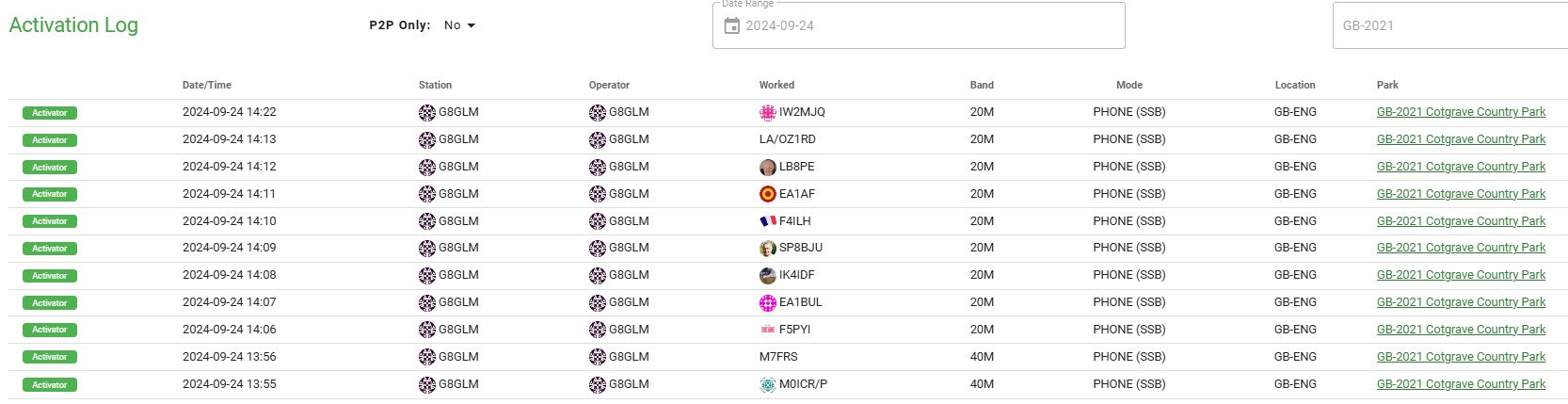
I had the opportunity on Tuesday to combine the activation of a POTA park near Nottingham, which for some reason, no one had yet activated, with taking my sister to visit a friend. Cotgrove Park has a housing estate in the middle of it but also some tributaries of the River Trent, near to one of those I found an area of grass large enough to set up the linked dipole and operated on 20 & 40m from a bench. There was some interest from passersby – mainly from their dogs – this seems to be a favourite dog walking park. Initially, I was only able to get contacts by search and pounce of strong stations but then after calling CQ for some time, I managed to get a flow of contacts ending up with 11 (one more than needed for a POTA activation). I then had to curtail operations as I needed to pick up my sister from a friend’s house where I had dropped her off earlier. The drive back to the other side of Nottingham was horrible. flowing traffic had changed into crawling traffic around the Nottingham ring road but at least I could chalk up an activation. I had started to think that my bringing the radio gear had been a waste of time. 

On Thursday I went to a point within a kilometre of a UKBunkers site about 20 minutes away from where we were staying. My originally planned set-up point was in a car park shown on Google Maps, which turned out to be a private one with locked gates at a (closed) sports centre, so I went further down the riverside and found a parking spot just before the Ferry Boat Inn at Stoke Bardolph. During my visit to the UK a year ago, I tried to get to one of two bunkers near where we were staying in the Lake District. The first was inaccessible as the fields were both overgrown and flooded, the second I managed to get to and operated from the top of the entrance but conditions were not kind to me and I got no contacts from there. This year, I checked the rules more carefully to find that I only needed to be within one kilometre of the bunker and could therefore activate from the road, from inside the car. The result however was not a lot better than the year before, with only two completed contacts.

Photos:

POTA GB-2021 – Cotgrave Country Park

This slideshow requires JavaScript.

UKBOTA B/G-0655 Burton Joyce ROC

This slideshow requires JavaScript.

Equipment taken:

  • Xiegu X-6200 radio.
  • Linked Dipole (used for POTA activation)
  • Six-metre mast (used for POTA activation).
  • Komunica Power HF-PRO2-PLUS-T loaded multiband vertical, tripod and radials (Used for UKBOTA activation).
  • 4Ah Eremit LifePO4 battery.
  • Plastic painter’s sheet and seat pad.
  • Lightweight headphones.
  • Smartphone for spotting.

Logs:

POTA GB-2021 Cotgrove Country Park.


UKBOTA B/G-0655 Burton Joyce ROC


Conclusions:

  • The activations could have gone better – whether that was conditions, lack of chasers or just not a big enough signal from the 8w X6200 (my normal G90 is a 20w radio) I am not sure. I question whether the extra effort of taking the radio gear was worthwhile (especially with the recent cases in the Middle East of exploding amateur radio transceivers making airport security more careful). I was the first activator of the POTA park, just beating another ham who activated the following day. 

73 until the next activation!


DD5LP/P – July 24th 2024 – First ever activation of POTA DE-0797 König Ludwig Weg & SOTA DL/AM-001 Peißenberg.

Preparation:

This is the second preservation/nature trail I have submitted for inclusion in the POTA award system and it was also accepted.  This trail is very interesting, starting as it does at the spot where King Ludwig was found drowned on Lake Starnberg and finishing near his world-famous Neuschwanstein Castle (think of the well-known Disneyland castle – that was a copy of this real-life one). Along its route, it entails a ferry trip across Ammersee a visit to the UNESCO-listed Weichkirche church and at least one SOTA summit. The route runs right past the seat that I use to activate the DL/AM-001 SOTA summit.   

One reason for this activation was to be the first to activate from the trail and to do that one does not have to walk the 6-day long trail but rather just set up somewhere along its route. Although I have already activated the SOTA Peißenberg summit this year and hence won’t get any points for it, I chose to do the combined activation as then I could call on two groups of chasers for contacts and my second reason for the activation would benefit from having as many contacts as possible. The second reason was to test out equipment prior to its use during the International Lighthouse and Lightship Weekend in August. I had found on previous ILLW activations, that the signal from my 20w radio was getting stomped on by other stations, so (as well as using the two-element wire beam this time), this year would have some more power on board, specifically 50-70w RMS (over 100w PEP) depending upon the band in use. I have worked at trying to get a Chinese amplifier to work reliably for a couple of months but with the MOSFETs blowing regularly it did not look promising and I decided to buy a commercial HF amplifier. Now those designed for ham bands are expensive, however, those designed for the CB bands are a lot cheaper and can be modified to work across the complete HF spectrum (3-30 MHz).  I bought an RM-Italy KL-203P unit. The missing component in a 27MHz amplifier is protection against harmonic emissions. In an amplifier designed for amateur radio use, switched low-pass filters are used to block any harmonic signals. As I had, from my work with the Chinese amplifier a switchable LPF board I cased this up and cabled it to follow the amplifier and precede the ATU-100 tuner. While the LPF box uses Butterworth filters, it can operate on transmit and receive.  So, as you can see, the station for the ILLW event is made of several, cabled together units and this combination needed to be tested in a portable operation before relying upon them for my ILLW station. This activation would be that equipment test.

Map where POTA nature trail and SOTA summit meet.

The Activation

POTA DE-0797 / SOTA DL/AM-001

Originally planned for Tuesday but rescheduled to Wednesday as some strapping components were delivered later than promised by Amazon and so I would have had no chance to do a dry run from the home station – that test took place on Tuesday with a contact with Leif LA9BM in Norway. He commented that the G106 with my RF Clipper speech processor and the amplifier and other components after if, while OK, the audio sounded a little deep and muffled. This report was also received later during the activation and the adjustment to the speech processor is an outstanding action to be completed.

As regards the activation itself, I had the alarm set for 6 am, was on the road by 7 am and set up and running at 8 am (all local times – UTC+2).

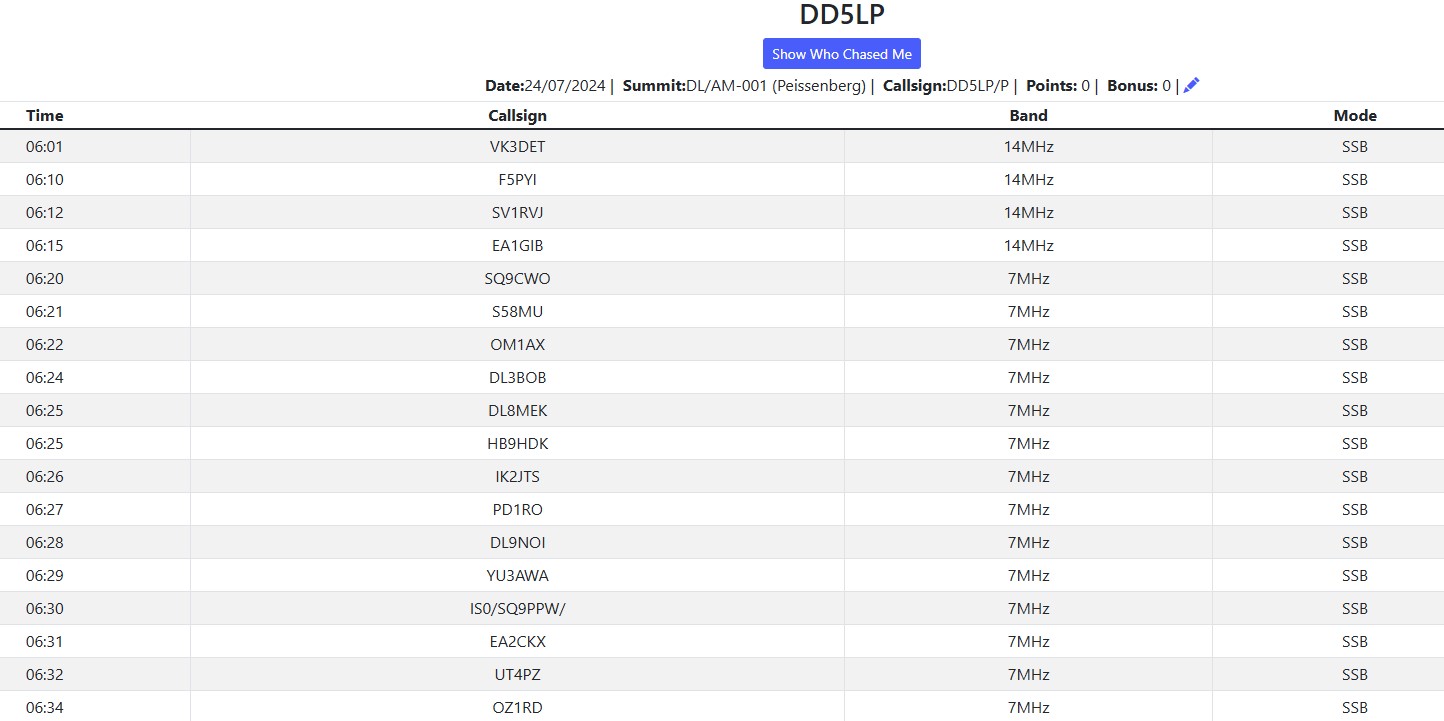
A quick tune of 20m showed a couple of US stations booming in. First in the log was Ernie VK3DET and we exchanged the same report on signal strength with Ernie running 100w, that seems a good start. It took a while to get the needed 4 contacts to qualify the summit. I put this down to the crowded part of the 20m band where I was operating. I could have moved to another frequency on 20 metres but rather I decided to change to 40 metres, as another test of the equipment. On 40 metres I had no problems finding the extra 6 contacts needed to qualify a POTA trail, indeed I had 18 contacts in 35 minutes and then, as the skies were darkening again, I decided to call it a day with the new combination of units working well together. Three further callers commented on the audio being a little difficult to read, so this confirmed what I already thought to be the case and that will get looked at while at home.

When I got home, I calculated that I had drained 2 Ah from the 8 Ah battery in just over 35 minutes so I will need to take a spare battery (or two) along for the (longer) ILLW activation next month.

Photos:

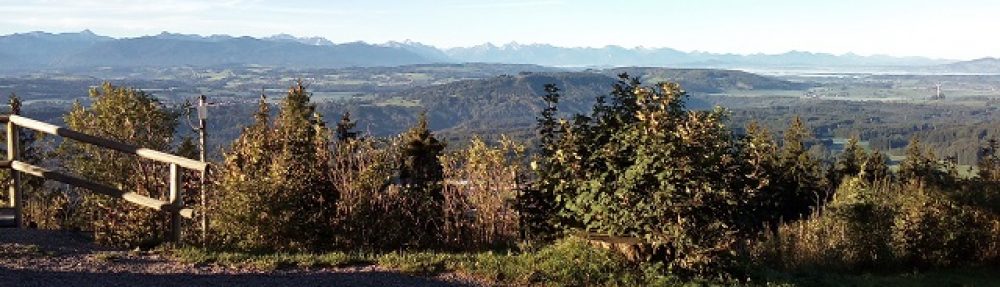
This slideshow requires JavaScript.

Equipment taken:

  • Xiegu G-106 radio.
  • DF4ZS Mini-RF-Clipper speech processor.
  • RM-Italy KL-203 P amplifier.
  • Switch LPF filters box.
  • ATU-100 tuner.
  • Aerial-59 OCF UL-404 dipole antenna.
  • Six metre mast.
  • Komunica Power HF-PRO2-PLUS-T loaded multiband vertical (not used).
  • 5-band linked dipole antenna (not used).
  • 8Ah LifePO4 battery.
  • 4Ah Eremit LifePO4 battery (not used).
  • 4 Ah 3S LiHV battery (not used).
  • Plastic painter’s sheet and seat pad.
  • Lightweight headphones.
  • Smartphone for spotting.

Logs:

POTA DE-0797 König Ludwig Weg.

SOTA DL/AM-001 Peißenberg

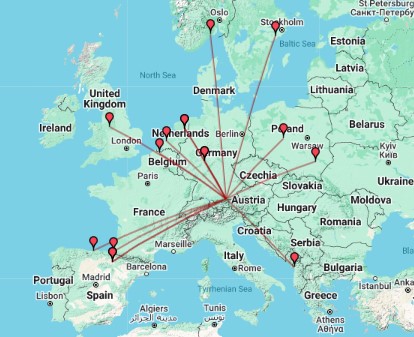
Contacts Map

Conclusions:

  • The activation went well, I was the first activator of this POTA trail, and the radio equipment performed well. The battery drain level will need to be watched at the higher power levels and the speech processor needs to be adjusted.

73 until the next activation!


DD5LP/P – July 10th 2024 – First ever activation of POTA DE-0791 Lech Erlebenis Weg Plus DE-0641 Via Romea Germanica & HEMA DL/HBY-040 Rosenau Kreuz.

Preparation:

I had submitted a preservation trail for POTA consideration while others exist in the system.  This one runs along the banks of the River Lech from Landsberg am Lech down to Fussen on the Austrian border. There are lots of beautiful spots along its length and the initial section from Landsberg runs through the POTA DE-0663 Possinger Au nature reserve further along its length, close to Schwangau, it goes over the HEMA DL/HBY-040 Rosenau Kreuz summit making it a location where points can be earned for both systems. In addition, another longer trail “Via Romea Germanica” also passes through this point and is in the POTA system as Trail DE-0641. Today I decided to combine both trails’ activation with a HEMA activation close to the Rosenau Cross summit on both trails.

The Activation

POTA DE-0791&0641 (2-FER) / HEMA DL/HBY-040

With the threat of bad weather later in the week (indeed it actually arrived later in the day), I decided to perform this first activation of the new POTA entity early in the morning, hoping to make some long-path contacts into Australia. So an early start was planned and I arrived on the summit/trail around 0600 UTC. I sent a quick message to Ernie VK3DET in Australia and he was the first into the log. After Ernie however, contacts were more difficult to find despite being spotted on both the HEMA and POTA systems.

The contacts eventually came however with five stations from Spain, one from Portugal. One from Serbia, a second from Australia (VK2) (a missed contact into VK4 would have made 3 contacts into VK however the VK4 station was battling local S8 noise so my 20 watts was not enough for him to hear me. He could tell I was there but not strong enough to work). An Italian and a French station rounded out the 11 contacts.

I would have stayed longer but as I could see black clouds approaching and more and more flying bugs had found me in their field, I decided to pack up and head home.

Photos:

This slideshow requires JavaScript.

Equipment taken:

  • Xiegu G-90 radio.
  • Seven metre mast.
  • Screw-in-ground mast base.
  • 2-element switchable direction, wire beam.
  • Komunica Power HF-PRO2-PLUS-T loaded multiband vertical (not used).
  • 5-band linked dipole antenna (not used).
  • 4Ah Eremit LifePO4 battery.
  • 4 Ah 3S LiHV battery (not used).
  • Plastic painter’s sheet and seat pad.
  • Lightweight headphones.
  • Smartphone for spotting.

Logs:

POTA DE-0791 Lech Erlebinis weg & DE-0641 Via Romea Germanica.

HEMA DL/HBY-040 Rosenau Kreuz

Conclusions:

  • The activation went fairly well although conditions were variable. It was good to be the first activator for another POTA entity (and a POTA 2-Fer as well!). I was hoping to take my 70-watt portable HF amplifier along to give a little more “UMPH” but it wasn’t ready – maybe next time.

73 until the next activation!

DD5LP/P – June 28th 2024 – First ever activation of POTA DE-0766 Seewald Landscape Reserve.

Preparation:

While preparing my trip to Ham Radio Friedrichshafen this year I saw a second POTA park defined in Friedrichshafen, other than the one I activated in 2023. As I normally activate both SOTA summits near “FN” when I am there, I decided instead to activate this new POTA and the closest SOTA location over the weekend. The weather forecast was for mixed sunny and rainy weather, so I could fit these activations in around the weather and the actions that I had planned at the HAM RADIO event. I added the location of one of the park’s car parking areas into my GPS in the car to simplify finding the location.

The Activation

POTA DE-0766

After arriving at Ham Radio and completing my first trip around the halls, I decided on a morning activation before lunch. The radio gear was already in the back of the car so it was a short 10 minute drive from HAM RADIO at the Neue Messe to this new park.  

I was hoping for a quick activation and operation from the car using a loaded vertical on a magnetic mount on the roof. The band of choice was 20m as higher bands had not been working well. Mode would be SSB as usual and with 20w from the G90 radio, I found a frequency and started calling and then spotted myself on the POTA spots list. The band was a little noisy atmospherically and as time went on, noisy from other stations. Add into this QSB and this was not the simplest of activations especially when in a rush. The chasers thankfully were there and after 11 contacts and when the QRM from a station that had fired up 1 KHz away from where I was got unbearable, I closed down, packed up and headed back to the show.

Photos:

This slideshow requires JavaScript.

Equipment taken:

  • Xiegu G-90 radio.
  • Three magnet car roof mount.
  • Komunica Power HF-PRO2-PLUS-T loaded multiband vertical.
  • 4Ah Eremit LifePO4 battery.
  • 4 Ah 3S LiHV battery (not used).
  • Plastic painters sheet and seat pad (not used).
  • Lightweight headphones.
  • Smartphone for spotting.

Log:

DE-0766 Seewald Landscape Reserve


Conclusions:

  • The activation went well for a rushed activation of a park. Initially, I was not sure if indeed I was the first to activate as one of the other 13,000 hams at the show could have activated first however as it turned out I was.
  • I would have preferred to have done a “proper” portable activation well inside the park however a PLOTA was all that was possible in the available time.

73 ’til the next activation!


DD5LP/P – April 16-19 2024 – Short Break to the Oberpfälz with POTA/HEMA/SOTA activations.

Preparation:

A short 3-night break with the family to the Oberpfälz region (in English Upper Plantine) of Bavaria near the Czech/German border brought the chance of some portable radio activations. The problem of planning ahead with this trip was the uncertainty of the weather with high winds rain and even snow forecast as possibilities, this was going to have to be, grab the activation when you can. Our base for the short stay was the medieval town of Nabburg between Regensburg and Weiden. The Oberpfälzerwald nature park covers a large area of land around our base and hence the likelihood would be that POTA DE-0017 would be activated at the same time as a HEMA or SOTA summit. Very near to the town was an unactivated HEMA summit Darlesberg and this would most likely be the summit in the park, dual activation. The only reasonable summit to take the family to was Fahrenberg (DM/BM-321) and this 8-point, drive-up summit is in the next POTA park northwards, DE-0024 Nordlicheroberpfälzerwald NP so this could be a combined SOTA/POTA activation. On the way to our holiday flat, my wife wanted to see an art exhibition in Regensburg, so this was planned to coincide with me activating the Donaupark which is within Regensburg city.

The equipment would be the 6m telescopic fishing pole, umbrella base and the 404-UL OCF dipole from Aerial-59. The reason not to use the usual linked dipole was the probably need for band changing given the variable radio conditions present. This set-up would be used for the summit activations and the Komunica HF-Pro2-Plus-T on a mag mount on the car roof for the POTA activation from the Regensburg park (or any others that might be needed/possible). 

The Activations

Tuesday 16th April – POTA DE-0376 DonauPark.

Apart from a delay finding my way to the parking area in this city park, the planned combination of dropping the wife off at the gallery, driving to the park, taking our dog for a walk, setting up the radio in the car, activating the park (10 contacts needed), closing down and packing away, taking the dog for her second walk and then going back to pick up my wife, went to plan and we were able to continue our journey on to our flat in Nabburg.

The activation itself brought in strong signals from around Europe on 20m but contacts number nine and ten took a little longer to get than the first eight which started me worrying a little that I would not manage the needed number of contacts in the time I had available. I tried 40 metres but with so many stations on that band, it was impossible to find a free frequency to call CQ on and when I did eventually find one, after calling CQ another station starting calling CQ without even asking if the frequency was free. It was a jungle of animals on 40 metres. Luckily I did manage to get the needed ten contacts on 20 metres. 10 metres was totally closed at the time.

Wednesday 17th April – POTA/SOTA DE-0024 NordlicherOberpfälzerWald NP / DM-BM-321 Fahrenberg.

As the first day proper of our holiday we had planned to split this between radio and visiting the town of Weiden about 5 km north of Nabburg and that’s what we did, We spent the showery morning in Weiden (well worth a look, especially in the large church there) and by midday, we were heading up to the Fahrenberg. Unfortunately, the restaurant was not open on Wednesdays but again, it has a nice baroque-style church that is worth a visit. Behind the church, there is a perfect grassed area to put the mast and dipole up on and while it was sunny when we got there we did not know how long that would last, so I quickly set up and got calling. An impressive 25 callers got into the log in 16 minutes when the calls dried up on 20 metres I considered switching to 40 metres but as I could see black clouds approaching, I thought better of it and packed up the equipment. Just as I lifted my rucksack to my shoulder the first few flakes of snow started to fall, so timing could not have been better.

As we drove off the snow stopped but it was clear rain at least was on the way.

A good day’s radio operating and sightseeing.

Thursday 18th April – HEMA DL/HBY-226 Darlesberg

This should have been the easiest of the activations. The parking spot I had found on the map was less than 10 minutes drive away from our flat and then it was about a 1.25 km walk up a forest track to a picnic area followed by a smaller walking track of about one kilometre to the summit.

Admittedly with this activation, I carry my rucksack laden with gear for the longest distance but despite that, I did not expect any problems. I arrived at the parking spot around 9 am local time, loaded up and started up the forestry vehicles-only track, the start was a little steeper than I had expected but then it got better. I kept following the main track until after about 45 minutes, it started to go downhill, which made no sense. Rather than take my rucksack off to check my printed-out paper map, I decided to use my smartphone to check how much further it would be to the picnic area. What I saw was that I was on the wrong track. I used Google Maps to start with but then switched to the Mapy.cz app for confirmation which, unfortunately, it gave. about 10 minutes earlier I should have taken another much smaller muddy track (which on the maps is shown as being of the same type as the one I was on – it isn’t). In fact, I was now level with the summit but about 60 metres below it. There was a track to go up through the bush to the summit from this point, but it was a boggy mess and with the steep climb that would have been needed, I decided it was not a good option to try in the drizzle in a remote location. If I slipped there would be no one coming by to help.

I then had to face the decision, of whether to go back and go up the correct track and then join the official walking track to the summit, as originally planned or to abort the attempt. By the time I got back to the junction, I would have walked as far as I would have needed for the complete walk to the summit and then would have to face probably another 30-minute walk. I decided to cancel. Had I been carrying less weight or if the ground had not been so soaked I may have made a different decision. I know now not to rely on my memory of a paper map in my rucksack and either to have it out to check junction by junction or as I did on the return walk to the car, follow my position on an online map.    

Friday 20th April – POTA DE-0017 OberpfälzerWald NP

As the previous day’s activation (which would have been a HEMA/POTA one) had to be aborted, I was still left with the POTA activation available to coincide with a break to our return journey home to allow the dog to have a walk and so it was decided that another car based POTA activation would be made near Steinberger See about 30 minutes drive away from the flat, So after packing all our luggage into the car again (which of course got in the way later when I wanted to get to the radio gear) we set off but unfortunately in this area of Germany, the GPS (navi) doesn’t always see enough satellites to navigate accurately. There is also a US forces training base nearby, so what signals they may be putting out could also be part of the problem for car-based Euro-GPS systems. In any case, we ended up near Wackersdorf (famous for anti-nuclear-power rallies in the 70s) and found a parking spot near some woodland which would serve the purpose needed. So with my wife taking the dog for a walk, I set to, finding the radio equipment mounting the antenna and calling for POTA hunters. The contacts took longer than I am used to with SOTA and again there was time pressure to get the needed ten contacts but as this was around 0715 UTC, long-path on 20m was open into VK and I managed a Park-to-Park contact with VK2USH, which while difficult, especially as it suffered heavy QRM from another station was completed.   

Photos:

POTA DE-0376 Donau Park

This slideshow requires JavaScript.

SOTA DM/BM-321 Fahrenberg / POTA DE-0024 NordlicherOberpfälzerWald NP

This slideshow requires JavaScript.

HEMA DL/HBY-226 Darlesberg (failed attempt)

This slideshow requires JavaScript.

POTA DE-0017 Oberpfälzerwald NP

This slideshow requires JavaScript.

Equipment taken:

  • MountainTop 40-litre rucksack.
  • Xiegu G90.
  • Komunica Power HF-Pro2-PLUS-T loaded vertical antenna. (used with magnetic mount for the first and last activations).
  • Three-magnet car roof antenna mount.
  • Lamdahalbe 6m mini-mast (used on 2nd activation).
  • Aerial-59 404-UL OCF dipole (used on 2nd activation).
  • 4 Ah LifePO4 Eremit battery.
  • 4.5 Ah LiHV battery (not used).
  • Painter’s thick plastic sheet and gardener’s kneeling pad.
  • Lightweight headphones.
  • Smartphone to spot and back-channel comms. 

Logs:

POTA DE-0376 Donau Park

POTA Contacts Map

POTA DE-0024 NordlicherOberPfälzerWald NP

POTA Contacts Map

SOTA DM/BM-321 Fahrenberg

SOTA Contacts map

POTA DE-0017 OberpfälzerWald NP

POTA Contacts Map

Conclusions:

  • The weather was a problem mainly on the third day, combined with the mis-navigation that was a “bad” day – lesson learned to use the Smartphone map/tracking app when attempting to activate a new summit.
  • The Xiegu G90 continues to work surprisingly well even when only using the Komunica Power HF-PRO-2-Plus-T on a mag mount on the car roof. That park-to-park contact with Australia was a highlight of the trip.

73 ’til the next summit/park.


DD5LP/P – April 11th 2024 – First ever activation of POTA DE-0663 Pössinger Au NP.

Preparation:

This was originally planned as a HEMA/SOTA activation to Berndorfer Buchet to try out the latest version of my 2 element portable wire beam however when the news came through that my application to have the local nature park added to the POTA system had been approved, there was a quick change of location, so that I could get to activate the new park first.

The purpose remained the same – to test the latest revision of the portable beam, for which I needed contacts from different directions so that I could see the effect of electrically switching the antenna between North, East, South and West. Rather than SOTA and HEMA chasers, I would rely upon POTA chasers. 

Pössinger Au runs south of the centre of the Medieval town of Landsberg am Lech down to the village of Pitzling along the eastern side of the River Lech. It contains an animal park with wild boar and deer, small lakes, lots of woodland walks and even an outdoor water playground. There are several car parks in the “Au” but this was not going to be a PLOTA (Parking Lots on the Air) activation, rather one a little way away from the car, so all equipment would need to be carried. For stability, I would take the surveyor’s tripod that I have which is very good to keep a mast stable and vertical but is an awkward and quite heavy thing to carry.

The Activation

POTA DE-0663

Being so close an early start was not needed as the drive was less than 10 minutes. Once parked, I unloaded and went to a spot where I could set up without blocking any of the trails. Unfortunately, this was a little down in a dip so some directions may well be impacted, however as this was to be an HF activation, the impact (I hoped) would be minimal.

As usual, I had arranged that Ernie VK3DET would be kindly listening for me and Mike 2E0YYY had also decided to head out to a local GMA summit, however as my main band was planned to be 20 metres the chances would be slim that I would hear Mike in the UK. 10 metres is no longer open from Central Europe as it has been for a few weeks.

The setup of the new board with its double cable (combined coax and DC power) on the top of my 7-metre mast, supported by the surveyor’s tripod went OK although I had to adjust the 4 elements (which also act as guy ropes) a few times to get the antenna right as the ground was not totally level.

First in the log, was, as usual, Ernie VK3DET and I could tell a slight difference in “electrically pointing” the beam due west for the long path compared to other directions. Mike had several other local UK hams lined up to talk to Ernie and as I could not hear Mike, I gave my apologies and went off to collect some more contacts to qualify the park.

This turned out to be a difficult task, despite spotting myself on the POTA cluster, I got very few calls. 20 metres was very busy and I suspect some other station was on the same frequency, that I had checked was free before spotting it, so I changed my frequency and re-spotted. Still nothing. I even tried 10 metres but it was dead and looking at PROPQUEST the MUF in Central Europe never got high enough for 10 metres to open. While on 10m however I tuned to the local beacon and tested antenna direction against it and it was very clear that all was working as it should with clearly the strongest signal when the antenna was pointing South – the direction where the beacon is. I even made a video of this test and will try to attach it here. After more calls on 20m I eventually got a call from IW9FFI which I was very grateful for. My signals were getting to Australia but it seems there were only a few European POTA chasers up so early in the day.

The beam was configured for 10 & 20m and I did not really want to take it down to put up a different antenna for 40m. So I decided to use the range of the internal ATU within the Xiegu G90 radio to match the 10/20m antenna. It would not be radiating a lot but after seeing S55G/P spotted in a Slovenian park (actually in three overlapping ones, SI-0073/72/93) I called him on 40m using the 20/10 beam and we managed a contact. This was still only my third contact of the day, so I still needed another 7 contacts to qualify the park. I persevered and even had a small run of contacts on 40m but then the last one took another 10 minutes that seemed like an eternity but with F8FSC in the log, that was the needed 10 contacts. After announcing “last call” and expecting the usual 2 or 3 late callers, there were none, so I started to pack up all the gear.

Once I had packed up and got back to the car I had a chance to look around at how beautiful this part of Bavaria is and ended up chatting to a local man for about 20 minutes before I could head home.

All in all, with a very cold 2°C start but later a little warmer with some sunny weather this was a successful test of the portable HF beam although, I now need to be able to deploy it without the tripod and indeed a smaller version of the feed point board is already being planned.

Photos:

This slideshow requires JavaScript.

Video of tests receiving local 10m beacon.

Video

Equipment taken:

  • Xiegu G-90 radio.
  • Portable HF 2 element, trapped wire beam for 20m & 10m) electrically switchable from ground between N, E, S and W.
  • Special coax and DC supply cable (10 metres long).
  • 4Ah Eremit LifePO4 battery.
  • 4 Ah 3S LiHV battery (not used).
  • Plastic painters sheet and seat pad.
  • Lightweight headphones.
  • Smartphone for spotting.

Log:

DE-0663 Pössinger Au

POTA Contacts Map

Conclusions:

  • The activation went well for a rushed “First activation” of a park. I was however surprised at the lack of callers on 20 metres while the band was busy with lots of QRM, the number of POTA callers was disappointing.
  • 10 metres sounds “wrong” on receive – it’s almost being pushed down by interference (perhaps from outside of the band). I have seen a similar situation on both the G106 and from home on the IC-7300, so I don’t think the G90 is faulty, just that 10m with no signals is a very quiet band.

73 ’til the next activation!


DD5LP/P – April 8th 2024 – POTA DE-0006 Augsburg Westlicher Wälder NP & HEMA DL/HBY-038 Staufenberg.

Preparation:

This was to be an activation to test out my “Ultra-light” kit. My Xiegu G106 radio and the SOTABeams Bandspringer long wire antenna as I have now added an external “Z-Match” manual ATU to the configuration. The antenna gets launched into a tree using a weighted bag and cord, so the complete station packs into a very small bag (about the size of a lady’s large handbag).

Radio conditions were all over the place so I wasn’t planning for any DX and while this was going to be a “family outing” with my wife and dog, I knew I would be restricted, however, I still packed the usual 40L rucksack with the G90 configuration in it, into the car as well, just in case the new configuration did not go as well as hoped. I could then hopefully qualify the park/summit having driven there.

The location chosen I had visited and activated before as a HEMA summit – DL/HBY-038 Staufenberg about 10 km west of Augsburg which itself is about 45 minutes to an hour’s drive away from our home. The summit overlooks the village of Bonstetten which has a wonderful, old restaurant in it, which is open on a Monday (many restaurants close on Monday & Tuesday here) and as the weather forecast was that Monday was likely to be the only dry day of the week, this fitted well. Since activating the (drive-up) summit last Autumn, I have started activating POTA parks and this summit was in the Park I could activate both schemes at the same time. POTA has almost as big a following as SOTA these days, so spotting on the POTA cluster pretty well guarantees enough contacts to qualify the Park (and Summit). Unlike the WWFF Park award scheme which requires 44 contacts, POTA only needs 10 (and HEMA only 4 of course).

The hope was to have the Ultra-portable configuration work “well enough” to use on the family short holiday in the Oberpfälz (Upper Platine in English) near the Bavaria/Czech border, the following week.

The Activation

POTA DE-0006 7 HEMA DL/HBY-038

The expected 45-50 minute drive was extended by the police stopping all traffic on the highway to pull out foreign trucks and check their loads and that the truck conforms to the regulations. This was STILL going on when we returned on the other side of the highway about 4 hours later, so this would have caused even bigger delays as the day went on. Of course, there was no warning of this happening in any of the radio road reports as the Police don’t want to tip off the truck drivers but I’m sure the word would have got out very quickly via their CB radio network or simply via some online social media platform.

As we had set off a little earlier than planned, this meant that I still got to the summit in the park at my alerted time of 0900 UTC (11 am local).

This summit is interesting in that as well as a small chapel, it also has the old American Forces Network (AFN) MW relay station for Augsburg on top of it. I’m not sure what it is now used for however the mast is still there and someone was working in the compound while we were there. Perhaps just keeping the grass under control?

From this summit, there are a few tracks off, that served well for my wife to take our dog on her morning walk, while I set up the antenna and radio. As I mentioned, I had brought along the SOTABeams Bandspringer end-fed antenna and a throw bag to get the antenna up into a tree. In fact, the design is for perhaps a quarter of the wire to head off from the location in the branches in an inverted L kind of configuration. The other half of the antenna, the counterpoise wire,  simply runs out over the ground. It was interesting that this wire was noticeably longer than the driven element.

Both wires have banana plugs on them which plug into a BNC adapter, which then goes directly into the ATU. In my case, this is a manually tuned Z-Match. I first tried to get a dip in the indicating LED in the ATU on 40 metres, both using the narrow and wide impedance settings of the ATU no dip could be found. I put out some CQs and spotted myself anyway and while I was receiving fine, I got no calls. I switched then to 20 metres where I could get a very slight dip in the LED light at the very end of the Tune and Load controls. I again spotted and called – no callers. I found another POTA activator who had a strong signal and tried calling him three times – nothing – and it was not a case of another station getting in first as he simply kept calling CQ. This antenna was simply not working. Which for SOTABeams is a surprise however I was surprised that it is supplied without the normal 9:1 UNUN for end-fed random wires.

Time was passing, so I decided to switch radios, leaving the same antenna up (as it had taken some time to get it up in the tree). I went back to the car and brought my Xiegu G90 and its battery, microphone, etc.  Connecting that up to the antenna and tuning, it took a lot longer than normal to find a match, but it did manage it (the G90 is known to have an in-built ATU with amazing capabilities). I found a free frequency on 20m and spotted and called again – now I had chasers calling me back and I received the needed 10 contacts to qualify the park (and the summit). No DX just calls from around Europe.

At this point, my wife and dog had been back for some time and were waiting for us to go for lunch in the village “Bonstetten” that this summit is above. So I packed everything up (the antenna, thankfully came down without any problems – often there can be problems with wire antennas jamming in trees) and we went for lunch to a lovely restaurant the “BräuStübel” in Bonstetten and then drove home at the end of what was a nice trip out and we may repeat later in the year.

 Photos:

This slideshow requires JavaScript.

Equipment taken:

  • Xiegu G-90 radio.
  • Xiegu G106 radio with Z-Match ATU
  • Komunica Power HF-Pro2 loaded vertical antenna with tripod (not used)
  • SOTABeams 60-10m Bandspringer long-wire antenna.
  • Linked dipole antenna and 6m Lambdahalbe mast (not used)
  • 4Ah & 2Ah Eremit LifePO4 batteries.
  • 4 Ah 3S LiHV battery and 3S 2.5Ah LiPO battery (not used).
  • Lightweight headphones.
  • Smartphone for spotting.

Log:

POTA DE-0006 Augsburg Westlicher Wälder NP

POTA Contacts Map

HEMA DL/HBY-038 Staufenberg

Conclusions:

  • The SOTABeams antenna needs the G90 ATU to work and the external manual Z-Match that I have added to the G106 is not as broad as the built-in one in the G90. I have bought a 9:1 UNU(N to add to the end-fed random wire from SOTABeams to see if that brings it into range for the Z-Match ATU.
  • It is always good to have backup options available and I will be taking the tried and tested G90 + dipole set-up on our holiday, even if I manage to get the BandSpringer to work with the G106 using a 9:1 UNUN.
  • Having the option to spot to a larger group of chasers, whether POTA or SOTA is very useful when the number of HEMA chasers available during a weekday is limited.

73 ’til the next activation!

UPDATE:

After writing the report above, I have indeed bought a cheap 9:1 UNUN from Amazon and by having this inline between the z-match manual ATU and the antenna, I can match the antenna to the radio on 60,40,20,15 &10m (I have not tried the WARC bands).

The UNUN was this one from Amazon:  ” https://www.amazon.de/dp/B0C3ZRXD2J

73 Ed.


DD5LP/P – March 3rd 2024 – POTA DE-0282 Forstenrieder State Forest.

Preparation:

This was to be a quick activation during a visit to Munich. It had to be fitted in between two short dig walks and so a park that I had previously researched in the outskirts of Munich fitted well. This would be another POTA activation from inside the car parked in a parking area within the park’s boundaries.

As such, the equipment was well defined – Komunica HF-PRO2-PLUS-T on my three magnet roof mount on top of the car and the Xiegu G90 as the radio. I wondered about trying for some DX on 10m but given the 40 minutes available for the activation, I decided to stick with 40 & 20 metres to make my minimum of 10 contacts.

The Activation

POTA DE-0282

The parking spot is just outside of Neuried with easy access into the forest.

Once I arrived I took Bonnie (the dog) for her first walk, down into the forest, and found a kindergarten in the forest. There was no one there as this was a Sunday but it seems this kindergarten has been set up where it is with the aim of educating young children about nature. After walking back to the car Bonnie happily hopped back into her area at the back of the car and now it was time for some radio!

The antenna was adjusted for 40 metres and then put on the roof and the radio was set up on the passenger’s seat. Immediately it was clear there was some kind of contest on as the band was FULL of stations and even picking odd “in-between”  frequency, the splatter was horrible from the obviously over-driven radios and amplifiers operating on the band. I found the best frequency I could, put out a spot on POTA and started calling CQ.

It was hard work, but after 10 minutes I had 5 contacts in the log but then the calls dried up. So it was time to switch to 20m where, again the contest was in full flow, however on 20m contesters are not supposed to operate above 14.300 MHz so I was able to find a spot between others who had moved this far up the band. After another spot on the POTA list, my first CQ brought back a pile-up of callers, who I worked through one by one, logging a total of a further 19 contacts in the next 20 minutes.

It was now time to pack the radio gear up, take Bonnie for her second walk in the other direction into the forest and then head to pick my wife up before heading home.

All in all, with nice sunny weather this was a good use of the time available and while I got no far DX, there were many good reports on 20m for the simple set-up from all around Europe.

 Photos:

This slideshow requires JavaScript.

Equipment taken:

  • Xiegu G-90 radio.
  • Komunica Power HF-Pro2 loaded vertical antenna with a three-magnet car roof mount base.
  • 4Ah Eremit LifePO4 battery.
  • 4 Ah 3S LiHV battery (not used).
  • Lightweight headphones.
  • Smartphone for spotting.

Log:

DE-0282 Forstenrieder State Forest


Conclusions:

  • I hate operating on a weekend because of the unnecessary QRM caused by “wanna-be” contesters. The main groups are fine, they do not over-drive audio or amplifiers, it’s the inexperience of newbies taking part that creates most problems as far as I have seen.
  • Forty metres was more of a battle than 20m and generally, I received better reports on 20m than on 40m, meaning (perhaps) that the antenna works better on 20m (where less loading coil is used) than on 40 metres.
  • Overall, however, I am happy with how well the (time-limited) activation went.

73 ’til the next activation!