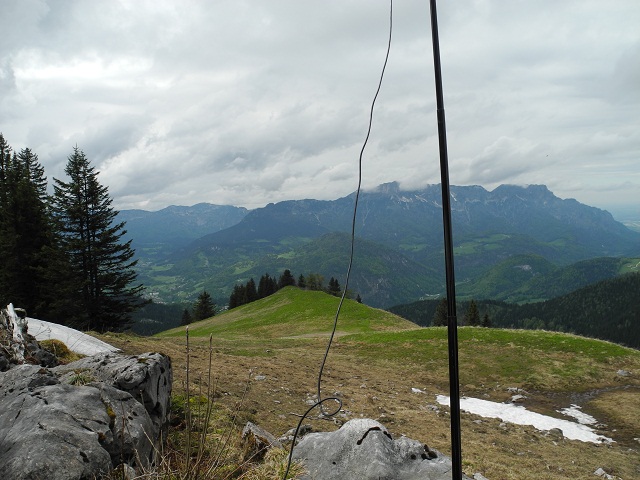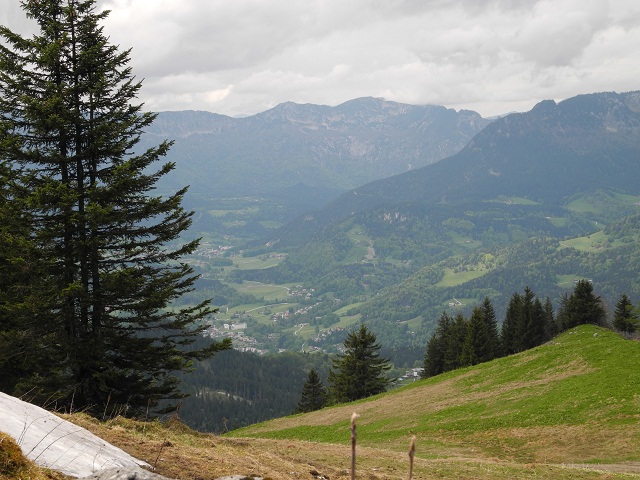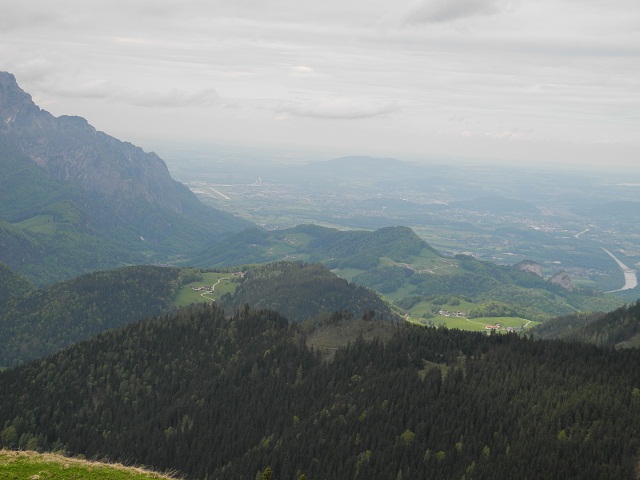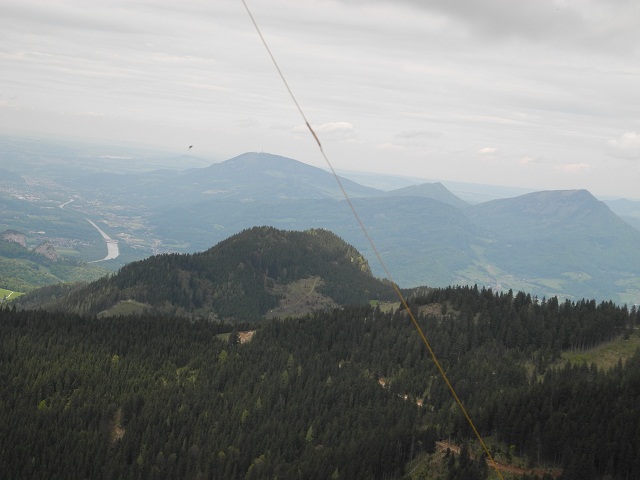
DD5LP – SOTA EUROPE – May 21st. 2014 – DL/BE-093 Buchberg

Preparation:

Having some time available and a good weather forecast, i wanted to get out and activate a summit again. If it could be close enough to where I live, I might even get some long path contacts back into Australia again..

I decided to take the standard equipment and stick to 20m SSB. So the FT817 (LIPO) battery was charged up, as was the 5Ah 3S LIPO that I use to run my small Ramsey amplifier, which I haven’t started my planned mods to, even though the parts arrived a couple of days before. Better to leave things working as they have been rather than change things with no fall back option!

The hill chosen is about an hours drive away and I had intended doing a “reccie” on the previous Sunday however I was quite ill that day and so I decided I would have to simply go by what I could see from Google maps and its satellite pictures.

The Location:

Buchberg is located not far away from Bad Tölz and across the road almost from the skilift up to the base of Zweisselberg, another SOTA summit that I would like to activate at some point.

The plotted route had me turning off the main B472 road on an unsignposted road and then running along the edge of a forest to the village of Buchberg and then taking one of several walking tracks to the summit. On looking at the layout, my fallback position would be to operate from within a forest just down from the summit as it is still within the AZ. DL-BE-093_Buchberg-map

The Activation:

 The morning started well with sunny weather and not too much traffic. Of course I drove past the un-signposted road off the B472. For others intending to activate this summit, the road is about 200m before the Gastehaus Wiessweber, which is just before the big lake (called Hinterstauau).

The road off the B472 is a single track road but with a proper surface. On getting to the point where I should turn off on the track along the edge of the forest, I was faced with a sign that said access is restricted to farm and forestry vehicles only.. Not wanting to get locked up for trespass, I started to look for an alternative route.

At this point the farmer from the farm across the road came along with his dogs and I decided to ask him if there was another route to Buchberg. He immediately said ignore the sign, everyone uses that road and it’s not private. On that basis I decided that rather than calling off the activation I’d risk it. The track was a little rough however no where near as bad as several tracks I have driven along with my low clearance Peugeot 308 in Australia and now I have a Ford Galaxy family van which has at least twice the road clearance that the Peugeot had.

At the end of the track I came into the village of Buchberg which is actually just a farm. On the other side was the track that runs half way up to the summit but it was clearly marked as no through road and it looked as if I would not be able to turn around when I got to the end of it.

I decided therefore to go to my backup position near the forest which was on the road going out of the other side of Buchberg. This turned out to be a narrow however properly surfaced road that I used when I completed the activation. It ran down the hill into Bad Tölz passing the Golf Course and Buchberg Clinic and the on the way. For future activators this would be the way to get to Buchberg if you don’t want to risk the forestry track. Take directions in Bad Tölz to the Buchberg Clinic and then after the clinic turn left (there is a sign to Buchberg on this junction) go past the golf club and keep on winding up the road for probably about 5 kilometers and you will arrive at Buchberg..

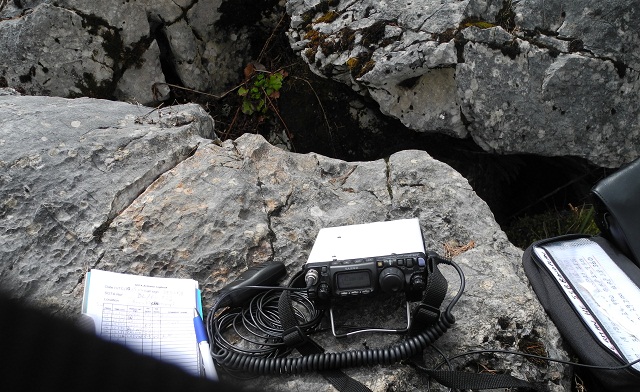
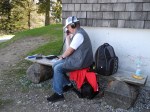
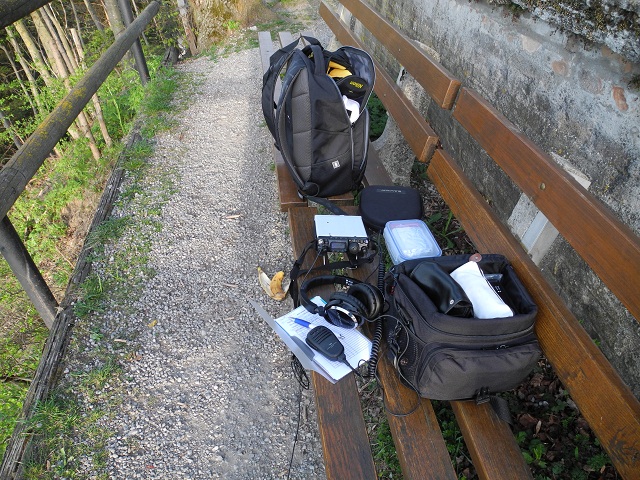
Back to the activation site. I parked up off the road near the forest and looked around for somewhere to set-up. I could not find anywhere that looked like I could fasten the squiddy to and have the antenna clear of the trees without being definitely on a farmers land or right next to the (narrow) road. I then looked up to the summit itself to see a large wooden cross that the squiddy should be able to be strapped to without any great effort. So that was the choice, no secondary option, i would activate from the very summit. Given the cross being there and the footpaths listed to it on  the maps, this “should” be public access. I walked up the side of the field and across the top to the summit (you should never walk directly across a farmers field as you can damage the crop, whereas the edge of a field is often considered waste land). On arriving at the summit I found there was even a bench to sit on – LUXURY!

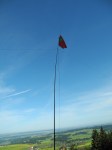
So I started to set up all the equipment as usual, trying to angle the antenna to allows a NW/SE radiation towards VK long path. Just down from the summit and not visible until you get to the summit is another farm / residence and after a while I got a visit asking what I was doing by a gentleman from this farm. After a few minutes discussion he was happy I wasn’t going to damage or steal the cross and so all was OK.

Now at last, time to start the activation….

I started on 20m trying to call some OE activators who were already on the air but I simply could not get through the pile ups. Even after one chaser kindly told one of the stations that they had a summit-to-summit call, they still could not hear me. With the mixture or QRM and deep QSB that was the story of this activation. I did manage one S2S contact into Spain but most other activators simply could not hear me. Later I found out that they were all running 100W RF while I was down in the noise with my 5-8W.

I called a couple of times specifically for VK chasers with no success however looking at all of the chasers I did work around Europe, I shouldn’t complain. Apart from the S2S into Spain, the other highlights were contacts with The Azores and Denmark, Norway & Sweden. The full log is shown below.

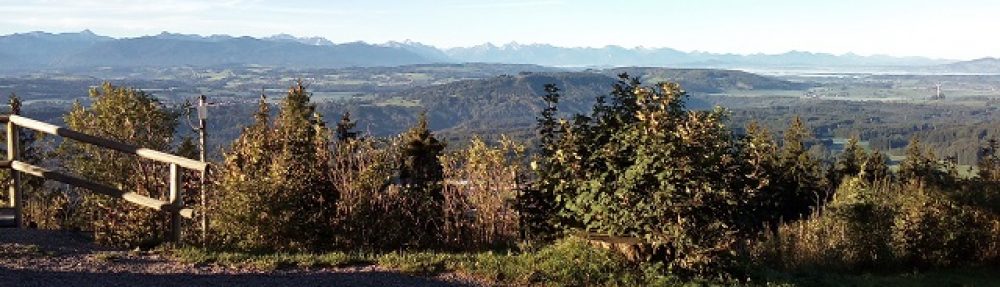
The real success of this activation was getting out in the fresh air and again enjoying some unbelievable  views. I have put together a gallery of some of the best views below.

This slideshow requires JavaScript.

Equipment:

FT817ND

Ramsey QAMP amplifier

SOTABeams Linked dipole

Log:
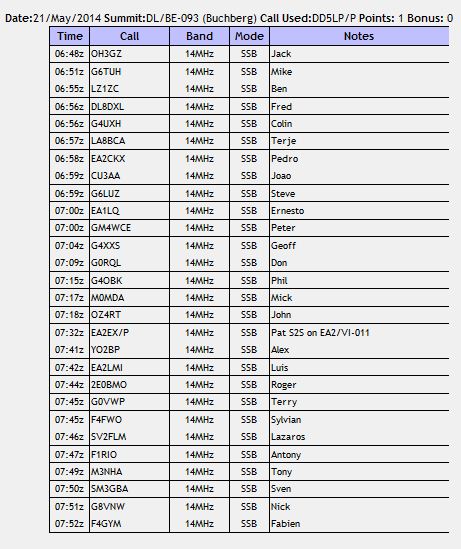
DL-BE-093_Buchberg-log

Conclusions:

A good activation. it would have been better if I had managed a long path conrtact back into VK but with the band conditions, that just wasn’t going to happen. I think the next time I try this however I will start earlier which would at least avoid some of the heavy QRM from such a busy band. Perhaps next time I will have a 17m antenna made up so that I can switch to that (quieter) band.Unfortunately many of the VK chasers can’t operate on the WARC bands, so maybe 15m as well would be a good idea.

73 ’til the next Summit!

DD5LP – SOTA EUROPE – May 10th. 2014 – DL/BG-023 Ahornbüchsenkopf

Preparation:

Saturday the 10th. of May was the first (forecast) dry day for over a week at the Ahornbüchsenkopf summit so I deceided to go ahead with this activation that had been canceled the previous weekend due to an extreme weather warning.

The activation was combined with a visit to a friend who then accompanied my wife and I to the Ahornkaser restaurant, which lies about 60 meters below the SOTA summit.

The fact that a visit to a friend and the 2.5 hour drive to get to the area from where I am living meant the start time of the activation was set at 2:30pm local, we were also limited in how long I could stay on the summit by the expected autobahn traffic levels on the return home. I had hoped for 90 minutes on the summit but this turned out not to be possible.

The Location:

The Ahornkaser restaurant that would form my “base camp” lies about 60 meters below the Ahornbüchsenkopf summit and is the highest road-accessible restaurant in Bavaria.

The Ahornkaser lies just off the “Rossfeld Panorama Strasse” not far from Berchtesgaden in SW Baravia.The road, which runs along the German / Austrian border, rises to 1570m at its highest point, just past the turn off for the Ahornkaser restaurant.

Tourist-map

The Activation:

 The morning did not start well with overcast weather on the way down but by 11am the sun had broken through and the temperature risen somewhat.

 On getting to the bottom of the ~ 60m summit climb at just before 2pm, I found the ground to be waterlogged. Parts could only be described as a bog. The week of heavy rain that the region received over the preceding week had obviously taken its toll. This made the climb / walk more time consuming as I had to work my way around the worst spots. The track to the top was not visible at this stage however as I got higher, at about 15-20 vertical metres from the top, the track was there but like the ground around it, it was under half a metre of melting snow. The snow would not support my weight so I found some rocks at the snow line and used that as my base, setting up antenna and rig as best I could. I would have like to have got to the summit and use the convenient table and seating bank however it was not safe to proceed any further.

As I sat, perched on my rock on the side of this mountain and looked out I realised how high up I was and how far I could see into Austria and back into Germany. I hoped that the fact that I could only manage to get the centre of the inverted-V dipole up to about 3.5m above ground instead of the usual 5m would not be such a problem given the location. What I could also see were some storms forming on neighbouring mountains, so no time to lose and it was nearly my advertised time to be on-air in any case.

I started on 20m and while there were the usual strong European stations, I could not hear any DX. I was hoping to make some short path contacts back into Australia as I had managed long path contacts on previous activations from lower summits. I found a free frequency and started calling CQ-SOTA and spotted myself on SOTAWatch using RRT at the same time. Cell phone coverage should be good in the area however my phone had the problem that it kept switching between the German & Austrian mobile phone cells and kept sending me SMS warnings about roaming charges. In any case when I stopped calling, there was Don G0RQL from Devon in England booming in as usual. Contacts with a few other European stations followed (see log below) but when I saw a Norwegian activator spotted on SOTAWatch I went after him and succeeded in making an S2S contact. Apparently there were several European SOTA activators out but they were on either different bands and mode than I could run or they were simply not active when I was.

 After the S-2-S contact I worked a couple more stations on 20m before trying 40m. At this point the mobile phone cells were even more difficult to access than before, making it very difficult for me to self-spot. I put out CQs for about 15 minutes with no responses, before light rain started at about 3pm local time. As I could see the storm coming towards me this was not a shower that would pass and indeed after I had packed up and carefully picked my way back down the mountain slope to the restaurant, a heavy storm came through.

DSCN1799-640 DSCN1800-640 DSCN1801-640 DSCN1802-640 DSCN1803-640 DSCN1805-640

Equipment:

FT817ND

SOTABeams Linked dipole

Log:

SOTA-Activators-logConclusions:

Not the best activation. A lot of work for being operational only half an hour. Activating later in the year when the snow had gone and later in the afternoon would have probably been better for propagation. But those views! even with the clouds, the views were fantastic, definitely more than the photos can show. Perhaps I’ll activate this summit again in 2015?

73 ’til the next Summit!

DD5LP – SOTA EUROPE – April 25th. 2014 – DL/AL-169 Auerberg.

Preparation:

As April 25th. was ANZAC day in Australia, it is a public holiday, so there may be some activators out and it is also one of only 3 days in the year when the AX prefix for Australia can be used instead of the usual VK prefix.

The plan for this activation was again to work chasers from VK and if possible also work Rod VK2LAX/P as a Summit-to-Summit contact. Martin DF3MC unfortunately had to work (as it is not a public holiday in Germany) and so could not make this activation either, maybe the next one.

Wx forecast – Sunny and fine.

Wx previous day – fine.

Wx forecast for following days – rain.

Actual Wx -sunshine but cool in the shaded area where I positioned myself.

Stats:

Total contacts: 44

Summit to Summit Contacts: 2 (both with Australia)

Contacts with VK/AX stations: 6

Total contacts 20m: 15

Total contacts 40m: 29

Time on Summit: 1.5 Hrs.

The Location:

Auerberg has easy road access with very little walking required. This is similar in some ways to Peissenberg with a church located on the absolute summit and a restaurant / cafe located next door. As my wife (who offered to come along) had twisted and badly bruised her ankle a couple of days previously, a summit with a lot of walking was out of the question.

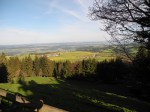
Unlike the previous two summits that I activated, this summit has wonderful views for 360 degrees around it. The drive was just over an hour and I was set up and operational by 9am local (0700 UTC). This is a later start than my previous activations as I wanted to see how long the long path window to VK from DL was and indeed after about forty minutes the window closed and no more DX contacts were possible.

map

The Activation:

 This beautiful location of course attracts the public, but being a Friday morning, before lunchtime very little was happening. Around 11am a lot of motorcyclists and some more cars arrived, but by this time I was packed up and enjoying a warm drink at the cafe before we left. All in all a successful activation however band conditions on 20m were not nearly as good as the previous Sunday (they were exceptional that day). Once I switched from 20m to 40m, I was flooded with calls – a good pile-up for about 25 minutes. Remembering this was a Friday when many people are at work, I suspect an activation of a summit on a weekend could be quite a thrill.

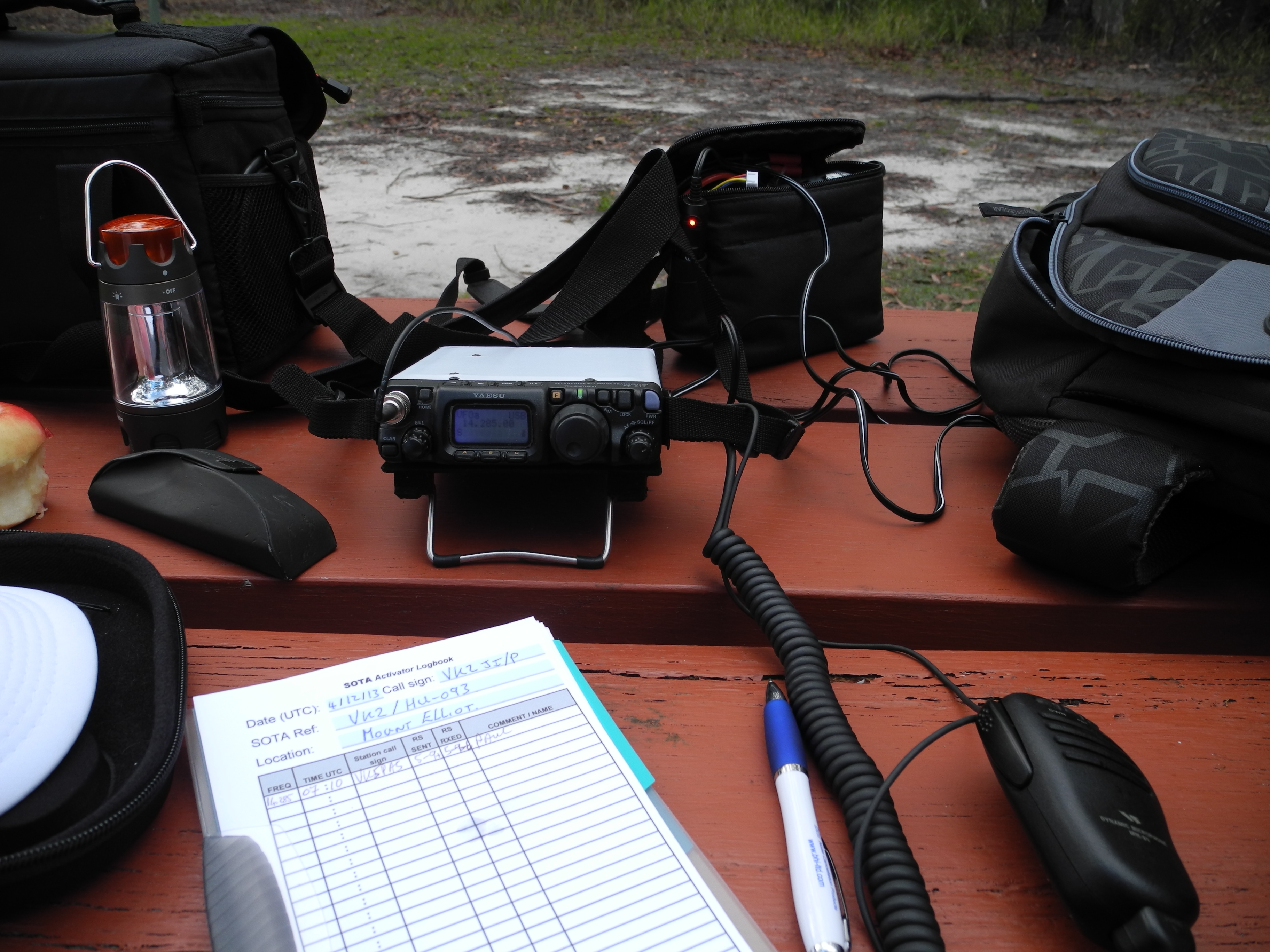
I am also glad to report that my first contact was with Rod – AX2LAX/P a S-2-S contact as Rod had gone out to Mount Elliot (VK2/HU-093) to make some more chaser points. One more s-2-S and chaser contacts were made into VK all with more difficulty than during the activation the previous Sunday.

During the activation I was again faced with the situation where a station came up on frequency while I was using it. This time however I did not move frequency but rather kept calling and after two extremely strong Spanish and Italian stations called me for the SOTA contact the Eastern European stations (Rumania?) decided THEY should move. So a win for the little guy with the help of some high power chasers – thanks guys!

Equipment:

FT817ND

Ramsey QRP amp.

SOTABeams Linked dipole

Log:

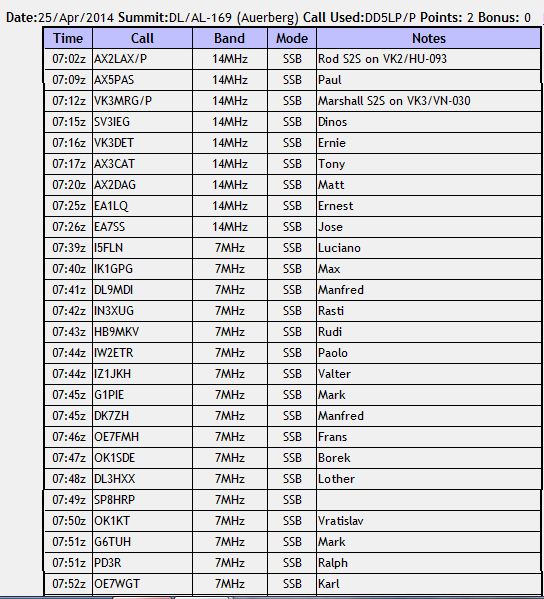
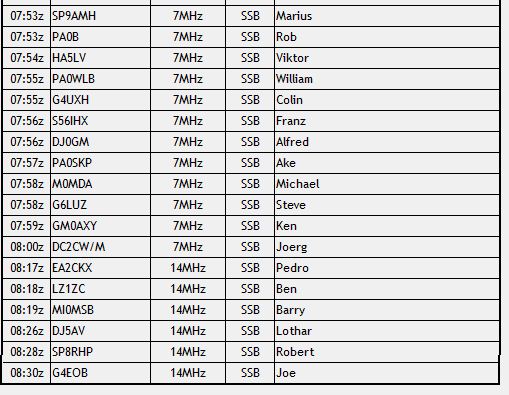
log-1-of-2 log-2-of-2

73 ’til the next Summit!

DL/VK2JI – SOTA Europe – April 20th. 2014 – DL/BE-094 Irschenhausen

Preparation:

As my German call sign came through, this activation was done as DD5LP/P. This was the first time I had used my new call sign.

The plan for this activation was again to work chasers from VK and if possible also work Rod VK2LAX/P as a Summit-to-Summit contact. Martin DF3MC had asked if he could come along as he had not yet managed an S2S to VK. Unfortunately as it turned out he could not make Easter Sunday, so perhaps I’ll have to find another summit in the next few weeks and do it all again (not that I needed an excuse for that).

Wx forecast – RAIN!

Wx previous day SNOW!

Actual Wx – no rain, sunshine but still only 2 degrees at 7:30am local time Brrrrrr!

Stats:

Summit activated (first 4 contacts) completely with VK calls (2 of these S2S).

4 x S2S (3 VK and 1 GM).

8 VK contacts.

22 contacts in all from VK1,2,3&5, KA3, EH1, YO7&8, YL2, EA1&2, LA, OH, LZ1, GM and G.

The Location:

Irschenhausen is a country village located about 10 km South East of Starnberg which itself is located about 20km South West of Munich in Bavaria. The “summit” is actually a hill within a forest adjacent to the village. In some ways similar to my previous activation (Berndorfer Buchet) which was also in a forest, views are limited. I found during my “reccie” a day earlier however in this case there were small trees still in place suitable to fasten the antenna squid pole to. Access from the public road is about a 15 minute brisk walk up reasonable tracks. No actual climbing was required however the summit itself was under about 3 inches of fallen leaves. Luckily I found a very broad tree stump to set up my station on and had the antenna (proudly flying the SOTA flag) attached to a small tree about 3 metres away.

DSCN1703-640 DSCN1706-640 DSCN1709-640 DSCN1712-640 DSCN1715-640 DSCN1722-640

The Activation:

I had measured the time required to get to site however as I woke up earlier and there was less traffic than the previous day, I arrived a good 30 minutes earlier than the planned UTC 06:00 start.

I took a little extra time to install my small linear amplifier in circuit as a test and I estimate that this raised the output from 5w PEP to perhaps 10w PEP. I had to run it straight from an 11v LIPO rather than from the 13.8v inverter that for some reason didn’t seem to want to work, so output from it’s, at best 14w output would be reduced.

As soon as I had the linked dipole antenna up and the FT817 and amplifier turned on, I could hear VK stations. Paul VK5PAS was blasting in while working Peter VK3PF, so I waited and gave Peter a call. He was pretty weak but we managed the S2S contact. After that an easy contact with Paul VK5PAS, followed by Matt VK1MA who also was putting in a strong signal from Mount Ginini and the forth contact needed for me to have officially activated the summit came from Ernie VK3DET. So I managed to activate this German summit purely with VK contacts – this was not planned but was a nice bonus especially with two of them being S2S contacts.

I am also glad to report that we managed the DD5LP – VK2LAX S-2-S contact.

During the activation I was constantly changing frequencies, not only to find stations but also to move away from QRM from either adjacent stations or a station who decided to put a carrier on the frequency I am calling on!

 Take a listen to the pile-up that Matt VK1MA had in the video below and see how badly some operators were operating.

Please consider adopting the DX Code of conduct whether you are a SOTA activator or chaser as the rules are as valid for SOTA as for DX chasing.

DXcochttp://www.dx-code.org/


In conclusion though the activation was very successful and as always an activation is only successful when there are chasers there looking out for you!

Video:


Log:

Activator Log

Activator Log

73 ’til the next Summit!

DL/VK2JI – SOTA Europe – April 10th. 2014 – DL/AM-180 Berndorfer Buchet

Convenient parking just down the road from the start of the track.

Convenient parking just down the road from the start of the track.

DSCN1666-640

Animal feeding point just before final climb.

For my second SOTA activation after moving to Germany, I decided on a very local summit (only 20 mins drive from where we are staying). Berndorfer Buchet (DL/AM-180) is a small hill in a forest between the Ammersee and Starnbergersee lakes about 30 km SSW of Munich in Bavaria.

I had managed a quick “reccie” the preceding Sunday and access was reasonably straight forward with about a 10minute walk from the road (the track is forestry services only) and then a steep climb of about 5 minutes to reach the summit. Being a forest, one issue I realised was that there were very few small trees where I could strap the “squiddy” pole. Most trees were very tall meaning the dipole wires would be touching the wood (not a good idea).

Initially I planned the activation for Tuesday the 8th. of April however as the weather forecast was not good for Tuesday or Wednesday, I decided to go with Thursday again, when a beautiful, sunny, dry day was forecast…..

Although I have a small amplifier that works well on 40m and helps a little on 20m, for simplicity, I decided to run just the FT-817 with the internal 2200maH LIPO, which I used on Peissenberg the week before.

So all was charged up and packed ready by Wednesday evening. When I woke up on Thursday expecting a nice sunny morning the sky was grey and it had rained overnight. Not deterred as it wasn’t “actually” raining I set off as planned.

On reaching Berndorfer Buchet, it was still grey and cold, but no rain although the track and especially the climb up the hill (now carrying several kilos of gear), was slippery so it took a little longer to ascend than on Sunday.

Climb up to summit - lots of slippery leaves!
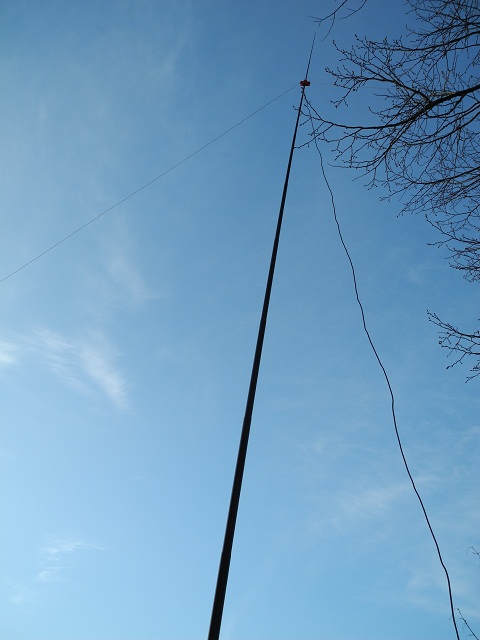
Climb up to summit – lots of slippery leaves!

I had found just one small tree on my Sunday and checking around I concluded this one was the only option. Unfortunately this small tree had several branches and twigs at a height I could not reach but blocked the direction that I wanted to run the dipole in. In trying to get the dipole wire over some of these branches, I managed to get the antenna stuck and in trying to clear it, the wire broke. I then still had part of the dipole stuck and one final tug resulted in the wire coming down but also me catching and scrubbing skin off my fingers on the side of the tree. Not a good start to the activation!

After applying some plasters and stripping and winding together the broken wire, I had a second go at getting the antenna up. On the basis that any antenna is better than no antenna, I decided to run the antenna at a slightly lower height, so as to miss most of the branches.

Station set-up.

Station set-up.

The start of the activation at 07:00 UTC was not encouraging, despite the band being full of stations (several very strong indeed) I could not get a contact. I thought perhaps the antenna was now faulty (even though I checked the SWR after the temporary fix and all seemed OK), I was happy to get my first call from RV3DSA – Serg near Moscow in Russia. It did take a while to even get the minimum 4 contacts to qualify the summit as being activated and get the 1 activator point. After several self spots on SOTAWatch and moving frequency when other stations simply started transmitting on the frequency I had been calling on for several minutes, I did start to get a few calls and the final log looked like this:

RV3DSA   EA1LQ   LZ1ZC   VK3DET   EA2BSB    MW3PZO   EA7PY   SV2OXS   F4FWO

(Ernie VK3DET was a good 5-7 signal but I know he had to really fight the QRM and QSB to make the contact – Thanks Ernie).

By UTC 08:00 the (20m) band had closed and as I finished the contact with F4FWO, the rain started, so I decided to call it a day.

What did I learn from this activation?

  1. It appears the best window from long patch EU-VK contacts at the moment is 06:00-08:00 UTC.

  2. Don’t pull so hard on the antenna if it gets stuck in the branches.

  3. More power is needed, 5W is really on the border line for contacts, 20W is more likely to get through.

  4. The LIPO battery installation within the FT-817 works very well.

On returning home my new German Amateur Radio licence (which I had applied for just two days earlier) was in the post box. So from now on the activations will take place as DD5LP – a reciprocal call that I had 20 years ago ! DD calls are usually only allocated to clubs nowadays, but as I had had it previously and it was not taken, I was re-issued it.

73 until the next activation.

DL/VK2JI – SOTA Europe – 3rd. April 2014 – DL/AM-001 Peissenberg

Now that I have moved back to Europe from Australia, I did not want to lose contact with my friends in Australia, especially those involved with SOTA. My main station is still en-route from Australia however I carried my SOTA kit with me on the plane, so I have at least some equipment available to try to get contacts back to VK-land. I am presently in rented accommodation, so setting up antennas here could be an issue, so why not from a summit.

Rod VK2LAX and I planned this first 2014 European SOTA activation for me, but I was confused with the correct time as based on the times I know we have had good contacts into Germany from New South Wales, Australia, was around dusk & sunset in Australia and I thought dawn in Germany. But this simply does not tie up with the Grey Line map – according to that at dawn in Germany, contacts should be possible into the US but not into VK. I later got confirmation of my suspicions that the contacts EU-VK were long path not the short-path indicated by the grey-line prediction websites. In any case, Rod and I decided to “give it a go”.

Given that dawn in Bavaria is at 7am local (UTC 05:00) currently, I was up at 5am to be able to get ready, drive the 45 minute journey, walk to the peak and set-up before sunrise. I was on the air at 04:45 UTC, it was still VERY cold and there were very few stations around on 20m. I wondered whether my rig was working or whether some damage had occurred  in transit. Then I heard W1AW/3 in Pennsylvania USA, gave him a call – he got  part of my complex call sign (DL/VK2JI/P) but then went back to another station. A second attempt about 10 minutes later “bagged” this special call and more importantly proved the FT817 (5w SSB running from the internal LIPO battery) and the SOTABeams linked inverted-V dipole was indeed still working. Actually working very well.

The first 45minutes of operation was patchy with contacts being spaced out quite a lot but as I crossed 05:30 UTC things got a lot better with contacts around Europe and Scandinavia as well as contacts back into VK2, 3 & 5. As 9am local (UTC 0700) approached activities died down again and after putting out a couple of CQs with no response a couple of UK stations called to keep me company. Thinking that conditions had died and since more walkers were appearing at the summit, I decided to close down and pack up. I later found that this had just been a dip in conditions and the following hour would have been better than the previous one. This appears to show that hours 1-3 after sunrise appear to be the best time for long distance contacts, so my next activation will be planned for 06:00-08:00 UTC rather than 05:00 – 07:00 UTC.

Here is the log of stations worked:

DL-AM001_activator_log


Here are some photos of this beautiful summit, like many summits in Bavaria, a Barock style church has been built on the summit.

DSCN1649-640

DL/VK2JI/P station set-up on handy benches.

DSCN1652-640

The 20m Inverted-V antenna atop the 6m “squiddy””.

DSCN1651-640

View from Peissesnberg to the South.

DSCN1654-640

Barock Church at Peissesnberg.

DSCN1663-640

View from Peissesnberg to the North.

VK2JI – SOTA in VK2 – 9th. March 2014 VK2 /CT-043 (Mt.Tomah), CT-012 (Glowworm Tunnel Road) & CT-007 (Mt. Lambie).

Last SOTA actvation in VK for VK2JI.

Preparation:

As I was to leave Australia permanently on March 14th. I managed to convince Rod VK2LAX to do a 3 summit activation before I left (I had already sold the Peugeot 308, and the fact that Rod has a 4WD makes the activations more likely to be successful in any case).

Originally this exercise had been planned for the preceding weekend however abysmal weather meant that we postponed. During the week up to the 9th. the weather forecast changed daily however on the day, the weather was perfect, dry, mid twenties and a slight breeze.

Two of the planned summits I had already activated in 2013, so I knew what to expect. The first (Mount Tomah) suffers badly from RF noise from the radio relay towers,so I was eager to try a different location within the activation zone. I am glad to report, this worked out well. The second summit (CT-012), I also wanted to try a different spot as the summit location indicated in the ARM and so in SOTA Maps is in fact below where the actual summit is and we managed to locate ourselves this time at the actual summit.

The third summit, Mt. Lambie, I had not activated before and was somewhat worried that we might find we could not access the site, having driven to about 20 kilometres  from Bathhurst (i.e. a long way from Sydney and even further from the NSW Central Coast). Access turned out to be easy with a reasonable, publicly accessible track with just two gates to open and close to keep the cows in. This has to be one of the most accessible 8 point SOTA summits anywhere!

VK2/CT-043 Mount Tomah.

DSCN1591As stated above, Mt Tomah at the summit has a radio tower that emits a high level of noise on the HF bands. So the intention this trip was to find a location as far away from the radio towers as possible while still being within the activation zone. Mapping the 25m vertical drop area, showed that the AZ goes right up to the main “Bells Line of Road” road and indeed a little way on the other side. This puts the “Mt Tomah rest area” nicely within the AZ and it provides some concrete shelters and tables to set up at. As this location is on the edge of the AZ, a few steps down into the bushes (the land drops off quite steeply) takes you out of the AZ.

I am glad to report this new location does not suffer any RF noise from the radio tower and only minimal electrical noise from passing traffic.

In this location we set up Rods FT857D and his new 10m squiddy with my SOTABeams linked dipole so that we could operate 40m and 30m.

VK2/CT-012 Glowwurm Tunnel Road (Newnes Plateau)

ct-012_contoursAs can be seen from the contour map, the location of CT-012 is not shown as on the actual summit, so we decided to carry on up the road a little until we actually got to the top and then set up a little away from the car and the track, which was lucky as there turned out to be a lot of motorbikes out on the day, racing along glowwurm tunnel road. This time we set up the QRP station, just running 5w from my FT817 and again the SOTABeams linked dipole. With the lower power, we got as expected lower signal reports however we made many good contacts from this location. Given the nature of this plateau, there is no practical way to walk out of the AZ and back in, so in this case we followed the MT guidance of ensuring we were well away from the vehicle, gaining no possible support of any kind from it.

VK2/CT-007 Mount Lambie.

DSC_0072Mount Lambie is about 20km from Bathurst, so not a “local summit” however a really good (and simple) 8 point, summit to activate. Access is from the Great Western Highway up Bonaventure road, two gates to open and close, making sure not to release the cows into the next field. This is public access all the way to the top. The AZ coincides roughly with the last (second) gate.

As this was our last activation of the day and the furthest from home, we were eager to get on air and bag the needed contacts. The mast was first planned to be fastened to the side of the trig point but this turned out not to be practical and instead a small tree was found to serve as support. Being someway away from the trees the ends of the strings on the ends of the SOTABeams linked dipole were held in place by putting one of the many stones in the area on them. Again lots of good contacts. If anyone is staying in this area, this summit would be great for early evening DX SOTA contacts into Europe but as we had a 3.5hr+ trip home it was not possible for us.

Equipment

(CT-043 & CT-007) Yaesu FT857ND transceiver (running at 100W output)

(CT-012) Yaesu FT817ND transceiver (5W output)

(all three locations) SOTABeams linked dipole in Inverted-V format on a 10m squid pole

Stations worked from Mt. Tomah (VK2/CT-043):

VK2LAX

40m

VK2IB/3
VK2FMIA/P
VK2GAZ

Post UTC Rollover

VK2YK

VK2IO
VK2DDS
VK1MDC
VK2IB/3
VK2YK
VK1MA
VK3PF
VK2UH
VK2DAG
VK3CAT
VK2AFW
VK3ERW/P
VK3FD
VK5WG
VK2KTT
VK2IO

VK2JI

30m

VK2KTT Paul
VK3BQ Andrew
VK3AFW Ron
VK3DET Ernie
VK3JM Fred
VK3WRL Ben
VK5AV Tim
VK4OZY Dave.

40m

VK2IB/P3 Bernard S2S on VK3/VE-169 Once before and once after UTC rollover.

Stations worked from Glowwurm Tunnel Road (VK2/CT-012):

VK2LAX

40m

VK2FGJW/P
VK2IB/3
VK1MA
VK2YK
VK1DA/P
VK1NAM

VK2JI

40m

VK2FGJW/P Greg S2S on VK2/CT-056

VK2IB/P3 Bernard S2S on VK3/VE-192

VK3BHR Phil
VK1DA/P Andrew S2S on VK1/AC-035
VK2ZRD Rod
VK2KTT Paul
VK2DAG Matt

30m

VK3AFW Ron
VK3CAT Tony
VK3PF Peter

Stations worked from Mt. Lambie (VK2/CT-007):

VK2LAX:

40m

VK1MA
VK3FQSO
VK2DDS
VK1DI
VK2YK
VK3PF
VK3BHR
VK2FMIA/P
VK2DAG
VK1NAM
VK2NNN
VK3CAT
VK3AFW
VK2PEP
VK2KTT
VK2AET
VK2CCT

20m

VK5NIG/P
VK5STU
VK8GM

VK2JI

40m

VK4SD/P2 Danny
VK2AET Scott
VK2PEP Bob
VK2NNN Darren
VK3BHR Phil
VK3CAT Tony
VK2ZRD Rod

20m

VK3AFW Ron
VK5WG Nev
VK3AMB Bernard
VK4OZY Dave
VK5NIG & VK5STU Nigel & Stewart both S2S on VK5/SE-005
VK8GM Greg

VK2JI – SOTA in VK2 – 2nd. February 2014 Activation of VK2/HU-080 (Summit Point) and VK2/HU-054 (Broken Back Ridge).

Preparation:

I have already activated Summit Point in December (see report on this site – which also contains directions on how to get to Summit Point) however Rod VK2LAX, who was activating again with me this time, had not and also as we are now in a new calendar year, I can claim another activator point be re-activating the summit.

VK2/HU-080 Summit Point.

S-Point-800

Sculpture rock at base of Summit Point.

This summit is a relatively close location only about 1 hours drive from home and access roads while a little rough are reasonable. So an easy summit to get to? Well not completely – the climb up the very steep and slippery due to many years of leaves and other undergrowth, hill with heavy gear packs on made it quite a climb for both of us. OK, I admit it – I’m not fit, and CRIKEY do I know it when trying a climb like this. Anyway we both arrived safely on the top of Summit point and after about 5

minutes and some good long drinks of water, we were ready to set-up.

Rod had brought along his new 10m Squid Pole, which when collapsed was not much longer than my (short) 6m version. This is a new item available from SOTABeams or DXWire and well worth a look. Although I had all of my equipment with me, we used Rod’s FT857D, 10m Squiddy and SOTABeams linked dipole on both activations. This enabled us to run 30w output rather than the usual 5w from my FT-817.

We were all set up are ready to go well before UTC roll-over and work many stations on 40 and 20 metres (see list at end of this article).

After completing this activation and working all stations who called, we had and even more difficult job getting back down the hillside back to the car, but it was managed with only minor scrapes.

Broken Back Ridge – VK2/HU-054

Microwave relay towers on Broken Back Ridge.

Microwave towers on Broken Back Ridge.

I had previously tried to get to Broken Back Ridge but thought better of it when I was about 25% of the way up the access track in my low ground clearance 2WD car and it was getting dark. I now know that was the right decision as in Rod’s 4WD, the rest of the track from where I turned around last time got worse to drive. Of course in a 4WD it took about the same time to drive the complete track as it had taken me to get a quarter of the way up it.

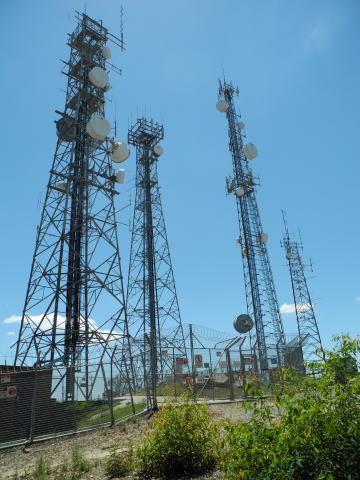
Once we arrived at the summit we were in the company of 5 microwave relay station towers of varying height and some great views, as you will see from the video.

We arrived around 03:00 UTC, walked down out of the AZ and back in and set up in the shade. Contact from here were more difficult to get, possibly due to the time of day, the interference from the towers or perhaps as we weren’t able to get the antenna as high or as straight as we would have liked. There was a fresh breeze as otherwise this may have been a really uncomfortable activation. Operators in other states were suffering an awful lot more than we were with the heat however. Unlike Summit Point, we managed no Summit-to-Summit contacts from Broken Back Ridge. One VK4 activator we had hoped for that had been spotted several times as we drove up the tracks had unfortunately packed up by the time we got set-up.

All in all however this was a very enjoyable day with Rod’s new 10m Squid pole being very much the star of the show – the higher you can get an antenna the better it seems to work.

Video

Equipment

Yaesu FT857ND transceiver (running at 30W output)

SOTABeams linked dipole in Inverted-V format on a 10m squid pole

Stations worked from Summit Point pre UTC Rollover (all on 40m):

By Rod VK2LAX

VK2JNG/P Gerard
VK2FGJW/P Greg S2S on VK2/CT-042
VK3FPSR Peter
VK2DI Ian
VK3PF Peter
VK1NAM Andrew
VK2CCW/P Mike
VK5TX/P Ben S2S on VK2/NW-006

By Ed VK2JI

VK2FGJW/P Greg S2S on VK2/CT-042
VK3EK Rob
VK2CCW/P Mike
VK5TX/P Ben S2S on VK2/NW-006

Stations worked from Summit Point on 40m and 20m post UTC Rollover:

By Rod VK2LAX

VK5TX/P Ben S2S on VK2/NW-006 (40m)
VK2FGJW/P Greg S2S on VK2/CT-042 (40m)
VK3FPSR Peter (40m)
VK1NAM Andrew (40m)

VK2AXL Jack (40m)

VK2JNG/P Gerard (40m)
VK5NIG/P Nigel S2S on VK5/SE-013 (40m)
VK5WG Nev (20m)
VK6MB Mike (20m)

By Ed VK2JI

VK5TX/P Ben S2S on VK2/NW-006 (40m)
VK2FGJW/P Greg S2S on VK2/CT-042 (40m)
VK5NIG/P Nigel S2S on VK5/SE-013 (40m)
VK1MDC Mark (40m)

Stations worked from Broken Back Ridge on 20m & 40m:

By Rod VK2LAX

VK2DAG Matt (40m)
VK2YK Adam (40m)
VK1NAM Andrew (40m)
VK3BHR Phil (40m)
VK2FGJW/P Greg (40m)
VK2FADV Jim (40m)
VK5CV Ian (20m)
VK3AMB Bernard (20m)
VK4TWS Bill (20m)
VK3AFW Ron (20m)
VK3YAR Raymond (20m)
VK4OZY Dave (20m)
VK5NIG Nigel (20m)

By Ed VK2JI

VK2JNG/P Gerard (40m)
VK2DAG Matt (40m)
VK3FPSR Peter (40m)
VK3SSB Ash (20m)
VK3CAT Tony (20m)
VK5WG Nev (20m)
VK3PF Peter (20m)

VK2JI – SOTA in VK2 – 21st. December – Activation of VK2/HU-080 (Summit Point)

Preparation:

This was an activation of a new summit for me. At the same time, I wanted to try to operate the digital PSK31 mode from the summit and use my new QRP amplifier to lift the FT817’s maximum 5w output to about 18w.

The access to Summit point is along Mount Sugerloaf Road from just outside of Seahampton. This is a normal small tarmac road and easy to drive right up to the Sugarloaf Mountain transmitter towers. Just before reaching the towers I needed to take a left turn onto Sugarloaf Range Road. This is a mud track but is fairly well maintained and easy to drive with a normal 2WD car as long you watch out for the occasional pot holes. 3.9 km down this road we come to the road up to the actual summit. This is less well maintained, very rutted and pot holes are the smallest concern as some sharp high rocks in the middle of the road means that a lot of care is needed to travel this road and not destroy your car. A high clearance 2WD or 4WD vehicle would be more suited to this track however this is not nearly as bad as the Broken Back Road that I tried to navigate a couple of weeks earlier up to HU-068 (Broken Back Range) and had to turn back. For one thing this road to Summit Point was only a couple of kilometres long. Simply follow this road until it stops rising and look to the left where there is an area to park and the rock with carvings – as shown in the video below.

S-Point-800

From here it is a steep climb on foot, on a slippery surface as there are lots of twigs and dead undergrowth meaning it is difficult the get a good foot hold while climbing and even more “tricky” on the way back down. Once I reached the top, there is a fairly wide flattish level with many trees suitable for attaching antenna to. I had arrived here about 30 minutes ahead of schedule however once I had everything set up I had lost 15 minutes of that advantage. I was on-air on 7.090 at 23:30 UTC (UTC day 20/12/2013 still) and managed to work 10 stations both before and 10 after UTC rollover (list below), all but two of these were on 40m SSB, the last two being on 30m SSB. Band conditions were not good with very deep QSB at times.

As I said above, one of the purposes for this activation was to test out my solid state linear to give a little more output for more distant contacts. Initially I thought it was actually causing me to lose signal strength on receive but this turned out to be two things – the delay in the RF sensing relay from switching back over and the conditions. Once I could make some “with and without” tests with the linear, it appears that on average I gain 2 S-points with the linear in circuit over not having it in circuit. So worth having and I need to look at fixing the relay delay. The other thing I wanted to try (and was unsuccessful with) was using a digital mode (PSK31) from the summit. Normally to do this you need a PC an interface and the rig, which is impractical to carry up a summit. I have the DROIDPSK software (from Wolphi plc) installed on my Android phone and his very small WolphiLink interface box to connect to the FT-817. The main problem I hit was that I could not clearly see the phone’s screen in the sunlight to be able to adjust it to receive signals. I believe I was transmitting PSK correctly but when I received signals back they appeared to be off frequency in the audio pass band and I could not see the screen to tune them in. I also need to practice more using PSK from home, so that I know more of the ins and outs of how it is supposed to work. Perhaps next time I try this on a summit, I will take my 7 inch Android tablet so that the program screen is more readable however the suggestion from Ron to take along a cardboard box to shield the screen (be it on a phone or a tablet) seems like a good idea also.

All in all not a bad mornings activation and with all such outings I have learned more things that I need to look into before I get that illusive “perfect” set-up.

Video

Equipment

Yaesu FT817ND transceiver (5W) Ramsey Electronics QAMP40 (18W) WolphiLink, DROIDPSK and Android 4 smart phone.

SOTABeams linked dipole in Inverted-V format on a 6m squid pole

Stations worked on 40m pre UTC Rollover:

VK2JDS Dave
VK3VBI Ron
VK1MDC Mark
VK2WG John (VK2YW operating the Wagga club station)
VK2IO Gerard
VK3FPSR Peter
VK2PHP/P Phil
VK2UH Andrew
VK5WG
VK3BYD

Stations worked on 40m post UTC Rollover:

VK2DDS Brenton
VK1MDC Mark
VK3FPSR Peter
VK4TSB Stewart
VK1RX Al
VK2FJPR John
VK2UH Andrew
VK1NAM Andrew

Stations worked on 30m:

VK3AFW Ron

VK3CAT Tony

VK2JI – SOTA in VK2 – 4th. December – Evening activation of VK2/HU-093 (Mt. Elliot) for EU chasers & S2S

Preparation:

This activation was in response to a request from Klaus DF2GN for a DM – VK Summit to Summit (S2S) contact.

I arrived on-site a little earlier than planned which allowed me to walk down and back up the trail (to meet the access on foot into the AZ zone ARM guideline) and set up and be operational 15 minutes early at 07:15 UTC. I did not stay as long as originally planned due to a plague of strange looking flies swarming around me despite the liberal use of insect repellant but the evening was a success. I regret not packing up 10 minutes later however as I might have managed a second S2S with GM4COX but I’m happy with my S2S with Klaus DF2GN portable on DM/BW-195, which was the main reason for the trip. I also worked another German chaser and eight VK chasers. I had hoped to have my “qrp” amplifier fully working to boost the FT817’s 5w output but it was not to be and while I had it with me, the unreliability of its operation at present, made me decide to work just with the FT-817 “barefoot”. They also say, don’t make two changes at the same time and I have made another change to my set-up. While looking for some parts last week, I came across a project that I built (or to be more accurate, boxed) some time ago. It is a 150W battery booster. Fed with anything above about 10V it can output anything up to 35V DC using it’s inverter. I had set this to output 13.8V previously and now decided to try using it with my 3S (11V) LiPo battery and what do you know – it works perfectly. I have an alarm on the LiPo to sense if any cell is dropping below a safe level and in the 1.5 hrs of operation all went well. I have found no interference from the inverter in the DC voltage booster. Perhaps this is a solution for others who are looking to use 3S LiPos to supply rigs (or amplifiers) that prefer a 13.8V supply. The booster and 2 x 5000maH LiPo batteries fit easily in a Jaycar SLAB battery bag with room to spare for cables sensors etc.

booster

In case anyone is interested in the DC-DC convertor – it cost me AU$7.98 including postage – the same item is now available for $5-$6. A whole list of them can be found on eBay here.

My apologies to the stations, both chasers and activators who came on a little after I packed up, but the flies were getting really unbearable!

Pictures:

 000220131204 000320131204
 

Video

The audio pickup of received sound is not so good……

Equipment

Yaesu FT817ND transceiver (5W)

SOTABeams linked dipole in Inverted-V format on a 6m squid pole

Stations worked on 20m:

VK5PAS Paul
DF2GN/P (S2S) Klaus on DM/BW-195
DJ5AV Mike
VK3AMB Bernard
VK3CAT Tony
VK1NAM Andrew
VK2IO Gerard
VK1DI Ian

Stations worked on 40m:

VK2AXL Jack.

VK3PF/QRP Peter.