As part of a holiday trip to the Freiburg area of Germany, on the French border, I planned an activation of Schauinsland, which is in both the SOTA and HEMA award schemes as a valid summit and also in the Parks on the Air POTA scheme as the summit sits within the Southern Black Forest National Park.
For equipment, I decided upon the usual G90 plus 6m mast and linked dipole antenna with tripod and HF-PRO2 as backup, all in my 40L rucksack.
The ActivationTuesday, 19th August 2025
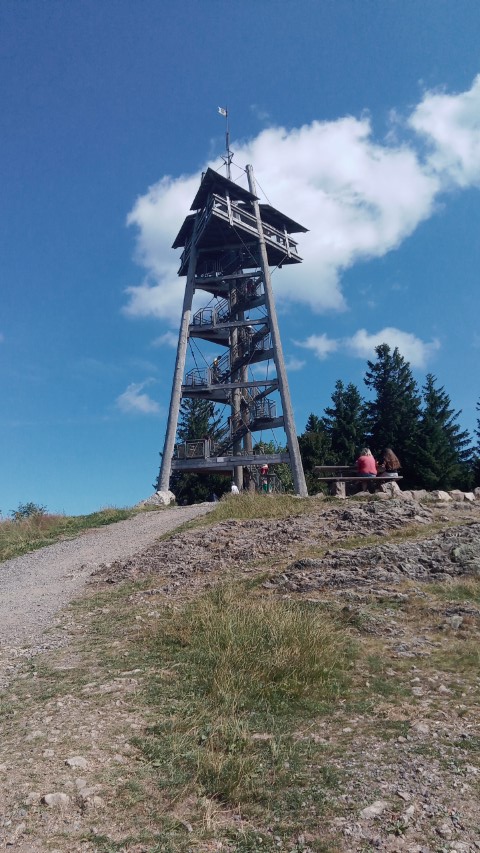
This summit is relatively easy to access with a road up to the restaurant and then a short climb up to the actual summit, which has an observation platform on top of it. Access is via a well-marked walking track, and while not wheelchair-friendly, there were some mothers pushing baby seats up the track.
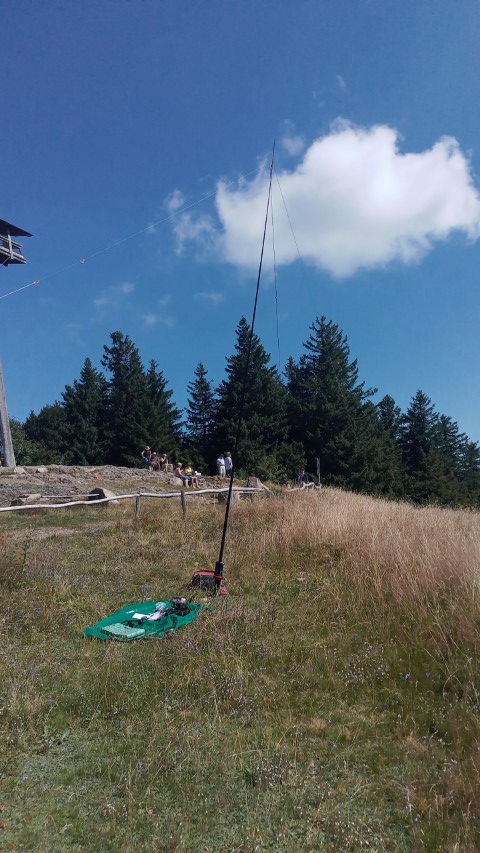
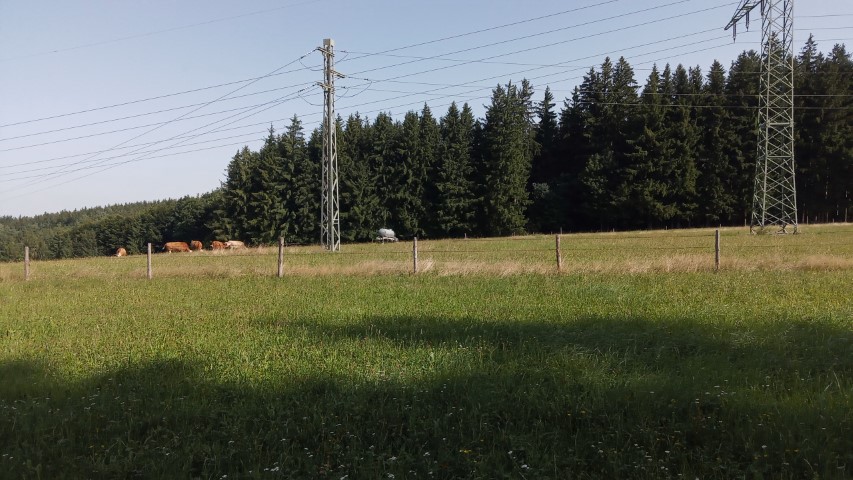
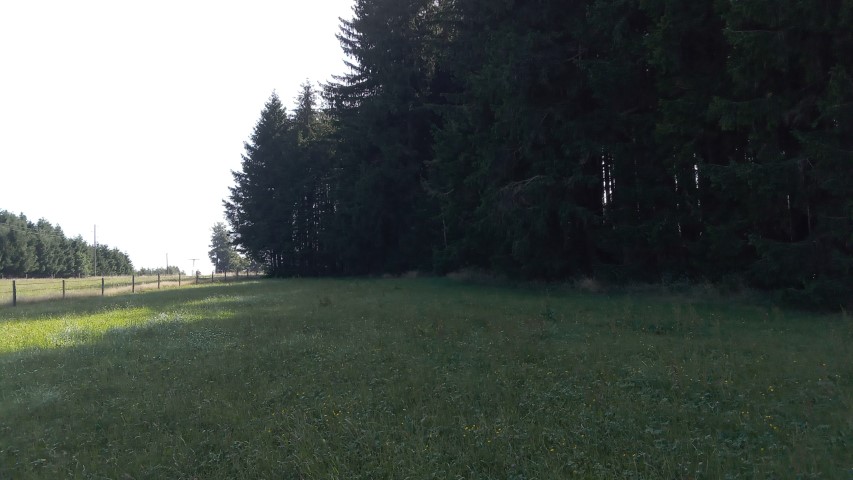
Upon arrival, the area directly around the observation tower was unsuitable due to the large number of tourists arriving and departing. Luckily, the adjacent field was relatively easy to access and gave enough space while keeping the public behind a wire fence.
Apart from a worrying warning about ticks, the location seemed perfect and I was set up in about 20 minutes, while the temperatures were not too bad (I applied sunscreen, however, as this location was in direct sunlight and the temperatures rose quickly as it was already nearly noon. I was glad, later that I had).
The bands were still a little noisy from a recent CME, and at this time of day, 20m is already dead, so I decided to stick to 40 metres to get enough contacts to qualify the park (10). I ended up with 16 contacts over 20 minutes, most of which, I believe, were SOTA chasers. There were summit-to-summit contacts. I had intended to stay longer, but after that 16th contact with Bernd, DL2DXA, the antenna’s VSWR shot up to an extent that the radio reduced output power. At that time, I suspected a bad connection on one of the links, but I could not see anything obvious and would not be able to fault-find to any level on the simmit. In these 20 minutes, the temperatures had shot up and even the radio was too hot to touch, so it was time to close down, pack up and head back down to the restaurant where my wife was waiting.
I was also unable to look at the antenna in our accommodation, so the Komunica Power HF-PRO2 loaded vertical would be the antenna in use for any further activations. Once home after our vacation, I tested the antenna for any DC breaks, and while I found nothing, I set the antenna up in the garden and put my antenna analyser on it – it showed an SWR between 8 and 10 to 1 across the whole HF spectrum. Something was definitely wrong. My presumption at this point was that with the excessive heat, the QRP balun may have failed, and so I took this out of circuit (it’s not essential when running low power to a centre-fed dipole). After doing this, I once again did a DC check on the antenna, and while I had connectivity to all the links, I also had a short between the outer and inner of the coax cable! It may be that the Balun was OK after all, but it’ll stay out of circuit for now. I then inspected the inside of the PL259 plug, and while there was nothing obvious, resetting the cable and re-testing removed the fault, and I could not make it recur. So now, I took the antenna back outside for testing on the analyser and now that 8 or 10:1 VSWR was 1.0:1 at 7.1MHz with the antenna set to 40m. Fault found and resolved.
Photos:
Route up to summit.
Route up to summit.
The observation Tower on the summit.
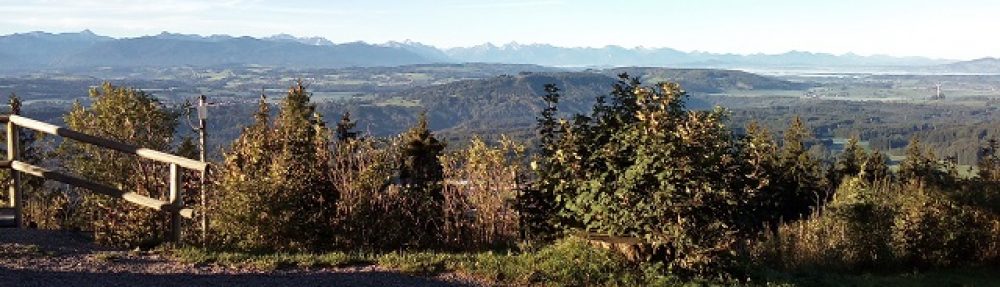
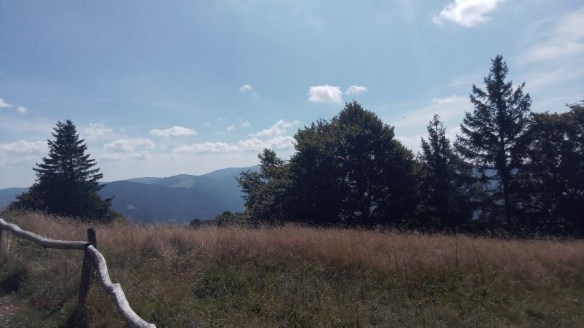
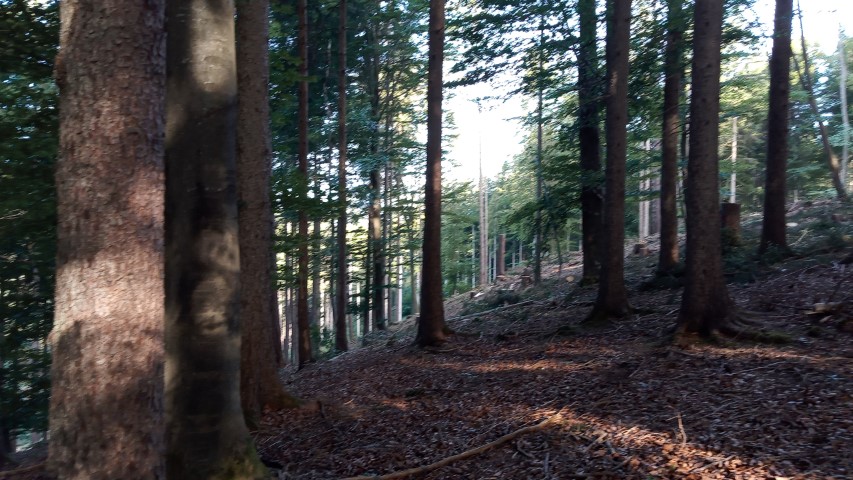
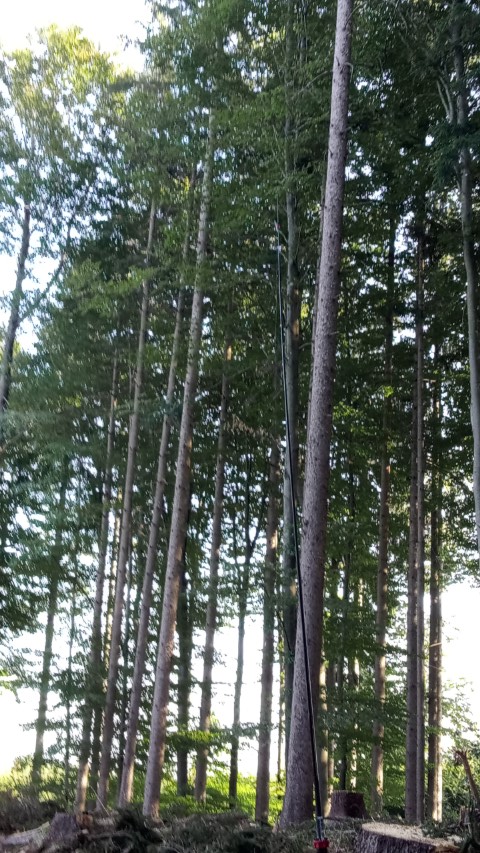
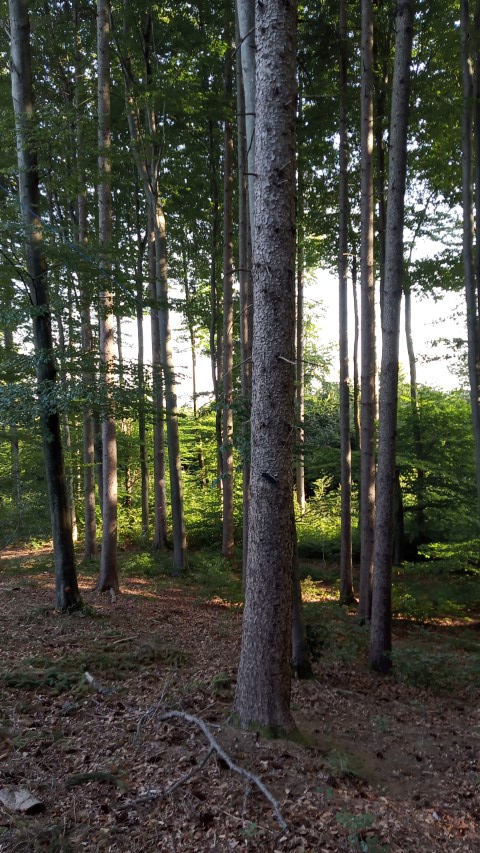
View around the summit.
View around the summit.
View around the summit.
View around the summit.
View around the summit.
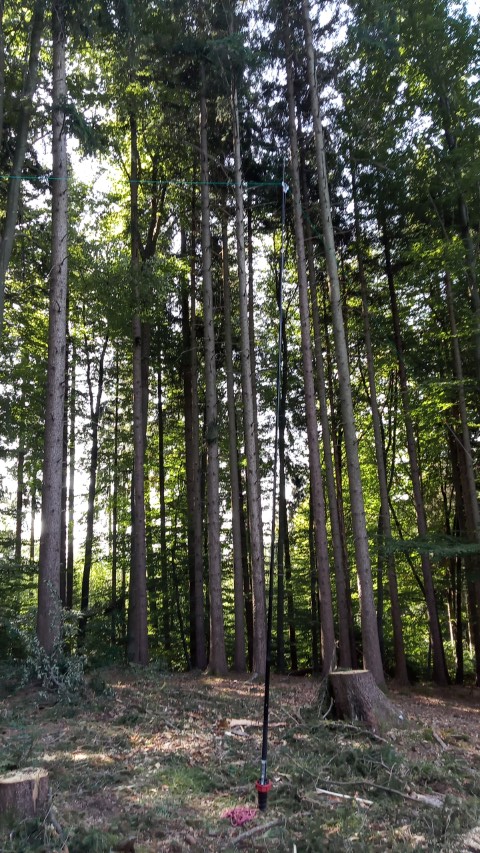
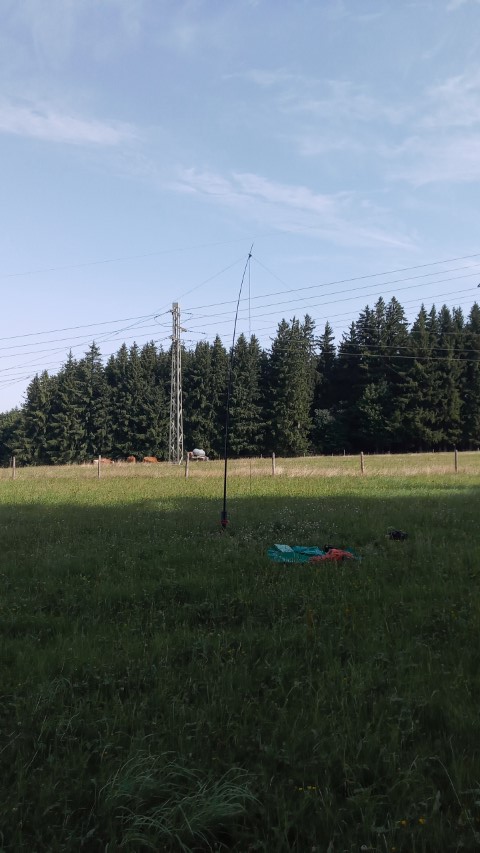
Antenna.
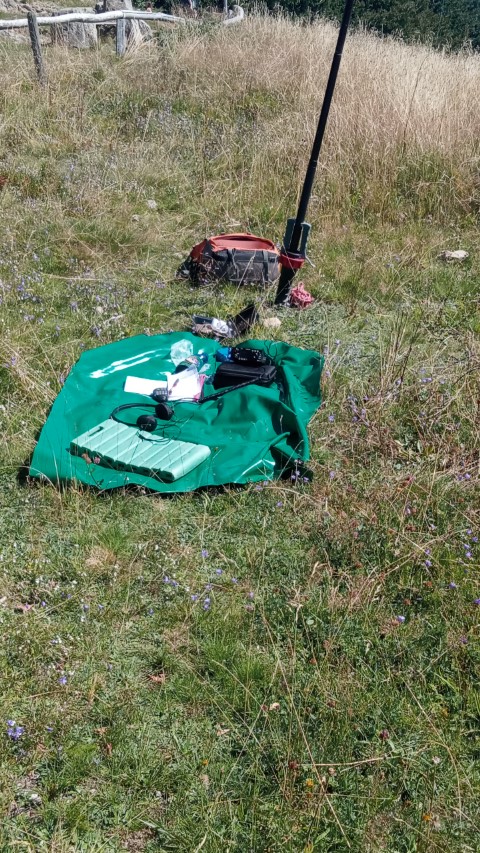
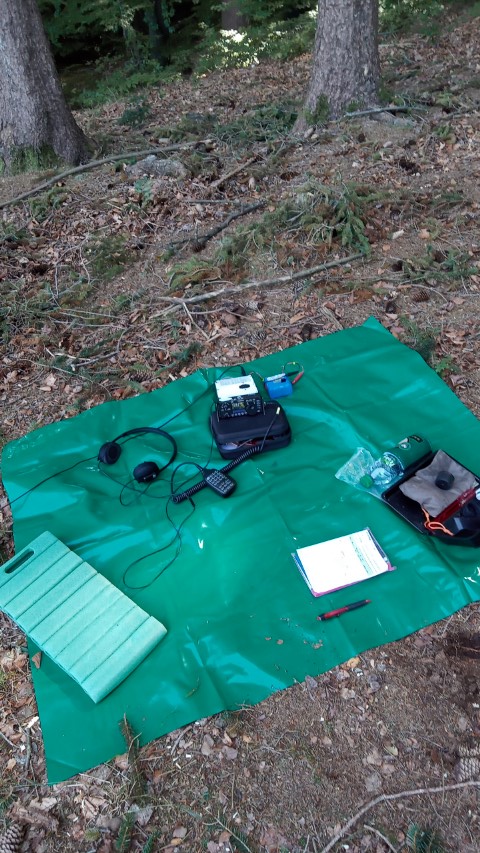
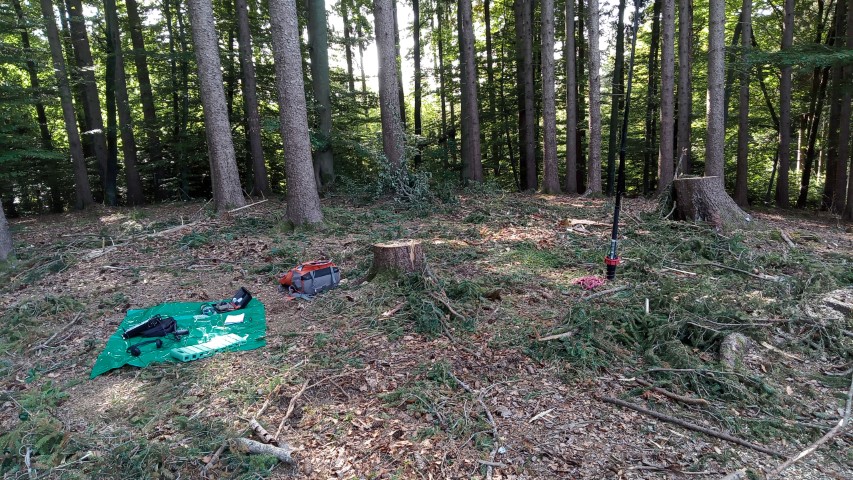
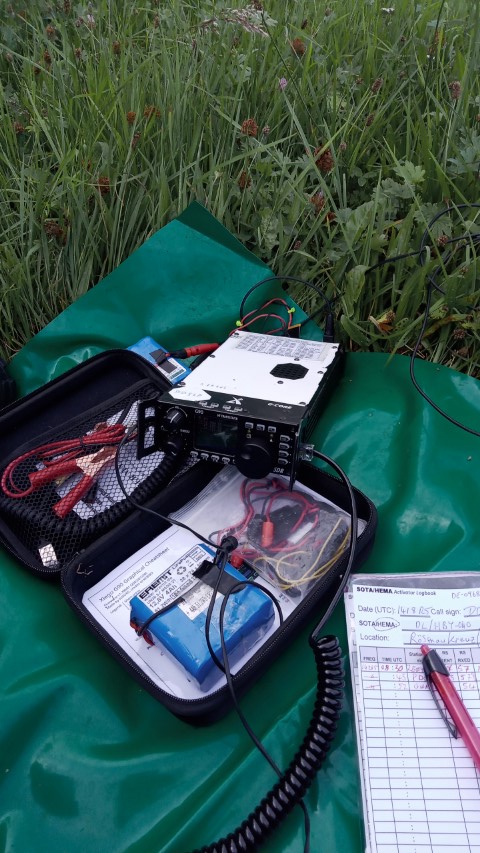
Station.
Equipment taken:
Xiegu G-90 radio.
Komunica Power HF-PRO2-PLUS-T loaded vertical antenna (not used).
Tripod with radials (not used).
2 x 4Ah LifePO4 batteries.
40L Rucksack
Inverted-V linked dipole
6 metre fibreglass mast
Screw-in sun umbrella base
Small headphones.
Smartphone for spotting.
Log:
HEMA DL/HBW-042 and SOTA DMBW-008 Schauinslandplus POTA DE-0004 Südschwarzwald
Conclusions:
It was good to get an activation in, with bad weather threatening the following days. The sudden antenna failure was possibly heat-related or possibly just through constant use and packing, and unpacking. Now that I’m home, I will see on the next activation whether the fault is solved or whether it is time to replace the complete feedline to the antenna.
With a holiday trip planned for the coming week and that to include some new (to me) summit & park activations, I needed to test out my gear as I have not been out for some time due to a combination of bad terrestrial and atmospheric weather. Coincidentally, Colin M1BUU was planning new HEMA summit activations in the Scottish islands on this Wednesday and Thursday, so HEMA-to-HEMA contacts may be a possibility.
On Wednesday, I was hopeful of a contact into VK however Colin’s travel to the new summit involved a ferry ride, which meant it would be approaching lunchtime when he got on-air, so I chose as late a time as I thought long path might be open, and planned (for me) an extended activation, hoping to fit in the contact with Colin as well.
On Thursday, the trip would be later as it was planned that I would take my wife to the swimming baths, which are on the route to the second HEMA summit, collecting her on my way home. On the day this plan changed as my wife decided she wished to stay at home, but by then the schedule was set, so this activation would have the main purpose, again, of testing equipment and a contact with Colin.
For equipment, I decided upon the usual G90 plus 6m mast and linked dipole antenna with tripod and HF-PRO2 as backup all in my 40L rucksack. As there is more space at rösenau Kreuz, I would take the wire beam antenna in its own camera bag and use it with the 6m mast, rather than the usual 7 metre and surveyors tripod.
The Activations
Wednesday 13th. HEMA DL/HBY-064 Berndorfer Buchet
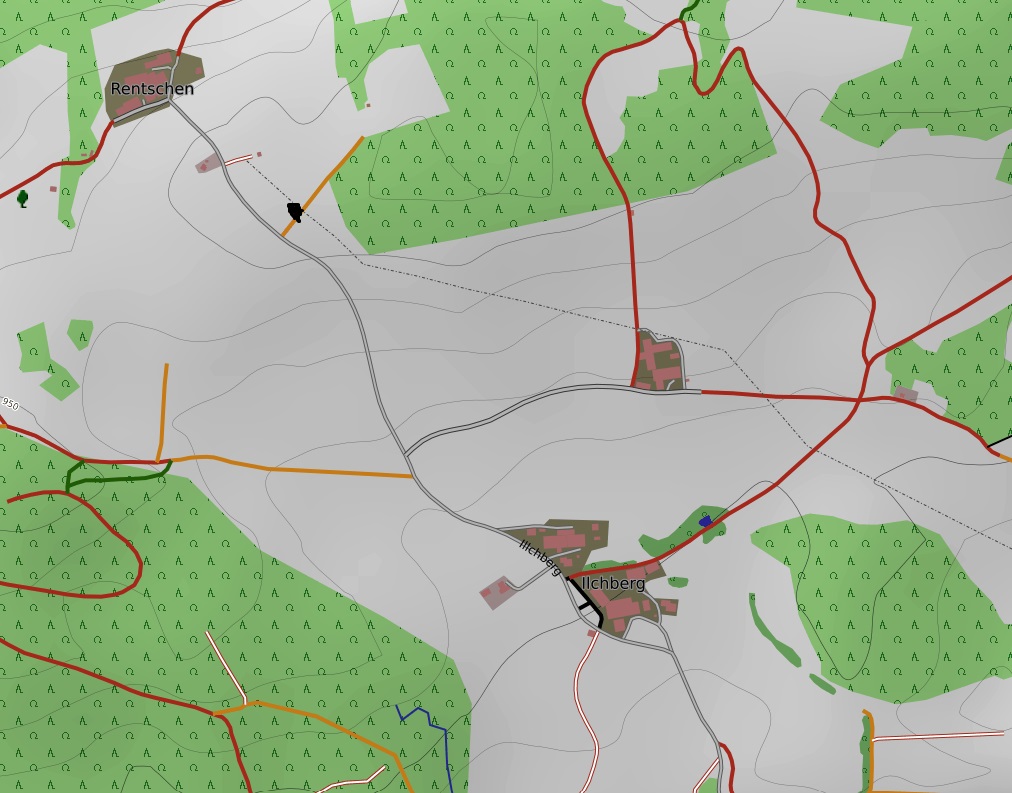
This summit is one of my local summits and, up until 3 months ago, was in the SOTA award scheme as well as the HEMA one; however, it has never had the needed 150m prominence, so it was always a matter of time before it would be removed from SOTA.
On arriving at my (usually deserted) parking area, there was someone organising parking, so there was some country event about to take place, it seems. No problems, I explained I was heading into the forest and nothing to do with his event and parked up as normal.
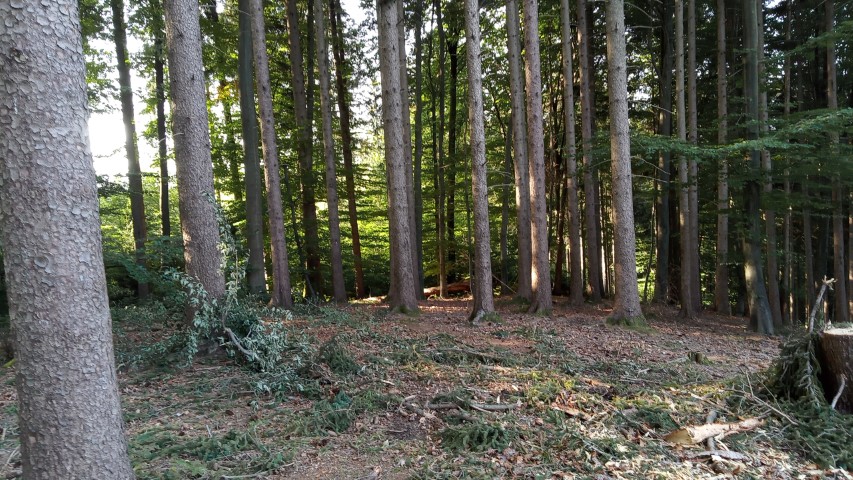
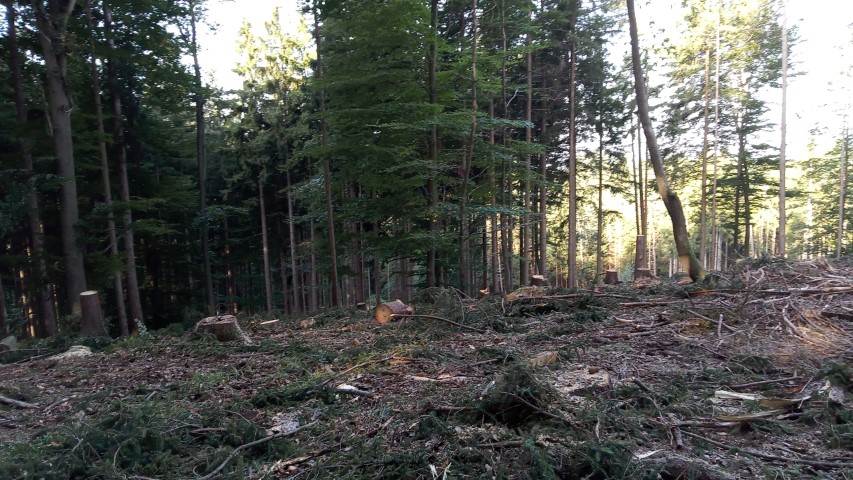
As I walked along the forest trail, it was obvious that the forestry commission had been harvesting trees, and indeed, about 60% of the trees on the summit have gone. This kind of action takes place every 10 years or so, to let the smaller trees have space to grow. The final climb to the summit was made more difficult due to lots of small wood branches all over the ground left by the log cutting crews, but with care, the way to the summit was possible.
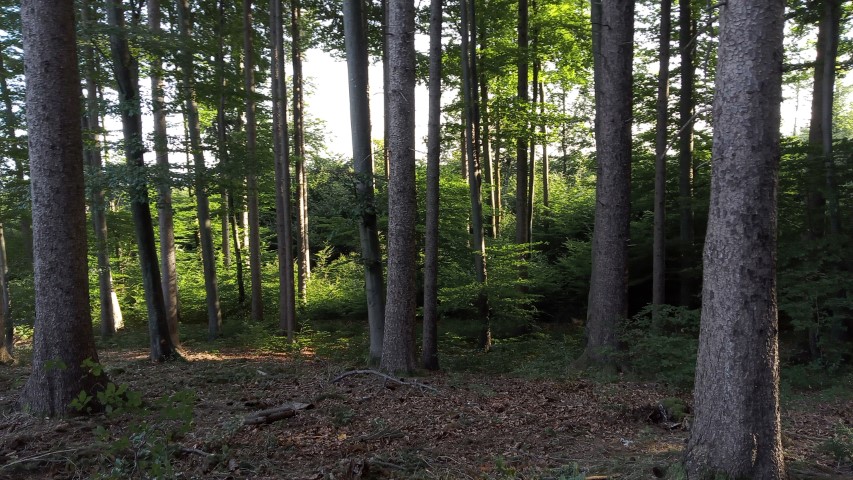
On reaching the summit, I was surprised by how cool it was under the remaining trees and was glad of that fact as noon approached (however, at the moment, the high 30s temperatures are hitting us at around 4pm local time).
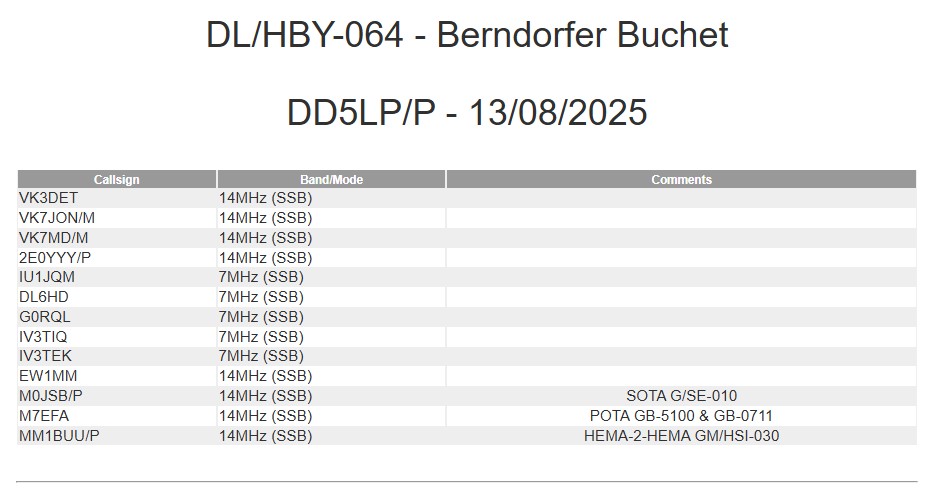
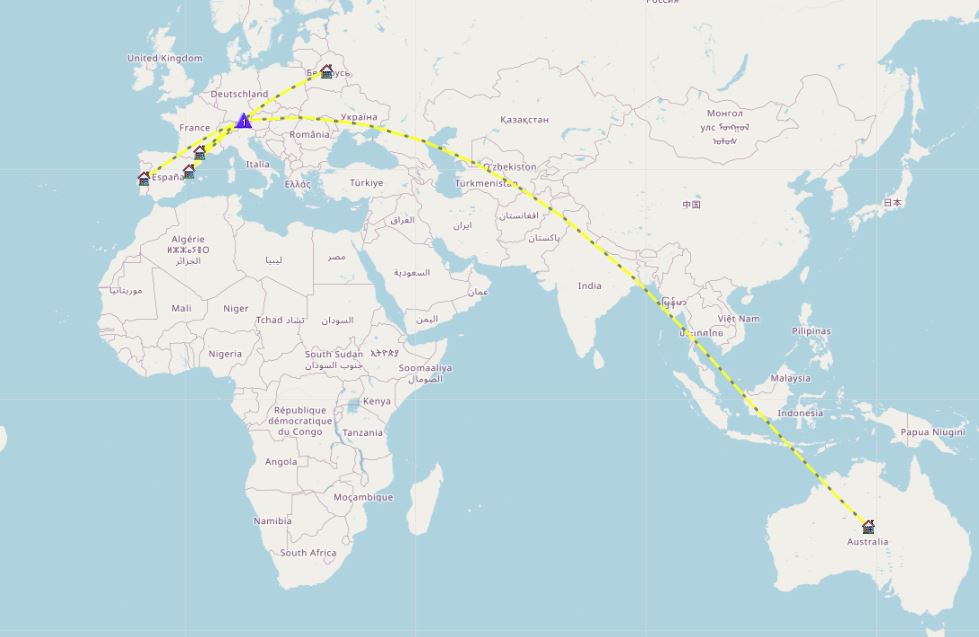
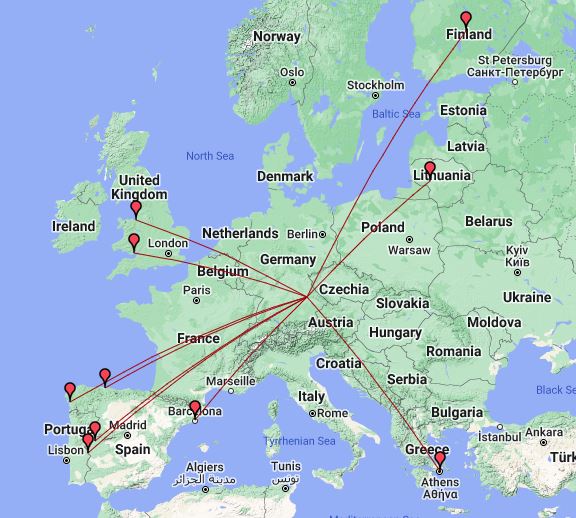
As is often the case, my friend Mike 2E0YYY was also out portable and we corresponded by WhatsCrapp, where our friends in VK also monitor. So the log started well with contacts with Ernie VK3DET, Jonathon VK7JON/M and Mike VK7MD/M being the first three in the log. Mike 2E0YYY/P came in as number four with the skip on 20m being long; it was easier to work those in Australia rather than Mike in the UK. This is normal at the time of day (0830 UTC).
After the initial contacts on 20m, the linked dipole was lowered, and the 20m link at each side was replaced to make this into a 40m antenna, as I wanted to give some of the closer HEMA chasers a chance to get some contacts. In effect, I can’t say when someone calls whether they are calling for the point for the HEMA summit or just as they have taken pity on my constant CQ calling. Either way, it’s always nice to see some calls in the log that I recognised.
Mike was keeping in contact with Colin as best he could as Colin climbed to his summit and relaying status to me, and when it seemed Colin should be on the air in the next 30 minutes, I changed back to 20 metres as a 40m contact over the distance at that time of day would be unlikely.
Before Colin came on as MM1BUU/P, I also managed to pick up a SOTA contact with M0JSB/P and a POTA one with M7EFA, so it was clear that my signal was making it into the UK.
At 0910 UTC, contact was made with Colin on G/HSI-030 at 57 both ways, followed by a final call with Mike on 20m.
After 3 hours of operation, I packed up and headed home.
As mentioned in the introduction, this was originally planned to be combined with the wife going to the swimming baths. With her last-minute cancellation, the schedule did not change, and my arrival at Rösenau Kreuz was around 0805 UTC, and I was set up and running by 0830 UTC. Well, that’s not entirely true …
When I arrived at this summit and set up, I again made contact with Mike 2E0YYY/P, but when I pressed the PTT to talk to him, the radio indicated I was only transmitting with 0.2W (200mW). As I have in the past had issues with a bad connection on the microphone lead, I had a spare packed with the station. After switching that out and even reversing the ends of the cable, the problem was still there. At this point, Mike messaged me to say he could hear me testing, and while I was weak, I was workable. So I went on air and explained the problem to him and said I would investigate further.
Switching from 20 metres to 40 metres, I suddenly had the full 20 watts output again. Should I suspect the antenna in some way – I don’t think so, as the ATU in the Xiegu G90 would match the coax run to the antenna and pump the full 20 watts into that had for some reason the 20m section not be attached but on a linked dipole the 20m section has to work for the 40m one to work as the RF currents pass through it as well. I stopped for a second and thought, what else have I changed? To switch from 20m to 40m, I had used the dual VFO feature as I normally leave VFO-A on 20m and VFO-B on 40m. So… what if I change the band on VFO-B to 20m? Well, it worked – I again had 20w on 20m. The way that the G90 radio works, it keeps all settings separate by band and VFO selected, so something in the settings for VFO_A has been corrupted (more than likely on the previous day when I ran one of my two 4Ah LifePO4 batteries down to a voltage when the G90 simply turned itself off). This can cause issues, and afterwards, things like output power ha.ve to be reset, but it looks like that is not the case here, as on VFO-A and VFO-B, 20W is indicated in the settings.
The best solution at this point is to do a factory reset (which I should have performed after the sudden power loss on Wednesday), but I had a problem. I could not remember which key combination is used to perform the reset, and before I did more harm, I decided to continue by just using VFO-B for this activation. Later, when I got home, I did that reset, and all was fine with the radio again – I have now added a note in with the radio pack, defining how to do a factory reset in case I make the mistake with the battery again.
In this activation, I stayed on 20 metres the whole time with the band being a “challenge”, the QSB taking S9 stations down to nothing in a matter of seconds. Again, I got plenty of contacts from around Europe, finishing up with a far more difficult one than on the previous day with Colin, who was now on GM/HSI-042 on 20m.
Before packing up I switched back to 40m to see how Colin was doing, and he had a big pile-up going as he had HEMA, WAB and Trig Point chasers all trying for a contact, as this area has not been activated before. I could hear all of the chasers but not Colin, so I was grateful for the 20 metre contact.
This activation achieved what it was done for – to test the equipment before the following week and to get another HEMA-HEMA contact with Colin. I did not put the 20/15/10m wire beam up, as with the QSB on the band comparisons between signals would have been meaningless.
Photos:
DL/HBY-064 Berndorfer Buchet
The view around the summit.
The view around the summit.
The view around the summit.
The view around the summit.
The view around the summit.
The view around the summit.
The view around the summit.
The view around the summit.
The view around the summit.
The view around the summit.
The view around the summit.
The view around the summit.
The view around the summit.
The view around the summit.
Station
Station
Antenna
DL/HBY-040 Rösenau Kreuz
Route to Summit.
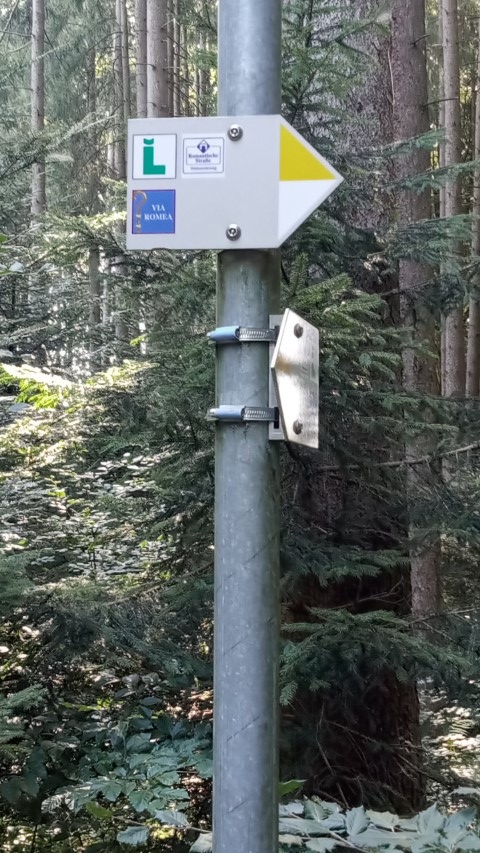
Trail Markers.
The little Rösenau Cross.
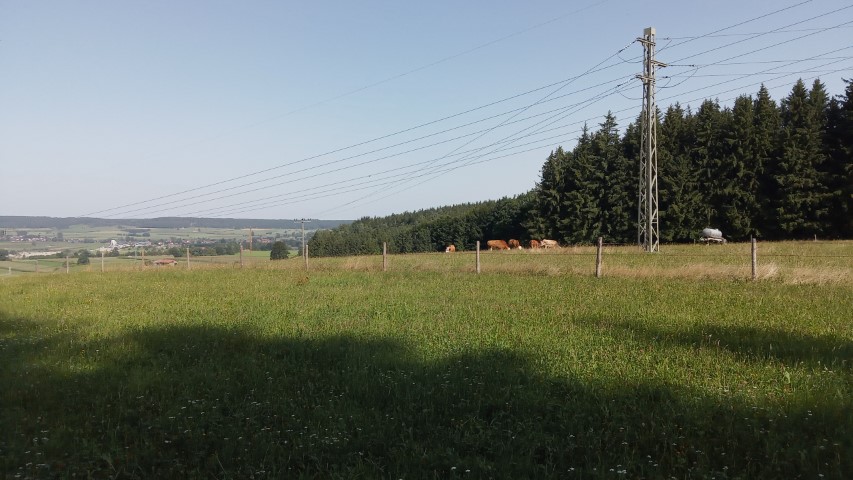
The View around the summit.
The View around the summit.
The View around the summit.
The View around the summit.
The View around the summit.
The View around the summit.
The View around the summit.
The View around the summit.
Antenna.
Station.
Equipment taken:
Xiegu G-90 radio.
Komunica Power HF-PRO2-PLUS-T loaded vertical antenna (not used).
Tripod with radials (not used).
2 x 4Ah LifePO4 batteries (not used).
40L Rucksack
Inverted-V linked dipole
6 metre fibreglass mast
Screw-in sun umbrella base
Small headphones.
Smartphone for spotting.
Logs:
HEMA DL/HBY-064 Berndorfer Buchet
HEMA DL/HBY-040 Rösenau Kreuz plus POTA DE-0968 & DE-0791
Conclusions:
It was great to bag the two rare summits that Colin was on, and indeed the tests of the equipment were worthwhile. All I need now is the terrestrial weather to behave itself next week, and I might get two good activations in, in an area I have never been to before.
The annual North America to Europe S2S event day had arrived again and (as usual), the weather forecast looked good until the day before when it changed from foggy in the morning and sunny in the afternoon (when the event is), to being cold, damp and foggy all day. Despite that, I decided to go ahead with the activation with the hope of getting some easy S2S contacts from this 1-pointer plateau summit.
Rentschen is the summit I choose for testing new antennas on as it is a flat plateau and so provides plenty of space.
I decided to play it safe for this afternoon’s activation. I packed not only the electrically switchable trapped tri-bander beam but also the manually switched 5-bander and my linked dipole, each with its own masts and supports. To be safe I also packed the antenna analyser, a complete spare radio station (G106 plus 100w amp tower) and 4, 8 & 12 Ah batteries. (I was hoping that the weather may improve so I would have the opportunity to compare various combinations). The weather didn’t change and most of the equipment stayed in the car as it turned out. This is thankfully a drive-on summit.
The Activation
It is rare that I only head out in the afternoon for a SOTA activation – usually, I am eager to get to the summit just after daybreak to work VK via the long path but in this case, where North America was the target the clock difference made a morning activation the wrong options and all of the many SOTA activators who would be out had alerted to be on from around 1300 UTC (or 2 pm local time here) – so that was my target to get on site and set-up.
The run down to Rentschen, I know very well and it was good that I did as the fog came in reducing visibility along the roads for a fair distance. On arrival at the summit, visibility was around 30 metres and it was a very damp fog. As Rob DM1CM was also going to join me I got started straight away with setting up the antenna and station.
As usual, the 2 element wire beam antenna was installed using the screw-in base with the four wires going out at 90° to each other, the combined length of the element and its cord extender (also acting as the guy cords for the mast), formed a 60° angle with the vertical mast, this after looking at a model of the antenna appears to be a better value than the normally stated 56° (the mast is a 7-metre mast but with the top section removed so that the feed point board sits at 6 metres above ground level).
As I was finishing up the set-up, Rob arrived and we took a listen around 10 metres (which I had expected to be the “money band” for this event going by recent radio conditions. Initially, the band was empty but then about 15 minutes later it filled up with stations from Russia and the US. It seems skip was not going to allow me to get any contacts inside Europe but the first in the log was Jörg signing as DL/HB9BIN/P from Laber DL/AM-060 – which, if there wasn’t a forest in the way, would have been line-of-sight from where we were. Watching the SOTA spots on my smartphone, I saw more & more European and UK stations spotting that they were out however when I tuned to their frequencies I could not hear them. I suspect the skip distance on the 10m band at the time was too long. This was in some ways confirmed by the strength of the US home stations. Unfortunately, the US SOTA activating stations all seem to have been using either CW or data so were not an option for me. I put out several CQ calls and was eventually rewarded by calls from three US SOTA chasers calling me.
The cold damp temperatures and the lack of contacts eventually decided me to cut the activation short and head home to the warmth. As I approached home, it was obvious that the weather at home had not been nearly as bad as where Rob and I were located.
There are positive points out of this action. The wire beam works well (even though I set it up 45° off the intended direction). It would have been nice to compare the linked-elements version against the trapped elements but the work involved in the wet and cold was not justified. The G90 radio with its 20 watts output on SSB, continues to “do the job” and the new 12 Ah LifePO4 battery also got another test.
Photos:
This slideshow requires JavaScript.
Equipment taken:
Mountaintop travelling 40-litre rucksack.
Raddy rucksack. (not used)
Xiegu G90 radio.
Xiegu G106 radio plus RMItaly amplifier, LPF box and ATU-100. (not used)
Screw-in mast base.
7 metre fibreglass mast.
Surveyors tripod and 10m mast. (not used)
10/15/20-metre band 2-element trapped wire beam.
10/12/15/17/20-metre band 2-element linked elements wire beam.
SOTA/HEMA logbook & pens.
Komunica Power HF-Pro2-PLUS-T loaded vertical antenna and tripod (not used)
6m mini-mast (not used).
SotaBeams linked dipole (not used).
4 Ah Eremit LifePO4 battery (not used).
8 Ah LiFePO4 battery (not used).
12 Ah LifePO4 battery.
Painter’s thick plastic sheet.
Gardener’s kneeling pad (not used).
2 x Lightweight headphones (one pair not used).
Smartphone for SOTA/HEMA spotting.
Log:
Conclusions:
The NA-EU SOTA S2S event is “jinxed” every year it is accompanied by bad terrestrial weather (at least here in Southern Germany).
The equipment used worked well and it was a nice “social” meet-up with Rob.
With progress made on the 2-element wire beam by adding a trap for 15m operation and reconfiguration of the speech processor that I use with my G106 radio, I needed to test both out on a summit. The results of these tests would also help me define what equipment I would take to Lindau, two weeks later for the International Lighthouse and Lightship Weekend.
Unfortunately, the sun is not on my side again, with a very active sun sending flares and CMEs which suppress the maximum usable frequency (MUF) since the weekend. I was hoping that things would be relatively back to normal on Tuesday (the activation had initially been planned for Monday).
As Rentschen is a drive-on one-pointer summit, I packed the “G106 Pack” and the normal G90 radio and accessories into the car the day before. Looking at the previous week, 21 MHz was unlikely to open before 0700 UTC (9 am local time), so it would be a 7:45 am departure from home to allow for the 45-minute drive and set-up time on the summit. The alarm was set …
The Activation
The morning of the activation arrived and the terrestrial weather looked nice. The trip down took a little longer than expected as I hit some of the morning commuter traffic but I arrived at around 8:30 am as planned and found a spot right next to the trig-point stone – the marker of the absolute summit point and set-up. I had a sked with Ernie VK3DET and we would try 20m and then move to 15m.
The antenna was installed using the screw-in base with the four wires going out at 90° to each other, the combined length of the element and its cord extender (also acting as the guy cords for the mast), form a 56° angle with the vertical mast (the mast is a 7-metre mast but with the top section removed so that the feed point board sits at 6 metres above ground level).
I had two aims with this activation – one was to check that the speech compressor which I use with the G106 and amplifier, now sounds better. I know the built-in one in the g90 is fine. The second aim was to make a contact on 15m with the wire beam, now that I had added the 15m traps to it.
I hadn’t expected problems with the “G106 Stack” ( G106 radio – CB amplifier – LPF filter box – ATU-100 ) as it had worked fine the last time that I used it, but OF COURSE – something went wrong there and instead of over 100w PEP that I got last time (70w RMS) – I got 20w RMS at best. I could hear the VOX relay in the amplifier chattering, suggesting it was not getting enough drive. This is at least something that I can test at home without needing to go /P again. Depending upon what I find, I could match the amplifier+LPF+Tuner up with the g90 on low power for ILLW. We’ll see.
As for the antenna test on 15m, my test with Ernie VK3DET was too early and we gave up because the band was empty of DX. I said 73 to Ernie, switched to the G90 20w radio and went back to bag some contacts on 20m to get the necessary 4 contacts to “qualify” the summit (which, as I have already activated this summit this year for both SOTA and HEMA brought me no points). Rather than the usual quick signal report exchange, I managed a few chats with hams who were interesting and a couple were interested in the wire beam I was using, so we exchanged website URLs and agreed to check out each other’s work. That was a nice interlude in the warm weather on the summit but I still wanted to know whether the beam would actually work on 15m so when I got no further replies to my CQs I went back to 15m
To my surprise there were stations now on the band and from 08:15 – 08:25 I happily listened in to a 15m net on 21.270 with Dave VK6IE, Steve E51CZZ on Aitutaki Isl (South Cook), Paul EA5JZ and a VK3 – It could have been VK3MH Brendan but I think I heard the others call him Andrew, so I may have that call wrong – he was the weakest of them all. The South Cook station was easier to listen to and that was SHORT PATH! I did “turn” the beam (via relays) and there was a difference, this was definitely short path VK-EU from 0800 UTC onwards. After trying to call into the net unsuccessfully – although Dave said he heard “someone” after I called – I gave up on the effort as one of those things, found another frequency, spotted myself on SOTA and called CQ for 5 minutes with no replies. One thing is clear – the beam receives on 15 metres OK, whether it works also on transmit will have to wait until another day.
Photos:
This slideshow requires JavaScript.
Equipment taken:
Mountaintop travelling 40-litre rucksack.
Raddy rucksack.
Xiegu G90 radio.
Xiegu G106 radio plus RMItaly amplifier, LPF box and ATU-100.
Screw-in mast base.
7 metre fibreglass mast.
10/15/20-metre band 2-element trapped wire beam.
Komunica Power HF-Pro2-PLUS-T loaded vertical antenna and tripod (not used)
2 x 6m mini-mast (not used).
SotaBeams linked dipole (not used).
4 Ah Eremit LifePO4 battery.
8 Ah LiFePO4 battery.
Painter’s thick plastic sheet.
Gardener’s kneeling pad (not used).
2 x Lightweight headphones.
Smartphone for SOTA/HEMA spotting.
Log:
HEMA
SOTA
CONTACTS MAP
Conclusions:
The antenna worked well on 20 metres and received fine on 15 metres (with directivity). I hope transmit on 15m will work fine as well but the conditions on 15m were so variable with the MUF bouncing below and above 21 MHz, it wasn’t a good day for the test.
The problem with the “G106 Stack” will need to be investigated – the fact that I could hear the input VOX relays “chattering” in the amplifier suggests to me that it wasn’t getting enough drive.
I will need to consider what I take for ILLW (International Lighthouse and Lightship Weekend) on two counts – firstly the antenna – the beam needs more space than a simple dipole and it doesn’t cover 40m, which could end up being the band of choice depending upon radio conditions. As for which transmitter, I would like to have more than 20w to “fend off” those stations who simply sit on my frequency and start calling CQ because they are either deaf or rude B’s. I could use the G90 with the amplifier rather than the G106 with the knowledge that if there is a problem, I can fall back to using the G90 “barefoot”.
I had submitted a preservation trail for POTA consideration while others exist in the system. This one runs along the banks of the River Lech from Landsberg am Lech down to Fussen on the Austrian border. There are lots of beautiful spots along its length and the initial section from Landsberg runs through the POTA DE-0663 Possinger Au nature reserve further along its length, close to Schwangau, it goes over the HEMA DL/HBY-040 Rosenau Kreuz summit making it a location where points can be earned for both systems. In addition, another longer trail “Via Romea Germanica” also passes through this point and is in the POTA system as Trail DE-0641. Today I decided to combine both trails’ activation with a HEMA activation close to the Rosenau Cross summit on both trails.
The Activation
POTA DE-0791&0641 (2-FER) / HEMA DL/HBY-040
With the threat of bad weather later in the week (indeed it actually arrived later in the day), I decided to perform this first activation of the new POTA entity early in the morning, hoping to make some long-path contacts into Australia. So an early start was planned and I arrived on the summit/trail around 0600 UTC. I sent a quick message to Ernie VK3DET in Australia and he was the first into the log. After Ernie however, contacts were more difficult to find despite being spotted on both the HEMA and POTA systems.
The contacts eventually came however with five stations from Spain, one from Portugal. One from Serbia, a second from Australia (VK2) (a missed contact into VK4 would have made 3 contacts into VK however the VK4 station was battling local S8 noise so my 20 watts was not enough for him to hear me. He could tell I was there but not strong enough to work). An Italian and a French station rounded out the 11 contacts.
I would have stayed longer but as I could see black clouds approaching and more and more flying bugs had found me in their field, I decided to pack up and head home.
Photos:
This slideshow requires JavaScript.
Equipment taken:
Xiegu G-90 radio.
Seven metre mast.
Screw-in-ground mast base.
2-element switchable direction, wire beam.
Komunica Power HF-PRO2-PLUS-T loaded multiband vertical (not used).
5-band linked dipole antenna (not used).
4Ah Eremit LifePO4 battery.
4 Ah 3S LiHV battery (not used).
Plastic painter’s sheet and seat pad.
Lightweight headphones.
Smartphone for spotting.
Logs:
POTA DE-0791 Lech Erlebinis weg & DE-0641 Via Romea Germanica.
HEMA DL/HBY-040 Rosenau Kreuz
Conclusions:
The activation went fairly well although conditions were variable. It was good to be the first activator for another POTA entity (and a POTA 2-Fer as well!). I was hoping to take my 70-watt portable HF amplifier along to give a little more “UMPH” but it wasn’t ready – maybe next time.
With HF band conditions being the worst in over 20 years the previous weekend, this activation was never going to fill several pages of the log book or deliver any “Special DX”.
Despite that, there was a break in the Terrestrial weather before the returning storms, so I decided I would activate “somewhere” on the 16th of May. As Mike 2E0YYY announced he planned to head out to Mow Cop (HEMA summit G/HSP-020) I decided to head also to a local HEMA summit with enough room for the wire beam, which I am still “fine-tuning”.
Despite the fact that I have already activated Rösenau Kreuz in February, I chose that summit as I know it, it’s about a 40-minute drive from home and normally I am not disturbed while operating there.
So the plan was to take the HF wire beam, but this time with its linked elements rather than the trapped ones, as Mike wanted to try out some of the higher HF bands and 10m was unlikely to be open (which turned out to be true).
Along with the wire beam antenna, I would also take the antenna analyser (with its new set of batteries) so that I could check each of the bands on it, before attaching it to the radio, which, as usual, would be the Xiegu G90.
Ernie (VK3DET) had said that long path propagation had been happening at around 0630 UTC – so planning for that I set my alarm for 6 am local time expecting to leave at 7 am at the latest. All radio gear was stood read in the hallway.
The Activation
DL/HBY-040 Rösenau Kreuz
I awoke before the alarm and was able to leave home at 6:30 am local time. The extra 30 minutes were useful as I had to get petrol at the local garage.
The run down was uneventful and I was on the summit with a heavily loaded rucksack by 7:30 am. I had everything set up for 20 metres by 7:50 but Ernie and Mike had already moved to the higher bands, so I spotted myself and called CQ HEMA on and off for over 10 minutes with absolutely no callers, I decided to try to catch the other two, who were now on 15m. I could not hear Mike in the UK but I managed a 3-3 contact with Ernie VK3DET.
Following 15m, 17m was tried and with Mike’s help, I managed contacts with two more Australian stations on 17m. We then went and tried 10 & 12m – both were completely dead. Mike and I eventually managed a 3-3 both-ways contact on 20m – a “HEMA-to-HEMA” contact as Mike was on the HEMA G/HSP-020 summit.
The thought was it would be a while before 10 metres opened up, so I suggested I would go to 40 metres after taking down the beam and putting up the linked dipole.
This brought its own problem, in that the T-Piece on my linked dipole normally slots over a much thinner fibreglass mast and the top section of this mast, which I have removed. So as always, we found a way and the T-piece got taped onto the mast using electrician’s tape.
Once the 40m antenna was up, I was able to make a far easier contact with Mike 2E0YYY and went on to get three more contacts on 40 metres but then again, the band started to get noisy and I was not getting any more calls.
As it was still cold, rather than continuing on, I decided to pack up and head home, which as it turned out was a good idea, as, just as I was leaving, the farmer arrived to cut the grass for hay.
The walk down the hill was uneventful, as was the drive home in time for lunch!
Photos:
DL/HBY-040 Rösenau Kreuz:
This slideshow requires JavaScript.
Equipment taken:
Mountaintop travelling 40-litre rucksack.
Xiegu G90 radio.
Sun umbrella screw-in base support.
7 metre fibreglass mast.
HF 2-element wire beam (with linked elements covering 20, 17, 15, 12 & 10m and remote (ISM) switching box).
RigExpert AA-30 Antenna Analyser.
Komunica Power HF-Pro2-PLUS-T loaded vertical antenna and tripod (not used)
40 metre linked dipole.
4 Ah Eremit LifePO4 battery.
4 Ah LiHV battery (not used).
Painter’s thick plastic sheet.
Gardener’s kneeling pad.
Lightweight headphones.
Smartphone for spotting.
Log:
DL/HBY-040 Rösenau Kreuz
Conclusions:
The bands were still in a mess. There was no longer a complete HF blackout but the bands were not as good as they were 2 weeks earlier.
The need to lower the mast to switch bands (by closing or opening links) is inconvenient however it does work when care is taken to have all four wires set the same.
Some of the elements probably need a little adjustment for best performance but checking with the analyser all were “near enough” for any mismatch to be compensated for by the ATU in the radio.
The control (direction switching system) box works reliably when a direction change is requested using the 4-button key fob, the switching is taking place correctly and can be heard on the radio.
My closest summit is Berndorfer Buchet and as I needed a summit I know to test my latest build of the 2-element HF wire beam, this one pointer was ideal as I had not yet activated it in 2024.
This was the first dry day in about a week and as more rain was expected later in the week, this was to be a quick activation. Just enough time to set up the beam, test it on the analyser and bag a few contacts ideally on 20 and 10 metres.
A relatively late activation was planned, to arrive at the summit by 9 am local (0700 UTC) but despite this the complete station fitted into/onto my 40L backpack would be loaded into the car, Monday evening, the night before to allow an easy departure the next morning.
The Activation
DL/HBY-064 / DL/AM-180 Berndorfer Buchet
As normal I woke 30 minutes before my alarm went off and was all packed and out of the door at 7:30 am as planned for a 9 am (0700 UTC) start. I had hoped to fill the car at a garage on the way but there were so many queued that I decided to leave it for the return journey.
Although sunny, it was still cool. Walking from the parking spot to the open area 15m below the summit, the track was muddy and I hoped that the small area where I intended to set up was not as much of a bog as it was the last time I used it.
Although soft underfoot, the ground had dried enough from the last few days of rain to be usable. After putting down my painter’s sheet, I proceeded to unpack everything from the rucksack. A more complex operation than normal with the HF beam antenna rather than just a dipole or loaded vertical. Once the mast and antenna were up and the elements/guy ropes positioned, my first task was to run my RigExpert antenna analyser on the beam with it switched to each of its four directions, as while, I had only moved the complete feedpoint electronics from a flat board into a box, there are several things that could have gone wrong. I had done DC connectivity checking but this was the first chance to test the antenna completely.
The first trace (see photos) for the beam on 20 metres (it covers 20 & 10m) with it pointed West, was a little strange with two dips shown. These were OK if a little strange. I then pressed the key fob to turn the antenna to the North and ran another scan – see next photo – this was all over the place. It was worse still when I wanted to clear the trace and try again, the RigExpert analyser would not let me. I tried turning it off – nothing! the trace stayed. Unplugged the coax, no change, so there was nothing for it, but to take the back off and remove the batteries, which I did and I was able to turn the unit on again, but as soon as I tried to take a trace again (this time with the antenna switched back to the known good West direction) the same mess on the screen and the unit had hung up. Luckily I have seen this before – these units don’t like low battery voltage and after once again removing and replacing the batteries, I could see on the startup display that the batteries were low. So, as I had no spare batteries with me I put the analyser away and continued to set up the radio, hoping that the antenna was OK.
Well, the first station in the log was Ernie VK3DET with a 5-5 in both directions, so I guess the antenna was working. Band conditions were all over the place though. Some DX stations (VK4 and Jamaica were booming in while others from Finland were not as strong as usual – with the beam switched north). Ernie reported having just worked some portable stations in the UK with S9+ signals and had expected me to be stronger but 20 metres was in such a mess that in the 10 minutes in between signals had dramatically changed.
After spotting myself on the SOTA cluster I tried calling CQ for 10 minutes on 10 metres with no responders. All I could hear was the local 10m beacon about 25 km to my south – I used this to check the antennas directivity and as before I got 2 S-points less signal off the back and 1 S-point less off the sides. That said, this was not a complete test for the antenna and I will need to plan to go out again and check it with the analyser again, now that it is working fine with some new batteries.
20m had really deep QSB but at least the weather stayed fine long enough for me to complete the activation.
Photos:
This slideshow requires JavaScript.
Equipment taken:
Mountaintop travelling 40-litre rucksack.
Xiegu G90 radio.
Screw-in sun umbrella base.
7 Metre Zita Fibreglass mast.
Komunica Power HF-Pro2-PLUS-T loaded vertical antenna and tripod (not used)
Remote switched 2-element wire HF trapped elements beam for 20 & 10m.
4 Ah Eremit LifePO4 battery.
4 Ah LiHV battery(not used).
Painter’s thick plastic sheet.
Gardener’s kneeling pad.
Electrical hand warmer.
Suncream.
Lightweight headphones.
Smartphone for SOTA spotting.
RigExpert AA-30 Antenna Analyser.
Log:
HEMA DL/HBY-064 Berndorfer Buchet
SOTA DL/AM-180 Berndorfer Buchet
Contacts map
Conclusions:
You can never predict what will happen. Thankfully the crazy readings from the RigExpert were caused indeed only because of flat batteries.
The band conditions were disappointing overall compared to activations a couple of weeks earlier.
A short 3-night break with the family to the Oberpfälz region (in English Upper Plantine) of Bavaria near the Czech/German border brought the chance of some portable radio activations. The problem of planning ahead with this trip was the uncertainty of the weather with high winds rain and even snow forecast as possibilities, this was going to have to be, grab the activation when you can. Our base for the short stay was the medieval town of Nabburg between Regensburg and Weiden. The Oberpfälzerwald nature park covers a large area of land around our base and hence the likelihood would be that POTA DE-0017 would be activated at the same time as a HEMA or SOTA summit. Very near to the town was an unactivated HEMA summit Darlesberg and this would most likely be the summit in the park, dual activation. The only reasonable summit to take the family to was Fahrenberg (DM/BM-321) and this 8-point, drive-up summit is in the next POTA park northwards, DE-0024 Nordlicheroberpfälzerwald NP so this could be a combined SOTA/POTA activation. On the way to our holiday flat, my wife wanted to see an art exhibition in Regensburg, so this was planned to coincide with me activating the Donaupark which is within Regensburg city.
The equipment would be the 6m telescopic fishing pole, umbrella base and the 404-UL OCF dipole from Aerial-59. The reason not to use the usual linked dipole was the probably need for band changing given the variable radio conditions present. This set-up would be used for the summit activations and the Komunica HF-Pro2-Plus-T on a mag mount on the car roof for the POTA activation from the Regensburg park (or any others that might be needed/possible).
The Activations
Tuesday 16th April – POTA DE-0376 DonauPark.
Apart from a delay finding my way to the parking area in this city park, the planned combination of dropping the wife off at the gallery, driving to the park, taking our dog for a walk, setting up the radio in the car, activating the park (10 contacts needed), closing down and packing away, taking the dog for her second walk and then going back to pick up my wife, went to plan and we were able to continue our journey on to our flat in Nabburg.
The activation itself brought in strong signals from around Europe on 20m but contacts number nine and ten took a little longer to get than the first eight which started me worrying a little that I would not manage the needed number of contacts in the time I had available. I tried 40 metres but with so many stations on that band, it was impossible to find a free frequency to call CQ on and when I did eventually find one, after calling CQ another station starting calling CQ without even asking if the frequency was free. It was a jungle of animals on 40 metres. Luckily I did manage to get the needed ten contacts on 20 metres. 10 metres was totally closed at the time.
As the first day proper of our holiday we had planned to split this between radio and visiting the town of Weiden about 5 km north of Nabburg and that’s what we did, We spent the showery morning in Weiden (well worth a look, especially in the large church there) and by midday, we were heading up to the Fahrenberg. Unfortunately, the restaurant was not open on Wednesdays but again, it has a nice baroque-style church that is worth a visit. Behind the church, there is a perfect grassed area to put the mast and dipole up on and while it was sunny when we got there we did not know how long that would last, so I quickly set up and got calling. An impressive 25 callers got into the log in 16 minutes when the calls dried up on 20 metres I considered switching to 40 metres but as I could see black clouds approaching, I thought better of it and packed up the equipment. Just as I lifted my rucksack to my shoulder the first few flakes of snow started to fall, so timing could not have been better.
As we drove off the snow stopped but it was clear rain at least was on the way.
A good day’s radio operating and sightseeing.
Thursday 18th April – HEMA DL/HBY-226 Darlesberg
This should have been the easiest of the activations. The parking spot I had found on the map was less than 10 minutes drive away from our flat and then it was about a 1.25 km walk up a forest track to a picnic area followed by a smaller walking track of about one kilometre to the summit.
Admittedly with this activation, I carry my rucksack laden with gear for the longest distance but despite that, I did not expect any problems. I arrived at the parking spot around 9 am local time, loaded up and started up the forestry vehicles-only track, the start was a little steeper than I had expected but then it got better. I kept following the main track until after about 45 minutes, it started to go downhill, which made no sense. Rather than take my rucksack off to check my printed-out paper map, I decided to use my smartphone to check how much further it would be to the picnic area. What I saw was that I was on the wrong track. I used Google Maps to start with but then switched to the Mapy.cz app for confirmation which, unfortunately, it gave. about 10 minutes earlier I should have taken another much smaller muddy track (which on the maps is shown as being of the same type as the one I was on – it isn’t). In fact, I was now level with the summit but about 60 metres below it. There was a track to go up through the bush to the summit from this point, but it was a boggy mess and with the steep climb that would have been needed, I decided it was not a good option to try in the drizzle in a remote location. If I slipped there would be no one coming by to help.
I then had to face the decision, of whether to go back and go up the correct track and then join the official walking track to the summit, as originally planned or to abort the attempt. By the time I got back to the junction, I would have walked as far as I would have needed for the complete walk to the summit and then would have to face probably another 30-minute walk. I decided to cancel. Had I been carrying less weight or if the ground had not been so soaked I may have made a different decision. I know now not to rely on my memory of a paper map in my rucksack and either to have it out to check junction by junction or as I did on the return walk to the car, follow my position on an online map.
Friday 20th April – POTA DE-0017 OberpfälzerWald NP
As the previous day’s activation (which would have been a HEMA/POTA one) had to be aborted, I was still left with the POTA activation available to coincide with a break to our return journey home to allow the dog to have a walk and so it was decided that another car based POTA activation would be made near Steinberger See about 30 minutes drive away from the flat, So after packing all our luggage into the car again (which of course got in the way later when I wanted to get to the radio gear) we set off but unfortunately in this area of Germany, the GPS (navi) doesn’t always see enough satellites to navigate accurately. There is also a US forces training base nearby, so what signals they may be putting out could also be part of the problem for car-based Euro-GPS systems. In any case, we ended up near Wackersdorf (famous for anti-nuclear-power rallies in the 70s) and found a parking spot near some woodland which would serve the purpose needed. So with my wife taking the dog for a walk, I set to, finding the radio equipment mounting the antenna and calling for POTA hunters. The contacts took longer than I am used to with SOTA and again there was time pressure to get the needed ten contacts but as this was around 0715 UTC, long-path on 20m was open into VK and I managed a Park-to-Park contact with VK2USH, which while difficult, especially as it suffered heavy QRM from another station was completed.
Photos:
POTA DE-0376 Donau Park
This slideshow requires JavaScript.
SOTA DM/BM-321 Fahrenberg / POTA DE-0024 NordlicherOberpfälzerWald NP
This slideshow requires JavaScript.
HEMA DL/HBY-226 Darlesberg (failed attempt)
This slideshow requires JavaScript.
POTA DE-0017 Oberpfälzerwald NP
This slideshow requires JavaScript.
Equipment taken:
MountainTop 40-litre rucksack.
Xiegu G90.
Komunica Power HF-Pro2-PLUS-T loaded vertical antenna. (used with magnetic mount for the first and last activations).
Three-magnet car roof antenna mount.
Lamdahalbe 6m mini-mast (used on 2nd activation).
Aerial-59 404-UL OCF dipole (used on 2nd activation).
4 Ah LifePO4 Eremit battery.
4.5 Ah LiHV battery (not used).
Painter’s thick plastic sheet and gardener’s kneeling pad.
Lightweight headphones.
Smartphone to spot and back-channel comms.
Logs:
POTA DE-0376 Donau Park
POTA Contacts Map
POTA DE-0024 NordlicherOberPfälzerWald NP
POTA Contacts Map
SOTA DM/BM-321 Fahrenberg
SOTA Contacts map
POTA DE-0017 OberpfälzerWald NP
POTA Contacts Map
Conclusions:
The weather was a problem mainly on the third day, combined with the mis-navigation that was a “bad” day – lesson learned to use the Smartphone map/tracking app when attempting to activate a new summit.
The Xiegu G90 continues to work surprisingly well even when only using the Komunica Power HF-PRO-2-Plus-T on a mag mount on the car roof. That park-to-park contact with Australia was a highlight of the trip.
This was to be an activation to test out my “Ultra-light” kit. My Xiegu G106 radio and the SOTABeams Bandspringer long wire antenna as I have now added an external “Z-Match” manual ATU to the configuration. The antenna gets launched into a tree using a weighted bag and cord, so the complete station packs into a very small bag (about the size of a lady’s large handbag).
Radio conditions were all over the place so I wasn’t planning for any DX and while this was going to be a “family outing” with my wife and dog, I knew I would be restricted, however, I still packed the usual 40L rucksack with the G90 configuration in it, into the car as well, just in case the new configuration did not go as well as hoped. I could then hopefully qualify the park/summit having driven there.
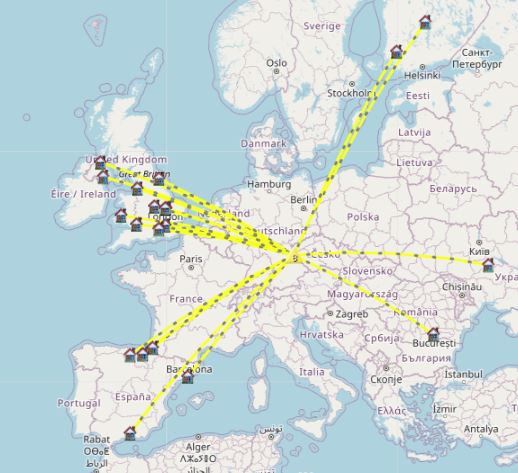
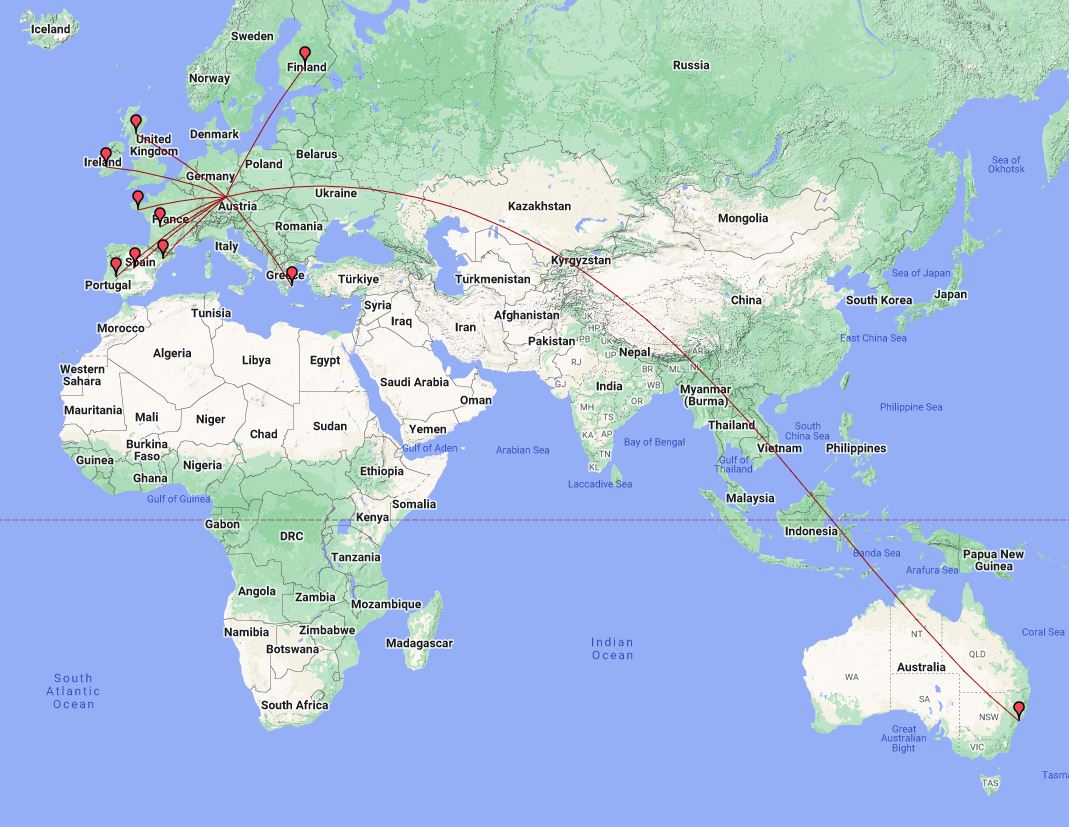
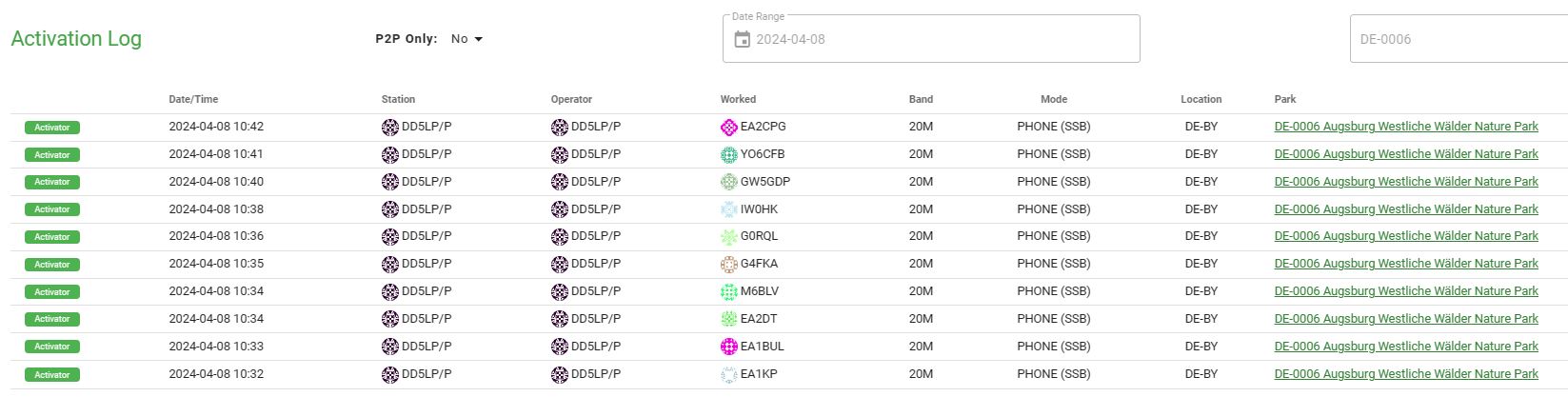
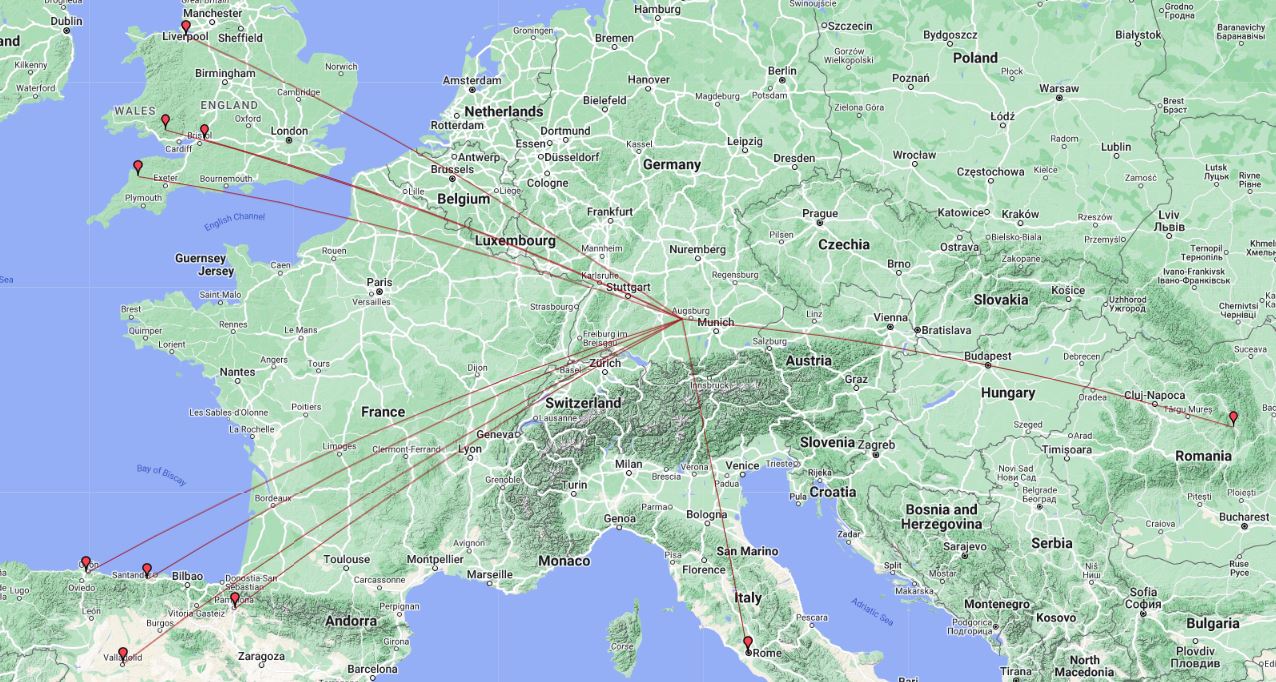
The location chosen I had visited and activated before as a HEMA summit – DL/HBY-038 Staufenberg about 10 km west of Augsburg which itself is about 45 minutes to an hour’s drive away from our home. The summit overlooks the village of Bonstetten which has a wonderful, old restaurant in it, which is open on a Monday (many restaurants close on Monday & Tuesday here) and as the weather forecast was that Monday was likely to be the only dry day of the week, this fitted well. Since activating the (drive-up) summit last Autumn, I have started activating POTA parks and this summit was in the Park I could activate both schemes at the same time. POTA has almost as big a following as SOTA these days, so spotting on the POTA cluster pretty well guarantees enough contacts to qualify the Park (and Summit). Unlike the WWFF Park award scheme which requires 44 contacts, POTA only needs 10 (and HEMA only 4 of course).
The hope was to have the Ultra-portable configuration work “well enough” to use on the family short holiday in the Oberpfälz (Upper Platine in English) near the Bavaria/Czech border, the following week.
The Activation
POTA DE-0006 7 HEMA DL/HBY-038
The expected 45-50 minute drive was extended by the police stopping all traffic on the highway to pull out foreign trucks and check their loads and that the truck conforms to the regulations. This was STILL going on when we returned on the other side of the highway about 4 hours later, so this would have caused even bigger delays as the day went on. Of course, there was no warning of this happening in any of the radio road reports as the Police don’t want to tip off the truck drivers but I’m sure the word would have got out very quickly via their CB radio network or simply via some online social media platform.
As we had set off a little earlier than planned, this meant that I still got to the summit in the park at my alerted time of 0900 UTC (11 am local).
This summit is interesting in that as well as a small chapel, it also has the old American Forces Network (AFN) MW relay station for Augsburg on top of it. I’m not sure what it is now used for however the mast is still there and someone was working in the compound while we were there. Perhaps just keeping the grass under control?
From this summit, there are a few tracks off, that served well for my wife to take our dog on her morning walk, while I set up the antenna and radio. As I mentioned, I had brought along the SOTABeams Bandspringer end-fed antenna and a throw bag to get the antenna up into a tree. In fact, the design is for perhaps a quarter of the wire to head off from the location in the branches in an inverted L kind of configuration. The other half of the antenna, the counterpoise wire, simply runs out over the ground. It was interesting that this wire was noticeably longer than the driven element.
Both wires have banana plugs on them which plug into a BNC adapter, which then goes directly into the ATU. In my case, this is a manually tuned Z-Match. I first tried to get a dip in the indicating LED in the ATU on 40 metres, both using the narrow and wide impedance settings of the ATU no dip could be found. I put out some CQs and spotted myself anyway and while I was receiving fine, I got no calls. I switched then to 20 metres where I could get a very slight dip in the LED light at the very end of the Tune and Load controls. I again spotted and called – no callers. I found another POTA activator who had a strong signal and tried calling him three times – nothing – and it was not a case of another station getting in first as he simply kept calling CQ. This antenna was simply not working. Which for SOTABeams is a surprise however I was surprised that it is supplied without the normal 9:1 UNUN for end-fed random wires.
Time was passing, so I decided to switch radios, leaving the same antenna up (as it had taken some time to get it up in the tree). I went back to the car and brought my Xiegu G90 and its battery, microphone, etc. Connecting that up to the antenna and tuning, it took a lot longer than normal to find a match, but it did manage it (the G90 is known to have an in-built ATU with amazing capabilities). I found a free frequency on 20m and spotted and called again – now I had chasers calling me back and I received the needed 10 contacts to qualify the park (and the summit). No DX just calls from around Europe.
At this point, my wife and dog had been back for some time and were waiting for us to go for lunch in the village “Bonstetten” that this summit is above. So I packed everything up (the antenna, thankfully came down without any problems – often there can be problems with wire antennas jamming in trees) and we went for lunch to a lovely restaurant the “BräuStübel” in Bonstetten and then drove home at the end of what was a nice trip out and we may repeat later in the year.
Photos:
This slideshow requires JavaScript.
Equipment taken:
Xiegu G-90 radio.
Xiegu G106 radio with Z-Match ATU
Komunica Power HF-Pro2 loaded vertical antenna with tripod (not used)
SOTABeams 60-10m Bandspringer long-wire antenna.
Linked dipole antenna and 6m Lambdahalbe mast (not used)
The SOTABeams antenna needs the G90 ATU to work and the external manual Z-Match that I have added to the G106 is not as broad as the built-in one in the G90. I have bought a 9:1 UNU(N to add to the end-fed random wire from SOTABeams to see if that brings it into range for the Z-Match ATU.
It is always good to have backup options available and I will be taking the tried and tested G90 + dipole set-up on our holiday, even if I manage to get the BandSpringer to work with the G106 using a 9:1 UNUN.
Having the option to spot to a larger group of chasers, whether POTA or SOTA is very useful when the number of HEMA chasers available during a weekday is limited.
73 ’til the next activation!
UPDATE:
After writing the report above, I have indeed bought a cheap 9:1 UNUN from Amazon and by having this inline between the z-match manual ATU and the antenna, I can match the antenna to the radio on 60,40,20,15 &10m (I have not tried the WARC bands).
With band conditions good as we are very close to the top of Solar Cycle 25 and the weather seeming more like spring than winter and importantly with only light winds, I decided another activation with the wire beam was in order.
This time, however, I wanted to use my screw-in-the-ground sun umbrella post base rather than the large surveyor’s tripod. I had also received my awaited rotary switch and so had built the feed-point board with switchable directions. In this case, the mast has to be lowered before the direction the beam is “pointing” can be changed, but this is less work than re-arranging the element/guy cords and less weight to carry that the remote controllable, Bluetooth controlled, relay board.
I had initially planned to activate on Thursday morning, however as Mike in the UK (2E0YYY) was also planning to go out and rain was expected for him on Thursday, we agreed on a Friday morning activation, with Ernie VK3DET also listening to help with tests (we do call ourselves the “Comms-Testers” so this all makes sense). My weather forecast for both Thursday and Friday were good and for one (thankfully) that turned out to be the case.
As usual, all equipment was packed in the back of the car, the day before to allow for an early start. This time in addition to the radio gear I also packed an electric hand warmer “stone” that had been recommended to me after my problems with cold hands on the last few activations.
The Activation
DL/HBY-040 Rösenau Kreuz
This is one of my closest summits about 30 minutes drive away so the trip down on Friday was uneventful. On arriving at my car parking spot in the forest at the first of a series of pilgrims’ holy crosses that lead up the hill into the forest, I finished packing the rucksack. I estimate it weighed somewhere between 16 and 17 kilograms but once on my back, I just had to bear it. The road itself goes further up the hill however it is restricted to non-powered vehicles apart from those with the right of access.
My usual spot is close to the cross outside of the forest where it is, but I wanted to see if I could set up closer to the escarpment which may give a better operation of the antenna. This meant heading in the direction of Schwalbenstein (a lower summit on this ridge). Upon inspection however the flat ground where I would have liked to set up is fastened off with barbed wire, so it is obvious the owner doesn’t want people going there. The activation zone for this summit spreads a little way up and down the ridge, so the next time, I may plan to explore some other areas to see if I can get nearer to the escarpment (and the wonderful views of the River Lech over 100 metres below – as you will see from the pictures). For now, though, I would have to return to my usual activation point as Ernie and Mike would be waiting for me.
Setting up the antenna and radio was problem-free and the screw-in post certainly provided enough support for the 7-metre mast and antenna, so that was one test completed successfully.
Having quickly checked the antenna on the antenna analyser I turned the radio on and tuning around on 20m, I found Mike and Ernie chatting and broke in at the point that they were saying they needed to send me the free frequency they had found. Both stations were strong and we exchanged 5-9+10dB reports between Germany and the UK and 5-7 reports between Germany and Australia. This was on 20m and while Ernie and Mike wanted to go off and try the higher bands, I asked them to give me 5 minutes of conversation, so that I could test switch the antenna direction. Well, of course, it turned out to be ten minutes but the results were worth it! With the antenna electrically pointing West (UK and long path to VK) I took reference signal values from the S-meter and then switched to the other three directions, checking back at the radio each time and on both signals (at different signal levels), I got the following results;
antenna 90° off – i.e. pointing North or South, signals 1-S-point down.
antenna 180° off – i.e. pointing East, signals 2-S-points down.
So another test was completed successfully, both on the switching mechanism and the antenna in general.
While Ernie and Mike went off to try and get successful contacts on 17, 15 & 12m, I spotted myself and worked half a dozen stations on 20m. When the callers dried up, I decided to switch to 10m and just as I was ready, I saw that Ernie and Mike had moved there, so I tried to get in contact with them again on 10m. 10m at this time was not very good and while I could hear both Mike in the UK and Ernie in Australia, I was only able to make a minimal contact with Ernie. One problem now was that I needed the beam pointing East to get the Short path to Ernie but West still for Mike. Despite this, the tests showed that again the antenna was directional but the signals were simply not strong enough to make easy contacts.
Once Ernie and Mike had finished their QSO, I asked Ernie to stick around while I changed the elements on the antenna. I suspected that the single band (10m only) elements might work better than the trapped elements, for some reason. Although Ernie was stronger after I changed the elements, 10m it appears had also improved, so this was not a valid test and is one that I will need to repeat this comparison on my next activation, where I intend to head to a summit in the early afternoon when more US stations could be on an. An early morning activation is OK for Australia but it corresponds to the middle of the night in the US and hence there are fewer people on the air.
All in all, this was a good activation and some good tests were completed. It was cold to start with and the electric hand warmer “stone” was used successfully a few times, so that was another successful test and will remain part of my activation “kit” at least in the winter months.
The return down the hill was uneventful, as was the drive home in time for lunch!
Photos:
DL/HBY-040 Rösenau Kreuz:
This slideshow requires JavaScript.
Equipment taken:
Mountaintop travelling 40-litre rucksack.
Xiegu G90 radio.
Sun umbrella Screw-in base support.
7 metre fibreglass mast.
10/20 metre 2-element wire beam (with switchable and simple feed-point boards).
RigExpert AA-30 Antenna Analyser.
Komunica Power HF-Pro2-PLUS-T loaded vertical antenna and tripod (not used)
Lamdahalbe 6m mini-mast and new metal base peg (not used).
SOTABeams end-fed random wire antenna (not used).
4 Ah Eremit LifePO4 battery.
4 Ah LiHV battery.
Painter’s thick plastic sheet.
Gardener’s kneeling pad.
Lightweight headphones.
Smartphone for SOTA spotting.
Log:
DL/HBY-040 Rösenau Kreuz
Activation Zone:
Map:
Conclusions:
The antenna worked well on 20m with between 1 & 2 S-points difference in signals depending upon the direction was switched to.
The need to lower the mast to switch the direction is inconvenient however the solution is lighter and stronger than the fully remotely switchable option that I tried on the last activation.
The 10m section of the antenna still needs to be tested as this time, the band was changing too much to make any conclusions as to whether the elements without traps work better than the trapped section on the 20m elements.






























 DD5LP / G8GLM / VK2JI blog
You must be logged in to post a comment.