
Preparation:
The saga of the 2 element wire beam has continued for some time (months in fact). First with physical feed point board mounting problems, then apparent electronic problems with the Bluetooth relay switching board, then I managed to blow that board by connecting the supply in reverse and when I got what I thought was an exact replacement it wasn’t, meaning that my direction switching scripts on my smartphone no longer worked and had to be replaced by single button switches in the app.
Then along came gale force winds, 30cm of snow and heavy rains in several different sequences delaying testing of the “fixed” electronics on the local field. While stuck inside not able to test the complete solution, I built up an elementary (no electronics) feed-point board, so that I could test out the straight elements and the elements with HF-Kits traps in them (making them suitable for 10 & 20m usage), without having to worry about electronics, Bluetooth or Smartphone issues. In this configuration, it is not possible to switch the direction of the beam, it points in the direction that it is erected for
After a couple of tests in the local field (still rather muddy, but with only three days of dry weather forecast I had to put up with that) the simple antenna was ready for use from a summit for which Peissenberg was chosen, being one of the closest that had room for my surveyor’s tripod, 7m mast and the wire beam. After a further test before lunch, where the trapped elements proved to still need some trimming but the simple 10 metre elements were spot-on, I decided to make this a 10-metre-only activation (even though a CME had just hit the Ionosphere, the MUF was still up above 30MHz) in the late afternoon when 10 metres had been opening up to North America.
The Activation
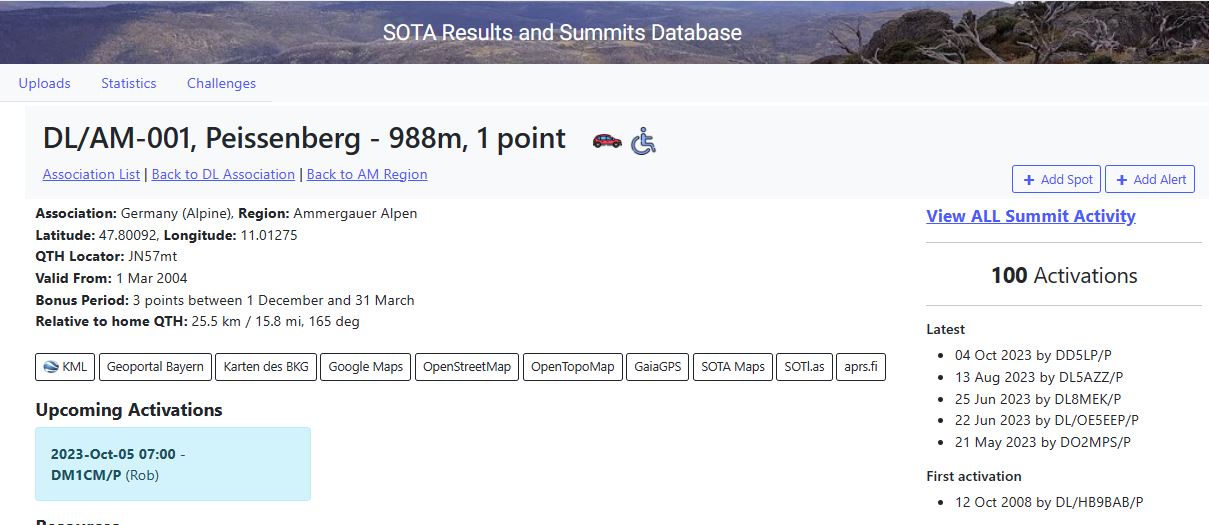
DL/AM-001 Peissenberg
On arriving at the car park for the summit, it was obvious that others were there, waiting (I believe) to watch the sunset while having a light meal.
I unpacked the antenna, mast and Tripod first before returning to the car for the radio later. I luckily had also brought my antenna analyser along that I had used during my tests in the morning, as after setting the antenna up, the 10 metre band sounded rather quiet and the ATU in the radio took some time to match it to the radio – a sign that something was wrong. I could have then tried the SWR scan feature in the G90 but while I had the Rigexpert AA-30 with me, I put that on and it was obvious that the antenna was not connected. I checked the PL-259 plug at ground level but it quickly became obvious that the problem lay on the feed point board up at 6 metres in the air, so down it had to come down.
The connection problem was traced to the BNC end of the RG-213 coax cable where it plugged into the BNC socket on the simplified feed point board. Once I detached and reattached the BNC plug to the socket on the feed-point board all worked OK for the whole of the activation. I need to find a better solution and indeed after returning home I have been able to make this connection a far more solid “match”. Should the problem re-occur I will solder the co-ax straight to the antenna element connectors.
Once I had sorted out the connection, 10m sounded a lot more like it should on receive, but despite that and having spotted myself several times on the SOTA cluster, I was not getting calls that I had hoped for, that was until I heard ZS5APT calling me! This was Adele and after exchanging reports she said -please wait I have another South African ham that wants to call you – who was ZS5AYC – Sid (her husband). So my first two contacts on the new antenna were in South Africa! I should be happy at that except … the wire beam was pointing at the US (which is West of me), not South Africa (which is South of me). This simple (one direction) antenna would be receiving Adele and Sid off the side of the beam, they were both 5-6 and gave me 5-8/5-9 – not bad for 20w and a wire antenna.
But it left me thinking – would the signal have been better with a simple dipole? I obviously need to do some more testing to prove the directional properties of this antenna.
The next three-quarters of an hour were difficult, I was not getting calls and when I tried to call other stations which I could hear well from the US and Canada, I’d get hammered in their pile-ups.
Two semi-local German stations (DA20XOTA and DJ0AL/P) did persevere through the QRM and QSB, but after that, I could not seem to get any more contacts. Other SOTA activators who were out in the area were too close for me to get S2S contacts, I could hear people chasing them but not the activators themselves.
I had just about decided to pack up as it was getting towards sunset and more campers were turning up so I used the magic words “LAST CALLS” – and who comes back to me? Gary K3TCU, from Pennsylvania. He was 5-8 and gave me 4-4 which sounds like an honest report. He kindly ventured from his normal CW to SSB to give me a call.
Photos:
DL/AM-001 Peissenberg:
Equipment taken:
- Mountaintop travelling 40-litre rucksack.
- Xiegu G90 radio.
- Surveyor’s tripod.
- 7 metre fibreglass mast.
- !0-metre band 2-element wire beam.
- RigExpert AA-30 Antenna Analyser.
- Komunica Power HF-Pro2-PLUS-T loaded vertical antenna and tripod (not used)
- Lamdahalbe 5m mini-mast and new metal base peg (not used).
- SotaBeams linked dipole (not used).
- 4 Ah Eremit LifePO4 battery.
- 4 Ah LiHV battery(not used).
- Painter’s thick plastic sheet.
- Gardener’s kneeling pad (not used).
- Lightweight headphones.
- Smartphone for SOTA spotting.
Log:
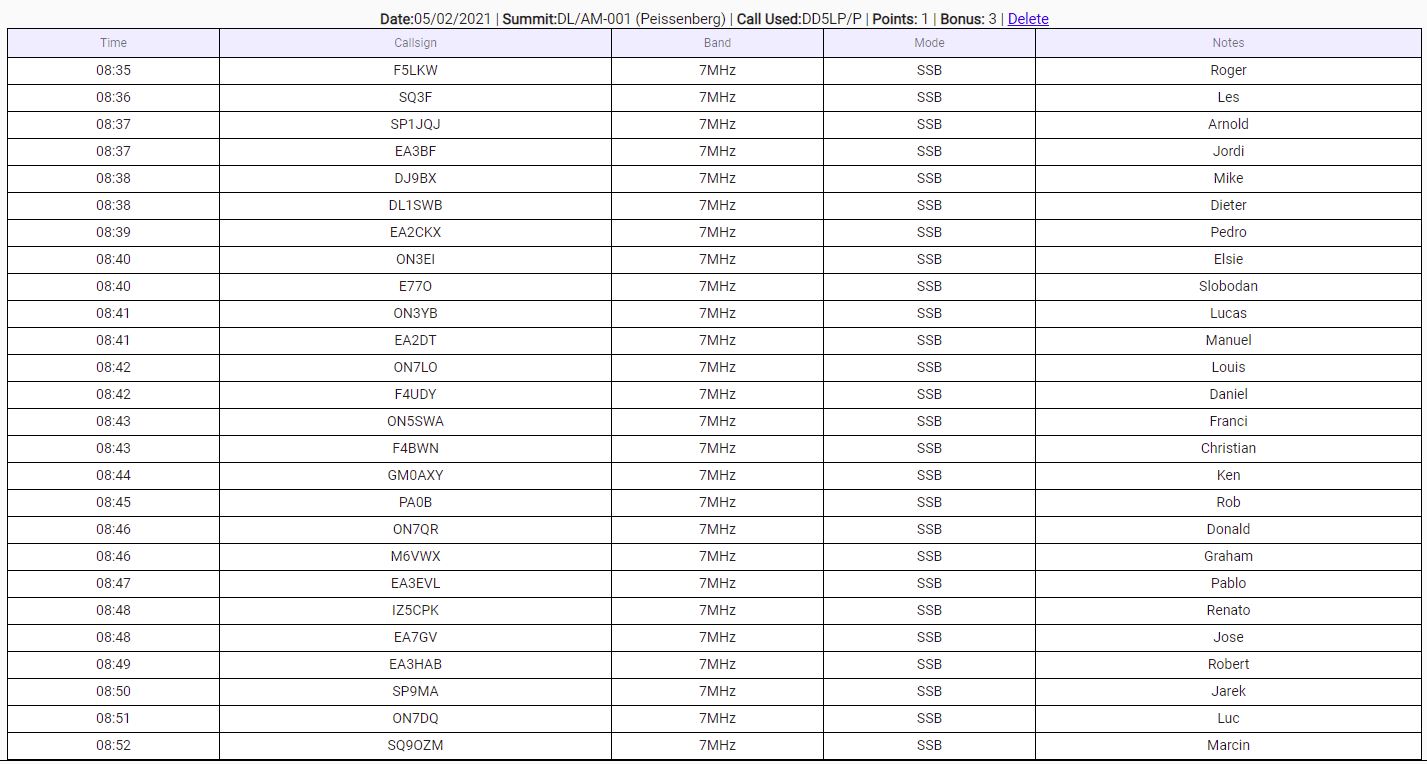
DL/AM-001 Peissenberg


Conclusions:
-
The antenna definitely works. It can be set up on a summit without too many problems but this time I used the surveyor’s tripod for support, next time I’ll try just the ground peg and the 6m mast rather than the 7m one.
-
If the feed cable issue re-occurs I have enough RG-316 coax (that’s the thin, lightweight stuff), so I will simply solder a length onto the feed plate element connectors and put a PL259 plug on the other end.
73 ’til the next summit.





 DD5LP / G8GLM / VK2JI blog
You must be logged in to post a comment.