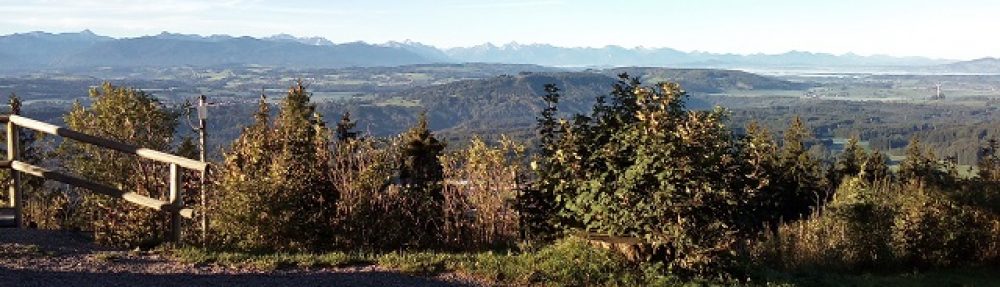
DD5LP/P – April 30th 2024 HEMA DL/HBY-064 & SOTA DL/AM-180 Berndorfer Buchet.

Preparation:

My closest summit is Berndorfer Buchet and as I needed a summit I know to test my latest build of the 2-element HF wire beam, this one pointer was ideal as I had not yet activated it in 2024.

This was the first dry day in about a week and as more rain was expected later in the week, this was to be a quick activation. Just enough time to set up the beam, test it on the analyser and bag a few contacts ideally on 20 and 10 metres.

A relatively late activation was planned, to arrive at the summit by 9 am local (0700 UTC) but despite this the complete station fitted into/onto my 40L backpack would be loaded into the car, Monday evening, the night before to allow an easy departure the next morning.

The Activation

DL/HBY-064 / DL/AM-180 Berndorfer Buchet

As normal I woke 30 minutes before my alarm went off and was all packed and out of the door at 7:30 am as planned for a 9 am (0700 UTC) start. I had hoped to fill the car at a garage on the way but there were so many queued that I decided to leave it for the return journey.

Although sunny, it was still cool. Walking from the parking spot to the open area 15m below the summit, the track was muddy and I hoped that the small area where I intended to set up was not as much of a bog as it was the last time I used it.

Although soft underfoot, the ground had dried enough from the last few days of rain to be usable. After putting down my painter’s sheet, I proceeded to unpack everything from the rucksack. A more complex operation than normal with the HF beam antenna rather than just a dipole or loaded vertical.  Once the mast and antenna were up and the elements/guy ropes positioned, my first task was to run my RigExpert antenna analyser on the beam with it switched to each of its four directions, as while, I had only moved the complete feedpoint electronics from a flat board into a box, there are several things that could have gone wrong. I had done DC connectivity checking but this was the first chance to test the antenna completely.

The first trace (see photos) for the beam on 20 metres (it covers 20 & 10m) with it pointed West, was a little strange with two dips shown. These were OK if a little strange. I then pressed the key fob to turn the antenna to the North and ran another scan – see next photo – this was all over the place. It was worse still when I wanted to clear the trace and try again, the RigExpert analyser would not let me. I tried turning it off – nothing! the trace stayed. Unplugged the coax, no change, so there was nothing for it, but to take the back off and remove the batteries, which I did and I was able to turn the unit on again, but as soon as I tried to take a trace again (this time with the antenna switched back to the known good West direction) the same mess on the screen and the unit had hung up. Luckily I have seen this before – these units don’t like low battery voltage and after once again removing and replacing the batteries, I could see on the startup display that the batteries were low. So, as I had no spare batteries with me I put the analyser away and continued to set up the radio, hoping that the antenna was OK.

Well, the first station in the log was Ernie VK3DET with a 5-5 in both directions, so I guess the antenna was working. Band conditions were all over the place though. Some DX stations (VK4 and Jamaica were booming in while others from Finland were not as strong as usual – with the beam switched north). Ernie reported having just worked some portable stations in the UK with S9+ signals and had expected me to be stronger but 20 metres was in such a mess that in the 10 minutes in between signals had dramatically changed.

After spotting myself on the SOTA cluster I tried calling CQ for 10 minutes on 10 metres with no responders. All I could hear was the local 10m beacon about 25 km to my south – I used this to check the antennas directivity and as before I got 2 S-points less signal off the back and 1 S-point less off the sides. That said, this was not a complete test for the antenna and I will need to plan to go out again and check it with the analyser again, now that it is working fine with some new batteries.

20m had really deep QSB but at least the weather stayed fine long enough for me to complete the activation.  

Photos:

This slideshow requires JavaScript.

Equipment taken:

  • Mountaintop travelling 40-litre rucksack.
  • Xiegu G90 radio.
  • Screw-in sun umbrella base.
  • 7 Metre Zita Fibreglass mast.
  • Komunica Power HF-Pro2-PLUS-T loaded vertical antenna and tripod (not used)
  • Remote switched 2-element wire HF trapped elements beam for 20 & 10m.
  • 4 Ah Eremit LifePO4 battery.
  • 4 Ah LiHV battery(not used).
  • Painter’s thick plastic sheet.
  • Gardener’s kneeling pad.
  • Electrical hand warmer.
  • Suncream.
  • Lightweight headphones.
  • Smartphone for SOTA spotting.
  • RigExpert AA-30 Antenna Analyser. 

Log:

HEMA DL/HBY-064 Berndorfer Buchet


SOTA DL/AM-180 Berndorfer Buchet


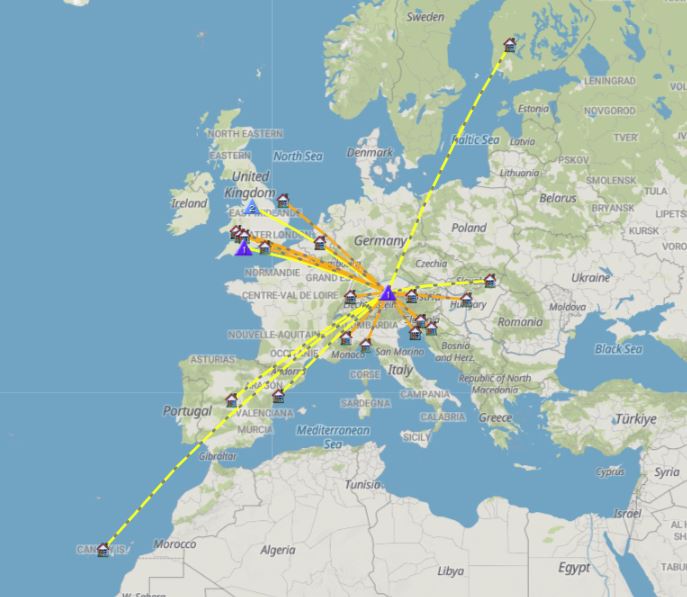
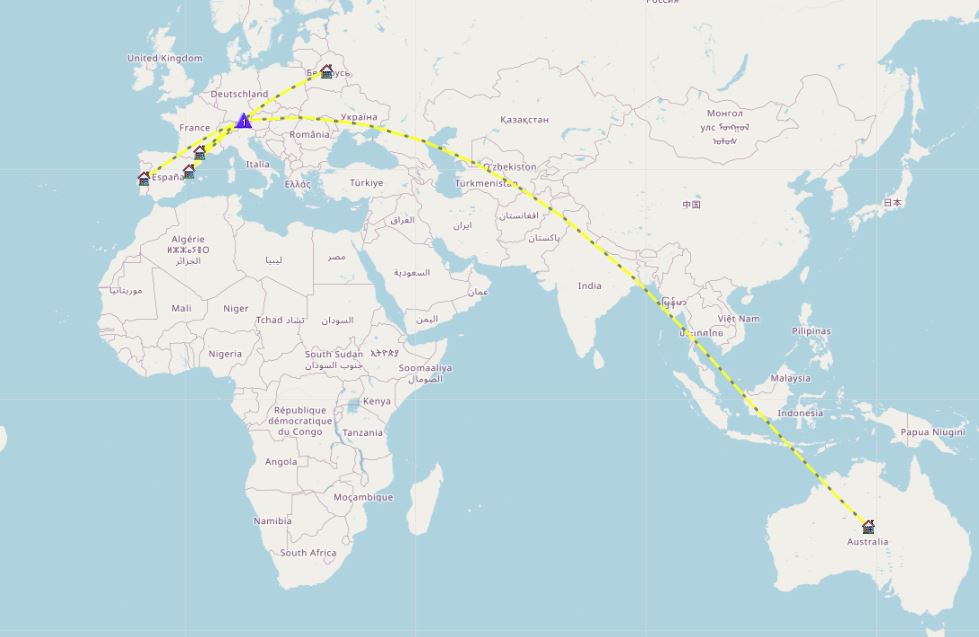
Contacts map
Conclusions:

  • You can never predict what will happen. Thankfully the crazy readings from the RigExpert were caused indeed only because of flat batteries.

  • The band conditions were disappointing overall compared to activations a couple of weeks earlier.

73 ’til the next summit.


DD5LP/P – June 18 2023 – HEMA DL/HBY-064 & SOTA DL/AM-180 Berndorfer Buchet.

Preparation:

Fresh back from my trip to Austria, it looked like John VK6NU was going out while on holiday in Ireland to an EI SOTA summit. Mike (2E0YYY) would also head out to give John a call and to round it off if we both could get to our summits early enough Ernie VK3DET had offered to try for a contact. So a contact with either John or Mike would be both an H2S and S2S contact as my chosen summit is in both schemes.

The set-up would be the tried and tested G90 plus Linked dipole and the 6m mast, all of which pack into, or onto my medium-sized rucksack. However, after struggling with carrying the rucksack over the last few days, I decided to try something different and bought a shopping trolley with fairly large wheels from the local Aldi store for €30. when the shopping bag is removed my 40-litre rucksack sits perfectly on the frame and is held there using the existing straps and clips on the rucksack.

As the Long path window to VK had been opening earlier over the last few days, this was going to be an early start to be on air by 0630 UTC – meaning I needed to set the alarm for 0630 local time (0430 UTC) to get up, drive to the parking area, walk with the (as yet untested) trolley to the summit and set-up the gear ready for operation.

 The Activation

Berndorfer Buchet – HEMA DL/HBY-064 and SOTA DL/AM-180.

This is my closest summit and it took just over 30 minutes to get to the car parking area early in the morning.

Once parked, it was a single action to take the rucksack on the trolley out of the rear of the car, so that saved a couple of minutes. I set off, half expecting to have a problem with the trolley before I got to the summit and then I would need to stop and “de-strap” the rucksack from the trolley and carry it for the rest of the distance. Luckily this did not happen and the trolley served me well, even when “bush-bashing” up the last (steepest) part of the access, where no clear path is available, there is high grass with nettles and thistles in it and the ground is covered with dead twigs and leaves.  

When reaching the summit, I was able to leave the masts in the side of the rucksack, strapped to the trolley, get the linked dipole out of the top of the rucksack, unpack it and thread it onto the top of the mast, run the wires out to roughly where I thought I would be tieing them off on trees and then raise the mast to its full height. This is an improvement on the usual process of screwing the sun umbrella base into the ground, adding the mast and so on.

After also taking my thick painter’s sheet out of the top of the rucksack, I opened up the front of the pack to take out the radio and battery. This whole process worked very well and overall saved me at least 5 minutes, possibly 10.

Once I was set up, I sent Mike 2E0YYY/P a message via the “signal” messaging app (this summit has a good cellphone and hence Internet coverage) to find his frequency. A couple of minutes later we had a contact, weaker than usual but good. At this point Ernie, VK3DET tried to listen for me and gave me a call. Although I could just hear Ernie, it was difficult and again a lot weaker signal than expected. It was no surprise (given the power difference) that he could not hear me. That’s the way the bands are sometimes – however, looking into this later I think I know the reason why;    

MUF during the activation – this explains some of the QSB and other problems on 20m (remember as a general rule, you will get the best DX conditions on the highest band under the MUF line). In short, 17m and even 15m might have been a better choice rather than 20m:

Being a weekend, there was of course the hassle of wide splattering contest stations (and wanna-bees) so finding a free frequency was especially hard on 40 metres but in the end, I got a few contacts in the log from around Europe as you will see from the logs below.

After packing up, thankfully, the route back to the car with the trolley was no more difficult than on the way up.  

 Photos:

This slideshow requires JavaScript.

Equipment taken:

  • Mountaintop travelling 40-litre rucksack mounted on a shopping trolley.
  • Xiegu G90.
  • Komunica Power HF-Pro2-PLUS-T loaded vertical antenna. (not used)
  • Modified mini photo tripod with clip-on radials (not used)
  • Lamdahalbe 6m mini-mast.
  • Screw-in sun umbrella support (not used).
  • SotaBeams linked dipole.
  • Aerial-51 404-UL OCF dipole antenna (not used).
  • 4000maH LiHV battery (not used).
  • 4 Ah LifePO4 Eremit battery.
  • Painter’s thick plastic sheet and gardener’s kneeling pad.
  • Lightweight headphones.
  • Smartphone to spot and back-channel comms. 

Logs:

Berndorfer Buchet

HEMA DL/HBY-064

SOTA DL/AM-180

Contacts Map:

Conclusions:

  • Weather conditions in Ireland meant that John VK6NU never got properly on the air before having to head back down ahead of the storm front.
  • Band conditions were variable on 20m and 40m was almost unusable because of contests that were going on, leaving hardly any free frequencies to operate on.
  • The equipment all worked as it should. The trolley helped with getting the heavy rucksack along the tracks however did have some problems as I went “Bush-hacking” up the final 25 vertical metres of ascent through grass, thistles and fallen twigs on a layer of old leaves. It performed wonderfully, however, as the base support for the antenna once I got to the summit. So “the jury is out” as to whether using the trolley is better than carrying the rucksack on my back. It may be better for some summits than others. It would be easier to pull if the handle was a little higher, so maybe some modifications will happen to the trolley over the next few activations.

73 ’til the next summit.


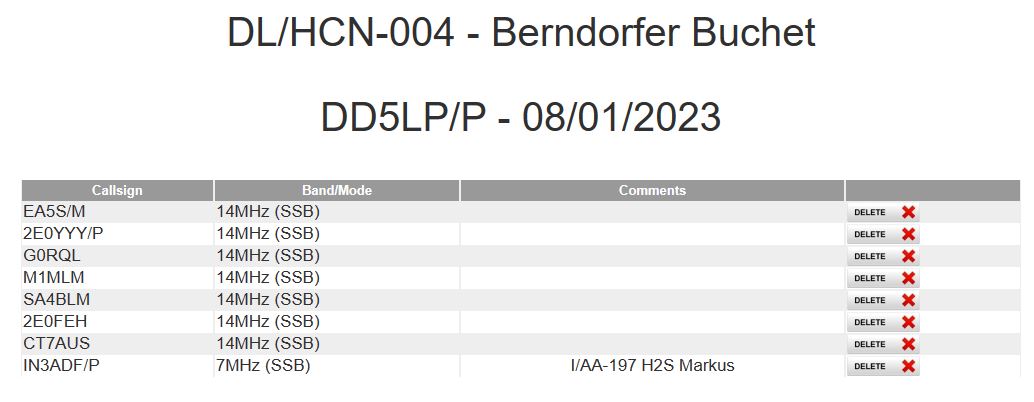
DD5LP/P – January 8 2023 – HEMA DL/HCN-004 & SOTA DL/AM-180 Berndorfer Buchet.

Preparation:

As Andrew VK1AD was going out using the VI10SOTA special event call sign to celebrate 10 years of SOTA in the ACT, I decided to go out at the same time and try for an S2S and an H2S. If the long path band conditions were as they have been, it should be possible with a little luck.

Mike 2E0YYY/P and Ernie VK3DET would get on as well.

The set-up would be the tried and tested G90 plus OCF dipole from Aerial-51 and the 6m mast, all of which packs into, or onto my medium sized rucksack.

All was prepared and put in the back of the car for a 7:30 am start on Sunday morning.

I decided that I would go to my closest summit, Berndorfer Buchet, which is a HEMA summit as well as a SOTA summit and so I alerted in both award systems of my intention of activating it. 

The Activation

Berndorfer Buchet – HEMA DL/HCN-004 and SOTA DL/AM-180.

The good drive down in just over 30 minutes and I was parked at my usual spot by 8:05 am. The walk from the parking spot to the summit takes 15 minutes and with another 15 minutes to set up the station, I was on the air by 07:40 UTC. I messaged Mike 2E0YYY who had just arrived in his local park and Ernie who was heading to his radio shack.

Tuning around 20m was already active with me but dead with Mike in the UK but as time went on this changed. I heard a JI1 (Japan) station but could not get a reply from him to me calls. I also heard and worked very easily EA5S/M in Spain, so I knew I was getting out. VI10SOTA was spotted on several different frequencies, Andrew was obviously having to move to get away from the normal weekend QRM. On some of his spotted frequencies I could hear the chasers calling him but not Andrew himself and that was to be the story of the activation. Although I eventually got an easy contact with Mike in The UK, I couldn’t manage one with Ernie. On a couple of occasions I could hear someone in the noise but I couldn’t say if it was Ernie or not. He of course could not hear anything from me.

As well as 20m, I also got lots of contacts around Europe on 40m. I tried 10 metres as well but it was the DARC 10m contest and so the band was full of loud, wide stations. Even if the band had opened for DX I would not have been able to get through the QRM from the contest stations.

One positive point from the outing, was that the new power lead which I made after the problems I had on the last activation, worked perfectly. Overall this activation in the cold (maximum +5°C) was a bit of a let down compared to “what could have been” but propagation is like that. I would have like to have worked Andrew on his summit in Australia and although some home stations in Europe managed it, it was not to be from where I was.

At least this time, i did not come home with a list of problems to fix, the equipment worked correctly for the whole 2 hours that I was on the summit.

 Photos:

This slideshow requires JavaScript.

Equipment used:

  • Mountaintop travelling 40-litre rucksack.
  • Xiegu G90.
  • Komunica Power HF-Pro2-PLUS-T loaded vertical antenna. (not used)
  • Modified mini photo tripod with clip-on radials (not used)
  • Lamdahalbe 6m mini-mast.
  • Screw-in sun umbrella support.
  • SotaBeams linked dipole (not used).
  • Aerial-51 404-UL OCF dipole antenna
  • 4000maH LiHV battery (not used).
  • 4 Ah LifePO4 Eremit battery.
  • Painters thick plastic sheet and gardeners kneeling pad.
  • Lightweight headphones.
  • Smartphone to spot and back-channel comms. 

Logs:

Berndorfer Buchet

HEMA DL/HCN-004

SOTA DL/AM-180

Conclusions:

  • Band conditions at the time of this activation were not as good as I had hoped they would be and 10m was totally unusable with the local contest being in full swing.
  • The equipment all worked as it should. The combination of the Xiegu G90 with it’s 20 watts and the Aerial-51 OCF dipole even with the small (effectively 5m high) pole continues to work very well. This is definitely a good combination for single backpack portable operation.

73 ’til the next summit.


DD5LP/P – September 30 2022 – HEMA DL/HCN-004 & SOTA DL/AM-180 Berndorfer Buchet.

Preparation:

As long path band conditions on 20m were good I wanted to get out and work VK from a portable location, away from “metro noise” and with a simple antenna and low power. The problem was that the terrestrial weather was not nearly as good as the space weather and we were having constant rain most days. Friday and Saturday mornings looked like they might be better. while I saw that Ian VK5CZ was going out to celebrate 10 years of SOTA in South Australia on Saturday the 1st. October. I thought this would be the best option however as the summit planned for Saturday needed a two-hour walk-in / out it meant that Ian would not be there when the 20m band has been opening up around 0600 UTC so the alternative was to head out on Friday as Ian planned to camp on a summit overnight and hence being on the summit at 0600 UTC (8 am with me, 3:30 pm with Ian) would not be a problem. So Friday it would be and as it turned out with a CME hitting the ionosphere on Friday afternoon, it was the better day in any case.

I decided on going to my closest summit, Berndorfer Buchet, which I had already activated twice this year and hence would not get any points for the activation but that was secondary in this case. This is a HEMA summit as well as a SOTA summit and so I alerted in both award systems of my intention of activating it. I set the HEMA time 15 minutes before the SOTA time.

The Activation

Berndorfer Buchet – HEMA DL/HCN-004 and SOTA DL/AM-180.

The drive down was uneventful and I was parked at my usual spot by 7:05 am. The walk from the parking spot to the summit takes 15 minutes and with another 15 minutes to set up the station, I was on the air by 05:50 UTC. As this was still too early for 20m, I started on 40m and having found a frequency spotted myself on the HEMA website and started calling CQ. Unfortunately, I got a limited response and so at 0600 UTC, I spotted myself on SOTAwatch where I got several more responses. Once these dried up, it was time to take the antenna down and un-link to make the linked dipole into a 20m antenna.

I was very happy to hear Ian VK5CZ/P on VK5/NE-093 come back to my call. he was followed by four other stations from Australia; Gerard VK2IO, Peter VK3ZPF, Andrew VK1AD/M and Ron VK3AFW. So in a matter of seven minutes, I had been called from four different Australian states and all from people I know from my time in Australia. Two more European stations finished the activation. I looked around to find other VK stations and one – Joesph VK3DXJ was hammering in but by this time there were a lot more people on the band and he had an enormous pile-up that I couldn’t break into.  As it was starting to rain, I packed up and was home before 10 am (0800 UTC). This was a short but very successful activation. 

The weather forecasts for the next few days (both terrestrial and space weather) don’t look very good, so it’ll be a few days before I get out portable again. perhaps next time with the new ultra-small G106 radio?

 Photos:


This slideshow requires JavaScript.

Equipment used:

  • Mountaintop travelling 40-litre rucksack.
  • Xiegu G90.
  • Komunica Power HF-Pro2-PLUS-T loaded vertical antenna. (not used)
  • Modified mini photo tripod with clip-on radials (not used)
  • Lamdahalbe 6m mini-mast.
  • Screw-in sun umbrella support.
  • SotaBeams linked dipole.
  • 4000maH LiHV battery (not used).
  • 4 Ah LifePO4 Eremit battery.
  • Painters thick plastic sheet.
  • Lightweight headphones.
  • Smartphone to spot and back-channel comms. 

Logs:

Berndorfer Buchet

HEMA DL/HCN-004

SOTA DL/AM-180

Conclusions:

  • Band conditions at the time of this activation were very good on 20m, making the run of five contacts possible via the long path. the following day a CME hit the ionosphere and I wonder how I would have faired, had I gone out as originally planned on Saturday morning.
  • The combination of the Xiegu G90 with it’s 20 watts and the linked dipole eve3n with the small (effectively 5m high) pole continues to work very well. This is definitely a good combination for single backpack portable operation.

73 ’til the next summit.


DD5LP/P & DL20SOTA – April 23rd 2022 – HEMA – DL/HCN-004 & SOTA DL/AM-180 – Berndorfer Buchet (for EU-NA S2S & First HEMA DL-G H2H).

Preparation:

Because of weather worries, I decided to head back to Berndorfer Buchet which is a current SOTA and a current HEMA summit.

As explained last time HEMA strictly adheres to its rule of including only summits with a prominence greater than 100 metres and less than 150 metres. For historical reasons, SOTA summits are not always over the SOTA rule of a minimum of 150m prominence.  Berndorfer Buchet is one such summit with a prominence of 135m.

The reason for the activation initially was to take part in a long-planned Europe to North America, Summit-to-Summit activity day. It seems the date of 23rd of April was a favourite for others as well and coincidentally this is also International Marconi Day, where many special event stations on both sides of the Atlantic are expected to be on the air. As this year marks 20 years of the SOTA award scheme, the SOTA Baden-Wurttemberg group applied for and got the special DL20SOTA call sign for use during the year. They, however, have a meeting planned for the 23rd and while several US SOTA activators would love to get a Summit-to-Summit contact with the special call sign, I offered to operate their call sign during my already planned activation and this was agreed (I am now a member of SOTA-BW).

This plan was originally based on my going to the DL/AM-060 Laber summit however with the weather forecast saying that heavy rain would start on Laber and surrounding mountains at the time I would be activating, I had to find an alternative. The forecast for Berndorfer Buchet was that there would be no rain (it actually started just as I got back to my car after the activation). So the summit was now to be DL/AM-180 Berndorfer Buchet and I was allocated the DL20SOTA call sign from 2pm local time. I intended to be on the summit at least 30 minutes before that, which meant I could activate the HEMA code for the summit (DL/HCN-004) under my own call sign as a test of equipment prior to starting with the special call. While the DL HEMA association has not as yet had an H2H (Hema to Hema) contact, perhaps that would also be possible.

So I had a lot of things planned in what would be a somewhat more complex action with two call signs and two hill references. 

I would stick with the now tried and true configuration of G90 radio and linked dipole antenna on the 6m mast with everything fitting into or onto the medium-sized (40L) rucksack.

The Activation

The trip to the car parking spot for the summit was uneventful. It took under 30 minutes from my home. On arrival, there were three other cars in the parking spot (normally it’s empty) so I thought I might run into some people during my planned 3-hour stay – I didn’t.

After a determined walk into the forest and up the last part of the summit, I arrived at around 12:45 local (1045 UTC) and started to set up the station. As some of the trees here have been cleared, I thought I would see if I could find the trig-point stone which I found several years ago. I couldn’t – perhaps it has been removed or one of the forestry vehicles has run over it and pushed it into the ground?

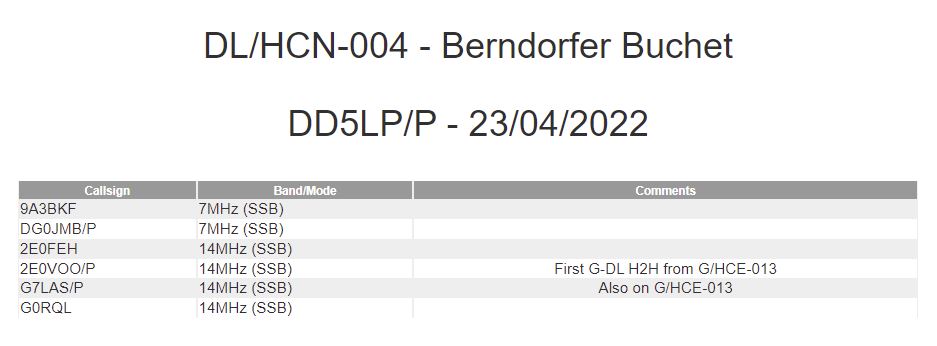
I had arranged with Rob G7LAS that I would be looking for a Hema H2H contact before 14:00 local (1200 UTC) when I would be switching to the special event call sign and the SOTA summit reference and I expected to be kept quite busy. I started on 40m expecting that 20m would be too close for a contact to the UK with the skip distance. I planned to start using DL20SOTA/P on 20m at 1200 UTC with the intent of giving some S2S contacts to some North American activators. Unfortunately, Rob was delayed in getting to his summit and it was 1220 UTC before we made the contact. At first, it was not G7LAS calling me but rather Rob’s son Ben 2E0VOO/P. I was somehow able to weave this first H2H contact in between the DL20SOTA activation calls. We made contact easily on 20 metres (that should have told me conditions were short skip and Dx would be difficult).

In HEMA, it is not all points, points, points from summits – indeed unlike SOTA where a summit can have a “value” of between 1 and 10 points, in HEMA all summits are worth just one point and the scale of measurement is how many unique summits you have activated or worked and how many H2H contacts you have made. The very first H2H contact between two associations also wins a certificate, so Ben and I will be getting those.

Once the HEMA related activity was out of the way with six contacts in the HEMA log, I could get back to operating DL20SOTA and giving out the SOTA summit reference.

It was interesting that both on 20m and 40m there were bursts of activity mixed with times where the caller liked to talk a little (which is fine). Those wanting the contact waited patiently until the long call was over and then we were off again, just giving an exchange and moving on to the next caller.

DL20SOTA/P under my control made 70 contacts from around Europe. Of those 10 were unique S2S contacts with another three that were activators sharing a summit with each other. So I could say there were 13 S2S contacts. The one non-European contact was “interesting”. While calling CQ on a 20m frequency that I had been on, for over half an hour, I heard another station calling CQ when I released the microphone. This was VU2DED in India, I pointed out to him that the frequency was in use but I would be happy to give him a QSO with the special event call. We had a reports exchange and then he started calling CQ on my in-use frequency again and European stations started calling him. I decided to leave him the frequency and switch to 40m to see what was happening there.

Overall the equipment worked very well with mostly 59 or 59+ reports and a good flow of callers. It’s a while since I have been able to get the voltage down on one of the two 5Ah LIPO batteries so that the radio closed down but it happened on this activation. 

I would have liked to have achieved a contact with a North American activator but it wasn’t to be. Perhaps this is the wrong time of day for the propagation or simply that it was too early for the US and Canadian hams, most of whom were probably still in bed, depending upon how far west they are located.

With the fact that 20m has been open from  Europe to Australia and New Zealand every morning this week, we should have had the EU-VK S2S event, not the EU-NA one on this day but as these events are planned well in advance we cannot predict what propagation will nor even less what the terrestrial weather will do!

 Photos:

This slideshow requires JavaScript.

Equipment used:

  • Mountaintop travelling 40-litre rucksack.
  • Xiegu G90.
  • Komunica Power HF-Pro2-PLUS-T loaded vertical antenna. (not used)
  • Modified mini photo tripod with clip-on radials (not used)
  • Lamdahalbe 6m mini-mast.
  • Screw-in sun umbrella support.
  • SotaBeams linked dipole.
  • Battery box (2 x 5000maH hard-case 4S LIPOs) – both batteries used.
  • 4000maH LiHV battery (not used).
  • Painters thick plastic sheet.
  • Lightweight headphones.
  • Smartphone to spot and back-channel comms. 

Logs:

HEMA (DD5LP/P)


SOTA (DL20SOTA/P)


Conclusions:

  • The weather was colder than predicted and I was glad I had my thick winter jacket on, I had considered changing to a thinner one but it’s always better to be too warm than too cold.
  • It was complex handling the change-over between HEMA and SOTA and those who called me for both summit codes and call signs were confused. In the end, I hope everything was clear.
  • The main purpose of the activation – S2S contacts with North American stations did not work out. The only North American stations that were spotted were either using 2m FM or 10m CW. As far as I know, no one managed a cross-Atlantic S2S on SSB, perhaps there was one or two on CW (but even that isn’t clear at the time of writing).
  • I was really happy that the equipment worked reliably however the fact that when the voltage gets low on the G90, it turns off is fine but that it also turns the power down to 1W from 20W and turns off the speech compressor surprised me. I’ll know next time.

73 ’til the next summit.


DD5LP/P – March 7th 2022 – HEMA – DL/HCN-004 & SOTA DL/AM-180 – Berndorfer Buchet.

Background – Double summit.

Some of you may recognise the name of this summit from my previous reports. Berndorfer Buchet is a current SOTA and a current HEMA summit. How can this happen? Well HEMA strictly adheres to its rule of including only summits with a prominence greater than 100 metres and less than 150 metres. For historical reasons, SOTA summits are not always over the SOTA rule of a minimum of 150m prominence.  

Preparation:

This activation would be the first activation of a summit in the HEMA Southern Bavaria Central region and I wanted to get out to see what conditions were like portable into VK, early morning (around 0800 UTC). While a group of us had been making contact from home around this time, I seemed to be getting a far better report from Ernie VK3DET, than I was giving him. I have checked antennas and equipment and we are both running about the same power level. Ernie has a 3 element beam and I am only using a wire sky-loop antenna but none of this really explained the difference. I had also looked into whether the use of different antenna types, could cause the angle of incidence to the Ionosphere to be different and hence change the skip distance and coverage area at each end. Perhaps man-made noise levels could be the cause? The portable operation would be another research action. If I were to be able to work Ernie, this would be with an even simpler dipole antenna not far off the ground sending signals to Ernie’s 20m Yagi beam.

The weather had been extremely cold of late and was staying that way, so the early start needed for the radio window to Australia would be a test of my fortitude as well as a test for the equipment!

As usual, I packed the one rucksack full of equipment into the back of the car the night before the activation, so I could get an early start.

The Activation

The trip to the car parking spot for the summit was uneventful. It took around 35 minutes from my home.

On arrival, I could see that a lot of tree-felling had been done and the logs were pilled up ready for collection. Unfortunately, the track that I walked up to the summit was quite a mess, hopefully, the forestry people will repair it after they take the wood out. I had packed my screw-in sun-umbrella base on the side of the rucksack and this was the first thing to be unpacked on the summit. I screwed it into the same old tree trunk remains that I have used for the last five years. Next was the 6-metre fibreglass mast and linked dipole, with the links set for 20m as I had planned to only operate on 20m so that I would not need to be on the summit longer than needed.

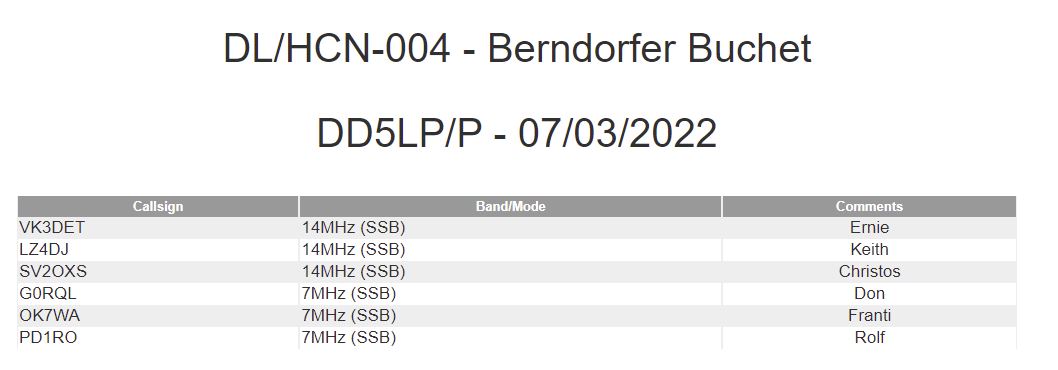
Sending a quick note via the Signal app, which serves as our “back-channel” when we test, Ernie was there straight away in response to my CQ call. We exchanged 58 / 56 reports for this 24,000 km / 15,000 mile SSB contact via long path.  The 13 dB difference in power levels (I was using 20w, Ernie 400w) matches the 2-S point difference in reported signals. So this seems to confirm the point about the received noise level causing the imbalance in reports from the home location. After Ernie, I worked Keith, an ex-Pat Brit living in Bulgaria with the call LZ4DJ and Christos SV2OXS from Greece. Although spotted on the HEMA & DX Clusters I received no calls from the UK and Mike 2E0YYY using the Hack Green SDR could not hear me at all. The 20m band was obviously “running long” as normally I would get calls from the UK. I hadn’t planned to, but as I was still missing one contact to qualify the summit, I took the antenna down and switched the links to 40m where I bagged another three contacts reasonably easily.

The over-bearing problem on this activation was not the equipment, nor the propagation but rather the weather. When I decided to go QRT at 0900 UTC it was still minus 3 degrees centigrade and there was an icy wind starting. In these conditions, the best action is to close down and head back to the car, which I did.

 Photos:

This slideshow requires JavaScript.

Equipment used:

  • Mountaintop travelling 40-litre rucksack.
  • Xiegu G90.
  • Komunica Power HF-Pro2-PLUS-T loaded vertical antenna. (not used)
  • Modified mini photo tripod with clip-on radials (not used)
  • Lamdahalbe 6m mini-mast.
  • Screw-in sun umbrella support.
  • SotaBeams linked dipole.
  • Battery box (2 x 5000maH hard-case 4S LIPOs).
  • 4000maH LiHV battery (not used).
  • Painters thick plastic sheet.
  • Lightweight headphones.
  • Smartphone to spot and back-channel comms. 

Logs:

HEMA

SOTA


Conclusions:

  • The weather was on the borderline of dangerously cold and if this hadn’t been a summit that I know well, I may well have cancelled. Learning – know your limits and be prepared to shut down and go home earlier than planned.
  • It does seem that the reason that I can not give Ernie as good a report at my home station as he gives me, is the local noise level. Ernie is out on a farm where I live in a modern village. So electrical QRM is likely to get worse rather than better!
  • I was really happy with the contact with Ernie VK3DET – it just shows what a portable location can provide if you are there at the right time, even with low power.
  • No comments on the equipment – everything worked as it should including the Xiegu G90 radio which continues to perform well, especially on receive.

73 ’til the next summit, be it HEMA or SOTA – or perhaps BOTH again?


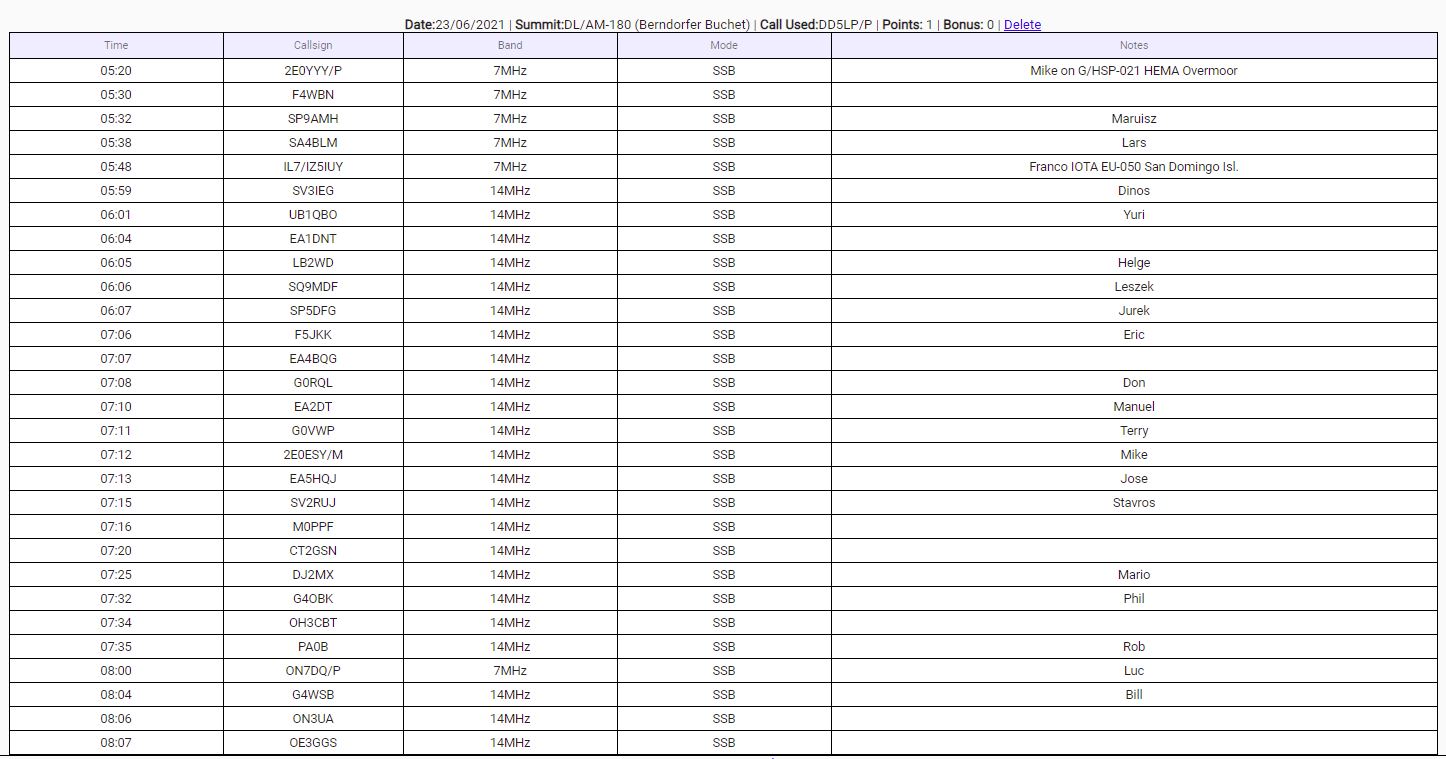
DD5LP/P – June 23rd 2021 – DL/AM-180 Berndorfer Buchet.

Preparation:

As we had now moved into hot summer days, where being on a summit later in the day was not be recommended, I decided to do an early morning activation when it was still cool. At the same time, I wanted to get a 40 metre Grey Line contact from a summit into ZL and possibly VK.

The conditions of late, hadn’t been so great and the SFI had dropped so it was quite possible that only a Grey Line propagation contact would be possible into VK/ZL and not the long-path F-Layer communication, but “who knows”? This would also be my second outing with the new XIEGU G90 radio.

Mike 2E0YYY kindly offered to go out to his local UK HEMA summit “Overmoor” G/HSP-021 at the same time and Ernie VK3DET and Ian VK3YFD would try to be listening from Victoria, Australia.

I decided on the one point Berndorfer Buchet summit as it is my closest summit and I hadn’t activated it in 2021 yet. My plan was to be operational by 0500 UTC (7am local time). so a short driving time means more time to wake up and have breakfast. Little did I know that there would be a road closure and diversion on my shortest route! The alarm was set for 05:30 local time and all equipment packed into the one (quite heavy) rucksack. The planned equipment was the new XIEGU G90 radio, battery box plus my new LiHV battery, my 6-metre mast with sun umbrella base and my linked dipole. As a backup, I would have my OCF dipole and the loaded HF vertical/tripod/radials configuration (hence the heavy backpack). 

The Activation

The trip down to Berndorfer Buchet normally takes 20-25 minutes but this day, the council had decided to do renovation work on part of my route adding 20 minutes to the first half of my journey and so dropping me into the time when many tradesmen are heading to work to be further delayed on the small country roads where overtaking is almost impossible. The result being that I arrived at the car park at Kerschlach around 7 am local time – when I had hoped to already be operational on the summit. It was raining and there was a cold, wet mist around. This was only to clear up and the sun to come out when I was packing up three hours later. I set off through the forest and up to the summit getting the gear set up and operational by 0520 UTC. As a change to my normal installation, I ran the linked dipole east-west rather than north-south. While at this height, the antenna is omnidirectional, the advantage of running it E-W is that it runs along the small ridge of the summit rather than down each side and hence the ends of the Inverted-V configuration are a little higher.  My first contact was with Mike 2E0YYY/P (so is that an H2S or an S2H contact?)  in any case he told me he had just worked Ron ZL4RMF in Dunedin, New Zealand (I often work Ron from my home station and he is always a pleasure to work), so I said 73 to Mike and headed off to find Ron – there he was a solid 55 signal but by now the pileup had arrived and I had no chance of getting through. When the hub-hub did finish and I might have had a chance, Ron either went off to 80 metres or for his evening meal. I did not have an easy way to check the DX Cluster (I must add a cluster monitoring app to my phone). Had I been on the summit 20 minutes earlier, it may have been before the amateurs in the UK could hear Ron and I think I would have had a good chance of a QSO with him as he is also in a location with a low background noise level. What I did realise during this activation was how the receiver in the new rig excels with no local “metro-noise” I was hearing lots of stations such as Jim E51JD in the south cook islands but with the high powered callers, again I had no chance of getting through although I’m sure he would have heard me.

During the 3 hour activation (a long one for me) I heard at workable strength’s ZL4RMF, Ron, (40m), E51JD, Jim (20m), VK3YFD, Ian (twice) 20m and K9TK BOOMING in from Florida on 20m. There was also some quite deep QSB on 20m, but I suspect this was related to the MUF only just getting above 14 MHz earlier in the activation.

What this outing has proved to me is when you get a good radio outside, even just with an inverted-V dipole at 5m AGL – you can hear the world! The problem is that with all the other impatient mega-watt home stations, the DX stations don’t often get a chance to hear lower power stations.

The SDR and waterfall proved useful when looking for a clear frequency but that didn’t help the one time when, by accident, I chose the SSTV calling frequency (14230) – oops -sorry! Even after finding a valid free frequency and checking it is free what often happens is that some idiot starts up 1-2 kHz off your frequency with modulation set far too high and never checks before calling! GRRR!

This was the longest activation I have done for some time with almost 3 hours on the summit. I actually managed to drain one of my 5Ah Lipo batteries so that the G90 reduced output power drastically at about 9v on load (receive kept working perfectly). I have two 5Ah Hardcase Lipos in my battery box, so it was just a matter of swapping the cable over and I could continue. Had it been needed, I also had a 4Ah LiHV battery in my bag as well.

Although it would have been nice to make a contact into VK or ZL during this activation, I am happy with the outing – I have 36 contacts in the log, including one H2S and one S2S contact and most importantly I have a station in one rucksack with everything needed, including a mast – a mast foot – a tripod mount with radials, two inverted_V antennas (one linked dipole, one OCF) and a loaded vertical that can do 80m through 70cm.

The G90 receiver, now that I am a bit more used to using it, is amazing! Certainly IC7300 class if not better and when I have been received, I have only had good comments about the transmit audio and I ran the whole time with speech compression on today.

 Photos:

This slideshow requires JavaScript.

Equipment taken:

  • Mountaintop travelling 40-litre rucksack.
  • Xiegu G90 transceiver.
  • Battery box with 2 x 5000 maH 4S LIPO batteries.
  • 4000 maH 3S LiHV battery (not used).
  • Komunica Power HF-Pro2-PLUS-T loaded vertical antenna (not used).
  • Modified mini photo tripod with clip-on radials (not used)
  • Lamdahalbe 6m mini-mast.
  • Screw-in sun umbrella base.
  • SotaBeams linked dipole.
  • Aerial-59 OCF dipole (not used)
  • Painters thick plastic sheet.
  • Lightweight headphones.
  • Smartphone with PocketRxTx App and USB cable acting as an external display to the rig. (not used).

Log:

Conclusions:

  • The G90 performed brilliantly – the receiver combined with the spectrum scope/waterfall, despite its small size, is really useful
  • I need to add an easy to use DX-Cluster displaying app to my phone, to see where the DX stations have gone to. 
  •  That 20 minutes delay with the road diversion was a problem and now I know it’d have been quicker to have turned around and taken a different route rather than follow the signposted diversion. 
  • Running the antenna at 90° to my normal direction seems to be better, perhaps only because having the ends of the Inverted-V higher does help?

73 ’til the next summit.


DD5LP/P – November 25th 2020 – DL/AM-180 Berndorfer Buchet – a lesson in strange propagation.

Preparation:

With the SFI breaking 100 in what must be the first time in almost five years, it was time to get out and get some summits activated before the COVID lockdown rules were changed again.

The original plan was to activate DL/BE-093 Irschenhausen and then go on to DL/MF-082 Schwarzer Berg, both of which I have not activated this year. Then two things happened – Mike 2E0YYY suggested we both try for contacts with Ernie VK3DET and Ian VK3YFD and that would mean an early start, plus I realised that Schwarzer Berg has 3 winter bonus points starting from December 1st (in a week), so would I want to do the almost 3-hour round-trip again in a week or 10 days time? No. So my revised plan became – head to my closest (already activated this year) summit – Berndorfer Buchet for the contacts into VK and then head on to Irschenhausen afterwards.

As it turned out because of cold, fog and a worry that something wasn’t right with the rig, after the Berndorfer Buchet activation, I headed home. The one pointer Irschenhausen can wait for another day.

I decided to do a comparison between my two most used antenna on this activation. The SOTABeams “band hopper” linked dipole and the Komunica HF-PRO-2-PLUS-T loaded vertical antenna, so both sets of antenna and accessories were loaded into my medium-sized rucksack and along with my screw-in foot (intended for sun umbrellas but great for holding up the 6-metre squid pole) and just in case, my 10m mast and modified surveyors tripod, all were loaded into the back of the car on the evening before the activation.

So all packed for what was planned as two easyish activations which turned into just one.

The Activation:

The trip across to Burndorfer Buchet went without any problems. When I set off it was clear visibility at about halfway, the fog came down and on arriving at the Kerschlach car park the fog was almost cleared (to return later).

The 10 metre mast and surveyors tripod got left in the car as the rucksack on its own was heavy enough for the walk up the forest track and up the final climb (which I found blocked by recent tree trimming actions and so had to take a slightly different route to usual). The last part of the climb is often covered in leaves and twigs that are easy to fall through so care is needed but I arrived safely at the summit. The only way to identify this summit is either by the map or to find the trig-point stone but that is often covered by undergrowth. There is no summit cross or identification sign on this summit.

 This was a confusing activation as I could hear VK and ZL stations from the summit on 20m but they couldn’t hear me – even spotting myself and putting out multiple CQ calls – I got no replies. When I changed to 40m though, everything was fine and even some of the chasers on 40m, said they had listened for me on 20m and could not hear me. The equipment used on bath bands was the same.

I used both antennas on 20m and 40m – the loaded vertical and the linked dipole. With the linked dipole I’ve worked into VK before on 20m from that summit and all around Europe as well. I wondered if it was an intermittent fault – but everything (SWR etc.) all looked fine and I know I had each of the antennas set correctly to 20m. The strength and clarity of the signals coming out of VK and ZL were amazing! ZL1ACE was literally 30 dB over 9! OK, he was running 750w and using a 3 element Opti-Beam, so he has a great station but even so, that signal was unbelievable! Ian, VK3YFD (who was trying to work Mike 2E0YYY/P) was also a very comfortable 57. Ernie VK3DET (same group) who runs lower power was 55 at one point and I was listening to those two talking to each other as if they were locals to me during the time that they could not hear Mike. Of course, they didn’t hear me trying to break in. With SFI at 100, the conditions this morning on 20m were great. Mike did get through to both VK3s later on. Mike, on 20m, was never strong enough for me to work on 20m. On 40m, no problem between us apart from some QSB, which tells me the skip on 20m was ultra-long and favouring VK to EU/UK rather than EU/UK to VK. I might have had a better chance 30 minutes earlier than when I arrived on the summit. I got there at 0720 UTC and it was -3°C at the time (30 minutes earlier would have been even colder!). It only warmed up a little, 2 hours later when the sun kindly melted the ice off the tree branches so the I had rain with no clouds in the sky. The fog that had cleared then returned, so this was not a very pleasant operating environment.

I did get some antenna tests done though.
The loaded vertical on 20 metres receives 1.5-2 S-points better than the dipole at about 5 metres AGL.
I don’t know how the two antennas compare on transmit as I could not get one contact on 20 metres on either antenna!

On 40 metres working Mike, the loaded vertical was one S-point down on receive and 2 S-Points down on transmit, compared to the dipole.

Whether the vicinity to vertical, wet, trees will have affected the vertical antenna more than the dipole, I don’t know but certainly on 40m – it is possible to work stations using a vertical on a wooded summit – some had said that would not be possible.

Photos:

This slideshow requires JavaScript.

Equipment:

  • Xiegu X108G.
  • Battery box (2 x 5000maH hardcase LIPOs).
  • SOTABeams linked dipole.
  • Screw-in sun umbrella base.
  • 6 metre LambdaHalbe fibreglass portable mast.
  • Komunica HF-PRO-2-PLUS-T and my modified photo-tripod.
  • Thick plastic painters sheet.
  • Smartphone PocketRxTx App and USB cable.

Log:

Conclusions:

The activation ended with more questions than answers and overall was a little disappointing but it is all part of the education that we get in this great amateur radio hobby of ours.

73 ’til the next Summit!

DD5LP/P – May 8th 2020 – DL/AM-180 Berndorfer Buchet.

Preparation:

With the mobility restrictions from the COVID-19 pandemic lock-down being lifted two days earlier, this was my first chance to get out onto a SOTA summit again.

On the 7th. I had worked Ron, ZL4RMF from his superstation in Dunedin from my home QTH at 05:20 UTC and so I sent him an email asking if he might be on the following day about the same time (long path time for New Zealand to Europe contacts) and he kindly said he would be happy to listen out for me. Given the early time, I needed a close summit and Berndorfer Buchet is my closest summit and while only one point, I hadn’t actually activated it this year as yet.

During the lock-down, I had investigated why I was getting RF into the audio of my portable rig (the Xiegu X108G) when using it with my portable 70w RF amplifier. I tried everything to screen all inputs but in the end, it turned out not to be RF ingress (although it sounded like that). The problem was in fact that the Chinese amplifier module that I had set-up exactly to the provided instructions was not running in class AB1 as it was supposed to be but when in use was going into class B or even class C amplification which of course distorts badly an SSB signal!

The problem was found, corrected and then tested firstly local into a dummy load and then via a WebSDR in the days before this activation, so the activation would be the proof of whether indeed now everything was OK.

Berndorfer Buchet is just 30 minutes drive away from home but to make sure I would not be too late for the possibly ZL contact, everything was packed into the car, the night before – including a spare antenna and small tripod.

So the equipment to be used would be the Xiegu X108G, the 70w portable amplifier, the 10m mast and surveyors tripod to support it plus I would also take a new external speech processor to test out if I had time, alongside the built-in one. As always the rucksack had the linked dipole and the 40m OCF antenna (just in case). The extra antenna and tripod I mentioned above are the Konumica HF-Pro2 loaded vertical and a photo tripod, which stays in the new rucksack in any case. Given that Berndorfer Buchet has a forest on top of it, having to revert to using a vertical antenna would be a last resort.

So all packed for what should be an easy activation with the small chance of a nice contact to Ron in New Zealand again.

The Activation:

The trip across to Burndorfer Buchet went without any problems and I arrived at the parking area about 10 minutes ahead of my schedule. Ten minutes that I would need later.

The walk from the road up the forest track while a little cool is nice in the morning. A small deer ran across about 10 metres in front of me – no fear, that is simply the way it goes to get to its feeding area or whatever. The last part of the climb and often covered in leaves and twigs that are easy to fall through, but this time a large forestry vehicle had been part of the way up the slope and made a really muddy mess, that I had to work my way around with my new “Mountaintop” rucksack on my back (appropriate name HI) and the large surveyor’s tripod with the 10m fibreglass mast packed inside it over one shoulder.

Suffice to say when I got to the summit, I was somewhat out of breath! After a slug of water and a quick check around, I started by putting the tripod and thee mast up ready to take the antenna. Then out came the thick green plastic sheet and all of the equipment including the linked-dipole antenna which I intended to use. On taking it out of its plastic bag, I got an unfortunate surprise. One complete leg of the antenna was no longer attached to the feed-point. I considered whether I could somehow work out a way to fasten it together but as the antenna wire also forms the guy rope for the mast, I decided that might not be such a good idea. I always have a second antenna with me and I’m not talking about the loaded vertical HF-Pro2 – I had left that in the car as it would not have radiated with all the trees soaking up the radiation. I’m talking about the Aerial-51 404-UL off centre fed dipole. This antenna has the advantage that it will work on multiple bands without having to be taken down. It has the disadvantage of having to have a 4:1 balun which is additional weight at the top of the mast. In any case, I was glad I had the antenna in the rucksack and that became the antenna for this 40-metre activation.

Once I had all the equipment connected up and turned ion, I started tuning around 40 metres as Ron had told me around what frequencies he normally tried to operate on. The band was electrically noisy, which is strange as there are no buildings anywhere near this summit – so the interference was coming down from the Ionosphere. The signals that I could hear on the band (and there were lots of those) were varying dramatically with QSB. I was starting to doubt whether I would manage any contact with Ron from my portable set-up. In any case, I wanted to try out the amplifier, so rather than immediately calling for SOTA, I went and did some search and pounce but wasn’t able to get any contacts so I put up a spot and called for SOTA contacts. My first reply now was not a SOTA chaser at all – it was Peter G8HBS who had simply heard me calling CQ and called me. We exchanged similar 55 / 56 reports and then I moved on and Terry from York G0VWP called me and again we exchanged similar reports, this time 57 both ways. No one was complaining about my signal being distorted, all was OK with the amplifier – that’s one item off the to-do list completed. I then had a call from Leonardo in Italy IW0QO and this time the signals were not balanced with me giving Leonardo a 59 and getting just a 52 – but that’s OK, the Italians tend to run LOTS of power.

As the SOTA contacts dried up, I went hunting for Ron again and came across a UK station who was also looking for him while talking to some other UK station – so I knew that conditions were perhaps not good enough yet for New Zealand or perhaps simply not good enough, full stop. While tuning around I came across Peter near Belfast in Northern Ireland MI0AIH and had a bit of a chat with him and then tested how well he could hear me without the amplifier so I went down from 70w and turned up the Xiegu to its maximum 20w. result? Peter could hear I was there without the amplifier but could no longer understand what I was saying because of QRM. With the amplifier on, we exchanged 59/57 reports.

By this time I had just about given up on getting any contact with Ron when  I came across that UK station – Rob, M0KPD/M who had been looking for Ron as well. When he finished talking with Per DK7LJ I gave him a call to ask if he had found Ron ZL4RMF. Instead of Rob coming back to me, Per did and once he recognised my callsign, he said that he had worked Ron and Ron had been looking for me. Per checked and indeed Ron was still listening on frequency and Ron and I managed a contact. Not nearly as good as from my home station the day before but despite conditions being worse we did manage a 54 / 45 contact – so the contact was made. When Ron had to go, I carried on talking with Per in Keil in North Germany and he has TWO 40 metre capable beams – one with 3 elements on 40m and one with 4 elements – unreal! No wonder he can get through to Ron in New Zealand on most days!!

The short activation ended very nicely in the end. I didn’t manage to test the speech processors but that’s now something for the next activation.

Photos:

This slideshow requires JavaScript.

Equipment:

  • Xiegu X108G.
  • Battery box (2 x 5000maH hardcase LIPOs).
  • SOTABeams linked dipole and Aerial-51 404-UL OCF dipole.
  • Surveyors tripod.
  • 10 metre DX-Wire fibreglass portable mast.
  • Thick plastic painters sheet.
  • Smartphone PocketRxTx App and USB cable.

Log:

Conclusions:

The portable amplifier is working well. When I dropped it off-line as a test with the station in Northern Ireland he noticed a difference immediately. I “guesstimate” 2-S-points improvement using the amplifier over the 20w from the X108G on its own.

My very quick test with the internal speech compressor proved nothing and I need to test how this should be set (and whether the external DYC-817 is any better) on an activation where I am not in a rush to pack up and leave. as was the case on Berndorfer Buchet as we had a short family outing planned for 10am.

The fact that the linked-dipole broke as I was taking it out of its bag was just unlucky and in the meantime, it is repaired and ready for use again.

The contact with Ron in Dunedin, New Zealand is 90% down to his great station and the help from Per DK7LJ letting Ron know that I was there, but contact was made, the radio waves travelled half the way around the world and back again and this on 40 metres at the bottom of the solar cycle!

73 ’til the next Summit!

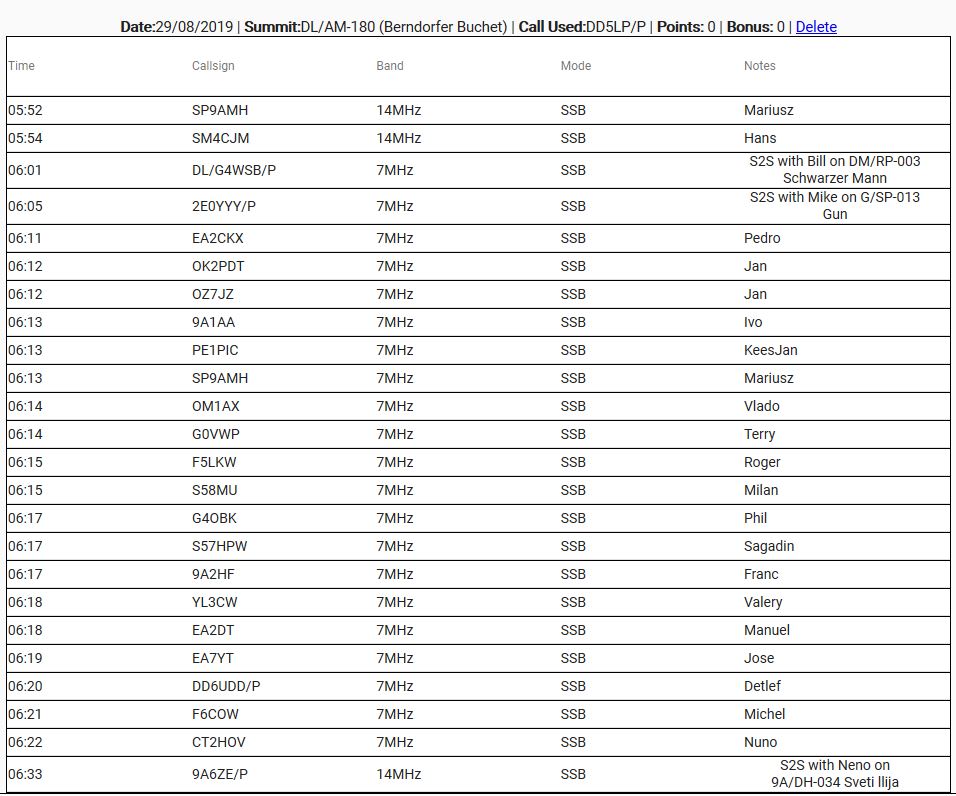
DD5LP/P – August 29th 2019 – DL/AM-180 Berndorfer Buchet.

Preparation:

The primary aim of this activation was to get out again after a time away from activating. To test the equipment (and I) still work. As we have had some small improvement in conditions caused by PAE (Pre-Auroral-Enhancement) over the last few days, I was hoping for perhaps a contact into VK or ZL.

Berndorfer Buchet is my closest summit, being 30 minutes drive away from home however as I had already activated it once this year I would not get the one activation point for the summit. As it turned out I got 3 S2S contacts so that was a good by-product of what was more or less a testing excursion.

As I had decided to try for a VK/ZL contact I planned the use of the linked 20/40m VP2E antenna. The very summit at DL/AM-180 is wooded however and there’s only a little clearing, with nowhere enough space to fit the VP2E in. Plus the VP2E as the name indicates is a Vertically polarised two element wire antenna and vertical antennas do not work well in forrests as the trees absorb the transmitted signal. Just down from the summit however, there is a flat area, still within the activation zone but often quite damp underefoot. This is where I would put up the antenna. Because of its length, the antenna needs to be supported on the 10 metre mast and that I support with my surveyors tripod as there are no suitable other supports for the mast in the area.

My plan was to be on the summit by 0600 UTC which meant setting the alarm for 6am local time and then get ready and leave the house as quietly as possible. To help with this I packed everything I could in the car, the night before.

The Activation:

The trip across to Bernorfer Buchet took exactly the expected 30 minutes, however as I set off at 6:40 am local rather than the planned 7 am. I was at the car park ready to start the 10 minute walk to the summit in plenty of time.  As I approached the area where I planned to set up, it was obvious that the constant rain overnight had made the area very boggy in places, so some care would be needed in setting up the station. One improvement that I implemented this time was to put the 10m mast between the legs of the tripod and fold them up, so i had one less piece to carry (I have been laying the mast on top of tripod when I carried it over mty shoulder but this still needed a hand on the top to stop it falling off – the new solution worked well and will stay as part of the “standard processes” as I normally need the tripod when using the 10m mast.

Once at the site, I took a guess at where i would need to set-up the tripod and only had to move it once as I ran the antenna out. One end of the antenna was tied to a tree branch at about 2 metres high, while the other (front) end went down and was tied to a plastic stake. Although I carried my modified telescopic walking poles with me, they didn’t get used this tim to lift up the ends of the antenna.

I had decided to start on 20 metres as the most likely to supply some DX so the antenna was erected with the links open. I had considered putting my traps in, meaning I could use the antenna on both 20 & 40m without having to lower it to change bands but I’m not sure how much signal I lose through the traps and until I’m sure that it’s not important, I will continue with the manual linking and unlinking to change bands.

As I self spotted on 20m, I saw that most other activators were on 40m but I persevered and after my CQ got calls from Poland and Sweden at a good strength but the 20m band was very quiet so it certainly hadn’t opened yet. After a couple more CQ calls with no response I decided to change to 40m, so the mast was lowered and the links put in. 40m sounded immediately louder and tuning around I could here a fair level of activity. I saw that Bill DL/G4WSB/P and Mike 2E0YYY/P were spotted, so I went and worked them for 2 S2S contacts, then found a free frequency, spotted myself and put out my CQ call. Even with some QSB, I had a solid stream of 19 calls in 11 minutes – so a busy time!

At this point I was hearing lightening strikes over the air and my wife had texted me that there was a big storm with her that would no doubt get to me at some point, so I decided to give 20m another go before packing up. Ernie VK3DET in Victoria had been listening for me all the way through the activation but had not heard me yet, so this was the last chance, so I dropped him an email, spotted myself and put out some more CQ calls on 14.310, all the time knowing it would take me probably 10-15 minutes to pack everything up and I’d prefer not to be doing that in the rain. After a few calls with no response I decided it was best to pack up and announced I was going QRT. At this point I saw another activator had also just moved to 20m, so I went to Neno, 9A6ZE’s frequency and he was there, after a few corrections we got the needed information over and there was another S2S contact “in the bag”. By this time, it was definitely time to pack up and get back to the car!

Luckily I got everything packed and was half way home in the car before the rain arrived so I think I did he right thing to pack up when I did.

Photos:


This slideshow requires JavaScript.

Equipment:

Xiegu X108G.

Battery box (2 x 5000maH hardcase LIPOs).

VP2E (Vertically polarised, 2 element, 20m wire antenna).

Surveyors tripod.

10 metre DX-Wire fibreglass portable mast.

Thick plastic painters sheet.

Smartphone PocketRxTx App and USB cable.

Log:

Conclusions:

The propagation was not good enough for me to make contacts into VK/ZL but I’m happy with the three S2S contacts that I made.

All the equipment worked correctly and I had no major problems either with the muddy site or with hiking to a summit after being away from SOTA for a couple of months.

The packing of the 10m telescopic mast “within” the tripod legs for transport is a good solution as is the wooden plate on the top of the tripod that gets used as a base for the mast.

I have confidence in the VP2E antenna which performed well but I still need to check what effect the traps have on it and also how directional the antenna is.

The sue of the PocketRxTx app on my smart phone to display what is on the screen of the X108G continues to be essential and the use of the one piece, short Micro-USB to USB-C-OTG cable instead of various combinations that I have used in the past works well. It is inconvenient to switch from the display app to SOTA Spotter or email however, so perhaps I need to purpose up a second Android smart phone, just to act as the rig’s display?

73 ’til the next Summit!