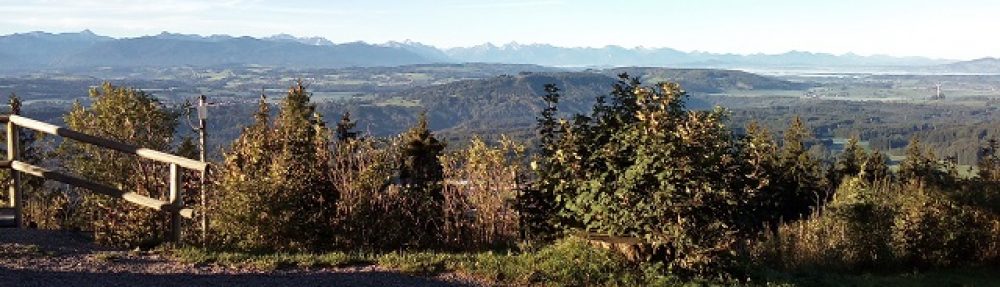
DD5LP/P – November 2nd SOTA NA-EU S2S event – DL/AM-176 Rentschen.

Preparation:

The annual North America to Europe S2S event day had arrived again and (as usual), the weather forecast looked good until the day before when it changed from foggy in the morning and sunny in the afternoon (when the event is), to being cold, damp and foggy all day. Despite that, I decided to go ahead with the activation with the hope of getting some easy S2S contacts from this 1-pointer plateau summit. 
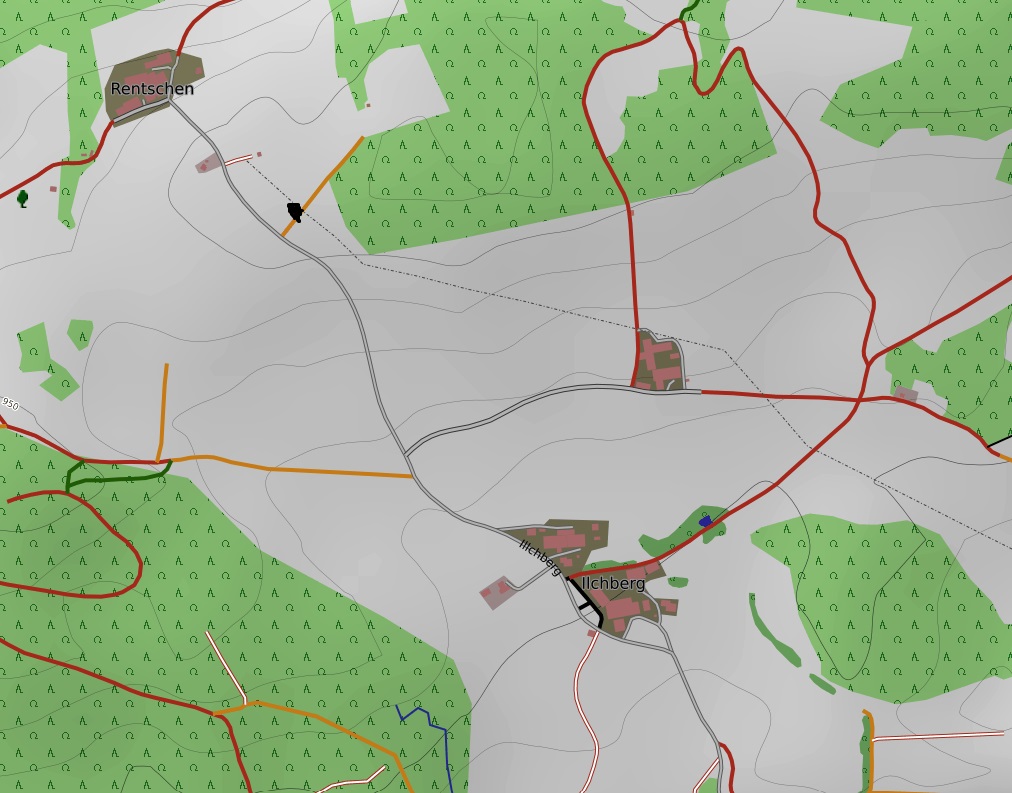
Rentschen is the summit I choose for testing new antennas on as it is a flat plateau and so provides plenty of space.

I decided to play it safe for this afternoon’s activation. I packed not only the electrically switchable trapped tri-bander beam but also the manually switched 5-bander and my linked dipole, each with its own masts and supports.  To be safe I also packed the antenna analyser, a complete spare radio station (G106 plus 100w amp tower) and 4, 8 & 12 Ah batteries. (I was hoping that the weather may improve so I would have the opportunity to compare various combinations). The weather didn’t change and most of the equipment stayed in the car as it turned out. This is thankfully a drive-on summit.

The Activation

It is rare that I only head out in the afternoon for a SOTA activation – usually, I am eager to get to the summit just after daybreak to work VK via the long path but in this case, where North America was the target the clock difference made a morning activation the wrong options and all of the many SOTA activators who would be out had alerted to be on from around 1300 UTC (or 2 pm local time here) – so that was my target to get on site and set-up.

The run down to Rentschen, I know very well and it was good that I did as the fog came in reducing visibility along the roads for a fair distance. On arrival at the summit, visibility was around 30 metres and it was a very damp fog. As Rob DM1CM was also going to join me I got started straight away with setting up the antenna and station.

As usual, the 2 element wire beam antenna was installed using the screw-in base with the four wires going out at 90° to each other, the combined length of the element and its cord extender (also acting as the guy cords for the mast), formed a 60° angle with the vertical mast, this after looking at a model of the antenna appears to be a better value than the normally stated 56° (the mast is a 7-metre mast but with the top section removed so that the feed point board sits at 6 metres above ground level). 

As I was finishing up the set-up, Rob arrived and we took a listen around 10 metres (which I had expected to be the “money band” for this event going by recent radio conditions. Initially, the band was empty but then about 15 minutes later it filled up with stations from Russia and the US. It seems skip was not going to allow me to get any contacts inside Europe but the first in the log was Jörg signing as DL/HB9BIN/P from Laber DL/AM-060 – which, if there wasn’t a forest in the way, would have been line-of-sight from where we were. Watching the SOTA spots on my smartphone, I saw more & more European and UK stations spotting that they were out however when I tuned to their frequencies I could not hear them. I suspect the skip distance on the 10m band at the time was too long. This was in some ways confirmed by the strength of the US home stations. Unfortunately, the US SOTA activating stations all seem to have been using either CW or data so were not an option for me. I put out several CQ calls and was eventually rewarded by calls from three US SOTA chasers calling me.

The cold damp temperatures and the lack of contacts eventually decided me to cut the activation short and head home to the warmth. As I approached home, it was obvious that the weather at home had not been nearly as bad as where Rob and I were located.

There are positive points out of this action. The wire beam works well (even though I set it up 45° off the intended direction). It would have been nice to compare the linked-elements version against the trapped elements but the work involved in the wet and cold was not justified. The G90 radio with its 20 watts output on SSB, continues to “do the job” and the new 12 Ah LifePO4 battery also got another test.

Photos:

This slideshow requires JavaScript.

Equipment taken:

  • Mountaintop travelling 40-litre rucksack.
  • Raddy rucksack. (not used)
  • Xiegu G90 radio.
  • Xiegu G106 radio plus RMItaly amplifier, LPF box and ATU-100. (not used)
  • Screw-in mast base.
  • 7 metre fibreglass mast.
  • Surveyors tripod and 10m mast. (not used)
  • 10/15/20-metre band 2-element trapped wire beam.
  • 10/12/15/17/20-metre band 2-element linked elements wire beam.
  • SOTA/HEMA logbook & pens.
  • Komunica Power HF-Pro2-PLUS-T loaded vertical antenna and tripod (not used)
  • 6m mini-mast (not used).
  • SotaBeams linked dipole (not used).
  • 4 Ah Eremit LifePO4 battery (not used).
  • 8 Ah LiFePO4 battery (not used).
  • 12 Ah LifePO4 battery.
  • Painter’s thick plastic sheet.
  • Gardener’s kneeling pad (not used).
  • 2 x Lightweight headphones (one pair not used).
  • Smartphone for SOTA/HEMA spotting.

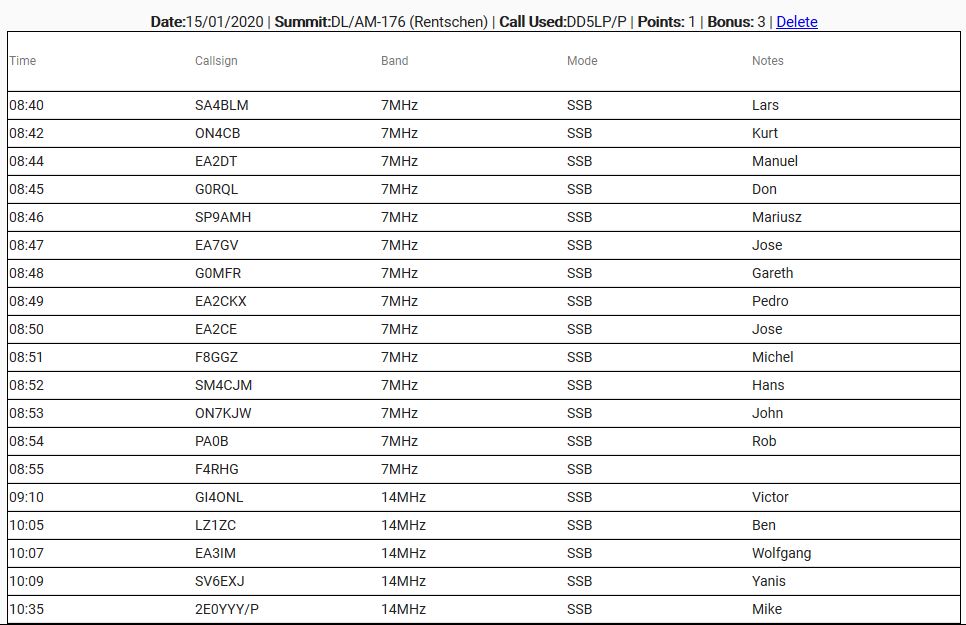
Log:

Conclusions:

  • The NA-EU SOTA S2S event is “jinxed” every year it is accompanied by bad terrestrial weather (at least here in Southern Germany).

  • The equipment used worked well and it was a nice “social” meet-up with Rob.

73 ’til the next summit.

DD5LP/P – August 6th 5th 2024 SOTA DL/AM-176 / HEMA DL/HBY-052 Rentschen.

Preparation:

With progress made on the 2-element wire beam by adding a trap for 15m operation and reconfiguration of the speech processor that I use with my G106 radio, I needed to test both out on a summit. The results of these tests would also help me define what equipment I would take to Lindau, two weeks later for the International Lighthouse and Lightship Weekend.

Unfortunately, the sun is not on my side again, with a very active sun sending flares and CMEs which suppress the maximum usable frequency (MUF) since the weekend. I was hoping that things would be relatively back to normal on Tuesday (the activation had initially been planned for Monday).

As Rentschen is a drive-on one-pointer summit, I packed the “G106 Pack” and the normal G90 radio and accessories into the car the day before. Looking at the previous week, 21 MHz was unlikely to open before 0700 UTC (9 am local time), so it would be a 7:45 am departure from home to allow for the 45-minute drive and set-up time on the summit. The alarm was set …

The Activation

The morning of the activation arrived and the terrestrial weather looked nice. The trip down took a little longer than expected as I hit some of the morning commuter traffic but I arrived at around 8:30 am as planned and found a spot right next to the trig-point stone – the marker of the absolute summit point and set-up. I had a sked with Ernie VK3DET and we would try 20m and then move to 15m.

The antenna was installed using the screw-in base with the four wires going out at 90° to each other, the combined length of the element and its cord extender (also acting as the guy cords for the mast), form a 56° angle with the vertical mast (the mast is a 7-metre mast but with the top section removed so that the feed point board sits at 6 metres above ground level). 

I had two aims with this activation – one was to check that the speech compressor which I use with the G106 and amplifier, now sounds better. I know the built-in one in the g90 is fine. The second aim was to make a contact on 15m with the wire beam, now that I had added the 15m traps to it.

I hadn’t expected problems with the “G106 Stack” ( G106 radio – CB amplifier – LPF filter box – ATU-100 ) as it had worked fine the last time that I used it, but OF COURSE – something went wrong there and instead of over 100w PEP that I got last time (70w RMS) – I got 20w RMS at best. I could hear the VOX relay in the amplifier chattering, suggesting it was not getting enough drive. This is at least something that I can test at home without needing to go /P again. Depending upon what I find, I could match the amplifier+LPF+Tuner up with the g90 on low power for ILLW. We’ll see.

As for the antenna test on 15m, my test with Ernie VK3DET was too early and we gave up because the band was empty of DX. I said 73 to Ernie, switched to the G90 20w radio and went back to bag some contacts on 20m to get the necessary 4 contacts to “qualify” the summit (which, as I have already activated this summit this year for both SOTA and HEMA brought me no points). Rather than the usual quick signal report exchange, I managed a few chats with hams who were interesting and a couple were interested in the wire beam I was using, so we exchanged website URLs and agreed to check out each other’s work. That was a nice interlude in the warm weather on the summit but I still wanted to know whether the beam would actually work on 15m so when I got no further replies to my CQs I went back to 15m

To my surprise there were stations now on the band and from 08:15 – 08:25 I happily listened in to a 15m net on 21.270 with Dave VK6IE, Steve E51CZZ on Aitutaki Isl (South Cook), Paul EA5JZ and a VK3 – It could have been VK3MH Brendan but I think I heard the others call him Andrew, so I may have that call wrong – he was the weakest of them all. The South Cook station was easier to listen to and that was SHORT PATH! I did “turn” the beam (via relays) and there was a difference, this was definitely short path VK-EU from 0800 UTC onwards. After trying to call into the net unsuccessfully – although Dave said he heard “someone” after I called – I gave up on the effort as one of those things, found another frequency, spotted myself on SOTA and called CQ for 5 minutes with no replies.
One thing is clear – the beam receives on 15 metres OK, whether it works also on transmit will have to wait until another day.

Photos:

This slideshow requires JavaScript.

Equipment taken:

  • Mountaintop travelling 40-litre rucksack.
  • Raddy rucksack.
  • Xiegu G90 radio.
  • Xiegu G106 radio plus RMItaly amplifier, LPF box and ATU-100.
  • Screw-in mast base.
  • 7 metre fibreglass mast.
  • 10/15/20-metre band 2-element trapped wire beam.
  • Komunica Power HF-Pro2-PLUS-T loaded vertical antenna and tripod (not used)
  • 2 x 6m mini-mast (not used).
  • SotaBeams linked dipole (not used).
  • 4 Ah Eremit LifePO4 battery.
  • 8 Ah LiFePO4 battery.
  • Painter’s thick plastic sheet.
  • Gardener’s kneeling pad (not used).
  • 2 x Lightweight headphones.
  • Smartphone for SOTA/HEMA spotting.

Log:

HEMA

SOTA

CONTACTS MAP

Conclusions:

  • The antenna worked well on 20 metres and received fine on 15 metres (with directivity). I hope transmit on 15m will work fine as well but the conditions on 15m were so variable with the MUF bouncing below and above 21 MHz, it wasn’t a good day for the test.

  • The problem with the “G106 Stack” will need to be investigated – the fact that I could hear the input VOX relays “chattering” in the amplifier suggests to me that it wasn’t getting enough drive.

  • I will need to consider what I take for ILLW (International Lighthouse and Lightship Weekend) on two counts – firstly the antenna – the beam needs more space than a simple dipole and it doesn’t cover 40m, which could end up being the band of choice depending upon radio conditions. As for which transmitter, I would like to have more than 20w to “fend off” those stations who simply sit on my frequency and start calling CQ because they are either deaf or rude B’s. I could use the G90 with the amplifier rather than the G106 with the knowledge that if there is a problem, I can fall back to using the G90 “barefoot”.

73 ’til the next summit.

DD5LP/P – February 5th 2024 SOTA DL/AM-176 / HEMA DL/HBY-052 Rentschen.

Preparation:

With progress made on the 2-element wire beam and success at Peissenberg a week previously in the 10m only form, it was time to test the antenna this time with the trapped elements which should make the antenna a dual band antenna able to operate on the 10-metre and the 20-metre bands. This was not to be a test of the Bluetooth relay switching board but rather purely to test out the dual-band nature of the elements. Testing the full system with remote switchable direction will need to wait until another day.

After some days of rain showers, Monday had a good forecast with winds supposed to cease by 9 am and then the day to be sunny if not warm.

After a couple of tests in the muddy local field, the simple feed-point plate with the trapped elements had been trimmed to length, so everything was set for a test from a summit and so the surveyor’s tripod, the 7-metre mast, the antenna analyser and the antenna components were all loaded in the car on Sunday evening along with my 40-litre rucksack containing radio, battery and several antennas and masts, ready for an early start on Monday morning.

The chosen summit “Rentschen” is a plateau and as such a good summit for antenna testing with lots of space and few obstructions. This is a summit that is both in the HEMA and SOTA schemes and so is a “twofer” as POTA activators would say.

The Activation

The trip down was uneventful and I arrived at my usual car parking spot at around 8:15 am local time with my plan to be on the air before 9 am to catch the 20m long path into VK (I had set up a sked with Ernie VK3DET) and then to try the antenna also on 10 metres.

I chose a spot not far from the trig-point stone and I unpacked the mast, tripod and antenna first. These went up well, in the same way as I had installed them on the local field for the earlier tests and trimming. The four wires go out at 90° to each other and because of the combined length of the element and its cord extender (also acting as the guy cords for the mast), form a 56° angle with the vertical mast (the mast is a 7 metre mast but with the top section removed so that the feedpoint board sits at 5 metres above ground level). 

Before unpacking the radio, I attached the antenna analyser to make sure that all still seemed  OK with the antenna – it did. Then the Xiegu G90, headphones, battery and log book were unpacked and laid on my painter’s thick plastic sheet on the ground.

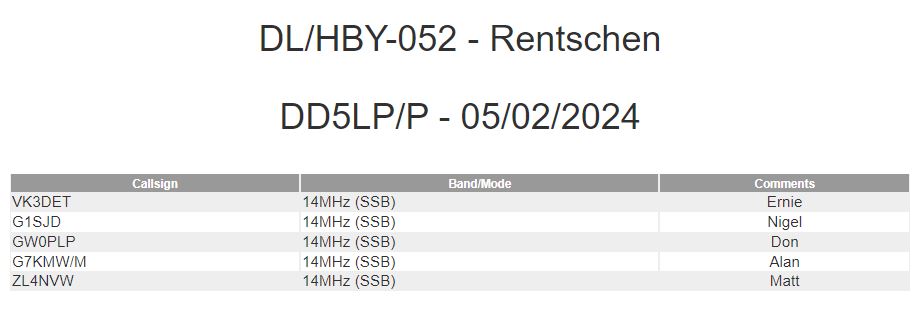
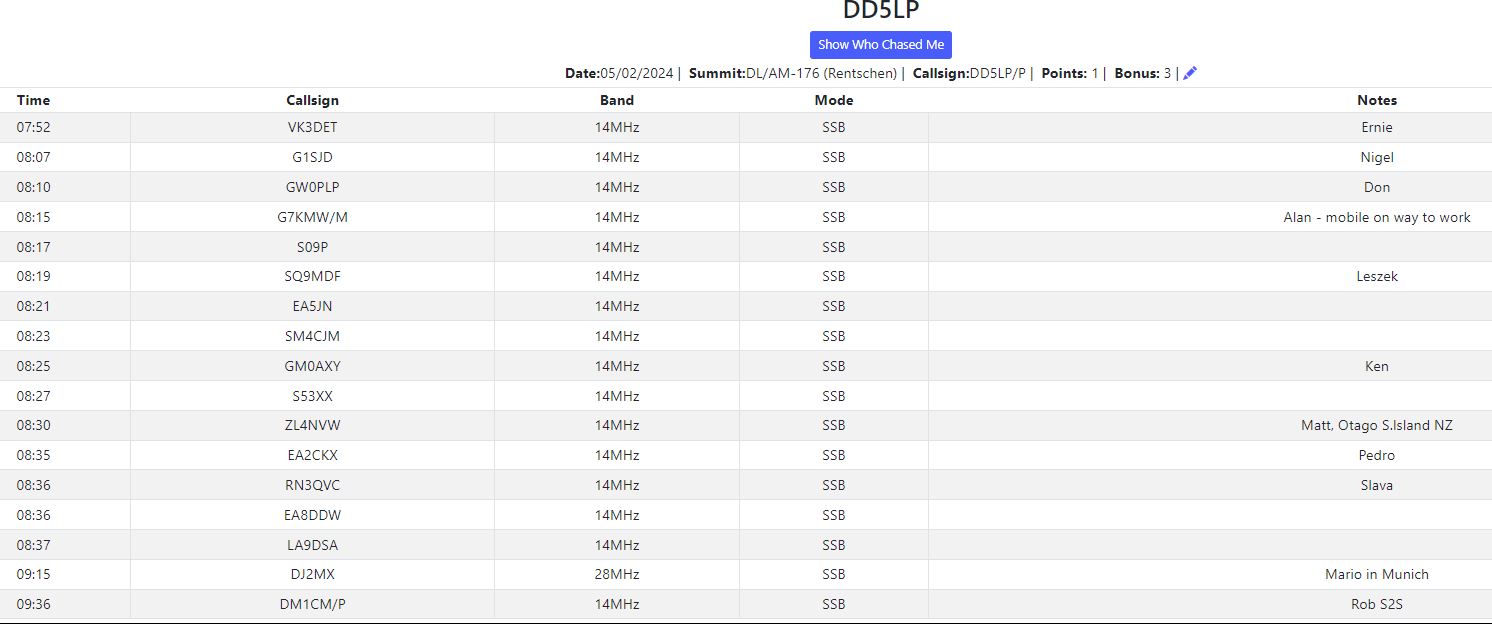
After sending a short Internet message to Ernie and agreeing on a 20m frequency that was free at both ends, I called Ernie and there he was – armchair copy, solid signal! I had the antenna “aimed” long-path (West from me) for this contact. When I needed to move to 10m, it would need to point short-path (East from me) so, rather than going straight on to 10m (a bad decision as it turned out), I decided to work more chasers (HEMA & SOTA) on 20m first.

In the middle of the SOTA callers on 20m,  Matt ZL4NVW from Otago on the South Island of New Zealand called in. This suggests that 20m would have still been good for contacts into VK for another hour or so at least.

Another surprise contact was Alan G7KMW actually mobile while heading into work in the midlands of the UK. An easy copy so I think the antenna is definitely working.

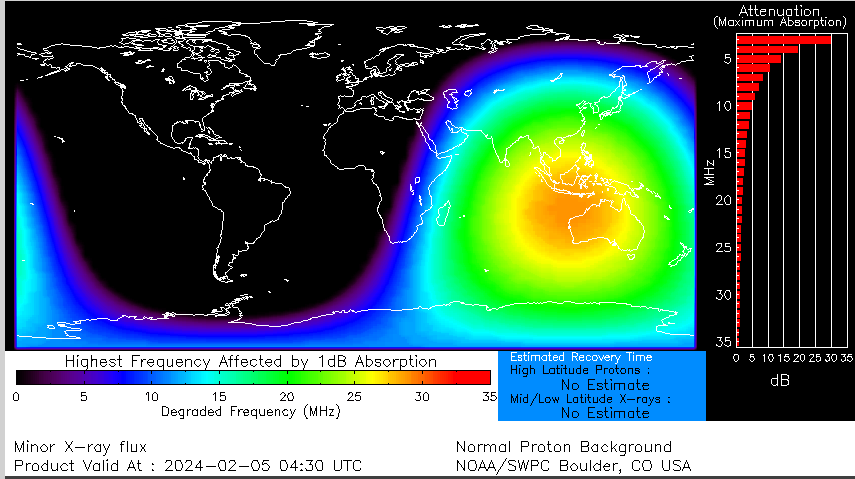
When I decided to switch to 10m it was getting close to 0900 UTC and after dropping the antenna, turning the feed-point board 180° so that the beam would be pointing short-path to VK and raising it again, Ernie VK2DET  and I tried for a 10m contact but if I hadn’t known he was calling I would have mistaken it for just part of the noise. The signal was so weak that there was no chance of Ernie hearing me (but I did try). What was strange was that two VK2 stations VK2CPC and VK2GM were both booming great 59 signals on 10m. Initially, I had thought my antenna wasn’t working on 10m but later I found it was most likely a propagation problem with an X-ray flare hitting the Ionosphere over Australia and pushing the MUF down over VKs 3,5,6 & 8 but not affecting VK2.

image

I only got one contact on 10 metres and that was off the side of the beam with Mario in Munich.

The next test will be to fit the Bluetooth-switched top board, to see if I can hear any difference in signal strengths as I “rotate” the static antenna electrically. I also want to see if I can support the mast with just a ground peg rather than using the surveyor’s tripod. On Rentschen at the start of the activation, there were only very light winds but when I went QRT, they had increased to a level where I may have had issues putting the antenna up so I had timed it right in that respect.

Photos:

This slideshow requires JavaScript.


Equipment taken:

  • Mountaintop travelling 40-litre rucksack.
  • Xiegu G90 radio.
  • Surveyor’s tripod.
  • 7 metre fibreglass mast.
  • 10/20-metre band 2-element trapped wire beam.
  • RigExpert AA-30 Antenna Analyser.
  • Komunica Power HF-Pro2-PLUS-T loaded vertical antenna and tripod (not used)
  • Lamdahalbe 5m mini-mast and new metal base peg (not used).
  • SotaBeams linked dipole (not used).
  • 4 Ah Eremit LifePO4 battery.
  • 4 Ah LiHV battery(not used).
  • Painter’s thick plastic sheet.
  • Gardener’s kneeling pad.
  • Lightweight headphones.
  • Smartphone for SOTA/HEMA spotting.

Log:

HEMA

SOTA

CONTACTS MAP

Conclusions:

  • The antenna worked well on 20 metres. The problem with getting through on 10 metres to VK3 was later found to be an X-ray flare hitting the atmosphere over part of Australia, explaining why VK2 and JAs were getting through but not VK3. Others in Europe experienced similar problems.

  • Once the band is open and DX stations are coming in, the “search & pounce” approach can be forgotten as there are too many high-powered stations with large beam antennas that believe it is their right to get in contact with the DX station and if they hear someone else calling ahead of them, they repeat their call after the portable station finishes to make sure that if the DX station goes back to the portable station, he/she can no longer hear the DX station because of the DQRM they are causing. Hardly in the spirit of ham radio!

73 ’til the next summit.
DD5LP/P – February 22nd 2023 – HEMA DL/HAM-014 & SOTA DL/AM-176 Rentschen.

Preparation:

After several cancelled (because of weather and unplanned commitments) tries, I was determined to get out to “a” summit again. Originally I wanted to test out the “wavelength-plus” on-the-ground antenna however following some positive comments from John VA3KOT on the VP2E antenna after I pointed him at it as an interesting antenna, I decided I probably should give it another try after building it nearly two years ago and only using it once or twice!

John VA3KOT, by the way, has a nice and friendly website that he calls Ham radio Outside the box, where he likes to look at unusual solutions used by hams to solve portable operations issues. The site is well worth a read and is where I found out about the wire-on-the-ground antenna while I was looking for a small lightweight antenna to use with my G106 radio while travelling.

I have built two VP2E antennas (actually three, but the third one was an attempt to make the antenna multi-band through the use of links – it failed).  So I have a 40m and a 20m version at the moment. Both are twice the size of a normal dipole on the band and hence need space for any tests. For antenna testing, Rentschen is ideal as it is a drive-on summit with a plateau top. So I have lots of space to set up the antenna. I decided I would only test the 20m version as that is the band where some directional gain might prove the difference between making a DX contact and not doing so. It has to be said that, the possible 2 dBD gain in some directions compared to a dipole, is not a lot – but as we know, every little bit counts and the 20 watts of SSB from the G90 radio is hardly a “QRO” set-up, so “all help is gratefully received”.

To find out all about the “Vertically Polarised Two Element” VP2E antenna, a little of its history, how I built mine and my calculator for you to get the needed lengths for whichever band you choose, click here.

  Ernie VK3DET had kindly said he would listen for me and Wx dependant, Mike 2E0YYY might get out to his local hill in the UK to give me an S2S contact.

As usual, all gear was packed in the car, the night before the activation, so that I could make an early start. That being said, this would not need to be a really early start as the 20m long path had been opening only from 0830 UTC (09:30 am local time) recently, so leaving home at 8:15 – 8:30 am would be fine.

The weather forecast was for a cool overcast day but, most importantly, no rain.

The Activation

Rentschen – HEMA DL/HAM-014 and SOTA DL/AM-176.

The good drive down in just over 40 minutes and I was parked on the summit by 9 am local time (0800 UTC). 25 minutes later I was all set up, with the VP2E “pointing” due West – my long path direction for contacts into VK. First in the log after a CQ call – Ernie VK3DET 5-4 in both directions.

Mike 2E0YYY had been unable to get out as they had constant rain all morning, so he kindly acted as my spotter and starting with the HEMA designation, I quickly put 18 contacts in the log. Many from the UK and many commenting on how loud and consistent a signal I had, while there was QSB on the band. In fact, surveying the contacts later I can tell that skip was short, which also explained why the band seemed full almost from end-to-end and this on a weekday! Ernie heard a couple of other European stations but none from Germany – perhaps we hit the best time with our contact or perhaps this antenna was achieving a good low-angle radiation pattern as the models show it should do. Some callers were weaker than I normally hear them, especially to the north and southeast – this could be the antenna’s directivity or simple conditions.

Once the callers dried up, I asked Mike to spot me again but this time on the SOTA cluster and the DX cluster and again I had a pile-up – another 18 contacts in the log. Of all the 36 contacts, Bernie was the only one from outside of Continental Europe. the majority of callers were from the UK, including one G0POQ from my town of birth – Hull in East Yorkshire. several of the contacts were conversations rather than only a report exchange, so the band conditions and the antenna were holding up well. After the second pile-up finished, I decided to pack up as it was only 3°C and the primary 4AH LifePO would have been somewhat drained after about a full hour of constant usage at 20 watts output. I did have a second battery with me (a LiHV 4 AH one) but I had achieved what I had come to do in testing the 20m VP2E and I am glad to say all worked well. None of the equipment had any issues on this outing.

Below as an extra in this report, I have the SOTAMapping map of all of my contacts.

 Photos:

This slideshow requires JavaScript.

Equipment used:

  • Mountaintop travelling 40-litre rucksack.
  • Xiegu G90.
  • Komunica Power HF-Pro2-PLUS-T loaded vertical antenna. (not used)
  • Modified mini photo tripod with clip-on radials (not used)
  • Lamdahalbe 6m mini-mast.
  • Screw-in sun umbrella support (not used).
  • Converted Surveyors tripod.
  • SotaBeams linked dipole (not used).
  • Aerial-51 404-UL OCF dipole antenna (not used).
  • 20 & 40m VP2E antennas (20m one used).
  • 4000maH LiHV battery (not used).
  • 4 Ah LifePO4 Eremit battery.
  • Painter’s thick plastic sheet and gardener’s kneeling pad.
  • Lightweight headphones.
  • Smartphone to spot and back-channel comms. 

Logs:

Rentschen

HEMA DL/HAM-014


SOTA DL/AM-176

Conclusions:

  • Band conditions at the time of this activation were short skip not as good as they have been, which makes the contact into Australia (albeit an arranged, scheduled one) all the more of a success.
  • The equipment all worked as it should. The combination of the Xiegu G90 with its 20 watts of SSB and the VP2E (Vertically polarised 2-element) antenna on the 6m-high mast supported by the surveyor’s tripod worked very well from the first moment it was plugged into the radio. I now believe the antenna has “some” directivity however I suspect its greatest asset is the low-angle radiation and the amount of wire in the air, being twice as large as the dipoles that I normally use. The fact that it is purely a single-band antenna is a drawback as is the need to use the large tripod to support the mast.

73 ’til the next summit.


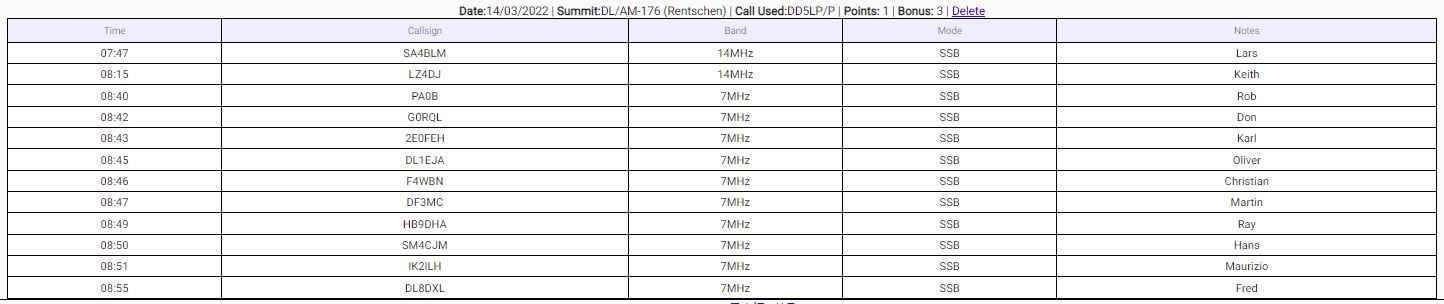
DD5LP/P – March 14th 2022 – HEMA – DL/HAM-014 & SOTA DL/AM-176 – Rentschen.

Background – Double summit.

Some of you may recognise the name of this summit from my previous reports. Rentschen is a current SOTA and a current HEMA summit. How can this happen? Well HEMA strictly adheres to its rule of including only summits with a prominence greater than 100 metres and less than 150 metres. For historical reasons, SOTA summits are not always over the SOTA rule of a minimum of 150m prominence.  

Preparation:

This activation was planned to coincide with our twice-weekly “Comms Testers net” on 14.242 MHz which runs from 0745-0815 UTC on Monday & Thursday mornings.

This net was formed out of a Signal messenger group and several years of attempts to make contact on SSB between Europe/UK and the state of Victoria in Australia. Those in the group and hence net normally are Ernie VK3DET, Ian VK3YFD, Mike 2E0YYY and myself. This net has only been formally running a couple of weeks as I write this report and it was created as an “attend if you have time” net but to give a point to start from for further communications tests.

Rentschen is a flat plateau with a road running across it, this makes this the ideal summit if multiple pieces need to be carried for testing and this was going to be the case for this activation. While I could have simply taken the same set-up as I had used on the previous two activations, I wanted to test out an antenna that I had built some time ago and because of the Covid pandemic had not been able to give a proper test on a summit. Now was my chance. the weather would not be as cold as it had been, no rain was forecast and so the 20m VP2E antenna (description here) would get its test on this activation. I was particularly interested as to whether what looks like a double-sized off-centre fed dipole would give the promised gain in the direction that I set it up in (pointing via the long path to Australia).

To support the VP2E only one of my 6m fibreglass poles would be needed however, I decided to take the architect’s tripod and my 10m mast along as well. I might put up both the linked dipole and the VP2E for comparisons in the EU-VK path. The 6-metre fibreglass mast would use the sun umbrella screw-in base as its support.

As usual for early starts, I loaded the car Sunday evening with all but my food and water so that all would be ready for a 7 am (0600 UTC) start the following morning.

The Activation

Although Google Maps suggested accessing Rentschen from the north, rather than through Wildsteig to the south would be almost 10 minutes quicker, after looking at a satellite image of the suggested route and seeing that it was a mud track rather than a normal road, I decided to take my normal approach route. I had enough time in any case.

The trip to the car parking spot for the summit took around 45 minutes from my home as there was limited traffic.

On arrival, it was not particularly warm and I was happy to have put my Parka on! I did a quick check of my usual set-up spot to find that the farmer had churned it up with his tractor recently, so I took a spot at the other side of the small track that runs from the road to the trig point.

I decided to initially set up the VP2E antenna as it was the one I wanted to test. Once that was up, I would go back to the car and bring the tripos and 10m mast for the linked dipole.

As I put down my painter’s sheet that I use on the ground, I received a message from Ernie and Ian, saying that they had a major thunderstorm coming through and they would have to disconnect all antennas and certainly would not be able to listen for me until the storms passed. Oh well “best-laid plans” and all that. There will be another opportunity I am sure.

I decided that as I had almost completed installing the VP2E antenna, I would continue to activate the summit with that antenna and Mike 2E0YYY would listen for me from the UK. The 20m band started long and then went short skip later but for the first hour or so, I could hear ZL1, VK2, VK5 & VK6 stations at or near S9 signal strength. Unfortunately, they were either in nets, calling an EU (usually EA) station or the pile-up to call them was horrendous!

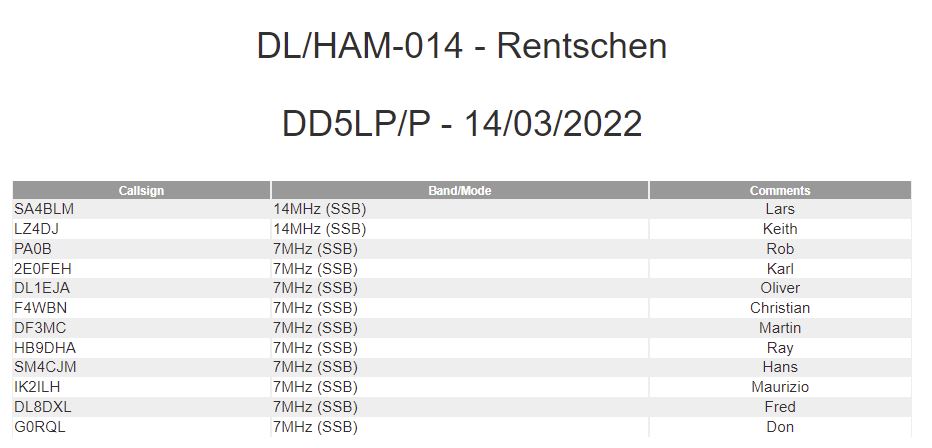
Mike kindly spotted me on the DX Cluster and the HEMA website but to little avail. Eventually, as I was considering pulling the antenna down and putting up the dipole Lars SA4BLM called me and then after tuning around, I found Keith LZ4DJ who I had worked the previous Monday from the Berndorfer Buchet summit. After this, however, despite searching and calling, I was not getting any contacts on 20m. The band had closed it seems. Mike suggested I try 40m as he was sure there would be HEMA and SOTA chasers looking for me there. I was then faced with taking down one antenna and putting the linked dipole up on the same mast or going back to the car and bringing the tripod and 10m mast. Both options were not very inviting as with an icy cold breeze, the summit was not very warm.

Knowing that the G90 has an internal matching unit that could match the proverbial piece of wet string, I decided to try the 20m VP2E on 40m. The result? Receive is fine but transmit is terrible as regards putting a signal out. Despite that 10 SOTA/HEMA chasers worked hard and I got them into the log.

Lots of lessons were learnt from this activation, despite having to change plans around.

 Photos:

This slideshow requires JavaScript.

Equipment used:

  • Mountaintop travelling 40-litre rucksack.
  • Xiegu G90.
  • Komunica Power HF-Pro2-PLUS-T loaded vertical antenna. (not used)
  • Modified mini photo tripod with clip-on radials (not used)
  • Lamdahalbe 6m mini-mast.
  • Screw-in sun umbrella support.
  • VP2E 20m antenna.
  • Surveyors tripod with 10m mast (not used).
  • SotaBeams linked dipole (not used).
  • Battery box (2 x 5000maH hard-case 4S LIPOs).
  • 4000maH LiHV battery (not used).
  • Painters thick plastic sheet.
  • Lightweight headphones.
  • Smartphone to spot and for back-channel comms. 

Logs:

HEMA

SOTA

Conclusions:

  • The weather although bright was not as warm as it looked!
  • It was a shame that Ernie & Ian could not make the Net, but safety first and trying to work DX with a storm around you is not only dangerous but also quite futile with all the electrical noise that a storm produces.
  • I need to put the VP2E 20m antenna up in the garden and check that it has not gone off-resonance since it was built.
  • The plastic (one-use) medical gloves that I took with me do not keep the hands warm enough. The cloth version is better for this but the plastic ones allowed me to use the smartphone’s touch screen where the cloth ones do not.
  • SURPRISE! – I hadn’t realised but until the end of March, Rentschen gets 3 winter bonus points in the SOTA award scheme.

73 ’til the next summit, be it HEMA or SOTA – or perhaps BOTH again?


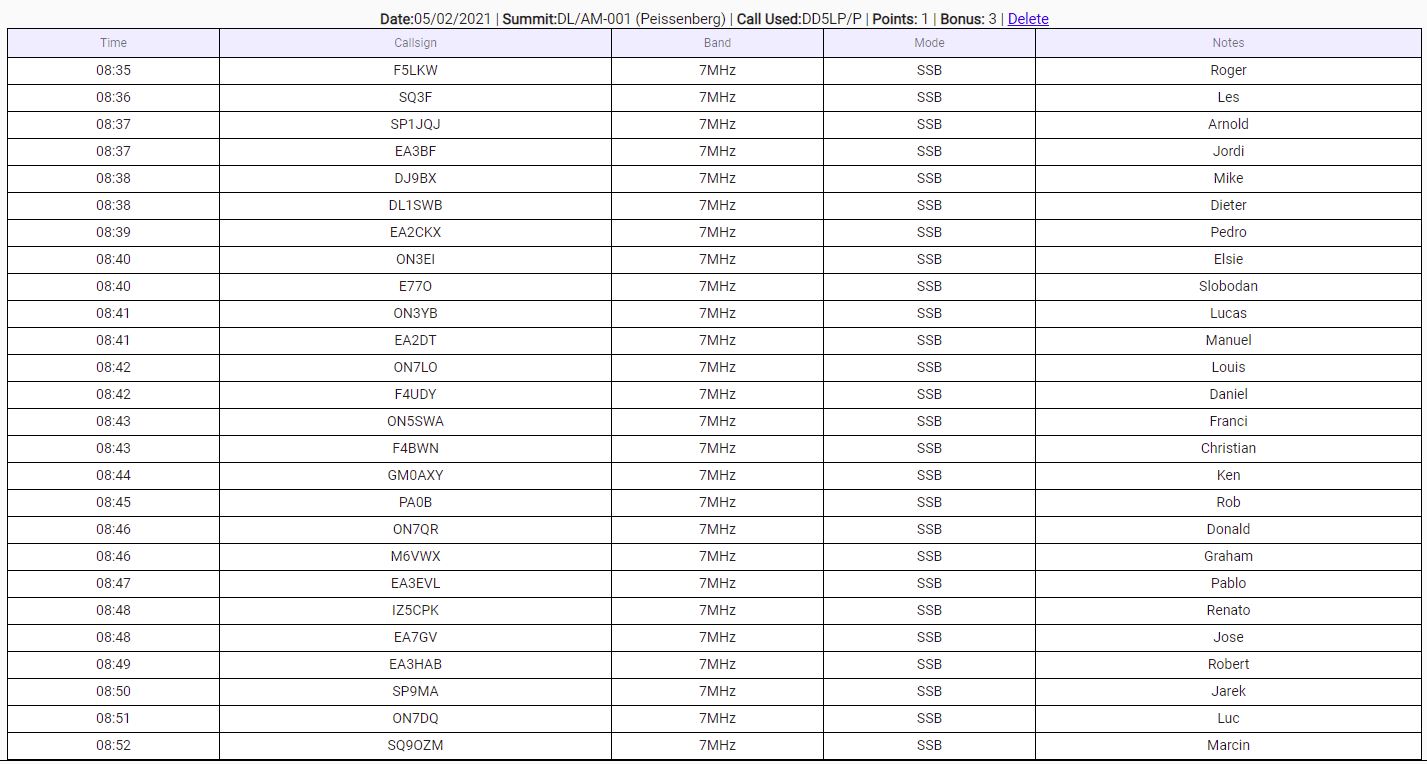
DD5LP/P – February 5th 2021 – DL/AM-001 Peissenberg & DL/AM-176 Rentschen.

Preparation:

As the pandemic lockdown situation combined with winter weather continuing, I was eager to get out onto a couple of simple summits and bag a few contacts along with some winter bonus points. My original plan was to head to a group of four which are reasonably close together but two of the four can be difficult to access depending upon the ground condition and as we had had multiple days of rain, following 2 weeks of snow, I was not hopeful for those, but depending upon how the first two summits went and what the ground was like on those, I could add one or two of the others into the day.

The gear would be the (now standard) X108G and battery in my rucksack and HF-PRO2 antenna but also taking along the old linked dipole and the surveyors tripod and 10 metre mini-mast as the main two summits are easy to access and have room for the mast.  

The Activations

As it turned out on the first two summits Peissenberg and Rentschen, there were large patches of soft wet ground and so the decision was made early not to attempt the two more susceptible-to-rainwater summits (Ammerleite and Kirnberg) this time, rather leave them as a pair to be activated when the ground dries out somewhat. So here are my reports on the two summits that I did activate.

Peißenberg DL/AM-001

Peissenberg has two good activation point. One on the very summit alongside the church and one in the car park below the graveyard. The first has a nice seat and fence where I can attach the mast and run the wire antenna out to a flagpole in one direction and down around a try to a second bench seat in the other direction. While this was still quite early in the day and we are still in lockdown, I didn’t expect that many people to be around. It seems that since this was the first fine day in some time all the local walkers were out and two had decided to sit at the bench that I normally use. If this wasn’t in the middle of a pandemic, it may have been possible to position myself closeby but mounting the mast would be an issue and being close to this pair who seemed to be going to stay there for some time, forced my decision to head down to the other location (still in the AZ). There I am glad to say was free of the public and indeed gave me lots of room to put up the surveyors tripod, 10m mast and linked dipole antenna.

The activation from Peissenberg was straight forward and I had 26 chasers call me (all at once it seemed) on 40m. With so many in the log, I decided to leave 20m but as I found out only later, I should have tried 20m as communication between portable stations in the UK and Australia was taking place via the long path. I had hoped for some greyline propagation on 40 metres but that did not eventuate, in fact, contacts were somewhat shorter distances than I am used to with only one contact from the UK and nothing from Scandanavia.

I had one member of the public who came by to ask if I had been taking photographs when I explained it was Amateur Radio he showed some interest and so he got a small brochure and my QSL card.

Once I could hear no more callers, I packed up and set off for my second summit.

Rentschen DL/AM-176

On arriving at Rentschen and almost getting stuck with the car at the spot where I always park, it was clear that the other two summits were out of the question with the land here being so boggy the other two would be underwater almost! I did manage to find a little harder ground to set up my station, right next to the Trig point Stone which marks the absolute summit. As Rentschen is a large flat plateau, it was easy to get the linked dipole strung out again, supported by the 10m mast and surveyors tripod.

Again I started on 40m, this time I worked a total of 30 stations before the clouds came over and a cold wind arrived. This was just around noon, so I decided after the calls dried up to pack up and head home as I had some AR podcasts to publish and some other computer-based AR work to complete.

l was happy to have got out away from the house, got some fresh air and make some radio contacts.

It’s interesting that I am now noticing some “new regulars” in the chasers calling me. I can only presume these are either people working from home or others that have returned to the hobby because of the lockdown. In any case, welcome! It’s good to have more join the party of SOTA.

 Photos:

   Peissenberg:

This slideshow requires JavaScript.

   Rentschen:

This slideshow requires JavaScript.

Equipment used:

  • Mountaintop travelling 40-litre rucksack.
  • Xiegu X108G.
  • Surveyors Tripod and 10 metre DX-Wire fibreglass “mini-mast”.
  • SotaBeams linked dipole.
  • Battery box (2 x 5000maH hard-case 4S LIPOs).
  • Painters thick plastic sheet.
  • Lightweight headphones.
  • Smartphone with PocketRxTx App and USB cable acting as an external display to the rig.

Logs:

DL/AM-001 Piessenberg:

DL/AM-176 Rentschen:

Conclusions:

  • The grab-and-go approach works well combined with bigger antennas as well – this time I had more time and so decided to put up the big mast and dipole antenna, which takes longer but the simplicity of laying the rucksack on the bench or floor and simply opening the side and plugging in the antenna cable makes life really easy!

73 ’til the next summit.


DD5LP/P – January 15th 2020 – DL/AM-176 Rentschen – Antenna and grey line tests.

Preparation:

As we have had some sunspots from the new solar cycle 25 and the SFI index was up at 75, I decided to do an activation back at the just after dawn hours to coincide with the grey line and long path propagation to Australia. I wanted to see if this window was once again open to Australia as of late we’ve been using the later short path windows at around 1030-1130 UTC. The predictions were that the SFI should stay in the mid-70s for a couple of weeks.

I chose Rentschen as it is an easy access plateau type summit where I have lots of room and could put up my 40m VP2E antenna which I was still not happy was working as expected and I could also put up my 40/30/20m linked dipole so that I had a comparison. As conditions were unlikely to be “easy”, I would also take my recently purchased and boxed Chinese 70 watt HF amplifier to give the signal a kick. I considered also re-testing my new external DYC-817 dynamic speech compressor but then (correctly as it turned out) decided I would be testing too many things in one go.

So the aims were;

  1. Test if the old early morning long path/grey line window to ZL/VK was once again available as the SFI had risen.
  2. Test the VP2E against the linked dipole on 40 metres (the dipole also providing 20-metre coverage if required).
  3. Make sure the rig sounds OK, without the speech compressor in use.

 As it would be an early (8am) start, all the gear was loaded into the car the night before so that I could just get up, get ready and go.

The Activation:

As planned I was up early – and hit the road a few minutes earlier than expected. As I would be putting up two antenna systems, having some more time available before the activation time that I had alerted on SOTAWatch would be useful.

The SFI, while predicted to stay at around 75, had dropped to 71 and worse still the K index was up at 3 and hence the bands would be noisy.

I like to coordinate my activations with when Mike 2E0YYY/P goes out as he will more often than not get contacts into VK/ZL from his local summits in the North of England. Today he was going to a HEMA summit, Mow Cop which has performed very well over the last few months for him. Mike, however, was still going out for the later window, so it was quite possible that I would be packing up at the time Mike was starting up but we usually try for a contact. Mow Cop, however, has a strange “curse”, that it seems to be blocked towards southern Germany and the only way I have worked Mike from this summit is via aircraft scatter (the summit is quite close to Manchester airport and the Manchester – Helsinki flight seems to provide a nice mirror for us on 20m).

The run down to Rentschen was uneventful and I was happy to see that the field where the summit marker trig point stone is located was bathed in the early morning sunshine. That wasn’t to say that it was warm – it might have got up to 2 degrees Centigrade while I was there, mostly it was around zero.

I set up the 40m VP2E on my 10m portable mast supported in my modified surveyors’ tripod, pointing in the correct direction for VK/ZL via long path. The linked dipole, set to 20m initially, so I had the ability to switch bands quickly if needed, went onto my 6-metre pole which had its base supported by a screw-in sunshade base peg.

One of my planned actions was to test whether the early – (Grey line) connectivity was again possible given the improved conditions over the last week. I can tell you – it wasn’t! I called and called and although I got several contacts around Europe, there was nothing from further afield on 40m or 20m. Interesting on 40m was how weak Scandinavian stations were but Spanish, French and some UK stations were booming in like they were next door – so this suggests that the VP2E is indeed providing gain in the direction it is pointed while reducing signals from other directions as it should. I left it a bit too long before thinking about comparing signals between antennas (next time I need to take a simple manual antenna switch to make it easy (and quick) to compare. By the time I remembered that I wanted to compare directivity and signals, we started to have QSB affect the bands.

With the sunspots disappearing and the SFI dropping to 70 despite the fact that the predictions were for it to stay in the mid-70s, along with a CME, which probably was the reason that there was so much QSB and higher noise levels on 40m & 20m, meant that conditions were not good for me.

I did make another discovery – the bad audio which I put down to a problem in the speech processor on my last activations is actually RF getting back into the rig’s audio. It only occurs when the amplifier is on and switching off the amplifier and hence dropping from about 70 watts to 3 watts stops the “rasping” sound in the audio. I noted to investigate this further when I got home and as I was told the audio was perfectly readable at the higher power and hence higher signal level, I decided to put up with it as I could do little on the summit (see conclusions section below).

On this activation, I lasted over 3 hours in the cold which is more than previous activations.  I arrived on the summit at 0800 UTC and left at 1115 UTC one reason that I stayed so long was in the hope of making a contact with Mike 2E0YYY/P on Mow Cop. For a long time, I could hear stations working Mike but nothing from him. When I eventually heard Mike, it was after he had switched from his Antron A99 vertical to a simple inverted-v dipole. I guess this shortened the skip distance as the signals take-off angle would be higher. He was only a 3-2 signal when we managed a contact (I was 3-3 with him) and then only for a short period. In any case, the Mow Cop screen to Southern Germany still seems to be in place! I even tried swinging my dipole 90 degrees but I couldn’t tell if it made any difference as his signal had dropped back into the noise. There’s something about Mow Cop that stops it from being able to get signals down here!

I started packing up the station at 1045 UTC and found out later that Mike made contacts into VK about an hour afterwards. So it appears the short path is still working down to VK/ZL but not the early morning long path/grey line.

Photos:

This slideshow requires JavaScript.

Equipment:

  • Xiegu X108G.
  • DX-Wire 10m mast and Lambdahalbe 6m mast.
  • Portable 70w PEP HF amplifier and cables.
  • Battery box (2 x 5000maH hardcase 4S LIPOs).
  • VP2E (Vertically polarised, 2 element, 40m directional wire antenna).
  • Surveyors tripod.
  • Screw-in sun umbrella base.
  • SOTABeams Band Hopper linked dipole.
  • Thick green plastic painters sheet and an orange plastic tablecloth.
  • Smartphone with PocketRxTx App and USB cable acting as an external display to the rig.

Log:

Conclusions:

The propagation was not as good as I had hoped for, there was a lot of QSB around that meant any antenna comparisons would not be valid. Even swinging the linked dipole around on 20m to try to get a better signal from Mike had no apparent effect but as Mike went into the noise at that point, we’ll never know if the linked dipole’s positioning was important or not

The problems of “raspy” audio when the amplifier is turned on, appears to be RF getting into the rig and as the accessory cable carrying the Tx/Rx PTT switching also has the Auxilary audio input pin wired up but going nowhere, my modification of cutting that wire in the cable near to the rig end of the cable along with adding ferrites to several of the other cables might resolve the RFI – we’ll see at the next activation. If the RFI is now stopped, I can again look at testing the external dynamic speech processor.

What is with the cell phone networks? From the Rentschen summit, I can see the cell tower but despite that, it stopped working during my activation making spotting and communicating via email, difficult to say the least. I have a SIM for each of the two major networks in Germany (Telekom and Vodafone) in my smartphone and I seem to be having issues with both networks!

73 ’til the next summit!

DD5LP/P – October 19th 2019 – DL/AM-176 Rentschen – UK/EU – VK/ZL S2S event.

Preparation:

I had planned to be on Attenberg in southern Allgau for the bi-annual UK/EU – VK/ZL/JA S2S QSO party however as the wife caught a rather nasty strain of Flu, she was told by her doctor not to travel. The plan had been to stay with wife and dog in the hotel that has Attenberg in its back field. We have done this before and I have worked both ZL and VK from there. OK radio conditions are not as good as they were last year, so the chances of a contact into Australasia were reduced and indeed that was to be the story of the activation. I had hopes that with a lot of luck and some ‘Pre-Auroral-Enhancement” created by ionised solar winds ahead of plasma from a CME from a coronal hole on the sun, I might just be able to get at least a contact with an Australian or New Zealand chaser.

In place of Attenberg, I had to look for another summit, which I could get to by 0530 UTC (0730 local) if not earlier, which ruled out a lot of the better summits as they require the cable car or seat lift to be running and they don’t start until 9 am local. As I intended using the 40/20m VP2E the summit also needed some space and the ability to put the antenna up in the correct direction. Rentschen is a drive-on plateau with plenty of space and only 45 minutes from home, so rather than not take part in the event, I decided to go back to Rentschen for my third time this year (which of course means I would get no activator points for it).

Knowing a summit, allows you to try out new things and as well as the VP2E antenna (which two others in the event had also built on my recommendation and would be testing), I also had a new HF portable amplifier which should give out up to 100 watts PEP on 40 metres. This might help a little in the bad radio conditions but brings with it, extra power supply and cabling needs, all of which I had tested at a local GMA summit Kramerberg, a couple of weeks earlier.

As I would need an early start, all the gear was loaded into the new car, the night before so that I could just get up, get ready and go.

The Activation:

As planned I was up early – in fact even earlier than I thought I needed to be but in the end, it worked out about right as setting up the antenna in half-light just after dawn took longer than I expected.

The run down to Rentschen was uneventful and I was happy to see that the field where the summit marker trig point stone is located had been recently cut so the farmer hopefully wouldn’t be coming up and moving me on. (The guy is really quite nice and understanding about what I am doing – his wife, not so).

Despite the weight, part of my standard gear to take to a summit is now the surveyor’s tripod and the 10m DX-Wire “Mini-mast”. This allows me to set up where it is best for the antenna rather than only where I might find a mast support. I decided to set up the tripod and mast right next to the trig point stone (i.e. on the absolute summit). I also noticed a nice looking hut at the edge of the woods that might be worth checking out next time as it open, it would give nice protection from rain and wind.

I was lucky with the weather despite some dark cloud overhead during the whole of the activation, the first rain I saw was just a few drops on the windscreen on the drive home. It was still cold though.

Setting up the VP2E antenna in the required direction took a little longer than expected as I misjudged the distance out to where I would put the walking stick posts and guy rope pegs meaning I had to do a couple of changes until the antenna was up as I required. In order to keep the ends of the antenna at the correct distance off the ground, I run the guy cords that are on the end of the antenna through a hole that I drilled in the tops of my telescopic walking poles. This simple solution seems to work quite well.

Once I had the mast and antenna up, I went back to my operating position and my painter’s sheet to set up the gear. Although the farmer had cut the grass he hadn’t yet collected it all and with the morning dew, the grass stuck to my boots and stayed there all the way home.

With the addition of the amplifier setting up the station was made more complex than usual but I decided to have it in-circuit ready for use although my first couple of contacts were made using the X108G “barefoot” at “only” 20 watts output but as I realised what a rat race 40 metres was going to be, I put the amplifier on full time on 40m. As 20m conditions were not good everyone was on 40m – including many of the contest stations who were getting ready for the “Worked All Germany” which only started in the afternoon, but it seems individual operators were running these QRO stations under their non-contest call signs to check out the equipment. This was also JOTA weekend and so there were also additional stations on the air for that. Normally I would be very happy with extra activity on the band but the problem turned out to be two-fold. One problem was that even with my extra power, within minutes of finding a free frequency, checking it was free and then spotting myself on the SOTAWatch cluster – some other station would fire up 1kHz above or below me and splatter all over the frequency. The second point was that when ZL and VK stations spotted their frequencies these would always be where a QRO European station was (correctly) operating – so I had no way of seeing if I could hear the DX station.

These are normal problems on 40m in Europe on a weekend. I believe it would be better to have our S2S event on a weekday when less is happening on the bands.

So how did I do? In just under2 hours of operating, I only worked 27 stations with a big part of the time being wasted on 20 metres. While activity was less and so more free frequencies were available – there was no propagation to speak of. 40 metres, on the other hand, had propagation and I actually heard a VK4 home station but could not call him as he was in a net. He was about 5-5. Mike 2E0YYY/P on G/SP-004 managed a short contact to Ernie VK3DET but the majority of stations didn’t manage any intercontinental QSOs and had to make do with intra-regional S2S and chaser contacts.

As you’ll see from the log below, I managed six S2S contacts and 2 JOTA contacts within my overall 27 contacts. That isn’t bad.

As is normal on my activations, I came back with some tasks to complete before the next outing, which is likely to be the North America – Europe S2S QSO Party on November 2nd. These are – it appears that the amplifier has stopped working on 20m – it’s fine on 40m so I suspect this could be a problem in the relay switched low pass filter module. The HB9SL Vertically Polarised two element (VP2E) antenna has an SWR of 2.2:1 which is higher than I would like and I suspect adding the links may be part of the reason for this, so I will need to get out in a large enough area (local farmers field) and run the analyser on the antenna and try to improve the SWR ratio by either shortening or lengthening both elements of the antenna. The old problem of the X108G display becoming invisible once there is any sunshine around, was less of a problem on this activation with the dark overhead clouds but towards the end I did have to plug in my smartphone to check settings, so this is still a problem with only one phone that supports the needed OTG feature.

I was fairly sure that the long path window to VK/ZL had passed by 07:45 UTC and I was not getting the flow of calls that I had previously so I decided to pack up and head home after watching a black hot air balloon travel down the valley (I would think they would not be travelling so well in the cold air).

Photos:

This slideshow requires JavaScript.

Equipment:

Xiegu X108G.

Leson amplified microphione.

Portable HF amplifier and cables.

Battery box (2 x 5000maH hardcase LIPOs).

VP2E (Vertically polarised, 2 element, 20m wire antenna).

Surveyors tripod.

10 metre DX-Wire fibreglass portable mast.

Thick plastic painters sheet.

Smartphone PocketRxTx App and USB cable.

Log:

Conclusions:

The propagation was not as good as I had hoped for. The problems with operating portable on 40 metres in Europe, especially when a contest or special event is also planned makes operating unnecessarily difficult.

The 20m performance of the amplifier will need to be investigated as will the reason that the VP2E now has an SWR of 2.2:1 rather than the previous 1.1:1.

The Leson microphone is better that the standard (ICOM) Xiegu microphone but the internal audio compressor in the X108G should not be turned up to 3 (out of 10) – it’s OK at setting number 2.

73 ’til the next summit!

DD5LP/P – June 18th 2019 – DL/AM-176 Rentschen.

Preparation:

The primary aim of this activation was to give John (VK6NU) a summit-to-summit contact while he was on a summit in Ireland (EI/IE-057) as part of his European trip.

I had planned to go to Wank near Garmisch Partenkirchen as I have not activated that summit this year as yet. Looking at the time involved and the somewhat strenuous last section up to the summit with all the gear, I decided to simply go to the closer Rentschen summit, where one can literally drive on to the summit (it is a plateau).

This would also be another chance to use the new VP2E antenna with its traps fitted, to see how it performs.

I only needed to be on the summit by 11:30am, local time, so I had time to prepare all the gear in the morning. This would be the Xiegu X108G and cable to my Smartphone, so that I can read the display, the 10 metre “mini-mast”, the Surveyors tripod and the 40/20m trapped or linked VP2E wire antenna along with the walking sticks to lift the ends of the antenna.

The Activation:

As I approached Rentschen, I saw a farmer cutting the grass and hoped he hadn’t planned to start on the top field where the actual summit with its trig point stone was. Luckily this did not turn out to be the case.

I set up right at the Trig point marker stone and after some taffling and un-taffling of the antenna wires, I had got the antenna up with the 20 metre traps installed in the antenna – this should make it possible to use the antenna on 40m and 20m without having to lower the antenna to link or unlink sections. I had tried these traps previously using the antenna on 20m and all seemed fine. This time I was going to start on 40m.

Listening around the band, despite all the space weather readings that say it shouldn’t be, the band was nicely active with strong signals coming in up and down the 40m band. I even heard and called GB19DDAY on-board the HMS Belfast ship in the Thames in London, but couldn’t get through all the others calling him. That was a shame as some of the ICQPodcast team volunteer on the HMS Belfast some weekends. But it wasn’t to be.

My first contact after spotting myself on SOTAWatch was Lucas ON3YB and although he was a strong 5-9 signal, his report back to me was only 2-2. I suspected the traps and so I asked him to wait until I removed them. I lowered the antenna, unplugged the traps and plugged the links for 40m through and put everything back up. Unfortunately, by this time Lucas had gone, but most of the following contacts got reports between 5-5 and 5-9 which is more what I would expect, so it does seem the traps degrade the antenna considerably. to be sure, however I’ll need to do more tests.

Mixed into my 17 contacts on this activation, I had 8 Summit-to-summit (S2S) contacts, including the planned one with John VK6NU in Ireland and Mike 2E0YYY/P who was out for the same reason and Luc ON7DQ who is on his way down to Friedrichshafen for the HAM RADIO show at the end of the week. I also talked to a few people who I plan to see at FN in a few days.

After an hours operating I got a problem that I switched the receive filter to the 500Hz CW position and while I could not read the display and the filter setting cannot be changed via the CiV remote control commands from my phone on this rig, I decided to pack up and call it a day with a nice list of contacts in the bag.

Photos:

This slideshow requires JavaScript.

Equipment:

Xiegu X108G.

Battery box (2 x 5000maH hardcase LIPOs).

VP2E (Vertically polarised, 2 element, 20m wire antenna).

Surveyors tripod.

10 metre DX-Wire fibreglass portable mast.

Thick plastic painters sheet.

Smartphone PocketRxTx App and USB cable.

Log:

Conclusions:

The propagation was better than was expected and reflected in the number of S2S contacts made. Some of them from stations that I would not normally hear because of skip distance. There was deep QSB on the band, so perhaps this was Sporadic-E ? whatever it was, it was a nice activation, making several nice contacts including the one with John VK6NU, which was the purpose of the activation.

The VP2E antenna performed well once the traps were out of the circuit. The SWR this time showed between 1:1 and 1.1:1 so it looks that raising the ends with the walking poles is a good move.

The problem at the very end of the activation, where I pressed a button in error and switched to the CW filter may be able to be fixed by using a special initialisation string in the remote control software that runs on the smartphone. I will take a look at this.

73 ’til the next Summit!

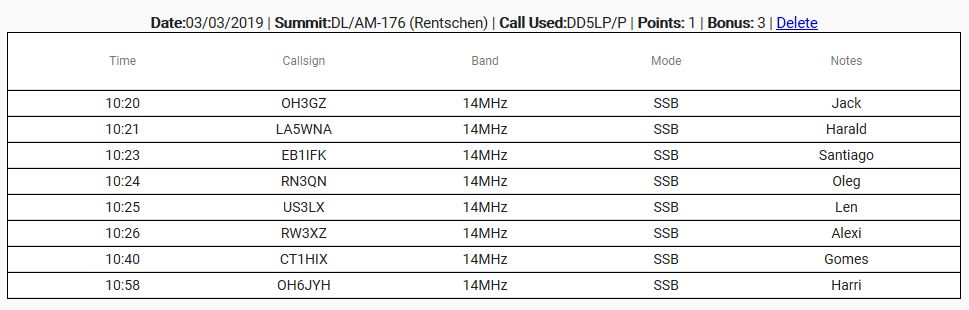
DD5LP/P – March 3rd 2019 – DL/AM-176 Rentschen.

Preparation:

There was little preparation for this activation as it was decided upon when the weather and radio conditions looked a little better, while those in the upcoming days were not looking very good.

For the last few activations I have been trying to make a contact into VK or ZL – something which used to be relatively easy as long as one was on at the right time to use the Long path or short path window. In this case, as the decision to activate was taken after the long path windows was nearly over – the only option was to try during short path window around 1100 UTC.  The closest summit where I could set up my new VP2E antenna up without any problems is Rentschen, the same summit that I couldn’t activate about 2.5 weeks earlier due to 1.5 – 2.0 metres of snow. I was hoping that most of the snow would have melted by now!

Once I had decided to try an activation, I grabbed all the needed gear, in principle my two standard bags, my surveyors tripod, screw-in sun umbrella base and two masts as I planned to put up my 40/20m dipole as well as the VP2E.

The Activation:

As I approached Rentschen, I could still see snow on the upper slopes but luckily when I arrived at the summit, a lot of the snow had gone and I could quickly find a spot to set up and I proceeded to put up the tripod, 6 metre mast and VP2E antenna set to direct its slight gain lobe in the direction of VK/ZL via short path. I was earlier than I expected on site but I decided the best action would be to start calling anyway to pick up the needed 4 contacts  for me to get the activator point plus the three winter bonus points for the summit.

Of interest, is the fact that the high voltage power lines that used to cross exactly over the trig-point / summit marker stone are gone! I presume they have been either buried underground or re-routed in some way.

Although the sun was shining, the temperatures were affected by a very cold wind, which in the end would limit the time I would be on the summit.

I had email contact with Ernie VK3DET and let him know that I was already calling, so he could try to listen for me. Unfortunately he could not hear anything from me – radio conditions were bad again. That being said I did make 8 contacts on what others reported as a “flat” 20m band. I managed two contacts into Finland, one into Norway, one into Portugal, one into Spain, one into the Ukraine and two into Russia. So the antenna does appear to work and the lack of contacts into the direction of the UK suggests some directivity of the antenna.

I had planned to put my second antenna up however a lot of my time was consumed with calming down a dog who came up to the summit on its own from a house down the lane and continually barked at me until she finally got bored and went home. Putting up a second mast with the dog there may have caused more problems with the dog. In any case I decided that as I had got my required 4 contacts fairly quickly I would continue testing with the 20m antenna and trying to get that short path contact into VK. Unfortunately the VK contact wasn’t going to happen, despite 20 watts of SSB and the new antenna, propagation simply did not happen.

To do proper antenna comparisons I think I need a second Op. along so that I can compare and log data and also get a second opinion of what is performing and what not.

Perhaps next time?

Photos:


This slideshow requires JavaScript.

Equipment:

Xiegu X108G.

Battery box (2 x 5000maH hardcase LIPOs).

VP2E (Vertically polarised, 2 element, 20m wire antenna).

Surveyors tripod.

6 metre lambdahalbe fibreglass portable mast.

Thick plastic painters sheet.

Smartphone PocketRxTx App and USB cable.

Log:

Conclusions:

The propagation seemed not to be very good with the noise level raised by yet another solar storm hitting the ionosphere. This was a risk, but at least I managed to activate and qualify the summit.

The display on the X108G was again unreadable so I used the Smart Phone to view and control the rig. With a different cable configuration to last time I had less problems with the program hanging-up and leaving the rig on TX, but it did still happen.

The VP2E antenna does appear to perform well, even though at one point the app on the phone told me that the X108G was seeing a 10:1 SWR but then the next moment it was 1.1 or 1.5:1. A bad connection perhaps? – Something to be looked at.

I am happy that I was able to simply grab my gear and go as the weather for the following week is not looking very good.

73 ’til the next Summit!