I/DD5LP/P – October 4th. 2014 – I/AA-303 Monte Bullacia (Puflatsch)

Preparation:

This activation was planned to coincide with the activations in VK5 that were to celebrate 2 years of the VK5 SOTA Association. As I was on holiday in Sud-Tirol (North Italy), a local mountain needed to be found and this one had the usual requirements for my wife to accompany me – access via cable car with a nice cafe not too far from the top station and not too steep a walk for me to get to the summit. In this case as I was trying to be on the summit before the long path window to Australia closed, I needed to be on-site and operational before 10am local time (UTC 0800) which meant an early start from our hotel in Seis and then two cable cars to the plateau summit. A reccie was performed on a sunny, warm Friday morning to make sure the Saturday activation would be possible time-wise and to decide what equipment needed to be brought along. Once I found the actual summit between the Fillen Cross and Witches Seat (please don’t go to the location given in the SOTA database as you’d be half way down the side of the mountain and probably not able to get back – a common problem it seems with several summits the Alto-adige AA SOTA Italy region), At the summit I saw that the edge of the plateau had an electric fence to deter the cows and horses that roam freely on the plateau from trying to go down the side of the mountain. More importantly I found some large wooden snow barriers. The first I checked seemed rather unsafe but the others were fine. So that would support the antenna mast (squid pole) and the antenna ends would tie to the other barriers. As this is already a high spot, I decided I would take the lighter 6m squiddy rather than my new 10m mini-mast and also decided to use the SOTAbeams linked dipole rather than the Aerial-51 OCF as I only intended to operate 20 & 40m on Saturday. If I had been unable to find a location to support the squid pole, I also had my photo tripod and Diamond vertical antenna packed in the car as a fall-back. Given that I was hoping for a long path contact into VK, I would also take my small Ramsey QAMP 20w amplifier and the 13.8v power booster and LIPO batteries that worked so well at the last activation at Piessenberg.

On testing access to the Internet, so that I could use Rucksack Radio Tool to view other activators spots and to spot myself, I found that despite a stong cell signal on my phone I could not get any Internet connectivity. At least I was able to send an SMS self-spot, not ideal, but better than nothing.

All was set for Saturday, so it was back down the mountain and off to Bozen for an afternoon shopping with the wife and an early rise the next morning.

The Location:

Cable Car to Puflatsch

Seilbahn Puflatsch Seiser Alm

{the following is a Google translation of the text from the tourist website – thanks Google – especially for the comical mis-translations!}.

Since the year 1960 was the old one-man chair lift, which transported the passengers from Compaccio on the Puflatsch, outdated and in so doing. The operating company had decided to completely modernize the chairlift. This happened in 2009, but the new chairlift to the Puflatsch is not just any chair. For the first time comes on the Alpe di Siusi with the new Puflatsch funicular railway to use a combination.

Complete modernization

The previous line was not only partially modernized. No, the entire old system was completely dismantled and rebuilt from scratch and modern again. Thus, the route of the railway was moved slightly to the right (ie slightly further east). As a result, that the mountain station no longer directly in the house of the mountain restaurants Puflatsch is, but about 200 meters away.

During construction of the new cable car special attention was paid to ensuring that the web harmoniously into the landscape – finally the Puflatsch is often referred to because of its excellent all-round visibility as a viewing platform of the Seiser Alm – fits. The hill station therefore was underground, so built into the hillside. Thus, the landscape is affected as little as possible around the mountain station.

A further appreciation received the new cable car Puflatsch fact that at the same time the base station of the panoramic lift has been moved further down. Thus, the valley stations of the cable car Puflatsch, the panoramic lift and lift the euro are now relatively close to a place, which greatly facilitates the advancement of winter sports on the Seiser Alm.

Combination in winter

While so far, especially in winter due to the low transport capacity of the old chairlift were long queues at the base station, these are now part of the past. In winter, the new cable car Puflatsch is operated as Telemix. Eighth-and six-seater gondolas are alternately hanged on a rope. This ensures that all passengers – their needs – can be transported quickly and easily. Skiers can therefore just as comfortable on the Puflatsch drive like hikers.

In summer, the cable car is powered solely by the gondolas.

The data for the cable car Puflatsch

On a billboard in the valley and mountain stations the data to the new cable car Puflatsch for passengers can be found. Then comes the ropeway technology the cable car Puflatsch by Doppelmayr.

The following data will be announced:

– Cable Car Type: 6.8 CGD
– Height of valley station: 1801 m
– Height of mountain station: 2104 m
– Difference in altitude: 303 meters
– Inclined length: 970 meters
– Travel speed: 5 m / s
– Year: 2009

The Puflatsch

The Puflatsch is visited by both locals and guests of the Seiser Alm throughout the year happy. Here are the famous witches’ benches, the Goller Cross, the Filln Cross and the angels rest. Puflatsch you have excellent views of the lying around the Alpe di Siusi places and mountains in the immediate and wider environment. These magnificent prospects which offer Puflatsch out, make a trip there every worthwhile and unforgettable.

The Puflatsch on the Seiser Alm

Puflatsch The Puflatsch is part of the Seiser Alm and extends to a height of 2,176 meters above sea level. The Puflatsch – or also called Puflatschalm – one of the most beautiful vantage points of the Seiser Alm, which in turn is having a size of about 56 square kilometers, the largest mountain plateau in Europe. Leaving the mountain station of the Seiser Alm cable car, which is now the main means of passenger travel on the Seiser Alm, extending left hand of Puflatsch.

If you walk on the Puflatsch to offer excellent views of the surrounding mountains of the Seiser Alm, but also to the more distant mountains. So you can Puflatsch from the south the Schlern, the Santner and Euringer and Ross teeth look. In the north, show the Sarntaler Alps, in the east of Sella and Marmolada. In the West can enjoy the view on a clear to the Ortler, the highest mountain in South Tyrol can wander. With a hike around the Puflatsch hikers also have a wonderful view of the locations of the Sciliar area and its immediate surroundings, especially on the main town of Castelrotto. But the witches banks to which there are numerous legends, the Goller Cross, the Filln Cross with its unique view of the Val Gardena valley and the angels rest are important points Puflatsch that should receive special attention.

The hike around

To hike around the Puflatsch, a ride on the Seiser Alm cable car directly to the Compaccio (mountain station of the Seiser Alm cable car) is recommended. From here a convenient, initially rather steep uphill path on the eastern side of the Puflatsch up to the Goller Cross. Already in this way provides the Puflatsch Hut and the arnica hut one Refreshments. On this stretch are also offer excellent views of Castelrotto. From Goller Cross it continues towards witches benches.

The witches’ benches are located on the west side of the Puflatsch. These are two great rocks of porphyry. Today it is believed that once a place of worship has been in honor of the sun god at the witches benches. Due to the peculiar appearance of the rocks that actually look like petrified seats, many legends have arisen. This porphyry formations have been given the name “witches banks”.

From the witches banks should continue right up to the Filln Cross. From here you can look the best on the Val Gardena valley, but especially on the village of St. Ulrich and the Bryan Group Bulla. The Filln Cross is often used by many because of the excellent prospect to take a short rest here. The Sella group, Piz Duleda and Sass Rigais and Peitlerkofel can be admired from Filln Cross as well.

Angels Rest

From Filln Cross can descend migrate towards mountain inn Puflatsch again. Directly at the mountain inn Puflatsch is the mountain station of the cable car renewed in 2009 Puflatsch, which can also be used by the way, if you want to bypass the ascent from Compaccio. There is also the Angels Rest near the mountain inn Puflatsch. Again, this is an observation deck that offers excellent views of the surrounding mountains. The Angels Rest, also known as “angels waiting”, was created by a South Tyrolean artist. In a square platform is an accessible roundabout, where a all-round steel plate is, by means of which all the contours of mountains can be seen here to be adjusted. The names of all visible from the angel rest of mountains are engraved including the altitude in the steel plate. And who takes the trouble to count the number of mountains with at least 3,000 meters above sea level, will find that can be admired by the angel rest of 53 three-thousand. Directly to the viewing platform perched on a pole an angel. But not only for the angel is the angel rest on the viewing platform of the Seiser Alm – as the Puflatsch can be called quite – an almost heavenly place.

For the hike around the Puflatsch you should definitely take at least three hours. While the total walking time is estimated at about three hours, due to the magnificent views that can be enjoyed by the individual viewpoints and Refreshments (Arnica Cottage, Puflatsch hut, mountain inn Puflatsch) you can hold a whole day easily on the Puflatsch spend.

Flora and Fauna

The hike around the Puflatsch can also be referred to as a botanical walk, because a rich flora is to be found. Who has special interest in the flowers of the Seiser Alm, takes place on the Puflatsch before a wide variety. To grow and thrive here the Spring Gentian, Fringed Pink, the Black sprouts in various color combinations, the Turk’s cap and the (mosquito) Handel covenant.

Regarding the fauna of the Brambling, the fir Higher and a large number of butterflies on the Puflatsch be admired.

{ end of funny google translated text }

The Activation:
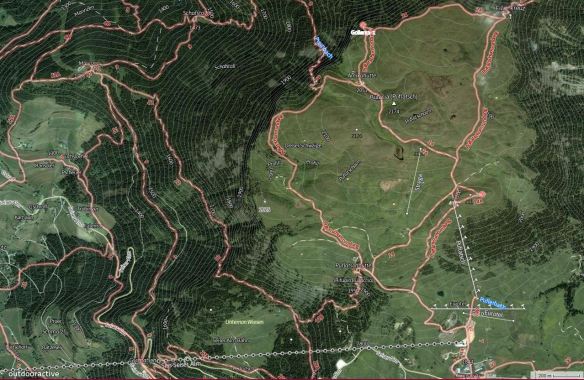
Summit-tracks-Satt

Map of Summit area

The trip on Saturday was the same as on the “reccie” on Friday. A 25-30 minute ride in the Seiser Alm cable car from Seis to Compatsch, a ten minute walk and then a 10-15 minute ride from Compatsch up onto the mountain plateau where Puflatsch (or Monte Bullacia as the Italians call it), is located. Once at the top station of the cable car, it’s a good 30-35 minute walk to the planned activation spot on the summit. I had a little luck as the second cable car started operation at 8:50 rather than the official 9am as I and a couple were waiting. This meant I managed to get to the summit and be operational about 15 minutes before my alerted time of 0800 UTC or 10am local.

Cloudy, damp and about 2 degrees on the summit – the predicted sunshine didn’t come until I was back down in the valley in the afternoon. A “frozen fingers” activation! I had gloves but had to keep removing them to check the spots on the phone (managed to fix the Internet connectivity on Friday night (it was an Android setting that had been reset)).  As well as the cold making the activation uncomfortable, the Ramsey amplifier wasn’t working so I was restricted to 5w out. At the time it appeared that my 13.8v inverter may have been the cause (no DC to the amp) however on later inspection at home, the invertor was OK however the fuse in both the 12v plug and inside the Ramsey amp had blown, suggesting another transistor failure. – more to look at before the next activation!

Once operational I could not hear anything from VK. Don G0RQL and a couple of others said 20m conditions were not good and no VK’s had been heard so far that morning. I had thought I might be too late for the long path but with the lifts I could not have got there any earlier in any case.

Luckily there was no noise from the nearby electric fence and I managed to work around Europe, from Russia in the East, Norway in the North, Ireland to the West and Spain, the Azores and Greece to the south. All reporting acceptable signals even with just the 5w from the FT817.

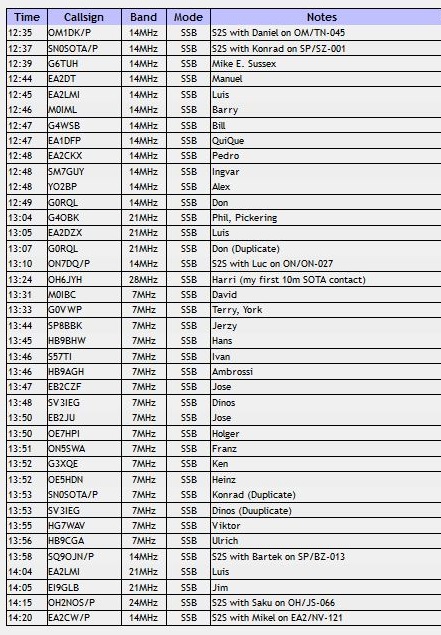
A total of 43 contacts in one hour including two S2S contacts but unfortunately no VK contacts. Well this is a new association activated for me in any case and it was good to catch up with the usual European chasers from a little further away than my normal summits and also nice pick up some new chasers. I think this is the first time I have had chasers from Russia calling me and there was the official IARU station from Geneva as well.

Slide Show.


This slideshow requires JavaScript.

Equipment:

Yaesu FT817ND,

SOTABeams 40/30/20 linked dipole.

6 metre squid pole.

Log:
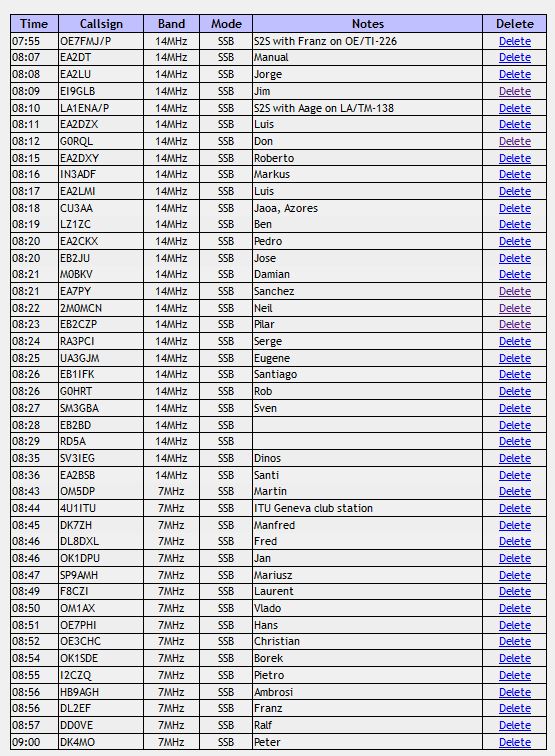
activator-log

Conclusions:

Test, test and test again! If I had tested the Ramsey amp on Friday night and found it was not working, I would have saved carrying 3 kilograms of equipment I could not use by leaving the amp, the invertor and two 5500maH LIPO batteries at the hotel.

73 ’til the next Summit!
DD5LP – September 6th. 2014 – DL/AM-001 Peissenberg

Preparation:

This activation was planned to coincide with the activations in VK2 that were to celebrate 1 year of the VK2 SOTA Association. As an added bonus a new Australian association VK6-Western Austrlia was launched on September 1st. 2014.

To avoid any risk and to be active when the long path conditions are open from Europe to Australia (early morning), I decided to activate Peissenbeg for a second time this year, despite the fact that I would receive no activator points.

A couple of activations ago my Ramsey QAMP stopped working, so before this activation I wanted to see if I could repair it. As it turned out, one of the two power MOSFETs in the small amp had failed and when I replaced it with a spare that I luckily had, the amp worked better than before. It appears that the two MOSFETs need to have very similar charactistics, possibly because there is only one bias transistor for both MOSFETs.

The Location:

Map

Peissenberg is an easy access summit which given the early start (7am local time) was welcome.

The trip down took just over 40 minutes, about 10 minutes longer than from my old QTH. The sun had just risen (with a very red sky, warning of storms later in the day that actually never came!).

The Activation:

On tuning around 20m it was clear that finding a free frequency was going to be difficult with multiple contests under way.

I invited Martin DF3MC along to the activation as one thing he had not yet achieved in SOTA is an S2S with Australia. He volunteered his FT857 to give us a little more power and we used my 6m mast and linked dipole. Not only did Martin manage an S2S with Australia, he managed two – one on SSB and one on CW. Conditions varied somewhat over the time we were there. As Martin needed to continue on to Munich, I completed the last hour of the activation using my FT817 and Ramsey QAMP and am glad to report all went well. The amp worked as it should, bringing me some more S2S contacts on 20m and 40m as well and many more chaser contacts.

Self spotting from Peissenberg is no problem with good cell phone coverage but initially we took a look around for activators to call, then I handed over to Martin to put out some calls on CW which were relatively effective. We alternated between Martin on CW and myself on SSB during the activation, which worked well. Setting up two stations in the limited area would have made no sense and it meant that Martin and I were able to take some photos and a videos when not operating (my video included below).

While the radio equipment all worked well, my camera did not. On turning it on, it did nothing. I tried a few times and then concluded that the battery must be flat and as I carry a replacement, charged, camera battery I swopped over. On turning the camera on with the new battery the camera started up but without my realising, it had done a factory reset in the process. I also appear to have had the video running for a long time without knowing it! Hence the audio is fine but the pictures leave a little to be desired!

Video.

Here is my video from the activation –

Equipment:

Yaesu FT857 and FT817, Ramsey 25w QAMP (modified to cover 40/30/20m)

SOTABeams 40/30/20 linked dipole.

6 metre squid pole.

Log:

activator-log

Conclusions:

All in all, this was a successful and enjoyable activation with 28 contacts for me including 5 S2S contacts. With the variable conditons we missed some VK2 activators and unfortunately there was no VK6 activator out on this Saturday (one was out on Sunday).

I should have checcked the direction of the dipole. Although not so critical being in Inverted-V form at a low height for maximum effect I would have liked  to have it run from NE to SW to radiate off its side NW for the long path to Australia. In fact it was running east-west and so radiating roughly north / south, in fact with the church right behind us it would be absorbing most of the RF in the direction of Australia.

73 ’til the next Summit!

DD5LP – July 25th. 2014 – DL/MF-079 Wendelstein

Preparation:

This activation was on my list for a while, it’s an “easy” access summit with a lift to “near” to the summit. In this case there is a cog-wheel railway as well as a cable car that brings you to the “berg staton”. Once at the “berg station” there is a serpentine track up to the actual summit about 100m higher than the top stations of the cable car and cog railway. The space observatory is located on the summit but is not accessible to the public.

The path is made up of a few steps and some long light climbs. It takes around 30 minutes to climb the track to the summit. Wendelstein attracts a lot of people probably 25% of them head up to the summit, making it a busy place with limited space.

Hence this activation needed a light configuration that should take up minimum space – so no squid-pole based dipole antenna, rather a Diamond RHM8B HF whip on a tripod with a counterpoise wire.

The trip down was planned to take 2 hours and meet the 12 noon train (it only runs on the hour) allowing a little extra time in case of traffic delays  (a useful point as it turned out).

Wendelstein-open-street-mapWendelstein-satellite-map.

The Location:

Wendelstein can be approached either by the cable car that starts near Bayerischzell or using the cog railway from Brannenburg. The cable car only takes 7 minutes to reach the summit while the railway takes 25-30 minutes. The railway also costs €10 more for a return ticket than the cable car – €31 – really expensive! However, the unique ride up the railway is special with the views you get. Brannenburg is easily accessed from the Innsbruck autobahn while access to the cable car requires some cross-country driving using smaller roads.

Once on the mountain, there are a few attractions – a restaurant with inside and outside seating, a lookout point, a small chapel, which is consecrated so it is the highest point in Germany where someone can get married. A small underground mine / display area, the Bavarian TV transmitter station and a small observatory. Apart from the observatory all attractions are located near to the railway and cable car “top” stations. The observatory is located on the actual summit which also has a cross, another small chapel and two lookout platforms. There is an extension to the track up to the summit, that continues around the back of the mountain, giving panoramic views and returning you back to the restaurant / stations. The track from the cable car and railway stations to the summit is achievable by most people and has hand rails all of the way up.

The Activation:

Our schedule was somewhat regulated by the hourly schedule of the train and it was good that we allowed some extra time for the trip as several farm tractors were underway on some of the roads that we needed to use as well as road works on the autobahn causing an additional delay. We did arrive in good time to meet the noon train to the summit from Brannenburg and it was a lovely trip up the mountain as shown by the photos  in the slide show below. Arriving at the top station we decided to get something to eat before doing everything else to avoid the lunch rush. This went well and indeed by 12:40 I was ready to start the trek up to the summit. While the climb up winding path was an easy climb, the path seemed to never finish. As you get to a point where you think you are getting close around the next corner the path goes out across the next cliff face into the distance! The path is narrow so stops to allow people coming down to pass also took up time however as I was running well ahead of my schedule this was not a problem.

On arriving at the actual summit, the number of people increased – there were about a dozen there however all had chosen the lookout platform with seats near the observatory on the right, so I quickly took up residence on the lookout platform past the summit cross and small chapel on the left. This is a platform made up of concrete tiles, so the tripod with the Diamond antenna attached sat well on this surface. I set up as quickly as I could while the space was available. While setting up a dipole on a squid pole may have been possible by lashing it to the railing surrounding the platform, the tripod and vertical approach was certainly quicker to install. There remained one problem, with the relatively small area, there was not a lot of space for the counterpoise wire but I managed to lay this out and taped the plastic reel on its end to the railing keeping it elevated about 1m above ground at the end. This also did not take up too much of the platform.Given the small area available I chose to go on 20m (with its shorter counterpoise wire first) and while the SWR was not as good as I had achieved during testing, I decided to use the antenna in any case and hope I would be able to get out OK.

On tuning around to find a free frequency I came across Hans on LA/TM-001 calling CQ SOTA. After a persistent call, stressing “Summit to Summit” I managed this contact into Norway. Not bad for this set-up I thought. I then found 14.275 apparently free and put out a QRZ to check it was free to have Nobby (G0VJG) operating as GJ3RCV (Cray Valley radio society)  come back and say he was monitoring the frequency and waiting for the IOTA contest to start. Nobby and his team were on the Minkies reef off Maitresse Ile in the channel islands which I believe he said was only 25m wide by 70m long. This was another interesting contact which proved the QRP equipment was working well. After eventually finding a free frequency and self spotting a further 10 contacts were made on 20m (see log below). Once the flow of calls stopped, I decided to try 40m and detached and rolled up the 20m counterpoise and installed the 40m one as best I could in the limited area. At this point a wedding party in full Bavarian costume arrived and started taking photos by the summit cross (on “my” platform). After adjusting the Diamond antenna for best VSWR, I tried tuning 40m – and found S9+ noise right across the 40m band. Given its strength I presume this is local QRM either from the weather station or the TV station on this summit. It made 40m totally unusable. As I was now feeling quite cold and felt a few spots of rain, I decided to pack up and head back down the track to the warmth of the restaurant and to take the earlier train back down the mountain. As always when half way down the climb, three additional activations were spotted on SOTAWatch that I probably would have been able to contact for S2S points.

Here are some photos from the activation and the train journey to and from the summit –

This slideshow requires JavaScript.

Equipment:

Yaesu FT817ND

Diamond RHM8B HF vertical whip antenna

Modified camera tripod.

Log:

activator-log

Conclusions:

While this was a good activation with some good contacts, I am not happy that the VSWR was higher than during the antenna tests earlier in the week. It could be that all of the metal work around the platform caused the issue or that because I was on a concrete platform, not directly on solid ground that the antenna didn’t tune as well as expected. In any case some more tests and possibly a quicker “clip-on” method needs to be found to attach the individual counterpoise wires to the socket base (presently I remove the nut, attach the wire and add the nut back – if I had dropped the nut between the concrete tiles on the summit, the activation would never have taken place).

Lessons learned –

When reducing items to cut down on weight DO NOT remove gloves from the pack! (It was cold on the walk up to and on the summit platform).

73 ’til the next Summit!

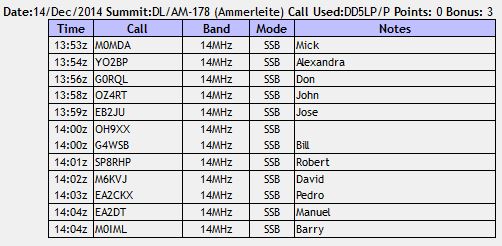
DD5LP – July 15th. 2014 – DL/AL-282 Steig, DL/AL-149 Blender, DL/AL-281 Ursersberg and DM/BW-088 Rangenberg.

Preparation:

As you will see from the title, this was a multi-summit activation. I initially was looking for the next summit that I had not yet activated and looked at Blender, when I saw that Urserberg was just across the valley from it and given the fact that the summit was over 2 hours drive away from my current home I thought I’d activate the two summits on the same excursion. When looking at my route, I also realised that Steig was also not too far off my route and made that the third planned SOTA summit in the Allgäu district of Bavaria that I would try to activate. As I had never been anywhere near these summits, there was always a chance that I would not be able to get access to one or other of the summits, so as a reserve, I decided to add a summit over the border in Baden WĂĽrttemberg – a summit which gets activated a lot, mostly around the time of the Ham Radio event in Friedrichshafen as activators often fit this summit, DM/BW-088 Rangeberg, in their route to or from Friedrichshafen. I had planned to activate it on my way back from Ham Radio at the end of last month however with a torrential storm on the Sunday, I ruled this out. As it turned out the first three (DL/AL) summit activations went so well, that I managed to fit in Rangeberg as well. This was a bonus as this DM summit gives 8 points whereas the other three summits, in the same general area and at around the same height only give 1 or 2 points.

I also wanted to give my new mast and antenna a further test and compare it with my old equipment. With the limited time I could not set up both antennas and masts on any of the sites, so although I used each set-up on two summits, the time of day and locations were different and so I cannot draw any conclusions apart from that both configurations work well and the new one is heavier to carry to the site, mainly due to the 10m vs. the 6m mast.

I still have been unable to repair my Ramsey QRP amplifier so these activations were “barefoot” with just the 5w from the FT-817.

region

The Locations:

Three of the sites are in DL/AL (Allgäuer Alpen) and the “extra” one is in DM/BW (Bathe WĂĽrttemberg). The closest location is probably accessible in under 2 hours, the other three a little over 2 hours, from where I am currently staying. As I hoped for a possible long path contact into VK from the first summit, an early (pre 7am) start was planned.

Apart from a couple of “whoops missed the turn-off” moments (I was navigating using a printout from Google Maps), the sites were not too hard to find. Steig has a nice car park at the edge of the forest from where a 10-15 minutes walk is needed to get to the summit. None of the summits chosen this time have any marker (Cross, Trig point etc.) at their summit, but two, the first one (Steig) and the third one (Ursersberg) have small wildlife look-out towers on the top of them, which serve well as antenna mast supports! Ursersberg is some distance from the car park near the lake – far too far for my timeframe, so it was a matter of driving up the well maintained track, which was labelled as forestry access only, while not 100% correct, it appears when one asks locals, they pay no attention to these signs and don’t expect others to either. For future activators, who prefer to walk, 25 minutes should be enough to walk along the track to the summit. The second summit Blender, is up a series of roads which are marked for local access only. Again while not 100% correct, use of these sealed roads by none residents does not appear to be policed in any way. As there is a residential care home near the summit, none locals do regularly use the roads to visit patients. For future activators – your choice. Perhaps take a push bike along for the final sections of these two summits as the signs relate to motor vehicles only.

The final summit of the day (Rangenberg) also had a car park at the entry of the forested area. I had considered driving into this site as well, however as I had time, I decided to walk from the car park the sign posted 1km (I think it was more!) steep and in places muddy climb to the summit. It took me about 20 minutes. When I got to the summit, I could see down the track going down the other side what looked like a copper building about large enough to be toilets but more important alongside it a table and benches – luxury for a SOTA activation. Checking the map this was less than 25 vertical metres down from the summit and hence still in the permitted SOTA activation zone. As I got closer I saw a small bell on the roof and realised this was in fact a very small chapel. The roof was copper and the sides covered with light brown wooden tiles. This looks to be a very new addition to the summit (see pictures later). Reading the sign on the door, It is only planned to be blessed in September 2014, to be called the “Alphornkappelle zur heiligen Cäcilia”. So this is a very new addition to the summit. This last summit was the physically hardest summit to get to with the long steep walk but with the best facilities for SOTA and of course, being in DM/BW 8 points for activator and chasers rather than the 1 or 2 points of the previous summits.

The Activations:

Steig DL/AL-282

I was hoping to manage a long path contact back into VK with this summit however band conditions weren’t good on 20m. It was quite hard going to get the minimum 4 contacts that I was eager to get in the log so that I could pack up and head off to the next (hopefully better) summit and perhaps, just perhaps manage to get all four summits activated in one day. It took about 10 minutes before I could get even one contact. I was just about to start checking all the equipment (this activation was using my new antenna), when Colin G4UXH came back. Over the next 10 minutes I bagged another 5 contacts, so I quickly packed up and headed back down the forest track to the car. Hopefully the next site would be better…

Blender DL/AL-149

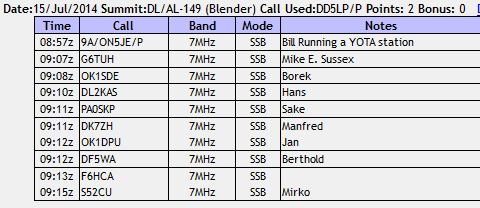
  This was a bit of a drive from Steig, going part way around Kempten and then heading off on several small roads. As I approached the area however it became very obvious where I was heading. The Television/Telekom tower is visible for miles around (in fact it was also still visible at my next summit). As mentioned earlier, access roads to Blender are marked as local access only. Until someone points this out to me though, I was happy to drive up the roads. I met one elderly lady out on her bike, who had cycled to the top to take in the view (I wish I could cycle up that hill as she did!). We had a short chat and I said that I was an Amateur Radio enthusiast and she knew what I was talking about. It seems AR in Germany is much better publicised that in other countries in which I have lived! After setting up I tuned around 40m and found Bill 9A/ON5JE/P operating a station for the Youth On The Air (YOTA) week. I then found a free frequency, spotted myself and put out a call. I bagged a further nine stations in just under 10 minutes. All signals from this summit were stronger than at the previous although reports given to me were not better. Was this the antenna? I had switched back to my linked dipole for this summit. Without also putting up the new antenna and doing a direct comparison, I can’t say. I think the location was simply better, I was also on 40m rather than 20m and of course this was now later in the day. Time to try summit number three…

Ursersberg DL/AL-281

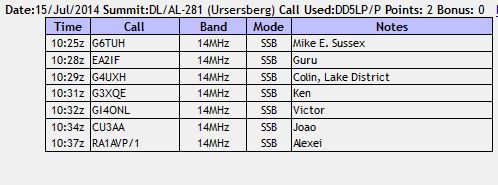
  This was a far shorter drive, back down the valley across and up the other side. Ursersberg is again in a forest above the top of some small ski lifts. Access is via a road marked as for only forestry vehicles. Never mind, after checking my map in the car park at the main road, I drove up the track, hoping not to meet a forestry vehicle coming the other way. The track is walkable and in fact on packing up I met a family who had walked up and amazingly again, the father knew all about Amateur Radio through a father at the monastery school where he was as a child having a station within the school and several large antennas outside! On arriving I had to walk a distance from the only place to park off the track, to find some way to get through all of the brambles and nettles that have taken over this forest. I eventually found a track and it led to a lookout tower similar to the one on Steig but in a somewhat worse condition. I decided to use the linked dipole again from here this time on 20m as en-route I had seen spots for three other summit activations on 20m. I didn’t manage to catch even one – either they had moved on or they were far too weak for me to hear (In one case I could hear chasers calling, but not the activating station). I did manage seven contacts in about 10 minutes. I considered switching to 40m to perhaps capture some more but decided rather to pack up and squeeze in the fourth summit activation for the day.

Rangenberg DM/BW-088

  While not as close as the last two summits, the trip to the last summit of the day took only around 20 minutes. That was to the car park. The walk up the hill with both sets of gear, took a further 20 minutes. I decided to give the 404-UL antenna another try along with the new 10m mast, admitedly probably only at about 8 metres as the support I was using (a fence post) was not totally secure! The luxury of being able to set up and operate from a table and seating bank at the end of a long day cannot be beaten. This is the site I made the most contacts from with twenty in all and three of those Summit-to-Summit contacts. I only used 40m as it seemed to be the better band on the day. This also meant that I had run both my old antenna configuration (6m mast and linked dipole) and my new antenna configuration (10m mast and Aerial-51 404-UL asymmetric dipole) on both 20m and 40m. I had thought of putting both configurations up at this last site and had carried both up the hill, however I was getting tired and there was still a long drive home, so I decided that I will plan an activation just to compare the antennas another time.

Here are some photos from each activation –

1. Steig.

This slideshow requires JavaScript.

2. Blender.

This slideshow requires JavaScript.

3. Ursersberg.

This slideshow requires JavaScript.

4. Rangenberg.

This slideshow requires JavaScript.

Equipment:

Steig & Rangenberg

Yaesu FT817ND

Aerial-51 404-UL asymmetric dipole

DX-Wire 10m “mini-mast”.

Blender & Ursersberg

Yaesu FT817ND

SOTABeams linked dipole

6m “mini-mast”.

Logs:

Steig:

Activator-log

Blender:

Activator-log

Ursersberg:

Activator-log

Rangenberg:

Activator-log


Conclusions:

No true comparisons of the antenna systems could be made. It was interesting that after 4 activations using the internal LIPO in the FT817 it still had 25% of it’s charge left at the end of the day. So I didn’t need to carry the extra weight of the two external 5000mAH LIPOs to each site.

I need to plan an activation, just to compare antenna systems from a known good location – I may combine this with the upcoming VK1 SOTA activation day on Sunday 27th. July.

A little extra power, especially on 20m would be an advantage, even if only the 10-14w that the Ramsey amp used to give out.

Lessons learned –

The idea of multiple activations in one day, while operating alone, is no fun and I will probably not do it again for a while.

73 ’til the next Summit!

DD5LP – July 6th 2014 – DL/MF-050 Rauhkopf

Preparation:

This was another activation to further test out my new equipment purchased the previous weekend at Friedrichshafen. I had made a small modification to the Aerial-51 UL-404 so that it would slide over the mast and had replaced the cords on the end of the dipole as the string I had used was water-logged from Rentschen. This was also a summit where my wife would accompany me, at least as far as the cable car top station and then would relax in the sun reading until I returned from the summit. The route to the summit was described as a 15 minute walk with no particular difficulties. So with the weather forecast being very good for the Sunday, I repacked my equipment into one small rucksack, leaving out the previous SOTABeams linked dipole and my 6m squid pole. This time I would rely completely on the new 10m pole and the Aerial-51 antenna. The not currently working Ramsey QRP amplifier would also be left behind along with its cables and the two 5000mAH LIPOs. I would rely upon the 2500 mAH LIPO that I have built into the FT-817 for all power requirments.

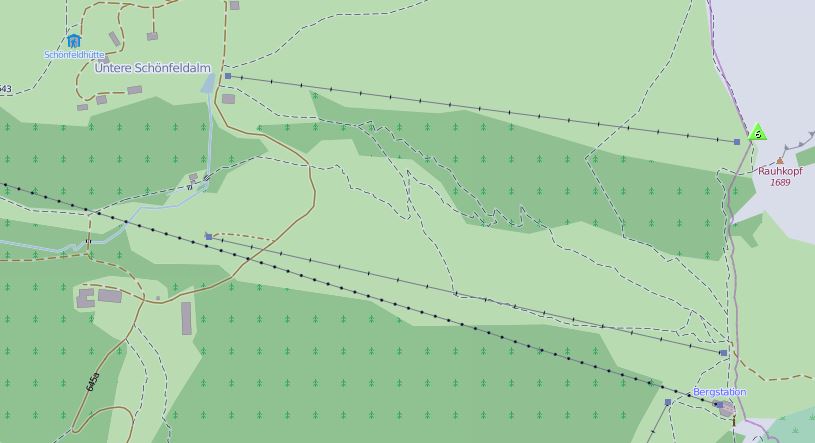
summit-map-DLMF050

The Location:

Rauhkopf is one of the summits in the skiing area above Spitzingsee, which is a tourist area not far from Miesbach about 30km south of Munich. The ski area is reached by a cable car rising about 500m from the lakeside. In winter several ski lifts are in operation one of which would take you very close to Rauhkopf but in summer only the Taubenstein cable car runs. This lift brings you fairly close to Rauhkopf in any case. A track that is graded as little or no difficulty by hiking websites should take around 15 minutes to walk from the cable car’s top station across to Rauhkopf. I found some difficulty with the rocks and steep climb in places, possibly due to the weight of my backpack plus my physical condition (not fit enough). In any case if you plan to activate Rauhkopf be prepared for this section to take 20 minutes rather than just the advertised 15 minutes.

Once I reached the summit, there is a cross to mark it and the views (of course) are fantastic. This is a summit that lots of walkers come to, in fact it forms part of a waking route that also can take in two other SOTA summits Aiplspitz DL/MF-054 and Jägerkamp DL/MF-053, if one had the time (and energy). Turning the other direction from the cable car, a long route, including two more SOTA summits Miesing DL/MF-057 and Rotwand DL/MF-058, is possible.

Rauhkopf is quite busy with walkers arriving every couple of minutes, so I decided to set up a little way back down and off the track. Even here I was asked by many what I was doing (I must get some AR/SOTA brochures in German to take with me). One walker knew exactly what I was doing as he was himself an amateur radio enthusiast, but the majority expressed polite interest and then carried on.

The Activation:

Once at my set-up position it was not all easy work. Although I had room to run the antenna out the new cords that I had added to the end of the antenna, replacing the fairly horrible strings that I had on the Rentschen activation, insisted on tangling themselves up with different parts of the antenna. After about 15 minutes of trying to untangle them, I had to resort to cutting them, untangling them away from the antenna and retying them. (I hope to get some better cord on Tuesday that will be thick enough not to tangle so much but still light enough to be easily packed). I used the available barbed-wire holding fence posts to support the 10m mast and the ends of the dipole. Of course upon raising the antenna I had to adjust the cord lengths holding the ends of the antenna and each time I dropped and raised the antenna, the barbed wire grabbed the antenna. It took some time to get the antenna raised at all. I had also made a modification to the UL-404 balun box, adding some screw in loops to the back of it, so that it slips over the squid pole and drops down to the top of a lower section. Unfortunately I had miscalculated and the section I had this drop down to, was one higher than the mast could support the weight at and the mast started to lean over badly. So I had to lower the unit again and then tie it to the correct section as I had done at Rentschen the previous Monday. When I eventually raised the mast for the final time, I decided not to raise it to the full height as I would have to readjust the cords again. The end effect was that I could have taken and used my old 6m mast instead of the 10m one and had less weight to carry.

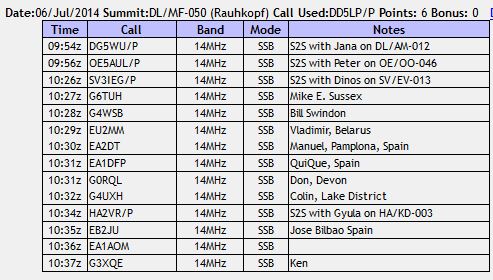
I estimate it took me about 45 minutes to set-up the equipment, by which time I was eager to self spot and get active. While searching around 20m for a free frequency I happened upon Jana DG5WU who was on another DL SOTA summit, so I called her and we had a short S2S contact, following my call Peter OE5AUL also called Jana from an Austrian summit, as Jana didn’t reply, I called and told her she had another S2S calling her. Still no answer, so I had a quick S2S call with Peter. Later I found out that Jana was activating 3 summits and so most likely had packed up following her call with me. Unfortunately I was no longer on my summit for her later activations.

So now it really was time for me to get calling for the chasers – I found a free frequency on 20m and started calling CQ at the same time sending a self spot using the RucksackRadioTool app both as an internet (data) alert and as an SMS. Nothing appeared on RRT. I thought it might be a network issue and as my phone is a dual-SIM phone with two networks, I tried the other network – still no change – no spot. I gave up on spotting myself and called CQ on both 20m and 40m for half an hour with no success. I was receiving some spots though and when I saw Dinos SV3IEG spotted on 20m, I went and joined the queue to work him – another S2S. At this point Mike G6TUH heard me and asked me to QSY up 5 KHz where we had a QSO and he kindly spotted me, after this the calls came flooding in.

Perhaps we shouldn’t be so reliant upon the spotting system? But with non-QRP stations sitting on the QRP preferred calling frequencies, and often being a weak signal it’s going to be difficult to get enough contacts to qualify a summit. Lets hope the links to and from Rucksack Radio Tool are fixed soon. If I’d have known this was not a problem at my end, I might have thought to start-up the web browser on the phone and go to the Sotawatch website and spotted myself there. “Shuda Wudda Cuddah…….”

Here are some photos from the activation –

This slideshow requires JavaScript.

Equipment:

Yaesu FT817ND

Aerial-51 404-UL asymmetric dipole

DX-Wire 10m “mini-mast”.

Log:

activator-log

Conclusions:

A good if a little slow to start, activation. More power is required to break in and use a frequency on 40m.

Lessons learned –

Cords and cables ALWAYS tangle when you have limited time. No matter how good or bad they are, but using new cords on a mountain top is not the best place to try them out!

I need to revise my mount for the 404-UL balun, so that it slides further down the mast.

When I can’t be sure that I will be able to get the 10m mast up, I might as well take the lighter 6m one.

NEVER believe track difficultly ratings given on a website aimed at eager walkers!

Get brochures in German about Amateur Radio and SOTA that can be laid nearby for those interested to take away.

73 ’til the next Summit!

DD5LP – July 2nd. 2014 – DL/AM-176 Rentschen

Preparation:

This activation was planned to test out some of the new equipment purchased the previous weekend at Friedrichshafen. Specifically the new mechanical IF filter in the FT-817, the new Aerial-51 404 Ultra-light wire antenna and my new DX-Wire 10m Mini-mast. As this was to be a test run, I did not “need” to go to a SOTA summit, however when the opportunity is there … Rentschen is one of the last two summits within 1 hr drive of where I’m living that I had not activated. When I took a look at the site via the SOTA mapping project, I was amazed to find that the summit is right on a roadway so I could drive-up park and then find a location a suitable distance away from the car to activate. I was only able to put up an alert the night before as the car became available when my wife changed her plans. I also posted a note to the SOTA Australia list, just in case I might be early enough to catch the end of the early morning long path window to VK on 20m (unfortunately this wasn’t to be, the conditions simply weren’t there but thanks to Paul VK5PAS and John VK6NU for listening).

As I could not locate and correct the failure in my Ramsey QRP amplifier that had occurred on Pfaender, I would have to do this activation “barefoot” with just the 5w from the FT-817.

The antenna and mast were exactly as bought, so I needed to add some cord to the antenna attaching it to the insulators at the ends of the dipole and on the balun case so that it could be tied to the mast. I first tried tying it to the top and second to top sections while still at home, however even extending the mast a metre showed that this would not work. Rick DJ0IP advised me on this mast to tie the balun to the fourth section down and indeed this is the point that the mast is able to carry the weight of the antenna without bending over. The new Yaesu (Collins) mechanical filter had already been installed and enabled, so all was ready for the following day.

DL-AM-176 satellite

The Location:

As it turned out the route to Rentschen is an extension to the route I had previously taken to Kernberg and Ammerleite, so I only needed to concentrate on the last 10km or so of the route to make sure I took the correct turns. During the drive, the rain started and when I arrived at Rentschen a constant drizzle was coming down. I decided to hope for the best and do what I could in the rain. As it turned out, the rain only got heavy after I had packed up and left. I took a walk around the area and unfortunately there are only limited possibilities to support a mast. One area of open ground was so waterlogged that when one stepped on it, water came up about 2cm! If the ground was drier, it might have been possible to get to the edge of the forest but I had to make do with the telegraph or power poles that cross the area. Thinking of electrical safety I went with a Telegraph pole however this limited the height I could extend the new mast to 6m. Any way this would have to do. I found some large logs that served as a table and set up my equipment.

The Activation:

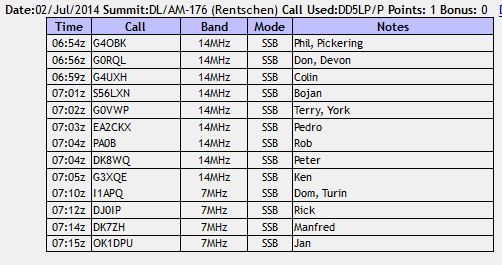
I decided to start on 20m in the hope that I might just manage a contact into VK. It was not to be the case however instead, it seems that the skip into the UK was just about right as I worked a stream of very loud UK stations one after the other. The FT817 audio was definitely easier to hear and close by strong stations did not give me the problems I have been having previously so I can say the money spent on the Yaesu 2.3KHz SSB IF filter appears to have been a good action. Before starting up on 20m I checked the reflected power on the FT-817 meter – nothing reflected and full power indicated as going out. This with the Aerial-51 antenna only at 6m (10m or more is recommended). Once the flow of calls on 20m dried up I decided to test the other reason I bought the 404-UL from Aerial-51, switching bands without having to lower the antenna, adjust the links and put it back up. As I have to do with my linked dipole.  On checking the SWR on 40m, there was a little reflected power but nothing to worry about. It’ll be interesting to see if this also goes away on my next activation if I can get the mast erected to its full height.

At this point the rain was getting somewhat heavier, so I kept the contacts on 40m to a minimum and worked just 4 more contacts before packing up. One of these contacts was with Rick DJ0IP, the designer of the Aerial-51 404-UL antenna.

Here are some photos from the activation –

This slideshow requires JavaScript.

Equipment:

Yaesu FT817ND

Aerial-51 404-UL asymmetric dipole

DX-Wire 10m “mini-mast”.

Log:

Activator-log

Conclusions:

My opinion on the Aerial-51 antenna? The quality of build is very good and the wire used for the dipole legs is light but strong and does not appear to tangle easily (more than what can be said for the co-ax but this is the same issue on all antennas using mini co-ax). From the few contacts I had the 404-UL does not appear to be significantly different on receive or transmit to the linked dipole but without having both antennas up at the same time and switching between them (which I didn’t want to do in the rain) I can’t say which is the better antenna at the moment. Both the SOTABeams and the Aerial-51 antennas are light weight. The SOTABeams linked dipole is lighter as it has no balun but the Aerial-51 antenna has the advantage of being able to put it up and left up and bands switched simply by changing them on the transceiver.  From a price point of view, the 4 band SOTABeams (80 – 20m) linked dipole is €66 whereas the 5 band (40m – 6m) Aerial-51 is €99 (with the addition of an ATU the Aerial-51 can also cover 12 & 17m). So the Aerial-51 is more expensive, but there’s more in it – the main cost is the balun and the SOTABeams linked dipole doesn’t have one. At the moment, I think it’s a “take your choice” situation, depending upon what you specifically need. Prices are without shipping costs in both cases.

The €110 2.3KHz IF filter addition to the FT-817 was indeed a valuable addition.

The DX-Wire 10m mini-mast will need more activations to see if it was worth it’s €55 price.

Lessons learned –

Nothing particularly from this activation, everything went as planned.

73 ’til the next Summit!

DD5LP – June 28th. 2014 – DM/BW-349 Aacheck

Preparation:

This activation was planned by Phil G4ODK and Nick G4OOE like OE/VB-512 the day before. This activation was planned for the afternoon of the second day of the Friedrichshafen HAMRADIO event. In fact two summits were to be activated by Phil & Nick and I asked if I could follow them to the first one (Aacheck) but not the second as I had an appointment in the evening that I needed to get back in good time for.

Aacheck-map

The Location:

Access to Aacheck is through the village of Betenbrun up a small road that then becomes a track up the side of a field, before getting steeper and rockier as it goes between two rows of trees to a plateau that is the summit.

The Activation:

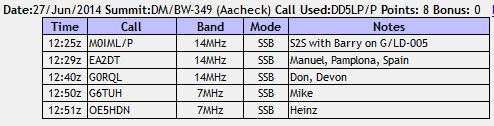
Upon arrival we decided to park before the rocky track and walk as we could see the summit about 25m metres above us and about 250m up the track.To avoid interference we each took a different band Phil-30m CW, Nick 40m-CW and I took 20m-SSB. We each then headed to a different corner of the plateau. I found a useful seat alongside a stone road at the far side of the plateau and started to set up there. I knew the internal LIPO battery in the FT-817 would not be fully charged as I had not charged it since the activation on the previous day. I also knew that the QRP amp was not working, so I planned to set up the FT-817 running barefoot, powered externally from a 5000maH LIPO through a “battery booster” that takes the voltage up from 11v to 13.8v. After putting up the antenna I unpacked the rest of the equipment and connected it all up …. NOTHING! No power was getting to the 817! Rather than fault-find on the summit, I rewired my connections to avoid the battery booster so that the 3C LIPO connected directly to the external power socket of the 817. Upon inspection later, I found the input power lead into the battery booster, inside its box, had come off and when reconnected all works again. These power issues on the summit had cost me time however, so it was time to get going. Searching around 20m to find a free frequency was almost impossible as the “King of Spain” contest was apparently on and everyone was using which ever frequency they could find and all were so strong so that they appeared to be splattering over 25KHz each side of the frequency they were centred upon. The best frequency I could find had a humming carrier on it that was S5 with me but that was all I could find, so I spotted myself and started calling CQ. This activation took longer to get contacts than any I had done before!

On 20m I had only got 3 contacts when Phil & Nick packed up to go to their next summit. As they had vacated the other bands I switched to 40m as the rain started to come down, after some more calls and self-spotting Mike G6TUH came back to make contact number 4 and to be safe Heinz OE5HDN came back after Mike, which made the activation successful. I now packed up as quickly as possible trying to avoid getting the rig or log book wet. When all was packed up and I set off back across the field, the rain stopped of course. Well that’s SOTA. I was lucky to get this activation in as it replaced the activation of DM/BW-088 Rangenberg that I had planned for the following day but was washed out by constant heavy rain (15 litres of water fell per square metre for pretty well the whole day!).

Here are some photos from the activation –

This slideshow requires JavaScript.

Equipment:

FT817ND

SOTABeams linked dipole

6m Squid pole.

Log:

Activator-log

Conclusions:

A difficult activation with the power problems, the King of Spain contest and then the rain. It would have been a shame not to have achieved a qualified summit for one last contact, so thanks to Mike and Heinz especially for their contacts.

It would have been good to have the 2.3KHz roofing filter (purchased the previous day) in the FT817 to limit some of the QRO station problems. I have now installed it, so we’ll see if this €110,00 purchase does help or not.

Lessons learned –

Don’t assume equipment is working just because it has worked on several previous activations. Always be prepared to run a simpler configuration if needed after all it’s better to get on with a weak signal than not to get on at all.

73 ’til the next Summit!
OE/VK2JI – June 27th. 2014 – OE/VB-512 Pfänder

Preparation:

This activation was planned by Phil G4ODK and Nick G4OOE to finish up the first day of the Friedrichshafen HAMRADIO event trip. I had contacted Phil and asked it I culd tag along and in the meantime Peter OK1CZ had also asked for a ride. So we took two cars with Phil & Nick in one and Peter and myself in the other. We all took our own SOTA gear to use. I had hoped to try out the new Aerial-51 wire antenna and DX-Wire 10m mini-mast that I had bought at HAM RADIO but decided it was better to rely upon the usual equipment.

PFander-map

The Location:

Pfänder is above the Austrian town of Bregenz which is just over the border with Germany on the banks of Lake Constance. Nowadays there are no operational border posts as both countries are members of the EU but to avoid autobahn tolls we took the old route which passed the old, now unused border posts. To use Austrian autobahns you need a sticker that lasts for a full calendar year. I have one on my car but Nick did not have one on his and there is no justification to pay for a years usage for a run of about 3km down the Autobahn.

Access to Pfänder is well signposted on the road up from Bregenz. The public car park (1 Euro per hour charge) is probably about 500m horizontally and 50m vertically away from the summit. There is a restaurant nearer to the summit and the top station of the cable car with it’s own car park but that road has a metal bollard that can be raised blocking the route (this almost caught Nick & Phil out as they drove to that car park not the main public one).

The Activation:

The run took longer than the expected 35 minutes from Friedrichshafen due to a lot of traffic however OE/OK1CZ/P and OE/VK2JI/P we operational on schedule at 15:30 UTC and Phil OE/G4ODK/P and Nick OE/G4OOE/P soon after. To stir up some activity I had decided to use my Australian call rather than my German one this time. When outside of Germany, I can chose any of my valid calls from CEPT member countries, so I could have used G8GLM or DD5LP also.

Pfänder has several good spots to set-up and I chose one directly across the path from the TV transmitter tower. Surprisingly I had no interference at all from it. Herbert OE9HRV who lives in Bregenz, below the Pfänder mountain, and is a SOTA activator, came up to say hello when he saw we were activating. He told me he had had interference from the tower previously.

I managed 18 contacts across 20 & 40m SSB, including one S2S contact (log below) despite the fact that the QRP Amp was not working and I was running, at best, 5w output. (I later found that the fuse inside the amp had blown, whether from a surge or a fault will need to be investigated once I get some replacement fuses).

At the end of the activation Herbert suggested a nice restaurant with a remarkable view out over Lake Constance and all five of us headed there for a great meal, a couple of beers and a good chat about SOTA and Amateur Radio in general.

As I had driven down to Friedrichshafen, early that morning, after dropping Peter back to his lodgings I was ready for a good sleep at my hotel, to prepare for another day at HAM RADIO and as it turned out another SOTA activation (DM/BW-349 Aacheck) on Saturday.

Here are some photos from the the activation –

This slideshow requires JavaScript.

Equipment:

FT817ND

Ramsey QRP amplifier (not working)

SOTABeams linked dipole

6m Squid pole.

Log:

Activator Log

Activator Log

Conclusions:

An enjoyable activation. I normally activate alone, so it’s a nice change to have company and Herbert joining us on the summit was a bonus.

It would have been good to have the 2.3KHz roofing filter in the the FT817 that I had bought earlier in the day to handle the QRO stations near the frequency but I decided to delay taking the rig apart until I got home and had the appropraite tools available.

Lessons learned –

Don’t assume equipment is working just because it has worked on several previous activations. It’s better to run barefoot than have a non-working amp in circuit losing a DB or two of signal both on TX and RX.

73 ’til the next Summit!

DD5LP – June 26th. 6 Dec. 4th 2014 – DL/AL-179 Weichberg

Preparation:

With the intention of catching some S2S contacts with SOTA activators on their way to the HAM RADIO event in Fredrichshafen (or already there). I sought out a summit that I hadn’t activated yet, where I could travel to from home and then return home, before driving myself to Friedrichshafen the next day (Friday 27th. June).

Weichberg with its small chapel is very easy to access, in the middle of a farming area that appears to have adapted itself for holidaymakers wanting to hike the local hills with holiday homes, cafes and one souvenir shop in the village of Rettenbach which is at the bottom of the Weichberg hill. There is a car park for about 5 cars and then a short path up through the trees to get to the chapel on the summit. Access is easy.

Weichberg

The Location:

I drove to Weichberg on the preceeding Monday (June 23rd.) to check-out the location and test for radio noise as there is a TV and Radio transmitter mast behind the chapel on the hill.

Weichberg is easy to find – take the B472 out of Schongau in the direction of MarktOberdorf and after about 10km Rettenbach is clearly signposted as a turn to the left. After going through the small village of Frankau continue on to the centre of Rettenbach where Weichberg is signposted to the left up a road called Dolce. Follow this road to the point where the road is restricted for forestry worker access only and at this point there is the official (signposted) car park and the start of the track up to the chapel. After walking up the track (it takes about 3 minutes) I did find some RF noise with my portable shortwave receiver but could not say if this is coming from the tower or elsewhere. In any case the level was not bad enough to block out all signals. At the chapel on the top of the hill there is a grassed area with some seating banks, a cross and some small trees. To the north of the grassed area a large forrest starts and to the south, the land drops off quickly to local farm land. This is a good area to set up the station in.

The plan was set – bring both bags of the usual equipment. Set up the dipole NE to SW in the hope of perhaps capturing the last of the long path window into VK at the 0730UTC planned start time. Then settle in for some DX and S2S contacts.

The Activation:

The activation went to plan, the weather, although starting off foggy cleared en-route. It was warm in the sun, but cold out of it. I set up using the wooden log table and banks and ran the dipole NE-SW (incidendaly end-on to the TV & radio tower a few hundred metres away – I had no problems from the tower). I was hoping perhaps to catch a VK chaser but it seems I was probably a little late for the long path window even though I arrived 30 mins earlier than planned and was operational by 0700 UTC (9am local). After working several chasers on a busy 20m band I switched to 40m and managed to contact Nick DL/G4OOE/P for a summit to summit contact. I also manged two S2S contacts into Austria. With a total of 40 contacts all up, this was a good activation.

 The site is very easily accessible, so for anyone looking to do a holiday style SOTA activation, this is a nice spot. The views are glorious and the small chapel on the summit is very neat and tidy inside. Quaint without being over done. The door on the chapel has an electric lock, simply press the button to allow the door to be opened. watch your head if you decide to go upstairs, the concrete roof is unforgiving which my wife unfortunately found out.

Here are some photos from the reccie and the activation –

This slideshow requires JavaScript.

The Second activation – December 4th.

Due to being unable to gain access to Eisenberg (DL/AL-171) for an attempt of an S2S into Virginia USA, I decided to re-activate Weichberg as it was on my route home. As the pictures show, it was a cold foggy summit, with ice droping out of the trees and a cold, damp wind. I earned my 3 bonus points for activating in the winter season!  Yes that is the coax all messed up – with cold fingers I was unable to untangle it.

The S2S with Eric W4EON/P on W4V/SH-015 was successful, so the hardship was, in the end worth it.

Equipment (1):

FT817ND

Ramsey QRP amplifier

SOTABeams linked dipole

6m Squid pole.

Equipment (2):

FT817ND

Ramsey QRP amplifier

Aerial-51 OCF dipole

6m Squid pole.

Log (1):

Activator-log

Log (2):

4-12-14_LOG

Conclusions (from 1st. activation):

An easy activation. A pleasant half a day out in the country with a stop for lunch mid-way on the way home. No equipment problems but still hoping to get a roofing filter for the FT817 to improve selectivity when strong signals are on the band. Let’s hope I can find one at a good price at Friedrichshafen.

Lessons learned –

Consider temperatures. A shaded area where the table was seemed a good idea, and it would have been later in the day, however in the morning, when the sun doesn’t get there it can be very cold. I would have been better to set up my two small camping chairs on the grass, nearer to the antenna mast.

73 ’til the next Summit!

DD5LP – June 15th. 2014 – DL/MF-026 Wallberg

Preparation:

The Wallberg mountain is another in the series fed with a cable car, with a nice restaurant on top of it with the ability to sit outside in the fresh air and admire the views (all pre-requesits for my wife to accompany me).

In this case the distance from the mountain station of the cable car and restaurant to the summit was to be a 30 min. walk, so I decided to reduce my usual 2 bags down to one. As it turned out this was a very good decision. Please see my “Sota equipment” page on this website for details of what I normally take and what I really need.

This activation had been planned for Saturday however after rising on Saturday, multiple weather forecasts predicted that showers would start at 10am local in the area, and continue for the rest of the day. As there is no shelter at this summit, walking up there in the rain, operating in the rain and then walking backed soaked in the rain doesn’t make a lot of sense to me if I could postpone for a day. The forecast for Sunday was far better, with no rain predicted. So I moved this activation to one day later Sunday 15th. June 2014. Checking the webcam on Wallberg on Saturday the forecasted bad weather hit right on schedule.

DL-MF-026_Wallberg-map2

The Location:

Wallberg overlooks the Tegernsee about 40Km SSE of Munich. As my father-in-law used to live in one of the villages on the banks of the lake, I knew some of the area but had never been up the Wallberg mountain. The views from Wallberg back over the whole of Tegernsee and further are very impressive.

Google maps predicted a drive of about 1hour 20minutes from my home to the valley station of the cable car which turned out to be correct. On getting there it appears that it would have been possible with permission, to drive up the mountain road to the top cable car station, but I would not advise this unless you have a 4WD or at least a car with high ground clearance. This road is closed in winter due to snow. In any case we took the cable car up the mountain. Apparently this used to be an open seat “sessellift” but thankfully it now has 4 seat closed cabins.

The Activation:

The mountain peak was difficult to get to and involved scrambling / climbing up a steep rocky section so that when I got to the top, I was exhausted and scared to think I had to go back down it. On the return journey I actually found a simpler route after being told by a local only the climbers come up the way I had come up!
When I was literally “perched” on the top of the mountain (there was no real flat area to sit on), I had no space to get my linked dipole out. So I had to rely upon my Diamond RHM8B, which is a loaded vertical that simply connects to the BNC socket on the FT817 and is tuned by moving the bottom part of the antenna up and down to find the best signal strength and lowest SWR. After several CQ attempts I managed the needed four contacts on 20m for the activation. 40m had some contest on it, making it unusable – I spotted myself on 40m and put out some CQ calls out then an Italian contest station simply started up on my frequency without warning. As it was getting cold and I could see the weather coming in, I decided to pack up and head back down the mountain.

On the way home I felt really crook as I had got cold into my kidneys on the top of the mountain. The pain was pretty bad even after taking some pain killers. Glad to say a day later the kidneys recovered.

Here are some photos from the activation –

This slideshow requires JavaScript.

Equipment:

FT817ND

Diamond RHM8B vertical antenna.

Log:

Activator Log

Conclusions:

All in all this turned out to be a hard activation. I had hoped to perhaps manage a long path contact into VK6, As I arrived 30 mins earlier than expected, it might just have been possible but with the restricted antenna possibilities there was no chance. I had also hoped for a contact with Tony VK3CAT on his last day of canal boat cruising in France, again with this antenna that was probably asking too much.

Lessons learned –

Unfortunately the DL peaks appear to have less information in the SOTAWatch database about previous activations than I am used to from SOTA in VK. If I had known there was actual climbing needed I would probably have tried to reduce the weight of my backpack even more than I had done. I may also have packed my end-fed half wave antennas rather than the squid pole as there are bushes on the summit that I could have laid the antenna across (I have done this before and the EFHW works suprisingly well even just a metre or so off the ground on the bushes!).

This is probably the hardest activation I have done so far!

73 ’til the next Summit!