DD5LP/P – March 15th. 2017 – DM/BW-484 Bussen.

Preparation:

Bussen is the summit that I had originally planned for the VK-EU SOTA S2S event the previous Saturday but as I wasn’t feeling 100% the early rise and long drive was not attractive. As the weather improved (spring has arrived – maybe…) I decided I should try to activate Bussen BM/BW-484 with its 8 activation points before the end of the winter period to grab was I thought were it’s 3 winter bonus points. But on the 15th. March, when I got up, I checked and realised that since 2009 Bussen no longer gets any winter bonus points but as all was prepared I decided to make this a 60 metre and 40m activation as I had completed the needed mods to my FT-817ND to enable it to operate on the new WRC15 60m band.

Equipment to be used would be the FT-817ND plus amplifier for 40m and the SOTABeams linked dipole that I modified a few weeks ago for 60m. I also packed the screw-in base, that had worked so well at Berndorfer Buchet, and Rentschen (although I found a great “natural” mast support as it turned out). I would not bother with the unreliable DX-Wire 10m mini-mast on this activation rather, stay with my old, trusted LambdaHalbe 6m one.

The Location:

Bussen is an 8 point summit roughly half way on a line between Lindau and Stuttgart. According to Google it’s between a 1hr. 40 min and 2hr. drive from my home location, depending upon traffic. Bussen, with its church and castle ruins can be seen from all around the areas on its 767m high hill in what otherwise is a relatively flat area.  The views from the summit are awesome when the weather is clear, which it was for the first time for me on this activation, my previous two activations were either in fog & rain or snow. access to the summit is restricted for vehicles and so one needs to park in the car park below the hill and walk up what is a very steep hill to the church and then across to the grassy area between the church and the castle ruins, where the trig point stone is also located.

The Activation:

I had decided to set off a little later so that I had time to take the dog for her walk before I left  and as I was not trying to meet the long path propagation window, I was more flexible with the times. So at about 9:30am local time I set off, expecting to miss the heavy traffic as well. While this was mostly true on the Autobahn, I was surprised to see so many large trucks on the small country roads that would make up 3/4 of my drive. Being stuck behind a line of trucks, without any safe chance of overtaking them can be annoying however most of these truckers were driving at 60 Km/h or even 80 Km/h when they could, so the difference in time taken compared to running at the 100Km/h speed limit of these small roads was not that great. The journey to Bussen took almost 2 hours however the return journey was completed in just 90 minutes as there was far less traffic in the afternoon.

On arriving at the car park, I packed just what I thought I would need  and left the screw-in base and the 10m mast (taken as a spare) in the car as previously I had managed to fasten the mast to the concrete and wood benches and tables and hoped to do the same again.

After slogging up the hill to the summit I arrived at the benches only to realise that the trees above them have grown more lower branches and these would be an obstacle to the mast and antenna. I decided to take a look at the other side of the park area away from the benches to see if I could find anything there as a mast support and was amazed to find a couple of concrete round hollow pipes in the ground, that while a little large, using the loose wood that was laid around as packing could indeed support the mast very nicely. This side of the park, being near the cliff edge, has less trees and I was able to find a good location for the antenna.

One “Ooopsie” as I was putting the mast up one section came out of the lower section and I was left with holding the mast and antenna with one hand and the mast’s bottom sections still sat in the ground! I knew I shouldn’t have cleaned the mast!! In any case – no biggie lowered the top sections with the antenna over to the ground, removed the antenna and then unscrewed the bottom cap off the bottom of the mast and slipped all the sections back into place. Re-attached the antenna and (carefully) up went the mast again, with no problems this time.

I was really happy with 60m. First of all I thought I would not have a chance to use one of the just two frequencies that overlap between the UK “bandlets” and the IARU WRC15 band. One of the frequencies had some kind of radar interference on it, the other had a CW operator. Oh well I thought – if the CW Op doesn’t get a response – which he didn’t, I’ll take that frequency, spot and call CQ – the result was 8 contacts. One into Slovenia, two Switzerland, two England, one Germany, one Ireland and finally one Belgian station! After switching to 40m, it was crazy! 37 contacts in 37 minutes, including 2 S2S and 2 Special Event stations! It looks like conditions are particularly good around lunchtime on 60 metres as all the stations were booming in and I was getting loud reports as well (remember 60m is a maximum of 5 watts rig output for 15w EIRP at the antenna for WRC15 countries).

Photos:


This slideshow requires JavaScript.

Equipment:

Yaesu FT817ND.

SOTABeams linked dipole modified for 60 metres.

LambdaHalbe 6m Mini-mast.

Modified QAMP amplifier (35W on 40m).

Thick plastic painters sheet.

Log:

Conclusions:

A nice activation where 60 metres performed very well around lunch time.

When considering winter bonus points, make sure I read “the small print”!

73 ’til the next Summit!

DD5LP/P – March 11th. 2017 – DL/AM-176 Rentschen (VK-EU S2S Event).

Preparation:

I had planned to activate Bussen BM/BW-484 with it’s 8 activation points plus 3 winter bonus points up until the 15th. March, however as I was suffering a little from the flu, the thought of a 4 hour round-trip drive was not so inviting. With propagation being variable at best and horrible at worst, there was a chance that 17m may be needed rather than 20m. Rentschen has a major advantage that being a drive-up summit, it would be possible to go back to the car and fetch and replace the OCF antenna with the 17m J-Pole antenna if needed (at Bussen, this would have been a major operation). Also Martin DF3MC ccontacted me and said he’d like to come along. I always enjoy operating wth Martin, so the fact that Rentschen ia about the same distance from him as from me, made it a good choice.

Equipment to be used would be the FT-817ND plus amplifier and the Aerial-51 OCF dipole with a 6m pole. The screw-in base, that had worked so well at Berndorfer Buchet, would also be taken along as there are no easy mast support structures at Rentschen. In the car would stay the 10m portbale mast along with the J-Pole antennas for 20, 17 & 15m.

The Location:

Rentschen is a one point, low summit that still has a 3 point winter bonus. It si about 50 minutes drive from my home and therefore one of my “local” summits. The actual summit is marked by a trig-point stone which is about 100m away from the road, where I would park my car as usual. The summit is between Rottenbuch and Steingaden villages.

The Activation:

Considering the propagation conditions, I think things went quite well. 2 x VK S2S contacts (I think my first DL-VK6 – thanks John VK6NU). I heard my first Japanese summit but got no response when I called several times. I thought I would have to re-cone the speaker after VK3MO called me, he was so strong! I also heard Matt VK1MA call me but he couldn’t hear me I think.

After about 0800 UTC, the usual QRO stations appeared on band and simply called CQ over the top of activators.
Conditions seemed to go up and down somewhat and at one point we had at least three summits on the same frequency!
A surprise on 14.280 was Elvira XT2SE from Burkina Faso, West Africa, (non SOTA) who I tried calling but of course with the pile-up I didn’t get through.
It was nice to operate with Martin DF3MC – he on CW and I on SSB, about 20m apart from each other – there was some interference but it didn’t stop us making contacts.
I thought I’d “pick up a few contacts” on 40m before packing up. Thirteen contacts in seven minutes was the result and then even managed an S2S into the UK (thanks for your perseverence Tom M1EYP). All in all a good activation.

Photos:

This slideshow requires JavaScript.

Equipment:

Yaesu FT817ND.

Aerial-51 OCF inverted-V dipole.

LambdaHalbe 6m Mini-mast.

Modified QAMP amplifier (25W on 20m, 35W on 40m).

Thick plastic painters sheet

Screw-in mast base

Mini Seat.

Log:

Conclusions:

Never base a decision on whether to activate on propagation predictions or even the conditions the previous day – Band conditions can improve (or get worse) without warning and the only way to know iff you are going to be able to make contacts is to activate and hope!

73 ’til the next Summit!

DD5LP/P – March 4th. 2017 – DL/AM-180 Burndorfer Buchet.

Preparation:

The purpose of this activation was to find out what the current time for the Long Path propagation opening was so that it would help my planning for the VK-EU S2S event on March 11th. Propagation conditions of late had been horrible and the chance of a contact into VK/ZL/JA on this activation would be rare but I might hear some of the QRO stations from VK or ZL and that would tell me what time I “might” get a contact the following weekend.Based on that information, I could calculate what time I would need to leave home to get to my chosen summit DM/BW-484 Bussen which is just less than 2 hours drive away.

In principle I would take exactly the same equipment that has got me contacts into VK from AM-180 previously, with one addition… Normally I strap the fibreglass mast to the side of a tree as there are no other supports available at Berndrfer Buchet however this means the antenna wires are close to the tree branches and probably de-tune because of this. Some years ago I bought a plastic, screw in the ground sun umbrella base. This I used with my aluminium mast when operating in VHF/UHF contests in Australia. I had never tried to use it as a base for the SOTA mast. If it worked, it would enable me to install the antenna away from direct contact with the trees. So another 2 kilograms was added to the equipment to be carried.

The Location:

Berndorfer Buchet is a one point, low summit but it is the closest to my home location, needing 30 to 45 minutes to get to the parking spot and about 15 minutes walk along a forest track and then up the reasonably steep final ascent to the summit. The summit overlooks Pähl and the Ammersee valley.

The Activation:

I had a good run down arriving at the car park about 35 minutes after leaving home. For the first hour there was nothing but I mean NOTHING on 20m – just noise. 40m was packed full with contest stations but I popped down there and grabbed 4 contacts that I need to have to get points for the activation – interestingly two of the four contacts on 40m were not SOTA chasers, just people who were tuning around and gave me a call. Thumping great signals out of (and into) the UK from here on 40m this morning – almost all 5-9 or 5-9+ both way contacts! As well as 20m & 40m I tried 15m – NOTHING – a waste of time … up to 0800 UTC at least…

Although conditions were not good enough to get a response from them, VK3YFD came out of the noise to a good signal from 08:10UTC and VK3MO was 5-9+ at about 08:35 – both were still there at 0900 UTC – so from that rough estimate, I would say the Long Path window here is only opening at about 0800 UTC at the moment – which is good for me for next Saturday’s activation as I’ll have time for the long drive to the summit I want to use. The two VK3 stations are “super stations” with enormous antennas and lots of power, so they get through on marginal conditions, but are still using the long path propagation.

As I transmitted for so long (calling CQ to no response on 20m mostly) I also had to test both of my back-up LIPO batteries for the FT-817 (internal 2500maH) and the amplifier (1700 mAH internal and 5000mAH external). All worked fine, however I managed to run down the Internal 1.6Ah LIPO in the amplifier too far (see conclusions section below).

The screw-in the ground plastic mast base worked perfectly. I’ve had it for some time (bought in Australia) but never tried it on a SOTA activation before – it’s going to get some kind of bag – as it gets dirty – and then will be a standard part of future activations. It’s really meant to hold up a sun umbrella but works fine as a mast base and avoids having to look for some other support on the summit.

I think I got the best of the weather, there was actually some SUNSHINE! On returning home the temperature has dropped and there are grey clouds around.

Photos:

This slideshow requires JavaScript.

Equipment:

Yaesu FT817ND.

Aerial-51 OCF inverted-V dipole.

LambdaHalbe 6m Mini-mast.

Modified QAMP amplifier (25W on 20m, 35W on 40m).

Thick plastic painters sheet

Screw-in mast base

Log:

activator-log

Conclusions:

One should watch the voltage on LIPO batteries. The internal amplifier battery could not be recharged after returning home, however a replacement was only €18, so it’s not the end of the world.

The screw-in base was a success and I will take it to Bussen next week.

Although (as expected) I made no contacts into VK/ZL/JA, it was obvious (almost like a light switch) that 0800 UTC is the current time that Long Path propagation becomes available and it is lasting about an hour. This was the purpose of the activation, to find this out, so with the (one) activation point, this was a successful activation!

73 ’til the next Summit!

DD5LP/P – February 20th. 2017 – DL/AM-001 Peißenberg.

Preparation:

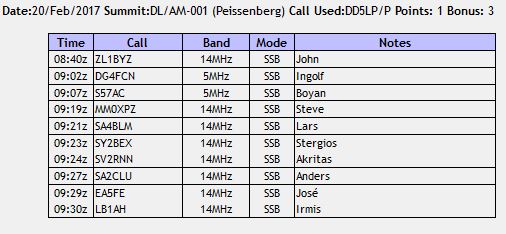
The purpose of this activation was to test out the extension I had made to my linked dipole to cover the Sixty Metre Band (5.3MHz) that Germany gained in late december as a result of the World Radio Conference in 2015 (WRC15). This band is only 1KHz wide (5.3515MHz – 5.3665MHz. At the moment some countries have this new band while others (such as the UK) have other odd blocks of frequencies or channels. In the hope of a contact into the UK and to simplify things (and make sure I don’t operate out of band) I chose a few “channels” within the band and programmed these into my FT-817.

With everything ready antenna, rig and food, I decided it was tie to do an activation and while this was an experiment, I decided on DL/AM-001 Peissenberg, being a summit I know and only 45 minutes drive away from home. The weather forecast for Monday the 20th. was good, so I decided with an early start I should be on the summit at about the right time for propagation on 5MHz into the UK and with a little luck I might catch the tail end of the Long Path window down into Australia and New Zealand.

The Location:

Peißenberg, or Hohe Peißsenberg to give it, its full name, sits above the village of Höhen Peißsenberg about half way between Weilheim and Schongau in upper Bavaria.

The Activation:

I had arrived and set up all of my gear by 0830 UTC. The drizzle had stopped but it was still quite cold with snow still in places on the ground (not what the forecast has said). In any case after manoeuvering the 10 metre mast around a little I managed to tie off both ends of the linked Inverted-V dipole to some handy points. Previously I would use the lower 6 metre mast but with the extra length, I need to get the centre up higher so that I could get the two ends of the dipole out in the restricted space that I had. I had had problems with the 10m mast collapsing into itself without warning on other occasions, so I was a little concerned that this might happen again, but I had to try. It was cold and the winds were getting stronger, so I needed to get a move on. I decided to start on 20 metres and had luck, my first contact was John ZL1BYZ in New Zealand. I was hoping for some more contacts from down under but as it turned out John was the only one. after another couple of CQs, with no successful responses I decided it was time to try out 60 metres. To do this I had to lower the mast and connect together again the 20m links so that the complete length of the wires were now in place as a 60 metre dipole. I switch to memory mode and quickly went through the channels I had programmed. Only hearing a couple of locals chatting on one frequency I went to one of my “international” frequencies of 5363.5 checked that no one was using the frequency by putting out a call asking if the frequency was in use – twice – no reply, so I spotted myself and called CQ. My first ever portable 60m contact was with Ingolf DG4FCN. Although he was about 5-4 the contact was difficult as there was QRM from another station just off my frequency. Later this station came and complained that he couldn’t hear his mate as I was “off-frequency” (i.e. not on a round number of KHz I guess and my little 5w from the FT-817 was flattening them). This will I’m sure remain a problem on this very narrow band as it appears some “channels” have been adopted for local natters in Germany. In my case, I realised that I could not simply tune the band while in memory mode and so I will need to look at somehow actually defining the 60m band in the FT-817. I moved to my other “International” frequency of 5.362MHz and put out another spot and call, this time I was called by Boyan S57AC and in this case band conditions did not make the contact very easy with his signal dropping into the noise, but we managed the contact and after getting no more calls I decided my experiment on this band was completed for the day but I’d try to grab a few more contacts on 20m before packing up. after seven more contacts on 20m, it also dried up and the winds by this time were whipping the antenna mast around somewhat, so I decided to pack up and head home. While pacing up the equipment and talking to a local walker explaining what I was doing, the mast self lowered (i.e. dropped into itself). This DX-Wire 10m mini-mast is not anywhere near the quality of the far cheaper Lambda Halbe 6 metre masts. I was lucky this time that the mast stayed up as long as it did. I may need to find a different location the next time I want to run 60m from Peissenberg, so that I can use the 6 metre mast instead.

Photos:

This slideshow requires JavaScript.

Equipment:

Yaesu FT817ND.

SOTABeams bandhopper linked dipole modified for 60 metres.

DX-Wire 10m Mini-mast.

Modified QAMP amplifier (20W on 20m).

Thick plastic painters sheet

Log:

activator-logConclusions:

I am going to have to rethink operating frequencies on 60 metres to avoid QRM to and from other stations, while still being on a frequency that non WRC15 allocated countries can come onto.

The 60 metre modifications to the SOTABeams Band Hopper have worked VERY well and it seems just 5W from a good location puts out a strong signal on 60 metres.

73 ’til the next Summit!

DD5LP/P – December 18th. 2016 – DM/BM-135 Hesselberg & DM/BM-226 Dürrenberg.

Preparation:

After a while not activating and with no snow to speak of on the ground I decided to make another activation. While the lifts to the DL summits are all stopped for maintenance before the start of the Skiing season at Christmas, I looked to the DM region, with their easier to access summits with higher point values. The problem for me is the distance, especially after the last purge of nonconforming summits in the DM region, the closest for me are around 2 hours drive away. Looking through some of the closer summits, I had activated Dürrenberg before but as that was back in 2014, I would get 6 points for an activation in 2016. This would still be a 2 hour plus drive, so I looked to see if I could possibly include another summit en-route to make the trip worth-while and found Hesselberg. A summit that appeared to have really easy access and again would give me 6 points. Neither of these summits have winter bonus points.

For these activations I would not be testing out any new antennas, rather relying on the old faithful SOTABeams linked dipole and the Lambdahalbe 6 metre squid pole. As I now always re-charge and re-pack all equipment when I get back from an activation, I only needed to check my two bags to see what was in them and remove what was not needed. I would add my pack-up the following day and then set off at about 10am hoping to be back by 4pm.

The Locations:

Both Summits lie north of Augsburg in the direction of Ulm and are around a 2hr. drive north from my home QTH. I decided to go to Hesselberg first as I had not yet activated that summit and it “seemed” to be easy to get to. Using the NAVI to find the shortest route about 40% of the route was on Autobahn or large roads and 60% on small country back-roads. Since I have loaded in all SOTA summits in Germany into my car navigator I planned to simply follow its directions. I did, however also print out the Google Maps routes to and between each summit, in case I lost GPS coverage as happened on the last outing.

The Activation:

DM/BM-135 Hesselberg

The weather over the previous week had been cold but sunny with morning fog clearing around 9am. This day was no different and I set off at the planned 10am. The further north I drove however, the darker the skies got and once past Augsburg, it was obvious that the weather was not going to be sunny. In fact quite the opposite, I had rain, mist and generally grey weather all the way to the first summit, Hesselberg, which after about 2.5 hours driving was sat in low clouds as you will see from the slide show below. There was actually snow on the ground in the car park. However this IS an easy access summit, also suitable for people with disabilities. The track up to the summit from the car park is about 60 metres (although the sign says 100m). On the summit there is a solid wooden picnic table with benches and the information panels make good supports for the squid pole mast. There is also a TV transmitter tower on this summit but although it couldn’t be more than 50 metres away, I could only see parts of it through the clouds. I am sure the views from this summit are normally fantastic but on this day it was simply a wall of white in all directions!

I had planned to activate on both 40 metres and 20 metres however 40 metres was the best band for propagation. It was impossible to find a completely free frequency and I ended up on a frequency where two russian speaking stations were having a local chat. Despite that (and I’m sure I didn’t disturb them with my lowly 30 watts and a dipole) I managed a good run of 16 contacts around Europe and then finished off with an S2S with John EI2KA/P and two other UK contacts on 20 metres before deciding to pack up. When I took the antenna down ice had formed all the way along the thin wire. No wonder I was also feeling cold and welcomed the fact that it was less than 5 minutes to get back to the car in the car park.

DM/BM-226 Dürrenberg

The journey from Hesselberg to Dürrenberg took longer than expected, partly due to the weather (which hadn’t improved) and partially due to road works requiring a slight change of route. I did however eventually get to the same place that I parked the last time that I had activated the summit, unpacked my gear from the park and started the 15 minute slog up the road (which is closed off with a locked barrier as this used to be a military installation). It was good that I knew the route as that low cloud / fog was still there and I could not see the summit from the bottom of the road. Visibility was probably down to 3 metres in some parts of the walk up the hill.

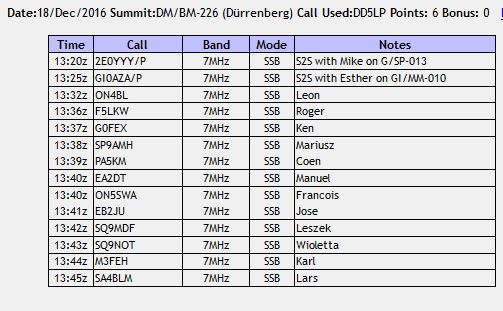
Dürrenberg is a wooden summit, which is generally bad from a radio point of view and also finding support for the mast to carry the Inverted-V dipole, however I already knew what I was going to do. The underground parts of this installation had air vent pipes coming out of the ground in the woods and these are perfect for attaching the 6m squiddy to with my rubber straps.

At this time, I started to think it was not as cold on Dürrenberg as on Hesselberg however I was wrong and by the time I finished the activation, I could feel the effects of Hypothermia, having difficulty concentrating and being slow at doing things.

On checking spots I could see the majority of activity was on 40 metres rather than 20 metres so I started there with two S2S contacts right away – one with Mike 2E0YYY on Gun and another with Esther GIOAZA over in Northern Ireland. The band was not nearly as busy as it had been on Hesselberg so it was easy to find a free frequency and I put out a CQ to receive a flow of 12 chasers from all around Europe in the next 15 minutes. There was no sign of the VK6 S2S that Mike and I had hoped to catch via short path unfortunately and 10 minutes of calling CQ on 20 metres brought no responses at all – that band had completely closed. By this time I was behind schedule for my return journey it was dark and I was feeling the cold now, so I packed up and returned to the car. the route home was quite different to the one I had used to drive to the area but after 2.5 hours driving (which seemed a lot longer), I arrived home at 5:30pm, glad to be safely home.

Photos:

Hesselberg:

This slideshow requires JavaScript.

Dürrenberg:

This slideshow requires JavaScript.

Equipment:

Yaesu FT817ND.

Highly modified Ramsey amplifier

SOTABeams linked dipole.

6 metre portable squid pole.

“Spy Glasses” for video recording (not used in the cold).

Logs:

DM/BM-135 Hesselberg:

activator-logDM/BM-226 Dürrenberg:

activator-logConclusions:

I need to consider the dangers of activating in the cold and wet. Hypothermia is a real danger as it driving a long distance when tired.

73 ’til the next Summit!

DD5LP/P – November 19th. 2016 DM/BW-064 Heersberg (for the EU-NA S2S event).

Preparation:

Following the success of the VK-EU S2S SOTA event on Saturday October 22nd, a similar one for November 19th. was planned but this time for EU-NA contacts. The 15m half wave, coax fed end-fed vertical (aka J-Pole) antenna that I tested at Buchberg, was replaced with one using RG-174 coax. As I didn’t want to have to take down the mast each time I wanted to change band between the possible 15, 17 & 20m being used in the event, I worked out a way of just mounting the 15m “element” on the mast and then plugging in extensions for 17m and 20m at ground level. Each band having its own stub (see my article on this antenna build under the equipment tab on this website). All three configurations were tested and trimmed in the garden ready for taking with me to the summit.

I was concerned about the weather, we had been having some awful rainy weather of late and it looked unlikely to stop. In the end I decided to stick to my choice og Heersberg as according to the Weather underground site (but not others), the rain should stop on the 19th. for a window of dry weather around the time I needed to activate. The published time for the S2S event was 1400 to 1700 UTC – 3-6pm local time here. As it gets pitch black by 5pm, I decided I would aim for the start of this window and run for about an hour, which should give me time to get back to the car before dark. I would adjust as appropriate with the weather on the day.

As well as preparing radio equipment, I also bought some new video equipment that I planned to use if possible on the activation. this is a video camera/recorder built into the frame of some polarised sun glasses. The are sold as “Spy glasses” but actually their specifications re rather good for the price. They are HD (720p) and take a Micro-SD card for storage of video or single shots. The glasses arrived two days before the S2S event and I quickly tested them out. The control is a bit fiddlely but they do indeed work as stated. So I packed them in with the gear for the activation (in fact I didn’t have time to try them out on the summit).

The Location:

Heersberg is located in the Albstadt area about three-quarters of the way from where I live near Munich to the French border. Put another way, it’s around an hour and a halves drive north-west of Friedrichshafen. Although the first 30-40 minutes of the drive is Autobahn, the rest of the way is A and B roads winding their way through small villages. Google maps quoted just over 2.5 hours to drive the route, so along with the weather predictions for when it should stop raining, I calculated a start time of 12 noon latest to be sure I would have time to get from the car park, the 2.5 Km to the summit and then set-up by 1400 UTC.  I decided to use my new “Navi” which I have loaded the SOA DL & DM summit kml file to guide me through the many turns en-route so that I could concentrate on driving and not need to look at the maps.

The Heersberg “summit” itself is relatively flat – so flat that there’s a cross-country skiing “loipe” set out across the top of it. Access to the summit is best from the car park near the start of this Loipe in Albstadt-Beergfelden.

The Activation:

The drive was 3 hours not the expected 2.5 but I had set off half an hour earlier in any case.

Drove through heavy rain and spray (particularly bad on the first section of the trip on the Autobahn, some aquaplaning – not fun). After leaving the autobahn for about 2 hours of back roads, I went through more heavy rain and then it cleared, there was even a little sunshine. Great I thought but 5 minutes later I was driving in a SNOW storm! At one point I lost GPS and I pulled into a lay-by. About 7 satellites were being received but were showing red not green in the display. I checked my position and route on a good old paper map and carried on. The GPS came back a few kilometres up the road. Interestingly on the return journey the GPS dropped out along exactly the same stretch of road. There are some military bases nearby, so I wonder what they were running to knock out the GPS? The cunning plan with the weather worked however as when I eventually drew up into the car park, the rain stopped and I had a dry (but 0°C) activation. The 2.5 Km walk up to the summit was an easy one. Over half of in on a tarmacced road, that later I saw a lot of (not farm or forestry) traffic on as people drove up it onto a convenient field and took their dogs for a walk. The wind howling up the valley sounded like a waterfall at some points as I walked up to the summit.

Having arrived, I set up the FT817, 15/20w amplifier and initially put up the 21MHz J-Pole antenna. Then I tried to spot and guess what – no Internet coverage with either Vodaphone or T-Online. Actually Vodaphone were showing a 3G signal but I couldn’t spot myself and only occasionally got the list of spotted stations into RRT. I tried spotting via SMS also without any luck. Eventually the Internet link worked for a few minutes before failing again – it was like that the whole time.

In any case after several CQ SOTA calls on 21MHz, I heard a very weak “summit to summit, summit to summit” it turned out to be Kevin, AC2KL on W2/WE-031. With a lot of patience from Kevin we managed an S2S contact and my first contact from this summit. More attempts to spot operation on 18MHz, having switched antennas, got through once on SMS I think. No contacts made on 17m though.

Switching to 20 metres, it was wall to wall NOISE from contest stations – which contest was this, surely not the small Bulgarian one – I never expected that to create so much activity – sure enough it was the LZ-DX contest! I decided to give 20m a miss and went back to 15m again.

I was rewarded with three more contacts on 15 metres – M6YOM (a second Kevin for the day), Victor GI4ONL, Don G0RQL and a VOTA to SOTA contact with Andy EA8/MM0FMF/P on the Canary Islands. That last contact was just as I had decided to pack up feeling very cold despite full skiing gear (less boots and skis) and Andy’s comment about being in 27 degrees of heat, along with some threatening clouds decided for me that 1 hour on this cold summit was enough and I packed up and headed back to the car under an ever darkening sky. As I got the boots off and into the car, the rain started again – call that timing or what? Just a 3 hour drive home in front of me (which I managed in just over 2.5 hours). Two long drives for a short activation but I’m happy with an African S2S plus a North American S2S and a couple of UK chasers.

Photos:

This slideshow requires JavaScript.

Equipment:

Yaesu FT817ND.

Modified Ramsey power amplifier ( 15w on 18 & 21MHZ ).

CO-AX fed half-wave end-fed 15m vertical (aka J-Pole) with extensions and stubs for 17 & 20m.

LamdaHalbe 6 metre fibreglass mast.

Log:

activators-logConclusions:

Three hours travelling for a 1 hour activation isn’t worth it, especially at this time of year when it is very cold and gets dark early. In better weather several 10 points summits in the area could be combined, to justify the long drive.

The new J-Pole antenna worked, whether it performed better than my linked or OCF Inverted V dipoles would have, I don’t know. It’s certainly easier to install and lighter to carry.

The “Spy Glasses” will have to wait for another activation to see how well they can record me operating.

Don’t under estimate the amount of QRM even a small HF contest can create.

73 – until the next summit!

DD5LP/P – November 1st. 2016 DL/BE-093 Buchberg.

Preparation:

Following the success of the VK-EU S2S SOTA event on Saturday October 22nd, a similar one for November 19th. was planned but this time for EU-NA contacts. Having only ever managed one S2S with NA and that on 15m, I decided to build a 15m halfwave, coax fed end-fed vertical (aka J-Pole) antenna. After several attempts to build one using the dimensions given by the same calculator I used to build the 20m one that I tested on Weichberg, I eventually managed to get the antenna resonant by using a frequency 800 KHz lower than the required frequency. After getting this working in the garden, I found out why the calculator appeared to be giving the wrong lengths – my thin coax that I thought was foam insulator RG-174, with a velocity factor of 0.735, was actually RG-179 with a velocity factor of 0.700! As I had got the antenna resonant in any case, my activation of Buchberg, which surprisingly I hadn’t yet activated in 2016 would serve to test the antenna and to see if communications across the Atlantic are even possible with the current propagation conditions.

15m-antenna

The best time for EU-NA contacts is between 1330 and 1530 UTC at present. As we have just put our clocks back an hour for Winter, this equates to between 2:30pm and 4:30pm local time, so this would be a nice afternoon outing. In case I wasn’t successful with the new antenna, I also took the trusted linked dipole and the 20 metre vertical (and the unreliable 10 metre pole) along. As it turned out, thankfully, I did not need these.

The Location:

Buchberg is located near to Bad Tölz in southern Bavaria and is a favourite spot for walkers to come out to from the town (as I found out). My new “Navi” in the Chinese car multimedia unit, to which I have loaded the SOA DL & DM summit kml file, did a great job of directing me the correct way to the nearest place to park for the summit. Unlike Google maps which routes you up a private forestry only road (see report on my first activation of this summit).

The Activation:

On arriving at the parking spot, I saw the field had several cows in it (no bulls as far as I could see) and an electric fence around it. I looked for another approach but then decided to sling my bags under the electric rope and duck under (as all the walkers did in the following couple of hours). I asked whether this was OK and was told, no problem the farmer allows access (which I know from talking with him on my previous two visits) and it’s just to keep the cows in, not people out. It was turned on however as became obvious when I later turned the rig on. But it was at a bearable level and QSOs easy to make despite the slight “clicking”.

I talked with several of the walkers who were interested in what I was doing and once I got down to operating, things kicked off very well with four North American contacts – all 5-9 plus in the first 25 minutes. The first one a “search & pounce” by me, competing with other callers, the other three in quick succession after 20 minutes, in response to my spot on SOTAWatch.
The contacts were:
Henry, N1HEN in Maine,
Luther, N4DA in Georgia,
Phillip, VE1WT in Nova Scotia, Canada,
and
Walter, NE4TN, in Tennessee
After these four however getting contacts via spots or using Search & Pounce was difficult, there were a couple of special DX stations booming in from Guadeloupe (Jule, FJ4NN) and Curaçao (Pete PJ2/K8PGM) as well as Fahed A61FK in Abu Dhabi but all of these had so many callers, I couldn’t break through. I then checked the amp and it appeared not to be switching on to TX – I have an LED that shows green on Rx and Red on Tx. No red light – so it’s possible that instead of my expected 20w, I was only running 5w output, possibly even on the first contacts.

I had just about given up and then Carlos, CT1HIX kindly gave me a call and we exchanged 5-9 / 5-5 reports – which is what I would expect with 5w output.

Upon arriving home the amp was taken down to the workshop to get looked at and it turns out one of the two power transistors has blown taking out the main fuse and effectively switching the amp out of circuit. This failure appears to have happened on the last activation, meaning all of todays contacts were with just 5 watts!.

Following this activation I think I can say, that 15m band conditions to North America are quite good at the moment!

Photos:

This slideshow requires JavaScript.

Equipment:

Yaesu FT817ND.

Modified Ramsey power amplifier ( in circuit but not working ).

CO-AX fed half-wave end-fed 15m vertical.

LamdaHalbe 6 metre fibreglass mast.

Log:

ativator-log

Conclusions:

The antenna worked. I will need to check out what is wrong with the amplifier and sort that out before the 19th. The chaep 6m mast is far, far more reliable than the expensive DX-Wire 10m mini mast. If I have to take 20 metres along, I’ll possibly just take the Inverted-V dipole rather than a vertical. First of all, I need to decide on a summit ….

73 – until (hopefully) the 19th. November 2016 for the SOTA EU-NA S2S activity event.

DD5LP/P – October 22nd 2016 DL/AM-001 Pießenberg for VK-EU SOTA S2S event.

Preparation:

The planned EU-VK S2S SOTA event was set for Saturday October 22nd, here’s my piece on ARNewsline:

“You don’t need power when you have altitude”

October 22nd. 2016 will see an increase in Summits on the Air activity between Europe and Australasia.
As has been the case for the last few years, a special event is being organised by Andrew VK1AD and Mike 2E0YYY to coincide with the improving radio propagation conditions.


 This “S2S” (Summit to Summit) ‘all mode’ CW, SSB, Data, and even FM, event already has commitments from VK, ZL, G, GM, DL, and OE stations with other European stations expected to join in the climb to the top of mountains in each region. These “activators” aim to make as many “S2S” contacts as possible with other hams on SOTA summits in Europe and Australasia.

The timing will be from 06:30 UTC for about two hours and is planned to coincide with long path propagation between Europe and “down under.” Around the same time, short path communications between Europe and North America is often possible. So if some SOTA activators in North America could listen out from a SOTA summit, this activity has the chance to create a World-Wide Summit to Summit event this year.

Most stations will be running low power with simple omni-directional antennas, so this event also aims to show just what can be achieved with limited equipment from a location with a low noise floor.

Although I had originally planned to use my new EFHW vertical on the 10m mast, at the last minute I decided it was better to go with the tried and tested linked dipole as risk the antenna collapsing on me again. I need to build some more confidence in the new antenna/mast before it can be used reliably. In fact I plan to create a lightweight version of the antenna using RG-174 co-ax in place of the RG-58 reducing its weight considerably.

Equipment would therefore be the 817, the 20W amplifier, the 6m mast and the linked dipole antenna.

The Location:

Pießenberg is about 45 minutes drive from where I live and a drive-up summit, making an early start as required for the long path propagation to VK a possible option. There is plenty of parking and a short walk to seating at the far end of the path around the church with railings to attach the mast to. As I have already activated this summit twice this year, I would not get any activator points for this extra activation but it is the most practical for an early morning activation and my S2S points are fast approaching 1000 – perhaps I could break the magic number on this outing? (the answer was NO – not quite).

The Activation:

The trip down to Pießenberg almost was a problem with a major accident closing the main road between Pießenberg and Hohen Pießsenberg where I needed to go. Luckily I was approaching on the back roads and when I was stopped by a young fire brigade officer he said I was fine to get through the village as far as the road up to the summit and take it up to the church.

 While setting up, in the dark, I found a broken link connector on the linked dipole, which would not affect 20 metre operation but would stop me from being able to move to 40m to catch local summits, and what I thought was a broken bongo-strap (turned out it was ok when I could see it in the light later). I was set-up and started operation at 0530 UTC (too early – also too dark and too cold!).

I was happy with one good contact with Jason ZL3JAS in Christchurch at 06:31 UTC. While tuning the band I heard his 5-9 signal, called him and he came back to me, giving me a report of between 4-4 and 5-5 – considering I was running 20 watts to a dipole and he was running 1KW to a cobweb antenna, I’m happy with that report. It seems that the grey line long path window at the moment from ZL to DL is around 0630 UTC. I also bagged 5 x S2S contacts within Continental Europe summits but could not hear the UK activators on 20m.

It was very annoying to find that whichever frequency a VK activator was spotted as being on had either a Russian or Italian 2KW+ station chatting to his mates – how do they manage this? Probably the same way as the Italian and Russian stations would come up on my (checked free before calling) CQ frequency meaning I was constantly having to move. I found out later that my signal was getting through the VK2 but I was not hearing the reply because of this QRM – that’s annoying.

By 0715 UTC I was hearing less on the band and the battery in my amplifier had run flat so I packed up at 07:40. Later I heard that VK6 was coming through at around 0800 UTC but without the amplifier, I suspect my signal would not have made the trip.  I also had a family trip I had to be back for. I’m kicking myself for forgetting the spare battery for the amplifier and for having two conflicting requirements on the same day, but I couldn’t do much about the latter.

Here is my report publshed on ARNewsline and WIA NEWS:

Summits on the air Summit to summit international event 22nd. October 2016.

October 22nd saw the Summits On The Air, Australia to Europe Summit to Summit event. Fifty one summits across Europe, Australia, New Zealand and Japan were registered by their activators as intending to take part in this 2 hour “super-activation”.

When 0630 UTC arrived with weather varying from freezing cold to pouring with rain in Europe and not a lot better in Australia, the SOTA activators started their calls. Between 6:30 and 8:30 UTC seventy three summits were activated – twenty two more than expected.

Mother nature and propagation were “variable” to say the least but contacts were made between continents as well as within each of the regions.

At times the number of active summits made it difficult to find a free frequency on 20 metres to call CQ on.

Thanks to Gerard VK2IO for the following audio clip of my signal making it through the “ether” from Southern Bavaria to New South Wales Australia. Unfortunately no contact was made due to QRM from QRO stations in Europe who often started up transmissions on top of the QRP SOTA stations.

< the audio clip was played here >

The organisers Andrew VK1AD and Mike 2E0YYY declared the event a success and planning is under way for future Australia to Europe SOTA events, most likely twice a year around the dates that we change the clocks in Spring and Autumn.

A similar event is being discussed between European and North American activators. Once details are confirmed, you’ll here about it here on ARNewsline. In the meantime checkout sota.org.uk to find out about Summits on the Air.

For AR Newsline this has been Ed Durrant DD5LP from Bavaria in Southern Germany.

Photos:

This slideshow requires JavaScript.

Equipment:

Yaesu FT817ND.

Modified Ramsey power amplifier.

SOTAbeams linked dipole.

6 metre “lambdahalbe” fibreglass mast.

Thick plastic painters sheet

Log:

activator-logChart of all stations talking part:

chart-of-stations-taking-partConclusions:

I had a few “OOPS” moments and wrong decisions:

  1. I was on site FAR too early, it was cold (but thankfully there was no rain), dark – I almost needed a torch to set-up but managed without and because I started so early I ran my rig’s (and more importantly, the amp’s) battery down.
  2. Rather than risk the newly built vertical, I decided to go with the tried and tested linked dipole. On putting it up I found one of the link connectors had broken off the wire – not an issue for 20m but this meant I couldn’t switch to 40m to pick up EU S2S contacts.
  3. I forgot to take the spare battery for the amplifier. In fact when I saw the amp was no longer turning on, the Internal LIPO had hit zero percent on all 4 cells. Later I managed to recharge the battery and it “seems” no worse for wear. Time will tell. Normally I avoid taking LIPOs below 25% charge.
  4. Timing – not only was I set up too early, I also shut down too soon (partially due to the amp battery but also as I needed to get home for a family outing). If I had stayed another 30 minutes, I might have bagged John VK6NU in WA.

Even with these errors I managed 5 x S2S contacts but only within Europe. I’m rather proud however that I managed a good contact with Jason ZL3JAS in Christchurch.

What I found REALLY annoying was the fact that I was not able to even listen for spotted VK & ZL SOTA activators as in EVERY case when I went to the spotted frequency a local high powered Russian or Italian station was chatting away to his friend down the road on exactly the frequency the DX SOTA station was spotted on. I also had to move several times when calling CQ when an EU QRO station simply decided they would use the frequency to natter on, without first checking it was free!

73 ’til the next Summit!

DD5LP/P – October 18th. 2016 DL/AL-179 Weichberg.

Preparation:

With the planned EU-VK S2S SOTA event set for Saturday October 22nd, I wanted to test a new antenna that I built from information given on the SOTA reflector. A 20m halfwave, coax fed end-fed vertical. This antenna has no BALUN/UNUN or ACU, it uses a quarter wave stub to match the 2.5K ohm of the end of the half wave to the 50 ohms needed by the rig.coax-efhw-calculatorI tested the antenna on my antenna analyser and was very happy with the results:

The results on the Analyser after building to the dimensions from the spreadsheet –

Resonant frequency 14.285 MHz (as required by me for SSB operation),
SWR 1.42:1
IZI = 52.4 ohms
R = 49.4 ohms
X = -17.4 ohms
C = 634 pf.

Very impressive for an end-fed simply cut and soldered – no trimming at all was necessary!

Now I needed to test the antenna in the real world and decided on an activation of DL/AL-179 Weichberg as I knew I had the choice of vertical supports to strap the 10 metre mini-mast to.

Equipment would be the 817, the amp, the 10m mast and the new antenna.

The Location:

Weichberg is about 45 minutes drive from where I live and as such one of the closest summits to my home. It is only a 1 pointer however relatively easy to get to – about 10 minutes walk up a forest track from where I park the car. Navigate to Rettenbach and then follow the road “Dolce” as far as you are allowed to drive and there is a parking spot for 4 cars and the track to the summit is across the track behind you.

The Activation:

Subtitle – Wet hands make sloppy installations!

The trip down to Weichberg was uneventful except for a diversion through a beautiful small village because one of the main junctions on my route is being repaired/upgraded. The further south I drove, the heavier the rain became, until I turned off the main road onto the small road to Rettenbach when it started to clear. By the time I got to the parking spot it was down to a light drizzle, at this rate this is going to work out! I thought. …

I walked up the track through the forest to the summit and into increasing rain – never mind, I’m here now, let’s get busy! I unloaded my two rucksacks and started attaching the 10m mast to the best vertical post available – the holy cross outside if the small chapel. With hands getting wetter and colder I stretched my first “Double Bongo Strap” around the post and just as I was about to interlock the bongo in the rubber band – “TWANG” – it was gone and no amount of searching would find it! OK, have to make do with just one double Bongo Strap, that went on OK and then I unrolled the 1/2 wave 20m coax fed vertical antenna across the ground, attached it’s crocodile clip to the top section of the mast and started winding the thin wire around the fibreglass pole as I raised it section by section. Slowly but surely the antenna was raised. By this time the rain had become heavy but I thought there’s no point stopping now as I’m soaked anyway. The rain had started coming through the sleeves of my so called waterproof winter jacket.

Once I had the antenna raised, I went back to the small table on this summit where I assembled the FT817 and amplifier, connected batteries and turned everything on. 20m sounded quite busy which was a good sign. I checked 14.285 which appeared free, put out a call to check and then started calling CQ. In parallel I tried to place a spot but with water running over the face of the smart phone, it was difficult to type anything in! Then someone called – QRZ? So I went back a couple of times but the caller said they had too much QRM from a station 2 KHz down so I announced I would QSY up to 14.290, which I did and started calling again. About this time I got the first spot out but the call that came back on 14.290 was from someone who had just heard me calling rather than a SOTA chaser and I had a nice, if short, QSO with Panna from near Athens in Greece. We exchanged 5-9 and 5-5 reports – so the antenna was certainly working.

I started to put out another CQ hoping for a SOTA chaser who would have seen my spot but just at this time there was a loud “CLUNK” behind me and the fibreglass mast had telescoped itself down to ground. This was probably just one junction that I didn’t pull out enough with the cold, wet hands as there was next to no weight on the mast.

I took a look and while the mast and antenna were not broken, the antenna had tied itself in so many knots that it would take me 10 minutes to un-taffle it in good weather with non-frozen hands. As I was finding more areas of my jacket where the, now heavy, rain was coming through, I decided to pull the plug and pack up and head back to the car and its heater to dry me out.

To add insult to injury, by the time I arrived home, the rain had stopped completely but the TV said there are banks of rain storms coming through.

Despite aborting the activation (it counts as an activation as I had one contact, and as activated this summit earlier in 2016, I would not get any activation points in any case if I had “qualified” it with 4 contacts) it was still a useful exercise. I now know the antenna works. I know to take more care “locking” each section of the mast in place. I have already found a replacement “Double Bongo Strap” that was holding some other antenna and it’s coax together. If anyone finds the strap on Weichberg – they’re welcome to it. Who knows perhaps I’ll find it there next year but searching for it longer in the grey, rainy environment today was pointless.

I will take both my usual dipole and this new antenna on Saturday for the VK-EU S2S party. I’ll decide which to use on the day – if Long Path to VK doesn’t look good I’ll need the 40 metre capability of the dipole to contact EU stations but the vertical up first to give it a good “go”.

All parts are currently drying out and I’ll most likely untaffle the antenna while watching the TV this evening!

 One amusing point is that I found the Trig Point stone on this summit as well. In fact there were three stones(see pictures) – the two with metal tops I suspect might be used for mounting the measuring instruments.

Photos:

This slideshow requires JavaScript.

Equipment:

Yaesu FT817ND.

Modified Ramsey power amplifier.

CO-AX fed half-wave end-fed 20m vertical.

DX-Wire 10metre “Mini-Mast”.

Thick plastic painters sheet

Log:

activator-log

Conclusions:

The antenna worked. I would have liked to have more reports from different directions and distances but in the weather, I was glad that I managed the one contact. I know to be mre careful with this mast now, making sure each section “locks-in”. This appears to be more of a problem on the DX-Wire mast than on the cheap “Lambda-Halbe” one!

73 ’til the next Summit!

DD5LP/P – September 22nd. 2016 DL/KW-008 Westlische Karwendelspitz.

Preparation:

As I am planning a trip over to the UK I needed to check out my “one bag” kit configuration and I had long wanted to activate Karwendelspitze as it is a ten pointer. In fact initially it was a 20 pointer up until the end of 2015 when it’s Austrian SOTA Summit code was removed. An action, I personally do not agree with. I believe those summit who sit on a country border should be allocated a code in each country, making them more attractive to activate for both activators and chasers. In any case many (not yet all) dual summits have been removed by the MT.

I had also considered activating this summit in winter to gain the winter bonus as well. I’m glad I didn’t as it turns out this summit is a difficult climb despite what several articles on the web say. With snow and ice around, this would be a dangerous summit to activate, for someone without mountaineering skills.

In any case, all equipment that was expected to be needed was packed into one standard rucksack. I actually find the camera bag a much more suitable bag however it only has a shoulder strap and climbing with that would be hard or even dangerous, with it rocking around.


DSCN3117

The Location:

The Karwendel mountains are on the German/Austrian border and some (including the Western Karwendelstein) are accessed from the village of Mittenwald from the German side. Mittenwald is located on one of the main routes from Germany to Austria, the one that goes through Garmish Partenkirchen (which itself has a couple of SOTA summits in Wank and Zugspitze). The roads are not large and hence can become blocked with traffic at times but normally mid-week as this activation was, there should be no big problems.

From what I had read after you take the 10-15 minute ride up in the cable car, it’s a 20 or 25 minute walk to the summit. I’m not sure who wrote these reports however even the sign when you come out of the mountain station of the cable car, says the ascent to the summit is 45 minutes, so allow more time. I think it took me 30 minutes but I was pushing on a bit.

The Activation:

The trip down to Mittenwald was uneventful some traffic delays but nothing too bad and on the way down the morning fog slowly cleared and it turned into a nice sunny day. This was officially the first day of Autumn.

When I turned into the cable car valley station’s car park however my timing expectations dropped – there was a long queue running out of the building. As this was the first nice day for a while a lot of other people had also decided to visit the mountain, some with their dogs, large and small.

Once  I found a parking spot, I went and joined the end of the queue only to find out 15 minutes later, (by which time the queue had grown even longer) that there was a separate queue to buy tickets and this was the queue to board the cable car once you had tickets. Luckily the lady behind me said she would save my place and off I went to the (thankfully shorter) ticket queue. Well surprise, surprise, a 50% price increase over the previous year AND a € 2,50 charge for the car park. This was probably financially a very good day for the cable car owners!

When I eventually got into the cable car, about an hour after arriving at the station, it took about 12 minutes to the mountain station with some fantastic views on the way up. Unfortunately as the car was packed as full as possible, there was no room for me to get my camera out of the bottom of my rucksack to grab some pictures. I thought I’d do so on the way back down but then I was so tired and not in a good position to see out as well as the car being packed full again.

On reaching the top station, the various options are well sign posted, so I set off straight away in the direction of the summit. The first part is an easy zig-zag walk up a track. This track is a little thin in places with steep gravel sides, so care was needed when people came the other way. Most people seemed to head up this track and then on around the mountain using the panorama way taking them back to the cable car station. At one corner of this track there were two smaller tracks one to the summit via a “kletter steig” where climbing gear would be needed and one to the summit via a longer, but not as mountainous route, which I took. This now smaller, track took me back across the face of the mountain to above the cable car station and then ziged back again as I moved up the mountain. Luckily I was the only person on this part of the track as passing here would be even more difficult than before. The last third of the climb however was over rock boulders, and up small water gullies that needed some sure footed work. I had put my hiking boots on at the car. At this point I wished I had my normal sports shoes on as they would have given me some more feeling when the stones were lose, which some were. This climb, now literally on the side of the rock face had a metal cable to hold onto to help with climbing. This is great until someone is coming down and you need to find a small spot to balance on without the rope, to let them pass (I had 6 kilos of gear, food and water on my back at this time). This climb seemed to go on and on and get steeper and steeper. I eventually saw the summit which was good as I was about to consider the climb too hard and turn around. Seeing the summit I decided that since I had got this far, I would manage the last part as well, and then worry later about how I would get down.

Despite the difficulty of the climb (to my standards) there were plenty of people already at the summit and while I was there many more (some with their dogs!) arrived as well, so I knew I could not set-up on the summit itself but about 10 metres below the summit there is, off to the side, what I call a small picnic area of about 6 square metres. Enough room to put out a blanket and several people could enjoy a picnic without being to dangerously close to the edge of the about 1000 metre sheer drops. So that is where I decided to set up. I crawled under the guide rope and put my rucksack down and stopped for a rest and a drink of water.

Unfortunately there was no easy way to support my fibreglass mast and I ended up leaning it against some rocks which sort of formed a wall between the path up the mountain and my “picnic area”. I found a large stone and leant it and my rucksack against the bottom of my mast. This was not very stable and so I could only extend the mast to about 2.5 metres high. On top of the mast I put my SOTABeams linked dipole and only rolled this out to just past the 20 metre links, tieing the next sections of antenna wire around some rocks at each side of the “picnic area”. Those rocks were as close as I wanted to get to the edge! Note to others planning to activate this summit – if you have a tripod supported antenna – that would be a better choice. So the antenna was somewhat compromised to say the least! I had brought my small amplifier with me, so I connected that up with the FT-817 to the antenna. Output power on 20 metres would have been around 20 watts. I was now over an hour late on my alerted activation time (but I had been spotting updates as the various delays occurred) and was wondering whether after all the effort, I would manage 4 contacts to get my 10 activator points for the summit. While with a better antenna set-up I am sure I would have had far more contacts, I was very happy with the eight which I got.

Karl M3FEH from the UK was first in the log, followed by calls from Belarus, the UK, Greece, the UK, Spain, Portugal and finally Central Norway. (Log is shown below). All of these contacts came in within 15 minutes of starting up. After that I tried for a further 5 minutes without any additional contacts so I decided to pack up and face the trip back down the mountain before it got any busier or hotter (and before I could think about it any more).

I am happy to report that I managed the trip down the mountain face, despite the highly polished stones caused by people sliding down on their bottoms – something that I reverted to on a couple of occasions as well. I got back to the cable car station just as my legs started to feel like rubber. I’m sure knowing now what I do about this summit, the next time I activate it, I will have less problems but it has taught me once more not to believe what hikers report as being an easy summit to always be so.

Things could have been very different if it had been a rainy day – I would not have even tried the climb to the summit, so (for me at least) this is a “fair weather summit”.

Photos:

This slideshow requires JavaScript.

Equipment:

Yaesu FT817ND.

Modified Ramsey power amplifier.

SOTABeams Linked dipole

Thick plastic painters sheet

Log:

activator-log

Conclusions:

The equipment worked well considering the compromised antenna. If I had known the situation with the space available, I probably would have taken my tripod mounted vertical antenna instead of the dipole however. I’m sure using the amplifier helped get over some of the disadvantage however it was also extra weight to carry, which would have perhaps been better avoided.

73 ’til the next Summit!