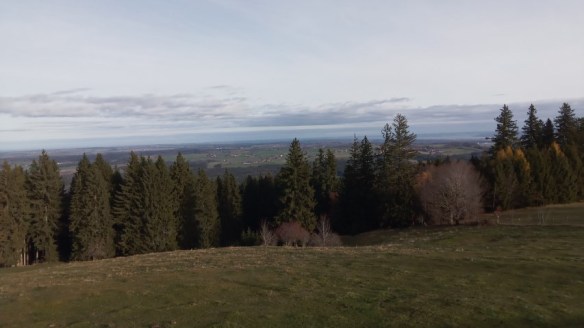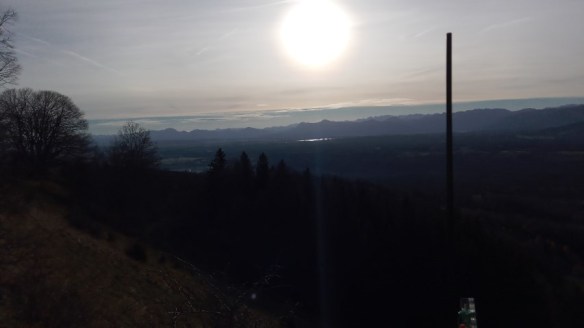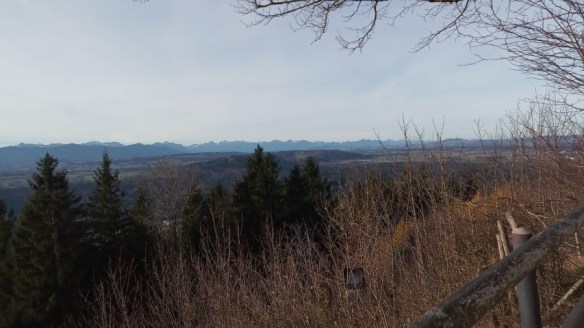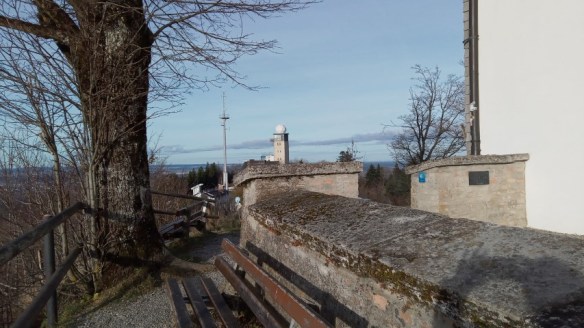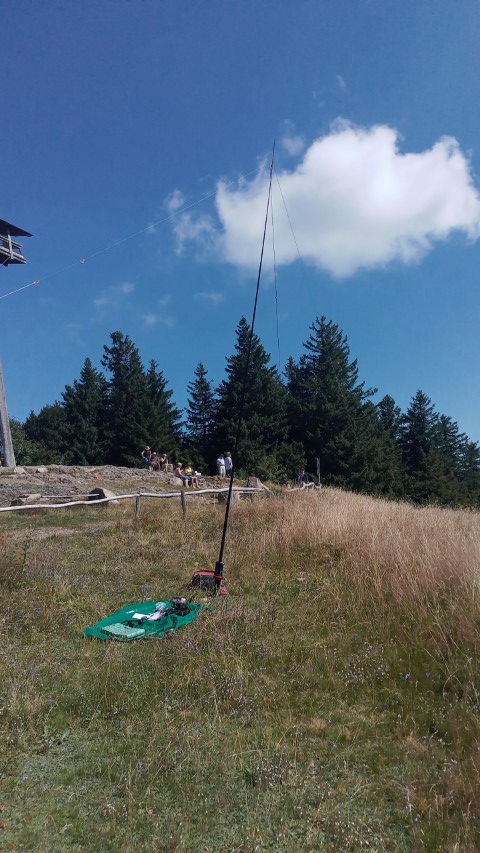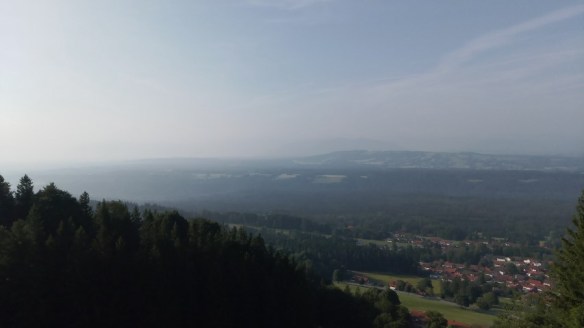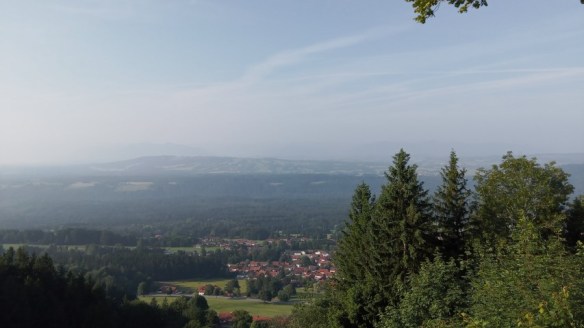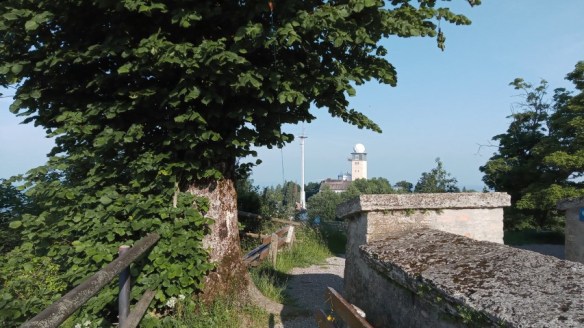
DD5LP/P – November 11th 2025 – Activation of 3-Fer POTA trails – DE-0594, 0595 and 0797 and SOTA DL/AM-001 Hoher Peißenberg.

Preparation:

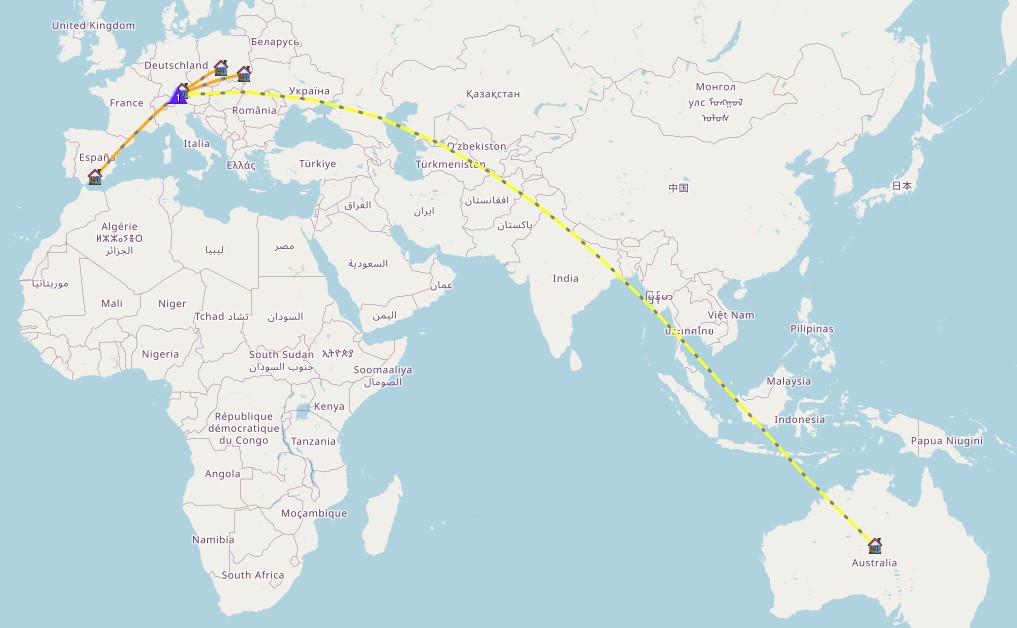
After several “PLOTA” activations (operating from within the car), I wanted to get out and do a “proper” activation with my 6m mast, linked dipole, and Xiegu G90 set up. Rather than the “usual” 20m long path to contact Ernie VK3DET in Victoria, Australia, the VOACAP HF page predicted that the Gray Line should be over Europe and at least New Zealand and possibly the east coast of Australia at 0700 UTC (8 am local since we have changed back from summer time in October). The Gray Line (the terminator between night and day – at dawn and dusk) throws a “channel” over different points on the Earth at different times of the year, this is because the Earth’s axis is not straight up and down relative to its orbit around the Sun, but rather at a bit of an angle, so different points on the earth are under the line at different times on different days of the year. November is the month for dawn in Europe to be on the same line with dusk in New Zealand and Australia. I compare the use of the Gray Line terminator to transfer radio signals as being somewhat similar to ducting on VHF in that the signals are carried along the line and, as a result, are generally stronger than if transferred by F-layer skywave propagation bouncing off the Earth and ionosphere. The result is, when it works, it produces stronger signals with lower power. It is very, very rare that Grayline works on bands above 10 MHz, and so it is normally used on 40 and 80m (60m should be fine as well; however, Australia does not have a 60m amateur radio band at the moment).

Everything was packed in the car on Monday evening, so that I could leave early on Tuesday morning without waking anyone.

The Activation

POTA DE-0594 / DE-0595 / DE-0797 SOTA DL/AM-001

I could probably drive the route to this summit with my eyes closed, and on some previous winter mornings in thick freezing fog, I had in fact effectively done that. This time, however, the weather was kind and the trip took around 45 minutes, with some delays caused by school buses as 7 am is the time the children are bused to their schools in Germany, and lots of tradesmen are on their way to their first jobs of the day.

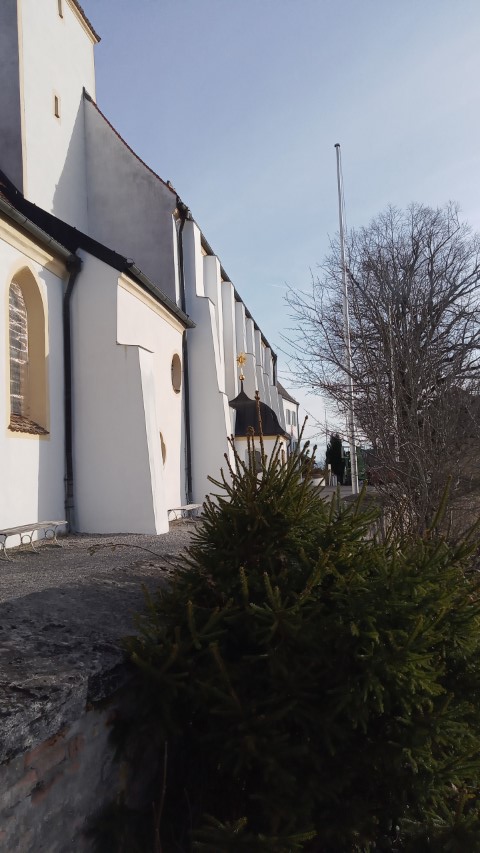
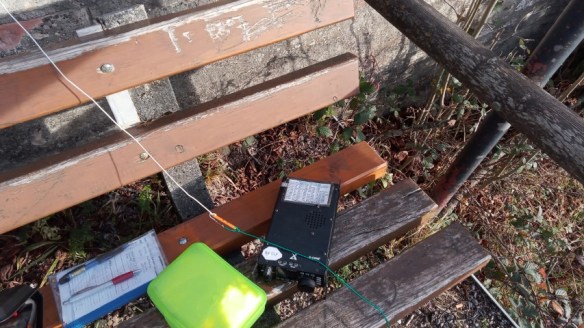
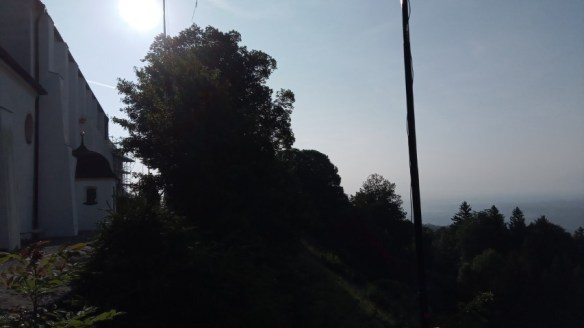
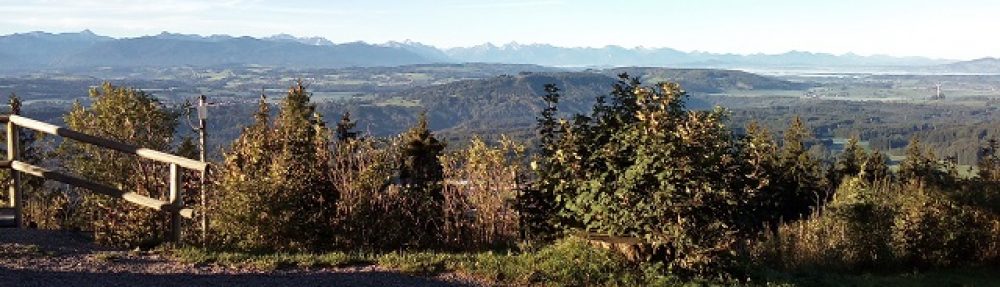
After buying a 3-hour ticket (€2) for the car park (using all of my small change as the card reading device in the parking ticket meter was not working). I headed up to my favourite seat alongside the church, looking out over the valley. I had a bad feeling at this point as it was 0645 UTC and VOACAP had told me that Dawn would be at 0700, but the sun was already over the horizon, meaning I should have been setting up at least 30 minutes earlier. The window of use of Grayline is often an hour at best, and I confirmed after getting on to 40m that I had missed it.

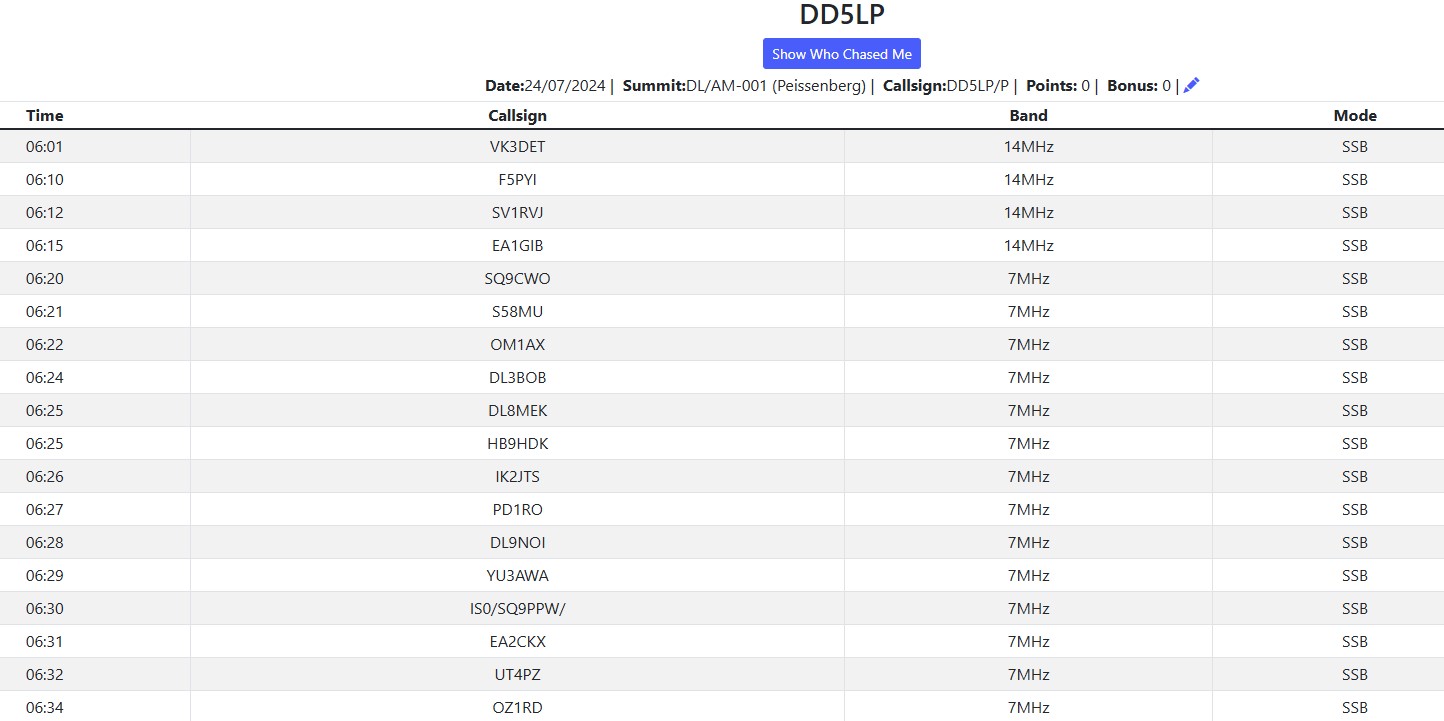
After spotting myself on SOTA and POTA sites, I also sent Ernie VK3DET a message, but he could hear nothing from me. I suspect that even if I had been on time for the Gray Line he may have been too far away from the line at his end and another possibility was that other stronger home stations were blocking my signal as the 40 metre band was packed with SSB stations, A little surprising for so early on a work day, but perhaps they were also looking for Grayline propagation? In any case, after spotting myself, I had to fight to keep my frequency after other QSOs (in at least one case, two other QSOs) started up on the frequency that I was using without checking first that it was free (as I had done). Luckily, many of the calling SOTA Chasers and POTA hunters had strong S9+ signals and crushed the other QSOs. I was amazed how my 20w and low linked-dipole was receiving (true) 59 reports for the majority of my contacts. This certainly proved that the 40m portable set-up still works very well! The pile-up only paused a couple of times, and I got 41 contacts in the log in just over 45 minutes. Once the contacts finally dried up, I considered trying 20m despite the threat of incoming CMEs but decided, rather, to call it a day and head home to the warm, happy that even if I was too late for the Grayline propagation, the equipment is still working very well.

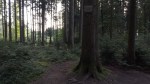
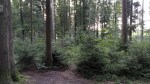
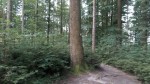
Photos:
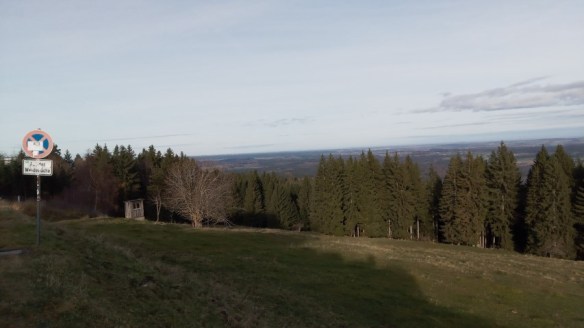
Equipment taken:

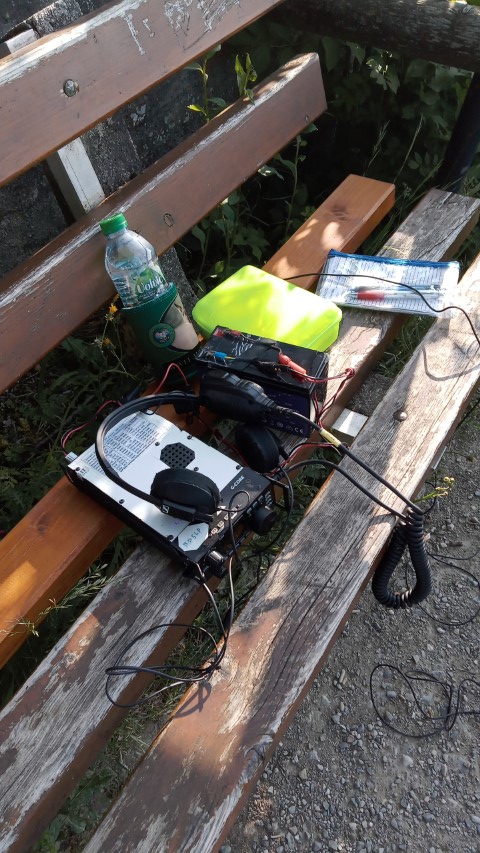
  • Xiegu G-90 radio.
  • Linked Dipole antenna.
  • 6m lambdahalbe mast.
  • 8 Ah LifePO4 battery.
  • 2 x 4Ah Eremit LifePO4 batteries (backup not used).
  • Lightweight headphones.
  • Smartphone for spotting.

Log:

POTA DE-0594 / DE-0595 / DE-0797

SOTA DL/AM-001

Conclusions:

The activation was a failure as regards Grayline; however, I know that at the right time on the right day, this can bring good results, so hopefully, I will get out again this month to prove that contacts via Grayline are still very possible. The equipment is certainly still working very well.

73 ’til the next activation!

DD5LP/P 19th August 2025 – HEMA DL/HBW-042 / SOTA DM/BW-008 Schauinsland and POTA DE-0004 Südschwarzwald.

Preparation:

As part of a holiday trip to the Freiburg area of Germany, on the French border, I planned an activation of Schauinsland, which is in both the SOTA and HEMA award schemes as a valid summit and also in the Parks on the Air POTA scheme as the summit sits within the Southern Black Forest National Park.

For equipment, I decided upon the usual G90 plus 6m mast and linked dipole antenna with tripod and HF-PRO2 as backup, all in my 40L rucksack.

The Activation Tuesday, 19th August 2025

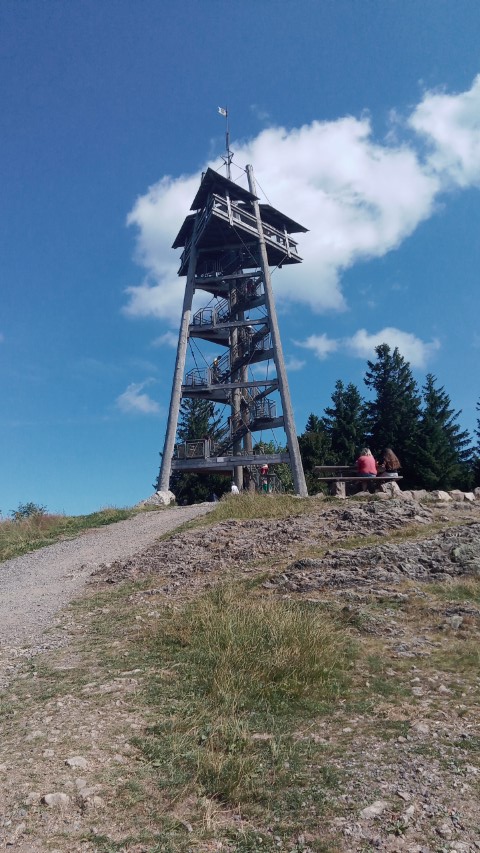
This summit is relatively easy to access with a road up to the restaurant and then a short climb up to the actual summit, which has an observation platform on top of it. Access is via a well-marked walking track, and while not wheelchair-friendly, there were some mothers pushing baby seats up the track.

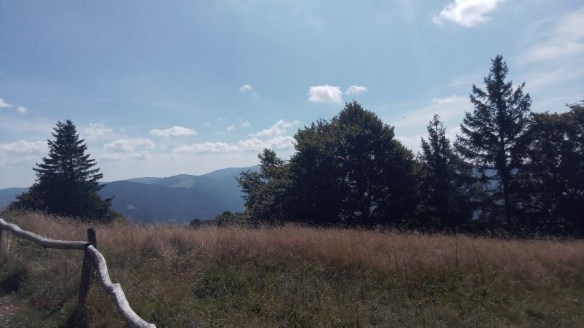
Upon arrival, the area directly around the observation tower was unsuitable due to the large number of tourists arriving and departing. Luckily, the adjacent field was relatively easy to access and gave enough space while keeping the public behind a wire fence.

Apart from a worrying warning about ticks, the location seemed perfect and I was set up in about 20 minutes, while the temperatures were not too bad (I applied sunscreen, however, as this location was in direct sunlight and the temperatures rose quickly as it was already nearly noon. I was glad, later that I had).

The bands were still a little noisy from a recent CME, and at this time of day, 20m is already dead, so I decided to stick to 40 metres to get enough contacts to qualify the park (10). I ended up with 16 contacts over 20 minutes, most of which, I believe, were SOTA chasers. There were summit-to-summit contacts. I had intended to stay longer, but after that 16th contact with Bernd, DL2DXA, the antenna’s VSWR shot up to an extent that the radio reduced output power. At that time, I suspected a bad connection on one of the links, but I could not see anything obvious and would not be able to fault-find to any level on the simmit. In these 20 minutes, the temperatures had shot up and even the radio was too hot to touch, so it was time to close down, pack up and head back down to the restaurant where my wife was waiting.

I was also unable to look at the antenna in our accommodation, so the Komunica Power HF-PRO2 loaded vertical would be the antenna in use for any further activations. Once home after our vacation, I tested the antenna for any DC breaks, and while I found nothing, I set the antenna up in the garden and put my antenna analyser on it – it showed an SWR between 8 and 10 to 1 across the whole HF spectrum. Something was definitely wrong. My presumption at this point was that with the excessive heat, the QRP balun may have failed, and so I took this out of circuit (it’s not essential when running low power to a centre-fed dipole). After doing this, I once again did a DC check on the antenna, and while I had connectivity to all the links, I also had a short between the outer and inner of the coax cable! It may be that the Balun was OK after all, but it’ll stay out of circuit for now. I then inspected the inside of the PL259 plug, and while there was nothing obvious, resetting the cable and re-testing removed the fault, and I could not make it recur. So now, I took the antenna back outside for testing on the analyser and now that 8 or 10:1 VSWR was 1.0:1 at 7.1MHz with the antenna set to 40m. Fault found and resolved.

Photos:

Equipment taken:

  • Xiegu G-90 radio.
  • Komunica Power HF-PRO2-PLUS-T loaded vertical antenna (not used).
  • Tripod with radials (not used).
  • 2 x 4Ah LifePO4 batteries.
  • 40L Rucksack
  • Inverted-V linked dipole
  • 6 metre fibreglass mast
  • Screw-in sun umbrella base
  • Small headphones.
  • Smartphone for spotting.

Log:

HEMA DL/HBW-042 and SOTA DMBW-008 Schauinsland plus POTA DE-0004 Südschwarzwald

Conclusions:

It was good to get an activation in, with bad weather threatening the following days. The sudden antenna failure was possibly heat-related or possibly just through constant use and packing, and unpacking. Now that I’m home, I will see on the next activation whether the fault is solved or whether it is time to replace the complete feedline to the antenna.

73 ’til the next activation!

DD5LP/P – June 11th 2025 – Activation of 3-Fer POTA trails – DE-0594, 0595 and 0797 and SOTA DL/AM-001 Hoher Peißenberg.

Preparation:

After several “PLOTA” activations (operating from within the car), I wanted to get out and do a “proper” activation with my 6m mast, linked dipole, and Xiegu G90 set up. As Ernie VK3DET, Mike 2E0YYY/P, Jon VK7JON/M, Helen VK7XYL/M and John VK7MD/M were planning to be on the band, this seemed to be an ideal opportunity to get back “into the field”.

As the Long Path on 20 metres has been opening around 7:30-8:00 am local time recently, this would be an early start with the alarm set for 6:15 am. The location needed to be a simple one to get to one and while I considered a HEMA/POTA location, when I realised that these three POTA trails go over the top of the SOTA DL/AM-001 summit, and this one-pointer is a drive-up, it won the choice.

Everything was packed in the car on Tuesday evening, so that I could leave early on Wednesday without waking anyone.

The Activation

POTA DE-0594 / DE-0595 / DE-0797 SOTA DL/AM-001

I could probably drive the route to this summit with my eyes closed, and on some previous winter mornings in thick freezing fog, I had in fact effectively done that. This time, however, the weather was kind (if still cold) and the trip took around 45 minutes. After buying a 3-hour ticket (€2) for the car park (it used to be free, but like many well-visited locations, someone decided they could make more money out of tourists). I headed up to my favourite seat alongside the church, looking out over the valley, on a very misty morning.

I had arranged a sked with Ernie VK3DET and Mike, and contacted them just as Ernie was finishing with Mike and packing up. I was told that Jon VK7JON/M/M, Helen VK7XYL/M and John VK7MD/M had all cancelled because of bad weather in Tasmania.

Never mind, for once, the terrestrial weather with me was good, indeed, even warm!

I set up the linked dipole set to 20 metres in my usual position and took a listen around the band. I could hear Mike 2E0YYY/P and Dave G4AKC/BM, but very little else on the band. Conditions were going to be a challenge. Ernie had just finished working Mike; however, I could hear nothing of Ernie. There was, however, another station, VK3USA, who joined Dave’s groups, and after Mike, I tried, but although we got reports across, I would not call it a real contact. The additional 10 dB loss from the UK to Southern Bavaria of the last hop, combined with my reduced power compared to Mike’s, was simply too much for a true contact to be possible.

I spotted myself separately for SOTA and POTA and had two different sessions for each award scheme, but at the end of the day, contacts were hard to get in the log with the radio conditions, the way they were.

Overall, the activation (my first SOTA of the year and first outside POTA (i.e. not PLOTA) was a success, as all the equipment worked as it should, and I got to sit out in the sunshine for 90 minutes before it started to get more crowded, and I decided to call it a day.

Photos:

Equipment taken:

  • Xiegu G-90 radio.
  • Linked Dipole antenna.
  • 6m lambdahalbe mast.
  • 8 Ah LifePO4 battery.
  • 2 x 4Ah Eremit LifePO4 batteries (backup not used).
  • Lightweight headphones.
  • Smartphone for spotting.

Log:

POTA DE-0594 / DE-0595 / DE-0797 SOTA DL/AM-001

Contacts Map Activation Log

Conclusions:

The activation was worthwhile to test out the equipment, even if the radio contacts were not all that they could have been. I hope the fine weather continues, and I’ll be heading to some more HEMA or SOTA summits in the next few weeks.

73 ’til the next activation!
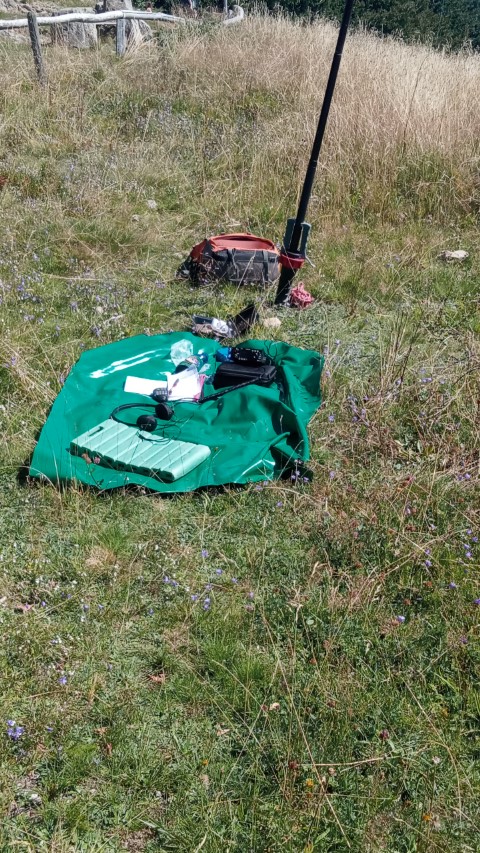
DD5LP/P – Activation of POTA DE-0456 Taubenberg/SOTA DL/MF-082 Schwarzer Berg and SOTA DL/BE-093 Buchberg.

Preparation:

These two summits are included in the around 45 summits that will disappear from the SOTA award Scheme on January 1st 2025. These two summits are the start of my “OLH” (One Last Hurrah) action. I hope to activate 2 or 3 more before the end of the year.

It just so happens that Schwarzer Berg DL/MF-082 is Taubengerg and Taubenberg has its own POTA park definition – so this location at least will not be lost for portable operators. Several other summits which are being removed from SOTA are already in the HEMA system and hence will “live on” within that scheme.

The weather and my health stopped my first two attempts to do these activations so I was determined to complete these activations once and for all. The weather looked good (as much as we can trust weather forecasts) until midday when rain was forecast. Checking the Activation Zone for DL/MF-082 the spot where I normally park my car near the St Benno chapel, is well within limits and as this will no doubt become the POTA-preferred location, I decided I could save myself the extra walk up to the observation tower where I normally set up. This also meant that I could use my 10-metre mast and surveyor’s tripod to maximise my chance of a contact with Ernie VK3DET via 20-metre long-path propagation when I arrived. (Band conditions had not been good for the last few days following CMEs and a minor G1 storm hitting the earth’s atmosphere). 

To get to Schwarzer Berg as early as possible, the car was packed the night before with the usual G90 backpack, now with the 12Ah LifePO4 battery plus the Aerial-51 OCF dipole, 10m mast and surveyor’s tripod.

The Activations

POTA DE-0456 / SOTA DL/MF-082

After rising at 06:30 am, I left home at the planned 07:30 CET, taking the cross-country route rather than the autobahn over Munich as the pre-Christmas traffic was already affecting that route. Unfortunately, only about 30 minutes away from home, the country road was closed by the Police and Fire Brigade following a road accident. Often in the country, parallel to the road there is a tarmac route used by farmers, cyclists and pedestrians and this was the case here and traffic was diverted around the completely blocked 2-lane road, first in one direction and then the other. This cost me about 20 minutes extra on top of the planned time but could not be helped and thankfully it looked like there was no one injured, just broken parts of the two cars all over the road.

I had heard in advance that, for the first time in over 20 years, the Taubenberg Park had been logged and to expect a messy (officially auto-useable) track up to the parking spot. This report was not wrong, however apart from all the logs pilled up at the side of the road awaiting collection, the road surface was not a lot worse than usual with potholes remaining the main danger although oncoming traffic was also a worry. On the way up I was lucky, on the way down later however, I had to clear the single-track road twice to allow cars coming up the track to get through.

I wish I had thought of setting up near the chapel on my earlier activations as it has a nice (fairly fat) area of grass which is unrestricted and larger than by the observation tower. Setting up the antenna took longer than hoped as it collapsed on itself twice before I finally got it erected. This has always been a problem with the DX-Wire/SotaBeams 10m travel mast. The whole set-up was, however, in place and operational almost at my planned time. I messaged Ernie VK3DET and he was ready and suggested a frequency which was clear with him but not with me, so we found another and tried again. I called Ernie and he could not hear anything – he then fired up his station with an amplifier and 3-element beam and I could hear him – probably about S2 but with zero noise level, S2 is fine but of course, it was clear, for once we were not going to make it, as I would be emitting a signal many, many, dBs less from my 20w and a dipole. We tried another time before calling it a day. 20m was short with inter-Europe contacts being easy but DX unobtainium.

Skip was definitely short as after I finished with Ernie and spotted myself on SOTA, I got a big pile-up from stations all around Europe, Scandinavia and the UK. 28 contacts in as many minutes including one S2S and the RSGB National Radio Centre GB3RS. Then I switched to POTA and in 23 minutes, made 22 contacts – one being Don G0RQL, so he got added to the end of the SOTA log as well.

SOTA DL/BE-093 Buchberg

I had taken the shortest (small roads) route from Bad Tölz to Schwarzer Berg, but I decided to take the main roads to get back to Bad Tölz (where Buchberg is located) expecting it to take less time but the same road is used to come down from the Autobahn to the Tegensee tourist area which meant it was busy and this route took longer than planned. On arrival at my usual parking spot, I found trees stacked awaiting collection, so I had to find another sport further along the road before walking back and then up to the Holy Cross on Buchberg. This time, as it is quite a steep climb, I decided just to take the G90’s 40L rucksack and operate using the loaded vertical on its photo tripod. 

Once I had all the equipment set up I was surprised to find that received signals on 20m were now stronger from this, lower summit with a smaller, less efficient antenna. One spot and a couple of CQ calls brought in 12 contacts (including one S2S contact) in 12 minutes. By noon the temperature had dropped somewhat so I decided to call it a day and just as I finished packing up, the first raindrops started. So, good timing.

The journey home was thankfully, uneventful.  

Photos:

Taubenberg/Schwarzer Berg

This slideshow requires JavaScript.

Buchberg

This slideshow requires JavaScript.

Equipment taken:

  • Xiegu G-90 radio & 12 Ah  LifePO4 battery.
  • Aerial-51 OCF UL-404 dipole antenna (used only at first activation).
  • Ten-metre mast (used only at first activation).
  • Surveyor’s tripod (used only at first activation).
  • Six-metre mast (not used).
  • Screw-in Sun umbrella foot (not used).
  • Komunica Power HF-PRO2-PLUS-T loaded multiband vertical (used only at second activation).
  • Photo tripod with radials (used only at second activation).
  • 2Ah Eremit LifePO4 battery (not used).
  • 4 Ah 3S LiHV battery (not used).
  • Plastic painter’s sheet and seat pad.
  • Lightweight headphones.
  • Smartphone for spotting.

Logs:

SOTA DL/MF-082 Schwarzer Berg

POTA DE-0456 Taubenberg

SOTA DL/BE-093 Buchberg

Conclusions:

  • The activations both went well, considering the limited time available.

73 until the next activation (s)!


DD5LP/P – November 2nd SOTA NA-EU S2S event – DL/AM-176 Rentschen.

Preparation:

The annual North America to Europe S2S event day had arrived again and (as usual), the weather forecast looked good until the day before when it changed from foggy in the morning and sunny in the afternoon (when the event is), to being cold, damp and foggy all day. Despite that, I decided to go ahead with the activation with the hope of getting some easy S2S contacts from this 1-pointer plateau summit. 

Rentschen is the summit I choose for testing new antennas on as it is a flat plateau and so provides plenty of space.

I decided to play it safe for this afternoon’s activation. I packed not only the electrically switchable trapped tri-bander beam but also the manually switched 5-bander and my linked dipole, each with its own masts and supports.  To be safe I also packed the antenna analyser, a complete spare radio station (G106 plus 100w amp tower) and 4, 8 & 12 Ah batteries. (I was hoping that the weather may improve so I would have the opportunity to compare various combinations). The weather didn’t change and most of the equipment stayed in the car as it turned out. This is thankfully a drive-on summit.

The Activation

It is rare that I only head out in the afternoon for a SOTA activation – usually, I am eager to get to the summit just after daybreak to work VK via the long path but in this case, where North America was the target the clock difference made a morning activation the wrong options and all of the many SOTA activators who would be out had alerted to be on from around 1300 UTC (or 2 pm local time here) – so that was my target to get on site and set-up.

The run down to Rentschen, I know very well and it was good that I did as the fog came in reducing visibility along the roads for a fair distance. On arrival at the summit, visibility was around 30 metres and it was a very damp fog. As Rob DM1CM was also going to join me I got started straight away with setting up the antenna and station.

As usual, the 2 element wire beam antenna was installed using the screw-in base with the four wires going out at 90° to each other, the combined length of the element and its cord extender (also acting as the guy cords for the mast), formed a 60° angle with the vertical mast, this after looking at a model of the antenna appears to be a better value than the normally stated 56° (the mast is a 7-metre mast but with the top section removed so that the feed point board sits at 6 metres above ground level). 

As I was finishing up the set-up, Rob arrived and we took a listen around 10 metres (which I had expected to be the “money band” for this event going by recent radio conditions. Initially, the band was empty but then about 15 minutes later it filled up with stations from Russia and the US. It seems skip was not going to allow me to get any contacts inside Europe but the first in the log was Jörg signing as DL/HB9BIN/P from Laber DL/AM-060 – which, if there wasn’t a forest in the way, would have been line-of-sight from where we were. Watching the SOTA spots on my smartphone, I saw more & more European and UK stations spotting that they were out however when I tuned to their frequencies I could not hear them. I suspect the skip distance on the 10m band at the time was too long. This was in some ways confirmed by the strength of the US home stations. Unfortunately, the US SOTA activating stations all seem to have been using either CW or data so were not an option for me. I put out several CQ calls and was eventually rewarded by calls from three US SOTA chasers calling me.

The cold damp temperatures and the lack of contacts eventually decided me to cut the activation short and head home to the warmth. As I approached home, it was obvious that the weather at home had not been nearly as bad as where Rob and I were located.

There are positive points out of this action. The wire beam works well (even though I set it up 45° off the intended direction). It would have been nice to compare the linked-elements version against the trapped elements but the work involved in the wet and cold was not justified. The G90 radio with its 20 watts output on SSB, continues to “do the job” and the new 12 Ah LifePO4 battery also got another test.

Photos:

This slideshow requires JavaScript.

Equipment taken:

  • Mountaintop travelling 40-litre rucksack.
  • Raddy rucksack. (not used)
  • Xiegu G90 radio.
  • Xiegu G106 radio plus RMItaly amplifier, LPF box and ATU-100. (not used)
  • Screw-in mast base.
  • 7 metre fibreglass mast.
  • Surveyors tripod and 10m mast. (not used)
  • 10/15/20-metre band 2-element trapped wire beam.
  • 10/12/15/17/20-metre band 2-element linked elements wire beam.
  • SOTA/HEMA logbook & pens.
  • Komunica Power HF-Pro2-PLUS-T loaded vertical antenna and tripod (not used)
  • 6m mini-mast (not used).
  • SotaBeams linked dipole (not used).
  • 4 Ah Eremit LifePO4 battery (not used).
  • 8 Ah LiFePO4 battery (not used).
  • 12 Ah LifePO4 battery.
  • Painter’s thick plastic sheet.
  • Gardener’s kneeling pad (not used).
  • 2 x Lightweight headphones (one pair not used).
  • Smartphone for SOTA/HEMA spotting.

Log:

Conclusions:

  • The NA-EU SOTA S2S event is “jinxed” every year it is accompanied by bad terrestrial weather (at least here in Southern Germany).

  • The equipment used worked well and it was a nice “social” meet-up with Rob.

73 ’til the next summit.

G8GLM/P – September 24th & 26th 2024 – First ever activation of POTA GB-2021 Cotgrove Country Park and UKBOTA B/G-0655 Burton Joyce ROC Bunker.

Preparation:

Linked with my visit to the UK to visit my brother & sister and to attend the national Hamfest in Newark, I wanted to do some radio activations using my new Xiegu X6200 transceiver. As I left Germany, it was not clear which SOTA, HEMA, POTA, COTA or UKBOTA sites I might get to activate. I had planned to activate Bardon Hill – a SOTA summit (G/CE-004) on the way from the airport to where I would be staying but the weather was terrible with many roads in the UK closed because of flooding and as the access to Bardon Hill starts with a trek over a field, on the way driving there, I decided to cancel and concentrate on getting safely to my destination.

The Activations

POTA GB-2021 Cotgrove Park  & UKBOTA bunker B/G-0655 Burton Joyce ROC

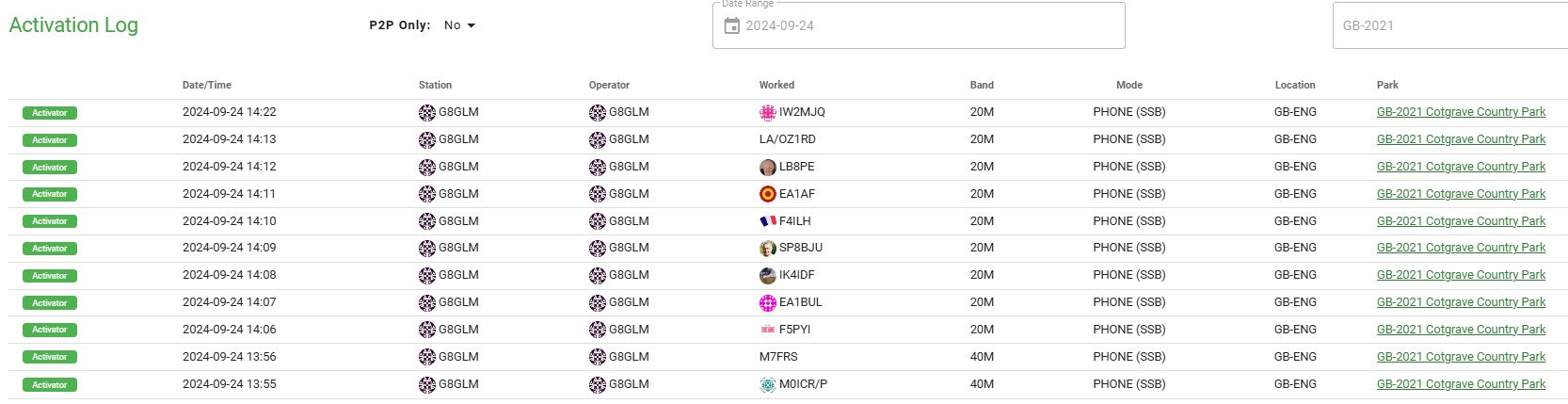
I had the opportunity on Tuesday to combine the activation of a POTA park near Nottingham, which for some reason, no one had yet activated, with taking my sister to visit a friend. Cotgrove Park has a housing estate in the middle of it but also some tributaries of the River Trent, near to one of those I found an area of grass large enough to set up the linked dipole and operated on 20 & 40m from a bench. There was some interest from passersby – mainly from their dogs – this seems to be a favourite dog walking park. Initially, I was only able to get contacts by search and pounce of strong stations but then after calling CQ for some time, I managed to get a flow of contacts ending up with 11 (one more than needed for a POTA activation). I then had to curtail operations as I needed to pick up my sister from a friend’s house where I had dropped her off earlier. The drive back to the other side of Nottingham was horrible. flowing traffic had changed into crawling traffic around the Nottingham ring road but at least I could chalk up an activation. I had started to think that my bringing the radio gear had been a waste of time. 

On Thursday I went to a point within a kilometre of a UKBunkers site about 20 minutes away from where we were staying. My originally planned set-up point was in a car park shown on Google Maps, which turned out to be a private one with locked gates at a (closed) sports centre, so I went further down the riverside and found a parking spot just before the Ferry Boat Inn at Stoke Bardolph. During my visit to the UK a year ago, I tried to get to one of two bunkers near where we were staying in the Lake District. The first was inaccessible as the fields were both overgrown and flooded, the second I managed to get to and operated from the top of the entrance but conditions were not kind to me and I got no contacts from there. This year, I checked the rules more carefully to find that I only needed to be within one kilometre of the bunker and could therefore activate from the road, from inside the car. The result however was not a lot better than the year before, with only two completed contacts.

Photos:

POTA GB-2021 – Cotgrave Country Park

This slideshow requires JavaScript.

UKBOTA B/G-0655 Burton Joyce ROC

This slideshow requires JavaScript.

Equipment taken:

  • Xiegu X-6200 radio.
  • Linked Dipole (used for POTA activation)
  • Six-metre mast (used for POTA activation).
  • Komunica Power HF-PRO2-PLUS-T loaded multiband vertical, tripod and radials (Used for UKBOTA activation).
  • 4Ah Eremit LifePO4 battery.
  • Plastic painter’s sheet and seat pad.
  • Lightweight headphones.
  • Smartphone for spotting.

Logs:

POTA GB-2021 Cotgrove Country Park.


UKBOTA B/G-0655 Burton Joyce ROC


Conclusions:

  • The activations could have gone better – whether that was conditions, lack of chasers or just not a big enough signal from the 8w X6200 (my normal G90 is a 20w radio) I am not sure. I question whether the extra effort of taking the radio gear was worthwhile (especially with the recent cases in the Middle East of exploding amateur radio transceivers making airport security more careful). I was the first activator of the POTA park, just beating another ham who activated the following day. 

73 until the next activation!
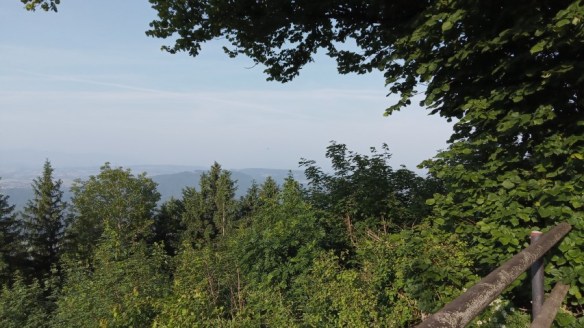


DD5LP/P – August 12th 2024 DL/AL-179 Weichberg.

Preparation:

This was a test of equipment to be used the following weekend for the International Lighthouse and Lightship Weekend, where I planned to head down to my only lighthouses within driving range in Lindau on Lake Constance.

The area available at Lindau to set up in a public park in sight of both lighthouses is fairly small and with very little topsoil, the same in many ways as Kappelhohe at Weichberg.

My experience in previous years has been that just running the 20 watts from the G90 with a dipole was not a strong enough signal to avoid being “stomped on” by other home station “crocodiles” (big mouth, little ears) so I will be using my “G106 Stack” with around 70-80w PEP output. I had considered also taking the wire beam however the space needed would block too much of the park area in Lindau, so I chose a dipole for simplicity (as I will be operating alone), the aerial-51 404-UL off-centre-fed dipole gives me multiple HF bands.

This activation was to check the planned set-up for use in Lindau. I would also have a backup station with me at Weichberg in case there was a single item that needed attention and could be worked around to complete the main tests.

The most critical test was the use of a small shopping trolley, not only to transport the equipment (radio and shade tent) but also to act as the base support for the 6-metre mast.

As usual, the car had the equipment packed into it the day before the activation to allow for an early start as Ernie VK3DET had once again offered to listen out for me from Victoria in Australia.  

The Activation

The drive down was uneventful and the weather was perfect – clear and warm however there was a “dangerous heat” warning out from 11 am local time, so I would need to be home and inside before that. The space weather was not so nice … a pair of CMEs hit the Ionosphere and shot the Kp Index up to 5 (a G1 storm), the disturbance storm index was into the moderate storm level, heading towards the major storm level and the maximum usable frequency was struggling to get up to 14MHz. If I had been heading to this summit just to accrue points I may have called off the activation, however as this action was more to test the mechanical status of my solution for the ILLW, I chose to go ahead with it. As I had already activated this summit in February, I would get no activator points for activating it in any case.

I had already strapped the 6-metre mast to the side of my little shopping trolley before putting it into the car, so once I arrived at the summit, I simply chose a point away from the trees in the middle of the lawn on the summit by the chapel, took out the radio gear from the trolley added the antenna Balun to the mast, raised it and ran out the two elements (which also act as the guy ropes). The “G106-Stack”  comes out of the small rucksack (which sits inside the trolley bag) and once the groundsheet was down on the ground it went onto it and the antenna coax connected to it. 

As I was ready 10 minutes earlier than expected, I sent Ernie a quick message via my phone and a few minutes later the 20m SSB DL – VK3 contact was in the log. Although Ernie was about 5-8 peaking 5-9, even my 70w PEP could only get a 4-4 signal into Victoria. I am not complaining – with all the “action” going on in the Ionosphere, I was happy to have got the contact at all. indeed tuning around, spotting and calling on 20m after the contact with Ernie got zero responses. All I could hear on 20m were some of the usual Russian super-stations. Not even any Italian stations – that showed me how terrible the radio conditions were.

Another component of the set-up for ILLW is an angler’s shade tent, which also packs nicely into the trolley, so I took that out and assembled it – all went well. Rather than finishing with just one contact in the log, I decided to try 40 metres which of course with higher bands being dead was full of stations but I found a spot put out a “CQ SOTA” and bagged 4 contacts in a few minutes. Even those (European) contacts were not as clear as they would normally be as the noise level was 2-Spoints higher than normal on 40m due to the increased atmospheric activity.

  So all in all a successful test of the equipment – I now need both good terrestrial and radio weather for the Lighthouse weekend.

Photos:

This slideshow requires JavaScript.


Equipment taken:

  • Backup-system (not used) Mountaintop travelling 40-litre rucksack with Xiegu G90 radio, batteries, 6m mast, screw-in base, linked dipole antenna, HF-PRO2 antenna and photo tripod.
  • “G-106 Stack” G106 radio, RMItaly amplifier, switch LPF box and ATU-100.
  • Shopping trolley.
  • Lamdahalbe 6m mini-mast.
  • Aerial-51 UL-404 OCF dipole.
  • 8 Ah LifePO4 battery.
  • Painter’s thick plastic sheet.
  • Gardener’s kneeling pad (not used).
  • Lightweight headphones.
  • Smartphone for SOTA spotting.

Log:

Contacts map

Conclusions:

  • The antenna support worked well and indeed apart from one sudden loss of power to the G106 (cabling) everything worked, even the shade tent went up without problems.

  • Band conditions were not good but as the target of this activation was primarily to test out the physical assembly of all equipment that was less of a problem.

  • I did have one ham come on the frequency and say that my (processed) audio sounded bad but never gave his call sign and did not come back to my request for help in trying different settings. all the stations I worked did not comment on the audio except that when I switched off the speech processor Ernie could no longer hear me. So I will leave that set as is for the ILLW event.

  • I did hear some RF-VOX relay chatter a couple of times, so I will increase the value of the capacitor in the amplifier to hopefully reduce this.

73 ’til the next summit.


DD5LP/P – August 6th 5th 2024 SOTA DL/AM-176 / HEMA DL/HBY-052 Rentschen.

Preparation:

With progress made on the 2-element wire beam by adding a trap for 15m operation and reconfiguration of the speech processor that I use with my G106 radio, I needed to test both out on a summit. The results of these tests would also help me define what equipment I would take to Lindau, two weeks later for the International Lighthouse and Lightship Weekend.

Unfortunately, the sun is not on my side again, with a very active sun sending flares and CMEs which suppress the maximum usable frequency (MUF) since the weekend. I was hoping that things would be relatively back to normal on Tuesday (the activation had initially been planned for Monday).

As Rentschen is a drive-on one-pointer summit, I packed the “G106 Pack” and the normal G90 radio and accessories into the car the day before. Looking at the previous week, 21 MHz was unlikely to open before 0700 UTC (9 am local time), so it would be a 7:45 am departure from home to allow for the 45-minute drive and set-up time on the summit. The alarm was set …

The Activation

The morning of the activation arrived and the terrestrial weather looked nice. The trip down took a little longer than expected as I hit some of the morning commuter traffic but I arrived at around 8:30 am as planned and found a spot right next to the trig-point stone – the marker of the absolute summit point and set-up. I had a sked with Ernie VK3DET and we would try 20m and then move to 15m.

The antenna was installed using the screw-in base with the four wires going out at 90° to each other, the combined length of the element and its cord extender (also acting as the guy cords for the mast), form a 56° angle with the vertical mast (the mast is a 7-metre mast but with the top section removed so that the feed point board sits at 6 metres above ground level). 

I had two aims with this activation – one was to check that the speech compressor which I use with the G106 and amplifier, now sounds better. I know the built-in one in the g90 is fine. The second aim was to make a contact on 15m with the wire beam, now that I had added the 15m traps to it.

I hadn’t expected problems with the “G106 Stack” ( G106 radio – CB amplifier – LPF filter box – ATU-100 ) as it had worked fine the last time that I used it, but OF COURSE – something went wrong there and instead of over 100w PEP that I got last time (70w RMS) – I got 20w RMS at best. I could hear the VOX relay in the amplifier chattering, suggesting it was not getting enough drive. This is at least something that I can test at home without needing to go /P again. Depending upon what I find, I could match the amplifier+LPF+Tuner up with the g90 on low power for ILLW. We’ll see.

As for the antenna test on 15m, my test with Ernie VK3DET was too early and we gave up because the band was empty of DX. I said 73 to Ernie, switched to the G90 20w radio and went back to bag some contacts on 20m to get the necessary 4 contacts to “qualify” the summit (which, as I have already activated this summit this year for both SOTA and HEMA brought me no points). Rather than the usual quick signal report exchange, I managed a few chats with hams who were interesting and a couple were interested in the wire beam I was using, so we exchanged website URLs and agreed to check out each other’s work. That was a nice interlude in the warm weather on the summit but I still wanted to know whether the beam would actually work on 15m so when I got no further replies to my CQs I went back to 15m

To my surprise there were stations now on the band and from 08:15 – 08:25 I happily listened in to a 15m net on 21.270 with Dave VK6IE, Steve E51CZZ on Aitutaki Isl (South Cook), Paul EA5JZ and a VK3 – It could have been VK3MH Brendan but I think I heard the others call him Andrew, so I may have that call wrong – he was the weakest of them all. The South Cook station was easier to listen to and that was SHORT PATH! I did “turn” the beam (via relays) and there was a difference, this was definitely short path VK-EU from 0800 UTC onwards. After trying to call into the net unsuccessfully – although Dave said he heard “someone” after I called – I gave up on the effort as one of those things, found another frequency, spotted myself on SOTA and called CQ for 5 minutes with no replies.
One thing is clear – the beam receives on 15 metres OK, whether it works also on transmit will have to wait until another day.

Photos:

This slideshow requires JavaScript.

Equipment taken:

  • Mountaintop travelling 40-litre rucksack.
  • Raddy rucksack.
  • Xiegu G90 radio.
  • Xiegu G106 radio plus RMItaly amplifier, LPF box and ATU-100.
  • Screw-in mast base.
  • 7 metre fibreglass mast.
  • 10/15/20-metre band 2-element trapped wire beam.
  • Komunica Power HF-Pro2-PLUS-T loaded vertical antenna and tripod (not used)
  • 2 x 6m mini-mast (not used).
  • SotaBeams linked dipole (not used).
  • 4 Ah Eremit LifePO4 battery.
  • 8 Ah LiFePO4 battery.
  • Painter’s thick plastic sheet.
  • Gardener’s kneeling pad (not used).
  • 2 x Lightweight headphones.
  • Smartphone for SOTA/HEMA spotting.

Log:

HEMA

SOTA

CONTACTS MAP

Conclusions:

  • The antenna worked well on 20 metres and received fine on 15 metres (with directivity). I hope transmit on 15m will work fine as well but the conditions on 15m were so variable with the MUF bouncing below and above 21 MHz, it wasn’t a good day for the test.

  • The problem with the “G106 Stack” will need to be investigated – the fact that I could hear the input VOX relays “chattering” in the amplifier suggests to me that it wasn’t getting enough drive.

  • I will need to consider what I take for ILLW (International Lighthouse and Lightship Weekend) on two counts – firstly the antenna – the beam needs more space than a simple dipole and it doesn’t cover 40m, which could end up being the band of choice depending upon radio conditions. As for which transmitter, I would like to have more than 20w to “fend off” those stations who simply sit on my frequency and start calling CQ because they are either deaf or rude B’s. I could use the G90 with the amplifier rather than the G106 with the knowledge that if there is a problem, I can fall back to using the G90 “barefoot”.

73 ’til the next summit.

DD5LP/P – July 24th 2024 – First ever activation of POTA DE-0797 König Ludwig Weg & SOTA DL/AM-001 Peißenberg.

Preparation:

This is the second preservation/nature trail I have submitted for inclusion in the POTA award system and it was also accepted.  This trail is very interesting, starting as it does at the spot where King Ludwig was found drowned on Lake Starnberg and finishing near his world-famous Neuschwanstein Castle (think of the well-known Disneyland castle – that was a copy of this real-life one). Along its route, it entails a ferry trip across Ammersee a visit to the UNESCO-listed Weichkirche church and at least one SOTA summit. The route runs right past the seat that I use to activate the DL/AM-001 SOTA summit.   

One reason for this activation was to be the first to activate from the trail and to do that one does not have to walk the 6-day long trail but rather just set up somewhere along its route. Although I have already activated the SOTA Peißenberg summit this year and hence won’t get any points for it, I chose to do the combined activation as then I could call on two groups of chasers for contacts and my second reason for the activation would benefit from having as many contacts as possible. The second reason was to test out equipment prior to its use during the International Lighthouse and Lightship Weekend in August. I had found on previous ILLW activations, that the signal from my 20w radio was getting stomped on by other stations, so (as well as using the two-element wire beam this time), this year would have some more power on board, specifically 50-70w RMS (over 100w PEP) depending upon the band in use. I have worked at trying to get a Chinese amplifier to work reliably for a couple of months but with the MOSFETs blowing regularly it did not look promising and I decided to buy a commercial HF amplifier. Now those designed for ham bands are expensive, however, those designed for the CB bands are a lot cheaper and can be modified to work across the complete HF spectrum (3-30 MHz).  I bought an RM-Italy KL-203P unit. The missing component in a 27MHz amplifier is protection against harmonic emissions. In an amplifier designed for amateur radio use, switched low-pass filters are used to block any harmonic signals. As I had, from my work with the Chinese amplifier a switchable LPF board I cased this up and cabled it to follow the amplifier and precede the ATU-100 tuner. While the LPF box uses Butterworth filters, it can operate on transmit and receive.  So, as you can see, the station for the ILLW event is made of several, cabled together units and this combination needed to be tested in a portable operation before relying upon them for my ILLW station. This activation would be that equipment test.

Map where POTA nature trail and SOTA summit meet.

The Activation

POTA DE-0797 / SOTA DL/AM-001

Originally planned for Tuesday but rescheduled to Wednesday as some strapping components were delivered later than promised by Amazon and so I would have had no chance to do a dry run from the home station – that test took place on Tuesday with a contact with Leif LA9BM in Norway. He commented that the G106 with my RF Clipper speech processor and the amplifier and other components after if, while OK, the audio sounded a little deep and muffled. This report was also received later during the activation and the adjustment to the speech processor is an outstanding action to be completed.

As regards the activation itself, I had the alarm set for 6 am, was on the road by 7 am and set up and running at 8 am (all local times – UTC+2).

A quick tune of 20m showed a couple of US stations booming in. First in the log was Ernie VK3DET and we exchanged the same report on signal strength with Ernie running 100w, that seems a good start. It took a while to get the needed 4 contacts to qualify the summit. I put this down to the crowded part of the 20m band where I was operating. I could have moved to another frequency on 20 metres but rather I decided to change to 40 metres, as another test of the equipment. On 40 metres I had no problems finding the extra 6 contacts needed to qualify a POTA trail, indeed I had 18 contacts in 35 minutes and then, as the skies were darkening again, I decided to call it a day with the new combination of units working well together. Three further callers commented on the audio being a little difficult to read, so this confirmed what I already thought to be the case and that will get looked at while at home.

When I got home, I calculated that I had drained 2 Ah from the 8 Ah battery in just over 35 minutes so I will need to take a spare battery (or two) along for the (longer) ILLW activation next month.

Photos:

This slideshow requires JavaScript.

Equipment taken:

  • Xiegu G-106 radio.
  • DF4ZS Mini-RF-Clipper speech processor.
  • RM-Italy KL-203 P amplifier.
  • Switch LPF filters box.
  • ATU-100 tuner.
  • Aerial-59 OCF UL-404 dipole antenna.
  • Six metre mast.
  • Komunica Power HF-PRO2-PLUS-T loaded multiband vertical (not used).
  • 5-band linked dipole antenna (not used).
  • 8Ah LifePO4 battery.
  • 4Ah Eremit LifePO4 battery (not used).
  • 4 Ah 3S LiHV battery (not used).
  • Plastic painter’s sheet and seat pad.
  • Lightweight headphones.
  • Smartphone for spotting.

Logs:

POTA DE-0797 König Ludwig Weg.

SOTA DL/AM-001 Peißenberg

Contacts Map

Conclusions:

  • The activation went well, I was the first activator of this POTA trail, and the radio equipment performed well. The battery drain level will need to be watched at the higher power levels and the speech processor needs to be adjusted.

73 until the next activation!
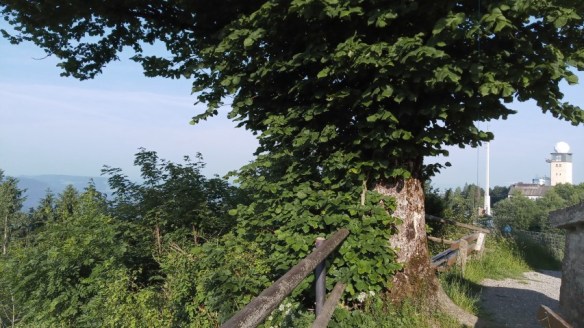


DD5LP/P – June 29th 2024 DM/BW-348 Gehrenberg.

Preparation:

This activation was scheduled as I would be in Friedrichshafen for the annual “HAM RADIO Friedrichshafen” event. There are two SOTA summits close to “FN” Höchsten” and “Gehrenberg” the latter being the closer but the former being a “drive-up” summit.

As I wanted to plan this as an early morning activation with the chance of some contacts into VK, Gehrenberg is closer to where I would be staying so it was chosen over Höchsten.

I had my standard rucksack packed with the G90, squid poles, screw-in base etc. in the back of the car, so the plan was for this to be a relatively quick activation on Saturday morning before heading into “HAM RADIO” which opened at 9 am.

The evening before however, I met Glenn VK3YY and Andrew VK3JBL who were over from Australia and said that they had tried to get to Gehrenberg and failed because of road closures due to recent flooding. When they described their route, I was of the opinion that they had used a different approach to the one that I have settled upon over the last few years and to be sure, after the SOTA dinner, I drove my route up to the place I normally park for the summit and the route was open however there were some confusing signs related to the route to a different town and these were not relevant but for non-German readers such as Glenn and Andrew, these might seem like road closed warnings.

That evening I documented the route with pictures and sent this all Glenn and he said that they might try to get to the summit the next morning and we could activate together. There was another reason that Andrew VK3JBL wanted to qualify the 8 point summit and that was because his current SOTA activator points total was at 997 and this would take him over the 1000 points making him a “Mountain Goat”.

The Activation

DM/BW-348 Gehrenberg

On Saturday morning I was awake early and decided to head straight up to Gehrenberg to get set up and if Glenn and Andrew came along, I would have made my 4 contacts and be out of their way. The run-up was the same as the previous evening so I sent a short email to Glenn confirming the road was still open.

Luckily the tracks were not as muddy as I had feared they might be and I was set up and running by a quarter to 7 am using the usual Xiegu G90 and the linked dipole with the 20m link open supported by a 6m telescopic pole in the screw-in sun umbrella base with the ends tied off to some tree trunks.  

The first contact in the log was a sked with Ernie VK3DET in Victoria, Australia, after that it was signals from the north – Poland and Finland before another Australian Peter VK3ZPF, who I haven’t talked with for several years and another Polish station and an Italian one finished up the contacts for a valid activation. As I was taking the mast down and packing the radio away, I heard voices and it was Glenn and Andrew coming up the hill, to start their activation and soon after another ham came from another direction to the summit, so this can be a busy summit during the HAM RADIO Friedrichshafen event.

I stayed long enough to see that Andrew qualified the summit and hence earned his Mountain Goat, before heading back into Friedrichshafen to the show.  

Photos:


Equipment taken:

  • Mountaintop travelling 40-litre rucksack.
  • Xiegu G90 radio.
  • Screw-in sun umbrella base.
  • 6 Metre Lambdahalbe mast.
  • Komunica Power HF-Pro2-PLUS-T loaded vertical antenna and tripod (not used)
  • Modified SOTABeams band-hopper, linked dipole covering 80m-15m.
  • 4 Ah Eremit LifePO4 battery.
  • 4 Ah LiHV battery(not used).
  • Painter’s thick plastic sheet (not used).
  • Gardener’s kneeling pad (not used).
  • Lightweight headphones.
  • Smartphone for SOTA spotting.

Log:

DM/BW-348 Gehrenberg


Contacts map:


Conclusions:

  • Something seemed wrong with the 20m section of the linked dipole. It could be that I had it too close to the trees and they were de-tuning it but it will need to be tested before the next usage.

  • It’s a nice feeling to be there when someone achieves Mountain Goat status (I took videos).

73 ’til the next summit.