
Preparation:
This activation was planned for Sunday the 20th of October to coincide with the “Support your parks” weekend and to test out my 2-element wire beam with its elements now extended to cover 40 metres.
The weather was not as forecast, in fact, Sunday was a cold and wet day where the grass never dried out from the heavy morning dew in it.
Monday’s weather however looked better, so the cancelled activation became a postponed one and took place on Monday the 21st of October.
The Activation
POTA DE-0663
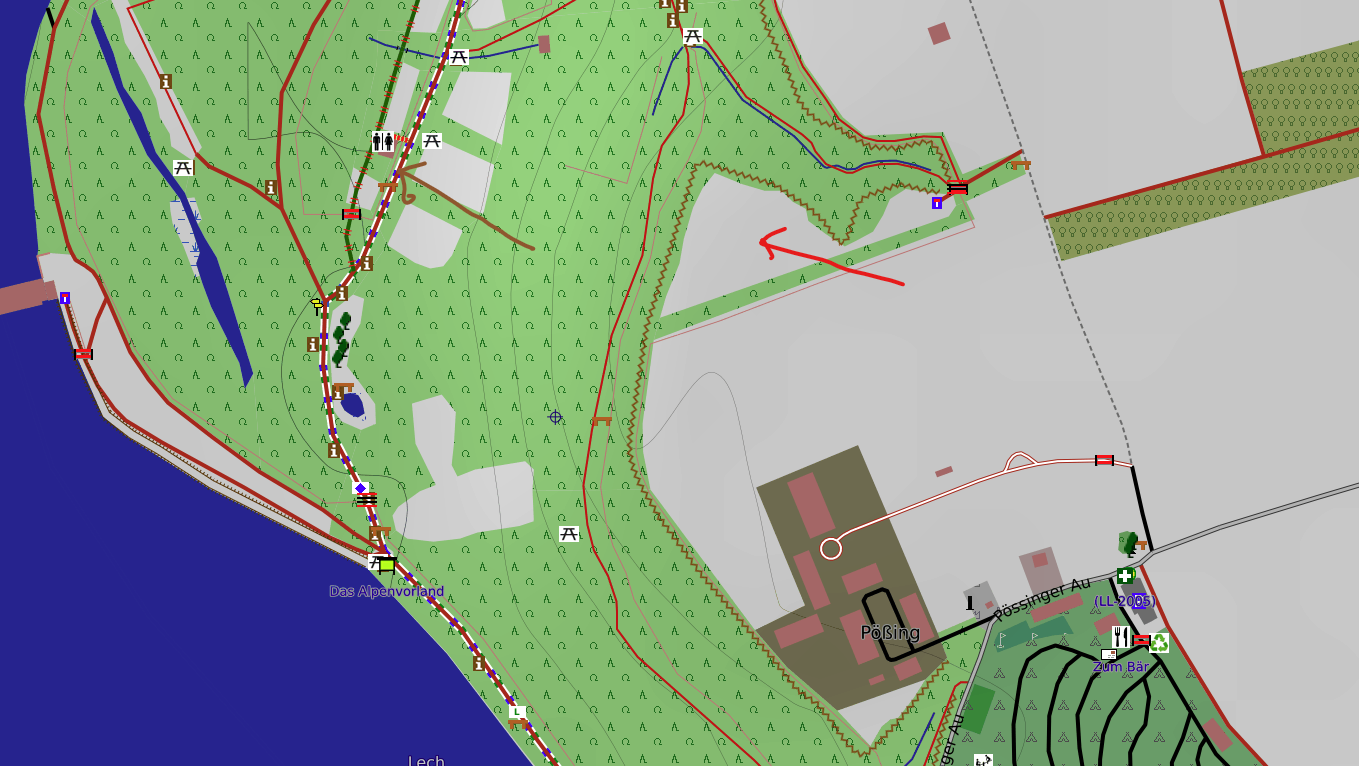
This is my closest park, a 15-minute drive away from home and while the park covers a large area along the side of the River Lech and encompasses an animal park, there are many locations where an activation is possible. I have found a field within the park, where deer often graze and is close to the road named “Pössinger Au”. As you can see from the picture below, (indicated by the red arrow) the area is bounded by trees but there is more than enough room for my antenna and is rarely visited by the general public. The Brown arrow is, in fact, part of the POTA nature trail DE-0791 LechErlebnisWeg, so operating from where the brown arrow points would be a POTA “2-Fer”. However, space there is restricted and in good weather a lot of people walk through there – so it is not a good spot to test a large antenna!
After arriving and setting up the antenna on 40m, I put the Antenna analyser on the antenna to find there was no dip at the expected (and tested the week before) 7.1MHz. The antenna was switched to point West and I wondered if I had a bad connection in the manual switch, so I lowered the mast, switched from West to North and tried again – the same problem occurred. Repeat and try – North to east – and now there was the expected dip near 7.1 MHz – perhaps it’s just one connection on the switch that has a problem? I lowered the mast again, switched to South, raised and tested, no dip. Odd, but East works so I lowered and tested again and this time even East did not have the expected dip. This has to be a common component that has failed, perhaps intermittently. I realised I had another feeder coax with me so I changed that out and “Bingo” all directions were now showing resonance around 7.1MHz. My conclusion – it must be the RG-174 coax cable that has failed in either the BNC or PL-259 plug, but in fact, when tested after returning home, the cable was fine and it was the BNC socket that had a bad centre connection – possibly as a 75 Ohm BNC plug had been pushed into the 50 Ohm socket, widening the grips on the centre pin. I re-tensioned those and the complete run checked out.
But, back to the activation. I had previously seen in a model that with my wire beam at only 7 metres AGL, the radiation pattern is close to omnidirectional rather than beam-like and that proved to be the case with my six 40-metre contacts coming from all points of the compass from where I was located. At least the antenna works on 40m, even if it brings no advantage over a dipole.
It was time to test the antenna on 10 metres, so I lowered the antenna and removed the link at the end of the 10m section on all 4 elements, switched the antenna direction to West and started calling CQ.
My first caller was VE3RNH from Canada and then in quick succession another ten calls from the US or Canada, including one Park-to-Park. There was also a call from Mike R2BRJ in Moscow off the back of the beam. Ten metres was certainly “open” and with a mixture of 59, 58 and 55 reports the wire antenna with 20 watts was certainly working well.
Looking at the POTA cluster, there were several operators out in Europe on 20m – so I again lowered the mast, reset the 10m links and removed the 20m ones. While tuning around, I came across YB7ONC from Indonesia, but even with my antenna switched in his direction I could not get a response from him. I was not alone however, he only seemed to return to very strong stations, so perhaps he has a high local QRM? In any case, it was nice to at least receive a signal from Indonesia. After this, I found a free frequency, spotted myself on the POTA cluster and waited for any calls. Unfortunately, I suspect the number of stations on the band was the problem and no one could hear me for the noise. I then saw a recent post on the cluster for another POTA operator IT9KHP in Sicily, whom I called and we had a 59 / 59 Park-to-Park QSO with no problem whatsoever.
Time was passing and while the 12Ah LifePO4 battery showed no signs of reducing its voltage I decided that I had done enough testing and given a lot of North American POTA chasers a new park and it was time to pack up and head home for tea.
Photos:
Equipment taken:
- Xiegu G-90 radio.
- 7-metre mast and screw-in sun umbrella base.
- 2-element wire beam.
- 12 Ah LifePO4 battery.
- 4Ah Eremit LifePO4 battery (not used).
- 4 Ah 3S LiHV battery (not used).
- Plastic painter’s sheet (used) and seat pad (not used).
- Lightweight headphones.
- Smartphone for spotting.
Log:
DE-0663 Lechpark Pössinger Au


Conclusions:
- The activation went well. It served the purpose of testing the antenna and its expansion to cover 40 metres however, my conclusion is to remove the 40m extensions and keep this as a 5-Band 10-20m antenna.
73 ’til the next activation!
 DD5LP / G8GLM / VK2JI blog
You must be logged in to post a comment.