Preparation:
With HF band conditions being the worst in over 20 years the previous weekend, this activation was never going to fill several pages of the log book or deliver any “Special DX”.
Despite that, there was a break in the Terrestrial weather before the returning storms, so I decided I would activate “somewhere” on the 16th of May. As Mike 2E0YYY announced he planned to head out to Mow Cop (HEMA summit G/HSP-020) I decided to head also to a local HEMA summit with enough room for the wire beam, which I am still “fine-tuning”.
Despite the fact that I have already activated Rösenau Kreuz in February, I chose that summit as I know it, it’s about a 40-minute drive from home and normally I am not disturbed while operating there.
So the plan was to take the HF wire beam, but this time with its linked elements rather than the trapped ones, as Mike wanted to try out some of the higher HF bands and 10m was unlikely to be open (which turned out to be true).
Along with the wire beam antenna, I would also take the antenna analyser (with its new set of batteries) so that I could check each of the bands on it, before attaching it to the radio, which, as usual, would be the Xiegu G90.
Ernie (VK3DET) had said that long path propagation had been happening at around 0630 UTC – so planning for that I set my alarm for 6 am local time expecting to leave at 7 am at the latest. All radio gear was stood read in the hallway.
The Activation
DL/HBY-040 Rösenau Kreuz
I awoke before the alarm and was able to leave home at 6:30 am local time. The extra 30 minutes were useful as I had to get petrol at the local garage.
The run down was uneventful and I was on the summit with a heavily loaded rucksack by 7:30 am. I had everything set up for 20 metres by 7:50 but Ernie and Mike had already moved to the higher bands, so I spotted myself and called CQ HEMA on and off for over 10 minutes with absolutely no callers, I decided to try to catch the other two, who were now on 15m. I could not hear Mike in the UK but I managed a 3-3 contact with Ernie VK3DET.
Following 15m, 17m was tried and with Mike’s help, I managed contacts with two more Australian stations on 17m. We then went and tried 10 & 12m – both were completely dead. Mike and I eventually managed a 3-3 both-ways contact on 20m – a “HEMA-to-HEMA” contact as Mike was on the HEMA G/HSP-020 summit.
The thought was it would be a while before 10 metres opened up, so I suggested I would go to 40 metres after taking down the beam and putting up the linked dipole.
This brought its own problem, in that the T-Piece on my linked dipole normally slots over a much thinner fibreglass mast and the top section of this mast, which I have removed. So as always, we found a way and the T-piece got taped onto the mast using electrician’s tape.
Once the 40m antenna was up, I was able to make a far easier contact with Mike 2E0YYY and went on to get three more contacts on 40 metres but then again, the band started to get noisy and I was not getting any more calls.
As it was still cold, rather than continuing on, I decided to pack up and head home, which as it turned out was a good idea, as, just as I was leaving, the farmer arrived to cut the grass for hay.
The walk down the hill was uneventful, as was the drive home in time for lunch!
Photos:
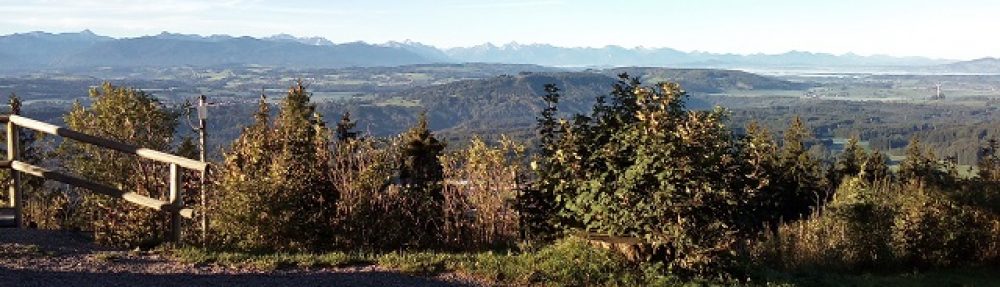
DL/HBY-040 Rösenau Kreuz:
Equipment taken:
- Mountaintop travelling 40-litre rucksack.
- Xiegu G90 radio.
- Sun umbrella screw-in base support.
- 7 metre fibreglass mast.
- HF 2-element wire beam (with linked elements covering 20, 17, 15, 12 & 10m and remote (ISM) switching box).
- RigExpert AA-30 Antenna Analyser.
- Komunica Power HF-Pro2-PLUS-T loaded vertical antenna and tripod (not used)
- 40 metre linked dipole.
- 4 Ah Eremit LifePO4 battery.
- 4 Ah LiHV battery (not used).
- Painter’s thick plastic sheet.
- Gardener’s kneeling pad.
- Lightweight headphones.
- Smartphone for spotting.
Log:
DL/HBY-040 Rösenau Kreuz

Conclusions:
-
The bands were still in a mess. There was no longer a complete HF blackout but the bands were not as good as they were 2 weeks earlier.
-
The need to lower the mast to switch bands (by closing or opening links) is inconvenient however it does work when care is taken to have all four wires set the same.
-
Some of the elements probably need a little adjustment for best performance but checking with the analyser all were “near enough” for any mismatch to be compensated for by the ATU in the radio.
-
The control (direction switching system) box works reliably when a direction change is requested using the 4-button key fob, the switching is taking place correctly and can be heard on the radio.
73 ’til the next summit.


 DD5LP / G8GLM / VK2JI blog
You must be logged in to post a comment.