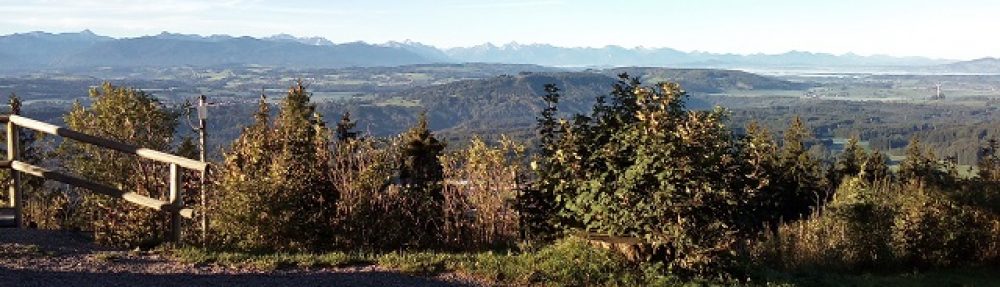
DD5LP/P – August 12th 2024 DL/AL-179 Weichberg.

Preparation:

This was a test of equipment to be used the following weekend for the International Lighthouse and Lightship Weekend, where I planned to head down to my only lighthouses within driving range in Lindau on Lake Constance.

The area available at Lindau to set up in a public park in sight of both lighthouses is fairly small and with very little topsoil, the same in many ways as Kappelhohe at Weichberg.

My experience in previous years has been that just running the 20 watts from the G90 with a dipole was not a strong enough signal to avoid being “stomped on” by other home station “crocodiles” (big mouth, little ears) so I will be using my “G106 Stack” with around 70-80w PEP output. I had considered also taking the wire beam however the space needed would block too much of the park area in Lindau, so I chose a dipole for simplicity (as I will be operating alone), the aerial-51 404-UL off-centre-fed dipole gives me multiple HF bands.

This activation was to check the planned set-up for use in Lindau. I would also have a backup station with me at Weichberg in case there was a single item that needed attention and could be worked around to complete the main tests.

The most critical test was the use of a small shopping trolley, not only to transport the equipment (radio and shade tent) but also to act as the base support for the 6-metre mast.

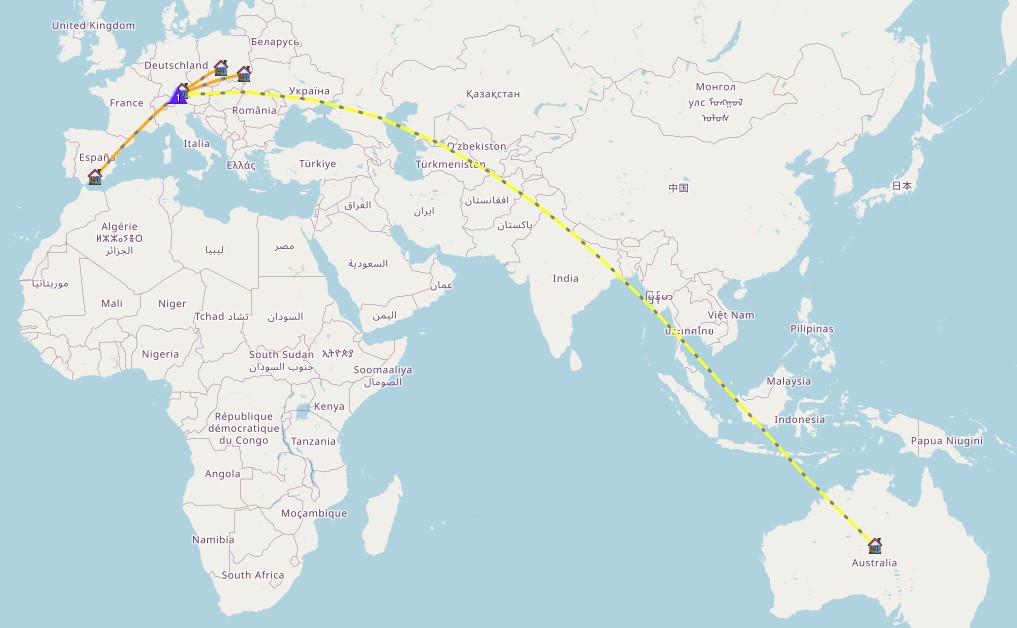
As usual, the car had the equipment packed into it the day before the activation to allow for an early start as Ernie VK3DET had once again offered to listen out for me from Victoria in Australia.  

The Activation

The drive down was uneventful and the weather was perfect – clear and warm however there was a “dangerous heat” warning out from 11 am local time, so I would need to be home and inside before that. The space weather was not so nice … a pair of CMEs hit the Ionosphere and shot the Kp Index up to 5 (a G1 storm), the disturbance storm index was into the moderate storm level, heading towards the major storm level and the maximum usable frequency was struggling to get up to 14MHz. If I had been heading to this summit just to accrue points I may have called off the activation, however as this action was more to test the mechanical status of my solution for the ILLW, I chose to go ahead with it. As I had already activated this summit in February, I would get no activator points for activating it in any case.

I had already strapped the 6-metre mast to the side of my little shopping trolley before putting it into the car, so once I arrived at the summit, I simply chose a point away from the trees in the middle of the lawn on the summit by the chapel, took out the radio gear from the trolley added the antenna Balun to the mast, raised it and ran out the two elements (which also act as the guy ropes). The “G106-Stack”  comes out of the small rucksack (which sits inside the trolley bag) and once the groundsheet was down on the ground it went onto it and the antenna coax connected to it. 

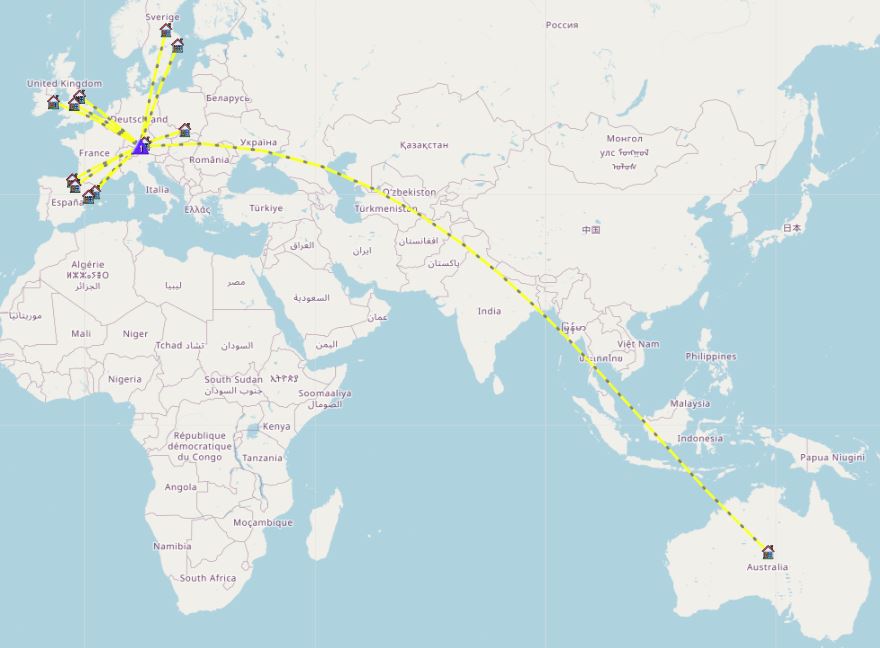
As I was ready 10 minutes earlier than expected, I sent Ernie a quick message via my phone and a few minutes later the 20m SSB DL – VK3 contact was in the log. Although Ernie was about 5-8 peaking 5-9, even my 70w PEP could only get a 4-4 signal into Victoria. I am not complaining – with all the “action” going on in the Ionosphere, I was happy to have got the contact at all. indeed tuning around, spotting and calling on 20m after the contact with Ernie got zero responses. All I could hear on 20m were some of the usual Russian super-stations. Not even any Italian stations – that showed me how terrible the radio conditions were.

Another component of the set-up for ILLW is an angler’s shade tent, which also packs nicely into the trolley, so I took that out and assembled it – all went well. Rather than finishing with just one contact in the log, I decided to try 40 metres which of course with higher bands being dead was full of stations but I found a spot put out a “CQ SOTA” and bagged 4 contacts in a few minutes. Even those (European) contacts were not as clear as they would normally be as the noise level was 2-Spoints higher than normal on 40m due to the increased atmospheric activity.

  So all in all a successful test of the equipment – I now need both good terrestrial and radio weather for the Lighthouse weekend.

Photos:

This slideshow requires JavaScript.


Equipment taken:

  • Backup-system (not used) Mountaintop travelling 40-litre rucksack with Xiegu G90 radio, batteries, 6m mast, screw-in base, linked dipole antenna, HF-PRO2 antenna and photo tripod.
  • “G-106 Stack” G106 radio, RMItaly amplifier, switch LPF box and ATU-100.
  • Shopping trolley.
  • Lamdahalbe 6m mini-mast.
  • Aerial-51 UL-404 OCF dipole.
  • 8 Ah LifePO4 battery.
  • Painter’s thick plastic sheet.
  • Gardener’s kneeling pad (not used).
  • Lightweight headphones.
  • Smartphone for SOTA spotting.

Log:

Contacts map
Conclusions:

  • The antenna support worked well and indeed apart from one sudden loss of power to the G106 (cabling) everything worked, even the shade tent went up without problems.

  • Band conditions were not good but as the target of this activation was primarily to test out the physical assembly of all equipment that was less of a problem.

  • I did have one ham come on the frequency and say that my (processed) audio sounded bad but never gave his call sign and did not come back to my request for help in trying different settings. all the stations I worked did not comment on the audio except that when I switched off the speech processor Ernie could no longer hear me. So I will leave that set as is for the ILLW event.

  • I did hear some RF-VOX relay chatter a couple of times, so I will increase the value of the capacitor in the amplifier to hopefully reduce this.

73 ’til the next summit.


DD5LP/P – February 12th 2024 DL/AL-179 Weichberg.

Preparation:

This was a re-try of the attempted activation from the previous Wednesday when high winds made me call off the activation from the car park before I climbed to the summit. This day was supposed to be a fine, warm, sunny day but as usual, two days before the activation, the forecasts changed to overcast, cold and possible winds.

Despite that, I was determined to be ready for an activation and as long as there were no high winds or torrential rain, I would activate. All the gear was packed in the back of the car on Sunday evening ready for an early start at 7:30 am the next day.

“All” this time was to include the surveyor’s tripod and the large feed-point board for the 20/10m wire beam – this would be the first real test on a summit of the ability to switch the antenna direction from my smartphone, something that had been giving me problems for the last six months. Of course, the usual backpack with radio, battery, masts, backup antennas, food and drink, would also be included along with the RigExpert Antenna Analyser.  

The Activation

DL/AL-179 Weichberg

On arriving at the car park for the summit, after an easy (and wind-free) trip down, the winds started to howl between the trees and some threatening-looking clouds were approaching. Despite this, I was determined not to call the activation off again as Ernie in VK3 was going to be available and Mike 2E0YYY/P was heading up to Mow Cop (HEMA G/HSP-020) so that we might make this a three-way contact today (at least on 20m, if not on 10).

After a hard trek up the forest path to the summit, with a loaded rucksack, the tripod over one shoulder and carrying a bag of documents, the antenna plate and antenna analyser in a shopping bag in the other hand, the top was reached and I put most of the gear down at the wooden table.

I unpacked the antenna, mast and Tripod and went straight to the complex installation including the relay board with Bluetooth switching and the trapped antenna elements. If this did not work, I could go back to the simpler setup as I had brought everything with me. Using my Rig Expert antenna analyser I could see that the antenna (initially set in the Long Path Direction (West)) was looking fine, so then I sent a message via the Signal app to the other two, who were both almost ready.

First in the log was Ernie VK3DET followed by Mike 2E0YYY/P a minute later. Both 5-8 to 9 signals on 20 metres. For once, it seemed the system was working well, the first time. My biggest problem was using the messaging app with frozen fingers. There was a light wind which grew over time but was always icy cold. The measured temperature would have been around 3°C but with windchill nearer to -3°C!

We actually managed an easy “net” between the three of us on 20m until Mike said 10m was open and he wanted to try there, so we moved up two bands and I switched the antenna to Short Path for Australia (East from my location). After trying several frequencies, we eventually found a free one and although Ernie was getting to me at around S2, he could not hear me. When Mike tried, I had to switch the beam around to West before I could hear him (again at about S2) again, he could not hear me. So the added problem I had was this need to switch directions to hear the two guys but as they could not hear me at all on 10m, nothing was really lost. they managed to make contact and I told them I’d head off spot myself and try to get some contacts in the log. To me 10 metres sounded rather quiet  compared to other days when I have use the simplified version of this antenna but this could also be propagation. in any case I was glad of a ground-wave call from Mario DJ2MX in Munich, so that I had at least one contact on 10m from the summit.

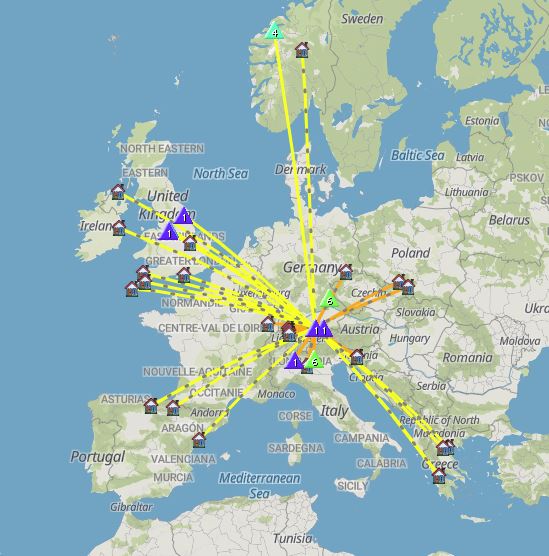
As I was still short of the needed 4th contact, I switched back to 20m, found a frequency, spotted myself and another 15 contacts came in, in quick succession. I was certainly getting out on 20m!

All of this time, I was fighting to have gloves on to try to stop losing all feeling in my fingers and taking them off when I needed to do something on the phone. Time was also passing, so when there seemed to be no more chasers, I called it a day, packed up, returned down the steep forest path and when I got to the car, it started to rain. That was lucky timing!

Photos:

DL/AL-179 Weichberg:

This slideshow requires JavaScript.

Equipment taken:

  • Mountaintop travelling 40-litre rucksack.
  • Xiegu G90 radio.
  • Surveyor’s tripod.
  • 7 metre fibreglass mast.
  • 10-metre band 2-element wire beam (full version).
  • RigExpert AA-30 Antenna Analyser.
  • Komunica Power HF-Pro2-PLUS-T loaded vertical antenna and tripod (not used)
  • Lamdahalbe 6m mini-mast and new metal base peg (not used).
  • Aerial-51 UL-404 OCF dipole (not used).
  • 4 Ah Eremit LifePO4 battery.
  • 4 Ah LiHV battery(not used).
  • Painter’s thick plastic sheet (not used).
  • Gardener’s kneeling pad (not used).
  • Lightweight headphones.
  • Smartphone for SOTA spotting.

Log:

DL/AL-179 Weichberg

Contacts map

Conclusions:

  • The antenna worked well with between 1 & 2 S-points difference on weak signals depending upon the direction was switched to.

  • It would be nice to have a method to have a one-button direction setting action rather than the 4 actions needed at the moment. Perhaps I will need to try to get another model of relay board to which I could script commands.

  • The 10m section of the antenna did not perform very well. Whether that was because of propagation or whether the capacitor does need to be a different value can only be tested by switching between models of the antenna (i.e. with and without the traps).

73 ’til the next summit.


DD5LP/P – December 18th 2023 DL/AL-179 Weichberg.

Preparation:

After being unable to activate for some time due to a long bout of Influenza followed by Covid (thanks to the thoughlesss person who decided it was more important to go and buy their coco pops or whatever from the supermarket rather than to self-isolate and in the supermarket, not even wearing a mask to protect others!), followed by a week where we had one metre of snow to block everyone in, I was ready to get out and do a simple activation.

I chose Weichberg as it is one of the closest SOTA summits at about 30 30-minute drive away from home. It also turns out that the last time that I activated it was April this year, it was after the Winter Bonus had finished, so while I wouldn’t get the 1 normal activation point for the summit, this time I would get the 3 Winter bonus points.

As often is the case, I decided to try some new equipment. Not the 20 & 10m wire beam that I have been working on but simply a new mast base spike after my previous two from DECATHLON failed on me. The last one on my Cyprus “mini.DXpedition”. I have bought two meal peg bases but as they are meant for the thinner carbon-fibre masts, I also made an adapter arrangement consisting of half a broom handle that pushes up inside my small 5-metre fibreglass mast.

Apart from the new base (I also packed the old sun umbrella screw-in base as well) the rest of the equipment would be the tried and tested Xiegu G90 radio and the SOTABeams linked dipole (with a couple of backup antennas as well of course).

I spotted for a 0830 UTC ():30 am local) start in the hope of catching the Long Path on 20 metres down into VK. This meant I would need to get up at about 6:30 am local to be on the summit on time.

The previous 4 days, the bands had been terrible due to one of the largest CMEs of the last 20 years hitting the Ionosphere but I was hoping it would have cleared by Monday morning.

I alerted on SOTAWatch and checked with Mike (2E0YYY) and Ernie (VK3DET) to see if they would be around and indeed Mike agreed to go up to his local HEMA Summit – G/HSP-020 Old Man of Mow.

The Activation

DL/AL-179 Weichberg

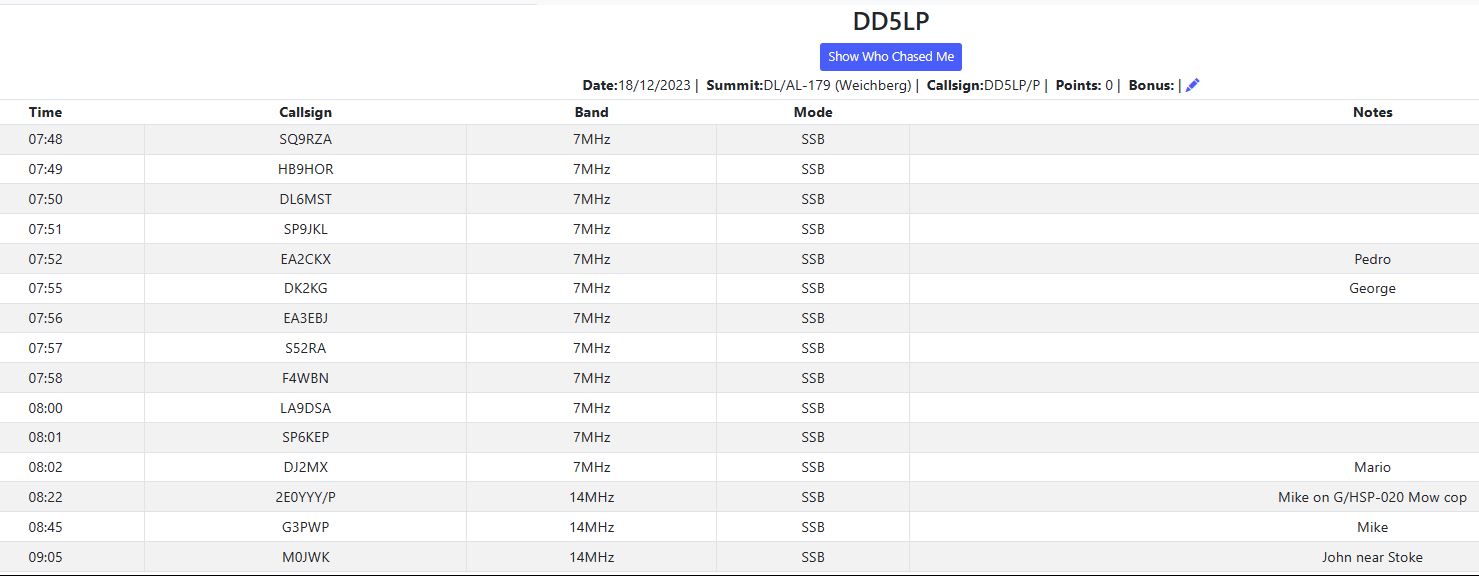
Well, I was up long before the alarm went off and rose at 5:30 am rather than 6:30 am, despite taking my time, this still meant that after an uneventful drive down, I was set up and calling CQ by 07:48 UTC. I started on 40 metres hoping that I might catch some DX via the Greyline but I think I was probably about 30 minutes too late.

I did however get a good pile-up of European chasers and despite the mast on the new peg almost falling over at one point (ground problem not a peg problem – once I moved it, it was fine), I managed twelve contacts in fourteen minutes.

At this point, Ernie and Mike sent me messages to say they were almost ready so I lowered the mast, unlinked the 20m links in the antenna and put it back up. Initially, the 20m band was empty but despite that, Ernie put out a call and I could hear him at around 5-3 to 5-4 level – unfortunately, he could not hear me strong enough to work. The difference between an S0-S1 noise level at my end and an S4-5 level at Ernie’s end along with the fact that Ernie was running 400w and I was only running 20w added up to a believable reason but what was to turn out to be the biggest problem was that the propagation skip distance was short (probably as the Ionosphere hadn’t yet recovered from its battering over the last four days). Signals from the UK and even local signals within Germany were 5-9+. Normally on 20m, I struggle to hear stations in the UK, but when I called John M0JWK, we exchanged 59+ reports despite his beam pointing Stateside!

Now I tried for a QSO with Mike 2E0YYY/P and to my surprise he was only about a 53 signal but gave me a 59 report. We wondered how that was possible. Due to high winds, his antenna was lower than usual but that should not make a great difference (if at all, as we both have height through being on top of hills). Mike runs 50w portable to my 20w so if anything Mike should be putting a stronger signal into me than I do into him – and usually he does.

Only later did Mike realise that he was not putting out the normal power level – indeed he could see almost nothing on the output meter. After getting home, Mike investigated further and it turned out to be a faulty cable between the microphone and the radio (we were both running SSB) – so very little audio equates to very little power output.

Overall, for my first activation after Covid, I was happy with the results but I could have done without the icy winds that gave a chill factor taking temps down to -2 or -3°C.

Photos:

DL/AL-179 Weichberg:

This slideshow requires JavaScript.

Equipment taken:

  • Mountaintop travelling 40-litre rucksack.
  • Xiegu G90 radio.
  • Komunica Power HF-Pro2-PLUS-T loaded vertical antenna and tripod (not used)
  • Lamdahalbe 5m mini-mast and new metal base peg.
  • SotaBeams linked dipole.
  • 4 Ah Eremit LifePO4 battery.
  • 4 Ah LiHV battery(not used).
  • Painter’s thick plastic sheet (not used).
  • Gardener’s kneeling pad.
  • Lightweight headphones (x2).
  • Smartphone for SOTA spotting.

Log:

DL/AL-179 Weichberg

Conclusions:

  • The radio conditions on 20m were short skip due to recent disturbences so although I could hear Ernie, VK3DET, a two-way contact was not possible.
  • All equipment (including the new mast spike) worked well.
  • I’m glad I went out despite the cold weather – after all, “Wintertime is SOTA activation time” Right?

73 ’til the next summit.


DD5LP/P – April 22nd 2023 – DL/AL-179 Weichberg for S2S Transatlantic contacts event.

Preparation:

Twice a year an attempt to make SOTA Summit-to-Summit contacts between Europe and North America is made during a specified day. This year the days are in April and November and this was my participation in the April one.

My originally chosen summit was Eisenberg but as that is a real tourist trap, this event is on a Saturday and this was the first dry and sunny day in three weeks, I decided that the number of people there would make it impossible for me to set up my antenna system without inconveniencing someone, so at the 11th hour I changed to Weichberg. that being said, this turned out not a “deserted location” with about 15-20 mountain E-Bike riders coming through in the 2.5 hours that I was there, but it was the right decision as I would have been overrun at Eisenberg and that SOTA/HEMA/GMA/COTA/WCA location can wait for a mid-week activation when there are fewer tourists.

I decided not to test any of my new antennas on this activation and the equipment list is fairly standard. As the grassy area at Weichberg is actually “fake” in that it is a thin layer of grass on top of rubble and stones, the screw-in mast support does not work well here, so I decided I would take my large Surveyor’s tripod and with it my 10-metre mast for this activation. As I had both the linked dipole and the 404-UL OCF dipole from Aerial-59 already in the large rucksack, they would be my choices of an antenna and indeed I went with the Aerial-59 one as I don’t need to lower it to change bands.

Given the wish to contact North America (most likely on 20m), this would be an afternoon activation and my plan was to set off at 12 noon local and be set up and operational by 2 pm local (1200 UTC). In fact, as I know this summit and the route to it so well, I was operational soon after 11 am local time (1300 UTC).

The Activation

DL/AL-179 Weichberg

As I was approaching the car park, I could see up on the hill that the wooden table that I normally sit at was in use by several people, so I might need to sit on the ground or use the bench under the trees.

On getting to the car park, some people had just come down and were about to head off on their bikes – luckily, it seems, these were the people who had been at the table and I found it clear when I got to the top of the track, so I dropped my rucksack on the table, marking at least a little spec for my use during the next few hours. In fact, the table and benches alongside it seem to get used more as a mountain bike stand than for sitting down at!. In any case, no one complained about what I was doing and only a couple asked more out of politeness than having any interest I suspect.

As I said earlier set-up went quickly with only one small problem – I set up the tripod and 10m mast a little too far away from the table for the coax to reach comfortably and had to lower the mast and move it and the tripod closer. Once in position and with the mast raised again, I tied off the ends of the dipole to a fence post at one end and to a peg at the other. Luckily (the wire being black) everyone riding around on their bikes saw the wire and avoided it.

I started in “search and pounce” mode and checked SOTA Spotter to see where other SOTA activators were on 20m and my first 4 contacts in the log were S2S contacts (but only within Europe). It seems that a lot of the activators who had alerted for 1200 UTC were, like me, already set up and operational by 1100 UTC. I then found a free frequency, spotted myself and started calling CQ. It was long before I got a steady run of calls including GB2GM – the Marconi station at Poldhu in Cornwall. It turned out that this was Marconi Day as well and I actually had three of the Marconi Special Event stations call me during the time I was active.

 Having put up the OCF antenna rather than the linked dipole had been a good idea as it meant that I could switch to 40m and 15m as I saw other activators spotted there.

Band conditions were not good with the Kp Index over 4 which also meant that the critical frequency was above 7 MHz and hence, when I moved to call CQ on 40m, it was Bedlam as so many stations were trying to fit into the band. We also had the “QRP to the Field” QRPTTF event going on and a YOTA contest, so things were busy. I worked several other activators in Germany via NVIS on 40m and a couple by groundwave on 20m. Rob DM1CM was out as well running a Delta loop antenna on 20m and using the same radio as I do – a Xiegu G90 was putting out a very strong signal with the antenna.

Unfortunately, there were to be no S2S contacts across the “pond” this time – the conditions were not good enough. I did hear one fixed US station early on but that was all. In fact, there were very few North American SOTA activators spotted until early evening European time by which point 20m has normally closed. 

Was the activation worth the effort? Yes even though there were no US or Canadian contacts there were plenty of others from around Europe. I did learn something new from this activation and that is a LifePO4 battery with a built-in BMS (Battery Management System) is not always your friend as when the battery’s charge is going down and before the radio can warn you of it – as is the case with LIPO batteries, the BMS inside the LifePO4 package simply cuts power without warning – mid-QSO! When this happened to me, I scrambled to connect my LiHV (LIPO-high voltage) battery up to get back on the air. This was a surprise I could have done without!

Photos:

DL/AL-179 Weichberg:

This slideshow requires JavaScript.

Equipment taken:

  • Mountaintop travelling 40-litre rucksack.
  • Xiegu G90 radio.
  • Komunica Power HF-Pro2-PLUS-T loaded vertical antenna with a modified mini photo tripod with clip-on radials. (not used)
  • 2 x Lamdahalbe 6m mini-mast. (not used)
  • DX-Wire 10m mast and Surveyors tripod.
  • Aerial-51 404-UL OCF dipole.
  • SotaBeams linked dipole (not used).
  • 4 Ah Eremit LifePO4 battery.
  • 4 Ah LiHV battery.
  • Painter’s thick plastic sheet (not used).
  • Gardener’s kneeling pad.
  • Lightweight headphones.
  • Smartphone for SOTA spotting.

Log:

DL/AL-179 Weichberg

Contacts map:

Conclusions:

  • This wasn’t the worst weekend activation that I have had – it actually went rather well. My call NOT to go to Eisenberg was the correct one.
  • I need to keep a closer eye on the battery voltage when using the LifePO battery to avoid the sudden cut-off problem that I had here.
  • The 10-metre mast and indeed the rest of the set-up worked well. It was probably worth having to carry the extra weight of the tripod and mast up through the fiorest track to the summit as with a lower mast, the antenna wires would have been more of a danger for the cyclists. 

73 ’til the next summit(s).


DD5LP/P – December 30th 2022 – DL/AL-179 Weichberg & DL/AL-169 Auerberg.

Preparation:

With the year coming to a close and the weather being dry, if not warm and radio conditions being generally good, I decided I would activate a SOTA summit. Looking around I realised that the easy summit Weichberg, although I had activated it, I hadn’t activated it in the winter bonus period in 2022, so that was the summit I chose. Given that Auerberg is also an easy summit and only 20 minutes drive away from Weichberg, I usually combine the two summits and that is what I did on this occasion as well. While I had activated both of these summits already in 2022 I would not get their basic points but I would pick-up 3 winter bonus points for both summits. In fact I don’t care so much about the points anymore, having passed the 1000 points mark some time ago and what I was hoping for was some DX contacts from these two summits.

At least from Weichberg, I should be on the summit around the time that 20m has been opening up via long path into VK/ZL recently and even 10 metres has also been opening up.

I put up SOTA alerts for both summits and decided to stay with my standard equipment apart from one change. As I wanted to try out 10 metres and my usual linked dipole does not have a link for 10m, I decided to take along the Aerial-51 404-UL OCF inverted-V dipole which covers the main bands between 40m and 10m. It also covers the WARC bands (30, 17 & 12m) but only using an ATU to match to the antenna on these bands. While my Xiegu G90 has a very good built-in ATU, I could use this however I was not planning activation on any of the WARC bands, and putting an ATU in circuit to match the impedance of a non-resonant antenna to 50 ohms to protect the radio means that the full radio power is not being transmitted from the antenna, so this is only a “last resort” option for me.

My plan was to operate primarily on 10m with 20m as a fall-back if needed. Unfortunately my mates in VK and UK were not going to be on the air to listen for me but Markus HB9DIZ sent me a message asking that I squeeze some time in on 40m as well – as he wanted “completes” of the two summits I was activating as he has activated them himself while on holiday in Germany. With the 40m OCF, and the G90, this request is not a problem. My only concern is not to get “stuck” on 40m and lose out on the opening of 20 and possibly 10 metres for DX contacts.

As these summits are relatively close (about 45 minutes drive from home to the first one), this would be a leisurely start leaving home around 8 am. I put all my gear ready in the hall on Thursday so I could pick it up and head straight off on Friday. 

The Activation

DL/AL-179 Weichberg

On reaching the summit, setting up and switching on the radio, I was surprised to hear as the first station, a VK2 working a pile-up on the frequency that I had last had the radio on – on 40 metres! I was not expecting that and of course I tried calling him when he finished with other stations, but he was only working stations that were 59+ with him it seems. This would have been greyline propagation.

I then tuned around 40 metres, found F8VOF calling CQ and gave him a call – 59 both ways, so I’m getting out OK. After that I searched for a free frequency, spotted myself, hoping some chasers in VK or ZL might see my spot. No such look, however, I made 36 contacts on 40 metres in the following 22 minutes at which point I decided I’d better try 10 metres and 20m before they closed.

Ten metres was totally dead, and was going to stay so for the rest of the day. Tuning around on 20m however, I came across several VK stations and one particularly strong one – Grant VK3OZY, I gave a call and thanks to his perseverance we managed to make a contact. By the time I got home later in the day, Grant had already sent me an email with a QSL card using an interesting new system, which I can see replacing QSL Bureau’s and direct via post, cards in the future.

Having worked Grant, I took another look around 10m and put out a call – no contacts – the band was dead. So back on 20m I found a clear frequency, spotted myself and worked another five European SOTA chasers. Then I saw that Leszek SQ9MDF and his wife Violetta SQ9NOT were out on an OK summit, operating on 40 metres, so I switched the radio back there and made easy 54/55 contacts with both of them for a summit-to-summit contact. Before closing down, I bagged one more SOTA chaser on 40 metres. 

As I was taking the equipment down, I realised two things, firstly that I could slowly feel my fingers again as it had been a cold morning and my new silk inner liner gloves hadn’t done their job very well but they were now warming up as temperatures rose and secondly how much more convenient using the OCF type antenna is compared to a linked dipole. The LD might have a little more gain as it is truly resonant on each band that it covers but the fact that I could simply switch bands on the radio without having to worry about changing anything on the antenna is a real plus point.

DL/AL-169 Auerberg

I know I have the address for Auerberg programmed into my Navi (GPS) in the car but I could not find it, so I just set-off and went from my memory for the route. No Problems 20 minutes later, I was in the combined restaurant and church car park at Auerberg.

When I finished setting up the station, I tuned a little around 20m and was surprised to find that at 1030 UTC (11:30 local), there were STILL VK stations coming through at good strengths. Of course getting a contact from them would only be possible if they wanted to call me, so again, I found a free frequency, spotted myself and hoped for a SOTA chaser from VK  to call, however, by now it would be approaching midnight in the “land down under” and indeed there were no DX calls answering my CQ SOTA call from Auerberg but I did work 23 stations from all around Europe including two S2S contacts in the next 25 minutes. I also checked 10 metres which was still closed and I almost forgot but Markus HB9DIZ texted me while I was packing up and I got back on 40m to give him his second complete of the day. 

The weather was kind to me (apart from the cold in the early morning), that there was no rain, indeed around lunchtime it was almost like a spring day and this at the very end of the year, almost .

Photos:

DL/AL-179 Weichberg:

This slideshow requires JavaScript.

DL/AL-169 Auerberg:

This slideshow requires JavaScript.

Equipment taken:

  • Mountaintop travelling 40-litre rucksack.
  • Silk inner gloves.
  • Xiegu G90 radio.
  • Komunica Power HF-Pro2-PLUS-T loaded vertical antenna with a modified mini photo tripod with clip-on radials. (not used)
  • Lamdahalbe 6m mini-mast.
  • Sun Umbrella screw-in base (used at Weichberg).
  • SotaBeams linked dipole (not used).
  • SotaBeams end-fed (not used).
  • Aerial-51 404-UL 40m OCF Inverted-V dipole.
  • 4 Ah Eremit LifePO4 battery.
  • 4 Ah LiHV battery (not used).
  • Painter’s thick plastic sheet.
  • Gardener’s kneeling pad.
  • Lightweight headphones.
  • Smartphone for SOTA spotting.

Log:

DL/AL-179 Weichberg

DL/AL-169 Auerberg

Conclusions:

  • A surprising change in the propagation conditions from the previous day. 20m was open and 10m completely closed. The reverse of what happened the previous day. Hearing VK on 40m via Greyline was a surprise.
  • The number of chasers is becoming too much for a comfortable activation. While it is an indication of how popular SOTA is, sometimes one likes more casual contacts. After all you need is four contacts to qualify the summit. I hate to let anyone down though.
  • Having not used the Aerial-51 antenna for a couple of years, it worked flawlessly and the convenience of being able to switch bands without having to change settings on the antenna cannot be understated.
  • I was lucky with the weather however I have made some more log sheets from glossy photo paper, and used these with my write-in-the-wet pens that I have. All OK but normal paper would also have been OK on this activation. 

73 ’til the next summit(s).


DD5LP/P – August 5th 2022 – DL/AL-179 Weichberg.

Preparation:

The purpose of this activation was to test that adding a link for 15 metres into my long-suffering linked dipole hadn’t caused issues on the other bands that it covers. Ideally, some contacts on the new 15m section would be great but this would depend upon the MUF getting high enough, which over the preceding days had not been the case.

I also had just received a new beta version of the FT8 Radio smartphone App from Dhiru, where he had added support for the G90 radio, so I needed to test that out as well. The change over just using vox as I have been doing is that the radio is now switched via CAT running over a second cable between the Xiegu G90 radio and my Android 11 smartphone. The change should also automatically move the radio to the required frequency to transmit its data message into the FT8 network, later to appear on SOTAWatch as a spot message – This is sent over RF for situations where no cell coverage for internet connectivity from the phone and even no SMS coverage. Some people would use APRS to achieve a similar result however the number of in-range APRS digital gateways on HF may be low, where HF skimmers and SDRs that receive FT8 signals are plentiful.

Checking with our small “comm Checkers” group, Mike 2E0YYY was willing to head out to his local park and Ian VK3YFD was also happy to try for contacts on the bands as we moved up them to test the antenna.

As usual, all equipment was packed and ready to go on Thursday evening for the early departure on Friday. This consists of just one backpack to carry everything needed.

The Activation

DL/AL-179 Weichberg

The last time I activated this summit was in May under the DL20SOTA call sign, so I would not receive any activator points for this outing but the main purpose was to perform tests. The site is good for that with a nice area for setting up the 6m mast and antenna. What I had forgotten was that there is only a thin topsoil before you hit stones into which the screw-in sun umbrella base which I use to support the mast does not cut into very well. I would have been better bringing the surveyor’s tripod with me but I didn’t so I had to make do with a slightly wobbly mast.

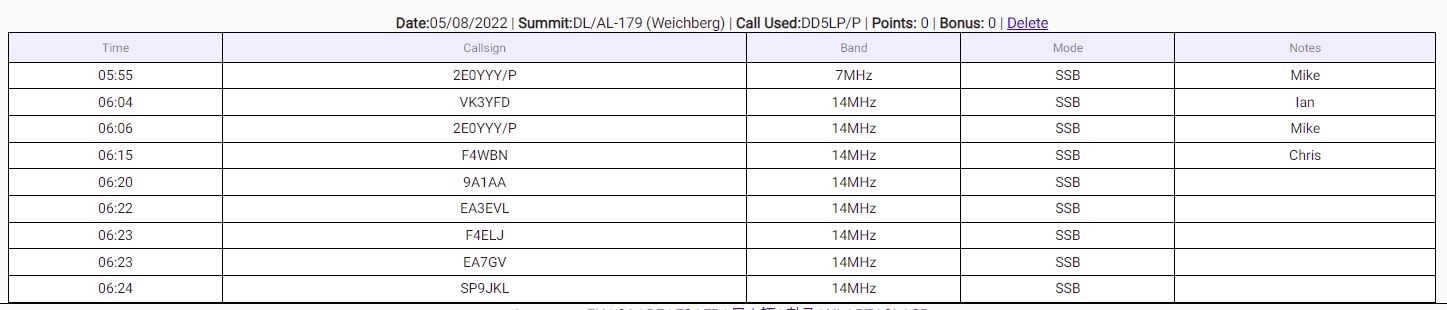
Both Mike and I arrived at our respective sites at around the same time just after 0530 UTC (or 7:30 am local time with me) and indeed the first and only 40m contact today would be a short contact with Mike, who was having difficulty hearing me. Ian in Victoria, Australia took a listen as well, but not surprisingly no contact on 40m. So we all agreed to head up to 20m and after changing the links on the antenna and finding a free frequency, Ian, VK3YFD was the first 20m contact this morning in my log. Ian puts a good signal into Europe thanks to his beam antenna. 

Mike joined Ian and me a couple of minutes later and we had a small net going. Ian was having issues with WSB on my relatively weak signal with him, but he made it work.

The next band up to test was 17m and when we all went there none of us could hear each other and indeed we could hear nothing on the band. The band was dead, so trying even higher on 15m would have been a waste of time, so we all agreed to head back to 20m, where I logged a few SOTA contacts before saying 73 to the guys, leaving Mike with the frequency.

So my next task was to test the updated smartphone App and although I was able to successfully send the spot via RF using FT&8 and it was picked up and displayed on SOTAWatch, I still had to tune the radio manually to the required 14074 kHz frequency for the transmission. So although the message sending worked, the new feature has not given me anything in addition to what I could do using VOX rather than CAT control and for CAT control I have to have a second cable between radio and phone.

I have reported back to the developer that the frequency change feature has not worked.

By 0700 UTC the skies were still dark and a cool wind had appeared. as I had finished the purpose of my activation, I decided to pack up and leave before any rain arrived (it didn’t, at least not until the afternoon).

Photos:

DL/AL-179 Weichberg

This slideshow requires JavaScript.

Equipment used:

  • Mountaintop travelling 40-litre rucksack.
  • Xiegu G90.
  • Komunica Power HF-Pro2-PLUS-T loaded vertical antenna. (not used)
  • Modified mini photo tripod with clip-on radials (not used)
  • Lamdahalbe 6m mini-mast.
  • Screw-in sun umbrella support.
  • SotaBeams linked dipole (modified).
  • SotaBeams random length end-fed antenna (not used)
  • 4 Ah Eremit LifePO4 battery.
  • 4000maH LiHV battery (not used).
  • Painter’s thick plastic sheet (not used).
  • Gardeners nealing pad (not used).
  • Lightweight headphones.
  • Smartphone for back channel comms with the group over “Signal”.

Logs:

DL/AL-177 Weichberg


Conclusions:

  • The FT8 Radio App appears to have an issue with the “set frequency” function.
  • Extending the coax on the Linked dipole made it easier to position the mast base than had been possible previously with just seven metres of the feeder. I now have almost 10 metres of coax on the antenna.
  • It appears that certainly on 40m and 20m that adding in the new 15m band link has not affected the antennas performance however the most likely band to be affected would be 17m I will need to test again, once 17 & 15-metre bands open up more often,

73 ’til the next summit(s).


DL20SOTA/P – May 5th 2022 – DL/AL-179 Weichberg & DL/AL-169 Auerberg.

Preparation:

As weather and radio conditions were OK and I had the opportunity to use the 20 years of SOTA special event callsign DL20SOTA again, I decided at relatively short notice to activate these two easy summits. I was looking for summits where if the weather turned bad, I knew them well and could safely get back down from them with the limited risk of injury. They also needed to be not too far away as I planned to get on the first summit at least in time for some 20m long path contacts into Australia and possibly New Zealand. It seems that now, in May, the greyline is coming across earlier and hence I would not be lucky enough to get 40m contacts “down under” but I did plan to try for some 17m contacts as well.

With a planned leave time from home of 7 am, the gear was packed in the car the night before and I also decided to take my new seat along for use on the second summit as the last time I was there, the benches had been removed. While this is a short walk from the car park the extra weight of the pop-out seat would not be a problem. 

The Activation

The trip down was uneventful and quick as this is a route that I know without the need for maps or GPS having been there many times (mind you, that didn’t stop me from missing one turn in the route between the two summits and having to turn back to find it).

Weichberg – DL/AL-179.

My plan was to work Ernie VK3DET, Ian VK3YFD and Mike 2E0YYY/P on 20 and possibly 17 and 40 metres before I started the “true” activation where I expected (and got) pile-ups from SOTA chasers wanting to talk to the special event station.

My equipment set-up did not start well. When putting up the antenna, running out both arms of the linked dipole (which also act as guys for the telescopic mast) one side broke off at the feed-point bracket. My belief is that this must have been bent backwards and forwards many times over the years and finally, it gave way.

While this was an unwanted problem, I did at least have 15 minutes or more in hand on my planned times. As you will see from the pictures I managed to jerry-rig a repair which thankfully worked for both activations. I had taken my Swiss Army penknife out from my bag just the day before as the wife wished to borrow it, so I had to revert to strip the wire covering off with my teeth. Thankfully everything went well and we were back in business. Had this not worked I also had my Komunica HF-PRO2 loaded whip antenna and tripod in my pack, however, I prefer to use the linked dipole when I have the option.

As I was a little early, Mike was still setting up as I worked Ian and Ernie on 20m. after those successful contacts I asked them to try 17m and while I could hear the guys in VK3, they could not hear me, so the band seemed not to be as good as it had been. By this time Mike had set up so we went back to 20m and then 40m, where I managed to work Mike but the others could not hear either of us on 40m. 

It was now getting close to my alerted time for the SOTA chasers, so I messaged the group via Signal and left them to complete their contacts while I went off and found a free frequency on 20m. Not a simple task as there are many stations these days on 20m in the morning. Many of whom were not around trying for contacts when conditions were more difficult over the last few years. Many of these stations need to go back and learn some manners as they start up without checking the frequency range that their wide signals cover is free for use. The end result is that the lower-powered stations like myself, have to change frequency often to be able to make contacts. Sometimes this frequency change can be combined with a band change to give different chasers a chance of a contact with the summit – and in these two activations with a contact with the special event call sign.

By the time I finished on weichberg, I had 39 contacts in the log mainly on 20 & 40m. 17m wasn’t working so well it seemed … but that was to change at the next summit.

Auerberg – DL/AL-169.

After packing up and returning to the car at the first summit, I set off for what should have been a 30 minute trip to the next summit (Auerberg). It actually took about 5 minutes longer as I missed one turn-off as mentioned before but I was still well within my time plan.

Because the last time I was here the benches behind the church (which is located exactly on the summit) had been removed, I took my new “telescopic chair” with me from the car. As I walked around the church, I saw there has been additional wooden benches installed at the side and as I turned the corner, also at the end of the church where I always set up. So the new chair was not needed after all.

On this summit, I did not try for any VK/ZL contacts as it was later in the morning and too late for long path, or so I thought. (I found out later that had I started on 20m rather than 40m from Auerberg I may have got a couple of VK contacts). In any case, on this 2-point summit, I wanted to get as many chaser contacts in the DL20SOTA/P log as possible. The surprise was three S2S (Summit-to-Summit) contacts including one with JW/LB1RH who is part of the DXpedition team to Svalbard way up in the Arctic Circle! That contact was even on 17m to surprise me even more. The other two S2S contacts only count as one as it was with Stavros SV2RUJ/P on a Greek summit – firstly on 17m and then on 20m. So 17 metres certainly seems like the band to look at to get away from the DQRM and general bad behaviour from some operators.

 I did get one request for a 60-metre contact and I only realised afterwards that I DID have the antenna extensions with me but while running the special event callsign and having the large pile-ups it was not the time to try out an untried antenna extension! That’s something to try when I’m “just” operating under my own callsign.

The totals from this second summit were 15 contacts on 40 metres, 4 on 17metres and 20 on 20 metres.

As I arrived home, the forecasted rain started but not as strong as had been predicted, at least not where I live. The heavy storms only arrived in the evening.

 Photos:

       DL/AL-179 Weichberg

This slideshow requires JavaScript.

     DL/AL-169 Auerberg

This slideshow requires JavaScript.

Equipment used:

  • Mountaintop travelling 40-litre rucksack.
  • Xiegu G90.
  • Lambdahalbe 6m mini-mast.
  • SotaBeams linked dipole.
  • 4000 maH LiHV battery (not used)
  • Komunica HF-PEO2-PLUS-T, tripod and radials (Not used). 
  • Battery box (2 x 5000maH hard-case 4S LIPOs).
  • Painters thick plastic sheet.
  • Lightweight headphones.
  • “Telescopic” seat (taken up to the second summit but not used).

Logs:

     DL/AL-179 Weichberg

     DL/AL-169 Auerberg

Contact maps from Sotamaps:

From Weichberg:

From Auerberg:

Conclusions:

  • The break in the linked dipole was a surprise from this, my most reliable antenna. It is now properly repaired and ready for a few more activations. At least my temporary fix held-up for both activations.
  • The Solar flares that arrived in the two days prior to these activations certainly had an effect on radio conditions but I was really happy to get the 17m S2S with the station on Svalbard – even more so when after getting home, I looked at where this island is! It is a lot further north than I had thought it was.
  • Overall the activation was a success with plenty of chasers getting a contact with DL20SOTA/P. The level of QRM on both 20m and 40m now, especially on a weekday, is becoming totally out of hand. Add to that incompetent or simply full-of-themselves operators and the WARC bands are becoming more and more attractive. I think I may try to use 60 metres next time out.

73 ’til the next summit.


DD5LP/P – January 22nd 2021 – DL/AL-179 Weichberg & DL/AL-169 Auerberg.

Preparation:

As the situation with a possible stronger COVID-19 lockdown has still not been clarified, I decided that I needed to get out and at least activate a couple of Summits in January. The weather, however, had other ideas, so between possibly travel restrictions coming in and bad weather I had been limited for the whole of January.

My preference would, of course, be a couple of higher height and higher scoring summits as these will again bring me more points as we are in a new year. Unfortunately, these summits need a ski lift for any practical activation and the ski-lifts are now closed because of COVID until at least February 14th (most likely until Easter). 

I decided that I would pick just two local easy summits that I could literally decide on the same day to go and activate. Weichberg and Auerberg fit this “half-day activation” model very well.

I always keep my equipment charged and packed ready to go. In fact, I now have one rucksack using the loaded vertical and tripod, battery box and rig in fact everything I need for an activation and a second rucksack with all possible optional additions such as an amplifier, Dipole antennas and even the VP2E antennas and a “short” 6-metre mast. Both packs go in the car but normally only the first one gets pulled out.

After several days of snow and ice an opportunity came up on Friday the 22nd of January and I took it before the expected new snow came in that night.

The Activations

Weichberg

The first summit (DL/AL-179 Weichberg), is one of my favourite summits, it’s not a long drive to get there and is not a busy summit. This time I only met a farmer who drove up a “no public access” track in his tractor, to replace a broken bulb in a spotlight that shines on the little chapel on this summit. Access for walkers is up from the car park just past the farm and before the “restricted road” sign using a track through the woods. I know this can be tricky in winter, so I added spikes to my hiking boots before setting off on the steep walk.

This summit has now got a second bench looking out over the valley, next to the information board and trig stone in addition to the wooden bench/table system that has been there next to the chapel for years and is where I always set-up. This is a larger summit and (in summer) is fine for setting up a larger antenna such as a mast with a wire dipole but in winter it has over two foot of snow on the chapel’s “lawn” so it was still a good idea to go with the simple and small, loaded dipole and photo-tripod option.

After setting up the antenna and radials I operated from the bench with my rig still in the bottom of my rucksack and just my “external control display” (an old smartphone) outside of the bag. I made 18 contacts in a fairly short time and when the calls that I could hear dried-up, I packed up ready to head to my next summit for the day.

Auerberg

The second summit (DL/AL-169 Auerberg) is another easy summit, where there is a car park almost at the summit and a shorter walk than at Weichberg, up to the church on the summit is all that is needed. This was steep and icy but several people had gone before me and kicked out steps in the snow and ice. (when there is no snow, there are proper steps in the ground).

At the rear of the church, there are two wooden benches which I used one of, setting up the tripod, radials and antenna just a little away from the Church walls.

The take-off from this summit would be great for a VHF activation with a good drop-off in all directions. It also seemed at the start to be a better summit than Weichberg with 59/59 reports being exchanged. After 10 minutes or so, signals seemed to drop off. I initially thought this could be band conditions varying but I now think more likely was a high powered station only a few kHz away that was de-sensing my receiver! On both summits, I heard the very loud (probably military) signal moving up and down the 40m band and when that comes, you have no choice but to wait until it passes your frequency. For a band where Amateur radio is supposed to be the primary user, this shouldn’t happen but the regulator isn’t going to argue with the military – most likely it wasn’t the German military rather an ex-eastern bloc EU member state’s military in any case!

I worked fewer chasers from this summit, despite it being a better location but once the chasers calling dried up, I decided to pack up as I was starting to get cold. I wondered whether I might fit in another “easy summit”, the problem was that the others are quite a drive away and I would have had to have started much earlier if I had wanted to include more summits. 

With snow forecast for the weekend, perhaps, just perhaps, there may be an opportunity to activate a group of 4 semi-local summits next week? 

 Photos:

   Weichberg:

This slideshow requires JavaScript.

   Auerberg:


This slideshow requires JavaScript.

Equipment used:

  • Mountaintop travelling 40-litre rucksack.
  • Xiegu X108G.
  • HAMA Photo Tripod.
  • Komunica Power HF-PRO2-PLUS-T loaded vertical.
  • Battery box (2 x 5000maH hard-case 4S LIPOs).
  • Painters thick plastic sheet.
  • Lightweight headphones.
  • Smartphone with PocketRxTx App and USB cable acting as an external display to the rig.

Logs:

DL/AL-179 Weichberg:

DL/AL-169 Auerberg:

Conclusions:

  • The grab-and-go approached after several planned activations having to be cancelled because of weather or possible travel restrictions. I did these two without any alerts as I was not sure all would go to plan.
  • Using the small tripod and Komunica Power HF-PRO-2_PLUS-T antenna is a very practical solution. With a set-up in 10 minutes from arriving on the summit being the “norm” putting up a mast and dipole in comparison can take up to 30 minutes depending upon the summit (and it’s more to carry).
  • The loaded vertical when compared to the dipole is an inferior antenna in some ways. If the critical frequency gets up to say 7MHz the vertical will not work as a good NVIS antenna but it’s a case of convenience versus performance. If I am going out trying for a VK/ZL contact for example I would take the linked dipole or even the VP2E, which take longer to put up but are better DX antennas. If I have to activate from a wooded summit, then again, it has to be a horizontal antenna.

73 ’til the next summit.

DD5LP/P – January 23rd 2020 – DL/AL-179 Weichberg & DL/AL-169 Auerberg – “Smash & Grab activations ??”.

Preparation:

Wanting to get out and grab some more winter bonus points while the roads are not blocked, I put together a plan to go and activate two “easy” summits. This activation pair got delayed a couple of days due to freezing fog, local to my home QTH but was eventually to go ahead on Thursday 23rd. January. I believe I have found where the RF is getting into the audio when I use my amplifier but I decided for this outing NOT to test out that solution nor to try out the VP2E antennas again (even though there is “just” enough room at Weichberg for the 40m VP2E). So back to the old, reliable linked dipole but I’ll take the surveyors tripod and the 10 metre mast as there is a lack of trees and fence posts in the right place at Weichberg to put up a mast in any other way.

I also decided to simply run the X108G rig at 20 watts rather than bothering with the amplifier on these activations. I would have it with me “just in case” the conditions turned so bad that I had to use it but as I didn’t expect any contacts in VK/ZL, it wasn’t needed for that reason and installing the cables to the amplifier needs more time on the summit in what would certainly be freezing temperatures.

When I indicated I would be going out, my mate in the UK, Mike 2E0YYY/P said he would also head to a SOTA summit and perhaps we would manage an S2S. As he had further to drive, if this happened at all, it would be from my second summit Auerberg. He would be staying later as well, waiting for the short-path window to VK to open – which I had decided I would not, given the worse propagation conditions compared to previous attempts where I failed to get a contact (or even hear any VK stations).

So the expected configuration on both Weichberg and Auerberg would be the X108G at 20 watts, surveyors tripod with 10 metre mast and the SOTABeams linked dipole. This (along with some spares) was loaded in the car on Wednesday afternoon, ready for an 8am (local) start on Thursday …

The Activation:

I woke to clear, if cold weather at the home QTH but this was not to stay that way, rather than it getting warmer and clearer as I drove up into the mountains, the fog got worse as did the roads.

Weichberg: The very last part of the road to my first summit, Weichberg was actually snow-covered. It was packed down, but not cleared so, as I don’t have a 4WD car or spiked tyres, I was a little careful on the last 500 metres or so.

Never mind, I was there now, or at least I was at the car park, there remained a 70 or so metres climb up through the woods to the actual summit with its chapel and holy cross.

After I got to the summit, I tried to kick the ice of the bench with some success but the painter’s plastic sheet went down to give me a dryish spot to sit. I set up the SOTABeams linked dipole on the 10 metre DX-Wire mast, supported by the surveyor’s tripod, with its spiked legs pushed down hard into the frozen ground under the snow. the coax just reached back to the wooden picnic table. As I connected up the radio and got out the logbook, I realised I was starting to feel really cold, especially in the hands. Operating the smartphone to send my self-spot was difficult, not this time because of cell-network, rather because of the temperature. It was still foggy but there was also a light ice-rain in the air blowing over the summit. this was an activation, I would keep as short as possible – as I had warned in my alert on SOTAWatch in any case. After working ten stations, it was time to pack-up and this is where the first equipment breakage occurred. after I lowered the mast (with some effort needed to get it to telescope back into itself), the plastic centrepiece of the Inverted-V antenna would not release from the mast. What had happened was that the ice-0rain blowing across the mast in the fog had frozen this piece to the mast. Remember I only had limited feeling in my fingers at this point and my attempts of trying to free the plastic feed-point piece from the mast resulted in it breaking in half. Well, I couldn’t do anything about that now, so I bundled up the antenna as it was into my rucksack and continued with packing the packs, tripod and radio gear so that I could get back to the car and some warmth. With everything packed and over my shoulders I started off down the hill and then remembered that I had not taken ANY photographs for this report, so I put down the mast, took out my smartphone and took a few “scenic shots” of the summit and the fog around it and then eventually headed down to the car with all the equipment. When I reached the car, I sat for a while to allow my hands to warm up again and wondered if I should go on to the second summit, or just head home. I decided to head on to Auerberg….  It was still very foggy some of the way and this on small country roads – never mind we arrived OK at the car park.

Auerberg: As the linked dipole had broken at Weichberg this meant on my second summit, Auerberg, I had to use my backup antenna, the Aerial-51 OCF dipole with it’s (relatively heavy) balun in the middle. After climbing to the top of Auerberg from its car park (somewhat easier than at Weichberg)- I went to the rear of the Church – my usual location to find that the two benches that has disappeared the last time I was there had been returned but were iced over, needing some more boot work and the plastic sheet. At this location, there are fence posts that can be used to support a mast and to tie the ends of the antenna off onto but as I had again brought the tripod up with me, I decided to put that up. At this point, I realised that the spikes on the legs of the tripod had mud frozen to them which I could not kick-off, so I tried to get the tripod to stand up through the snow and into the ground below. The result was not as stable as I would have liked. the tripod was standing one (not in) the ground under the snow. I carried on in any case and got the antenna up nicely and was on-the-air fairly quickly. I checked if the frequency (7.145 MHz) that I had been using at Weichberg, was still clear here at Auerberg. “Is the frequency in use” … “is the frequency in use?” – no response, so I self-spotted and off we went. I had call after call after call or rather call on top of call on top of call – a true pile-up. So it seems I was certainly getting out! I wonder if that frequency is really meant for WWFF operation as I got a few stations using “44” rather than “73” which is a sign of a WWFF (Parks) operator.

Mid pile-up, I got a surprise as the 10m DX-Wire mast collapsed down into itself. After the trouble I had to get it to come down on Weichberg, it seems (perhaps as ice inside slowly melted in the sunshine) it now wanted to come down without my help – the extra weight of the balun on the UL-404 antenna puts more weight on the mast than the linked dipole which may be part of the reason for the collapse as well. Never mind, got it back up and tried to get back the station who had been calling me when no doubt my signal strength dropped significantly with the mast!

All was running OK, except that I was getting cold again then after about another 10 minutes of contact after contact, the rig went off. What? Turned the rig off and on – nothing. Then looking into my battery box the problem was apparent. For my 13.8V supply from the 16.8V LIPO supply, I use a matrix of high current diodes. I have tried electronic “step-down” boards but they all create QRM across HF bands. the simple diode matrix uses the voltage drop across the diodes to reduce the voltage. The diodes are rated at more than enough current. they can get hot but won’t break. What I didn’t allow for however was that this heat transfers along the wires from the diodes and melts the solder connecting some of them together ! Running the X108G at 20 watts output for a really busy 30 minutes was too much and one diode simply de-soldered itself! That was the end of that activation! Strangely had I been running more power – 70 watts using my amplifier, this problem wouldn’t have occurred. Why? Well, the battery-box has two 5Ah LIPO batteries in it One feeds the diode matrix to give 13.8V output for the X108G. The other goes straight out to the amplifier which needs the 16.8V from the second 4S LIPO battery. When I run the amplifier the X108G rig only runs at 3 watts and the amplifier runs off the second 4S LIPO battery, so the current drawn for the power stages does not go via the diodes.

 I took this power failure as a sign to pack up. I was getting some great reports from there though – lots of 59 or 59+ and that was without using the amplifier! Just 20 watts. The battery at the end of the day still had at least 40% change in all of its 4 cells, so had that diode not de-soldered I could have continued and perhaps got an S2S contact with Mike but it was time to stop. Even in the occasional sunshine, I guess it was still under zero degrees and I was getting cold again.

After packing up the gear and heading back past the church, I realised that once again, I had been so busy that I had not taken any photos, so once I again I put down the tripod and mast and took some scenery shots, which are better than nothing but it would have been nice to have a picture of the station.

Photos:

This slideshow requires JavaScript.

Equipment:

  • Xiegu X108G.
  • DX-Wire 10m mast
  • Battery box (2 x 5000maH hard-case 4S LIPOs).
  • Surveyors tripod.
  • Aerial-51 OCF 40-10m dipole (Auerberg).
  • SOTABeams Band Hopper linked dipole (Weichberg).
  • Thick green plastic painters sheet.
  • Smartphone with PocketRxTx App and USB cable acting as an external display to the rig.

Logs:

DL/AL-179 Weichberg:

DL/AL-169 Auerberg:

Conclusions:

The weather was not as expected and on both summits, I stayed too long with the cold getting into my hands. The propagation was good compared to the previous few days with calls on Auerberg from all around Europe but no DX calls from outside of Europe. I’m rather proud of the 48 contacts in 30 minutes on Auerberg but there would have been more, had the DX-Wire mast not collapsed into itself about halfway through the activation and the battery box failing as the diodes over-heated. Perhaps with the cold, that was the best time to stop in any case? It would have been nice to have an S2S with Mike 2E0YYY/P in the UK but it wasn’t to be (I think had I stayed longer on Auerberg that may have happened).

I wonder if 7.145 is a WWFF frequency? I certainly got a lot of calls there and more than one ended with “73 & 44” – 44 is the usual WWFF code. In any case, I was glad to get a free frequency on 40m and the fact that I could use it on both summits was a real bonus!

Testing whether I have cured the RF Ingres and whether the external speech compressor works still needs to be done but while it remains so cold on the summits, I expect my next few activations will stay with the minimum and simplest set-up I can muster to keep activations short.

73 ’til the next summit!

DD5LP/P – October 8th 2019 – DL/AL-179 Weichberg – Tests before UK/EU – VK/JA/ZL S2S event.

Preparation:

With the S2S event coming up on the 19th and the fact that I have built an HF Amplifier that hasn’t been tested “in the field” I needed to do an activation where I could use all the gear I have planned for Attensberg on the 19th. Weichberg is a good location to test as it’s about a 50-minute drive from home, has just enough room to get the VP2E antenna out and it has a picnic bench and seats to work from. I had intended to do my test a week earlier however I caught the flu and the weather turned bad. The weather forecast for the 8th. was one of the better days in the week, with heavy rain expected from Wednesday onwards. As I was going to be using the gear intended for contacts into VK/ZL, I decided an early start to get me to Weichberg in time for the morning long path window would be a good idea and one of my mates in Australia – Ernie VK3DET agreed to be in the shack to see if he could hear me and give me a call.

All was not to go to plan …. But the purpose of this activation was to catch problems before the “big event”.

The Activation:

The trip down to Weichberg was uneventful even in the new car (a three-year-old Peugeot mini-SUV 2008 model – a bit underpowered compared to my last car but far more economical). Another question was answered as regards transport – the Surveyors tripod would fit in the back of the car along with the usual small rucksack and camera bag (which now holds the rig, the amplifier and the battery box).

The weather forecast was for dry but cold – and indeed it WAS cold! My quilted winter jacket put in good service but as many actions needed me to take off my gloves and by the end of the activation I could hardly feel my fingers. I guess it was never over 6 degrees on the summit and with the winds during the second half of the activation, I guess the wind-chill factor took temperatures down to near zero.

As mentioned above this was NOT an easy activation with several problems occurring causing me, most likely to miss the long path window due to the delays. Here is a list of the problems …

Problem 1 – while putting up the mast, I dropped and lost a large silver coloured washer – not essential but I didn’t want to leave litter on the summit – searched around for 15 minutes – it had disappeared! I found it when packing up, but why was it not visible earlier I have no idea!

Problem 2 – I was surprised to fund squeezing in the 40/20m VP2E antenna was a stretch and involved a bit of careful climbing down a slope to tie off one end of the antenna to a tree in the correct direction. This took longer than expected.

Problem 3 – Once I had connected all the gear up (made more complicated with the added amplifier and its control cable), it didn’t seem like I was getting nearly as much power out as I would expect. Suspecting the new amplifier I tried with the amplifier turned off (pass-thru mode) – even that was not showing a fifth of what I would expect on the power meter. I replaced both coax leads thinking that may be the issue – no change – then I decided to check the SWR on the antenna – it was bad, with way too much RF coming back down the antenna lead!  OK, something has failed in the antenna. should I put up the 20m/17m VP2E antenna instead? Probably not as 40m seemed to be the band of choice. So I took down the 40m/20m VP2E and packed it away and then put up “old faithful” the SOTABeam 40/30/20m linked dipole. As I was rushing, it managed to tie itself in knots but I got it up eventually.

Problem 4 – now checking the SOTABeams linked dipole, it also had a terrible SWR – why is that, is it the SWR bridge that is faulty? Then the penny dropped …. the coax cables on the back of the meter were reversed – so of course the reflected power was high and the forward low – as this was reversed!! I switched the cables around and things looked fine again. Of course, I now don’t know if the VP2E had a problem or not – probably not but I will need to check again. Having lost so much time, I decided not to switch back to the VP2E and rather just use the linked dipole – which was, of course, was set-up in the wrong direction for VK/ZL but even at the 9 metres that the middle now was, the Inverted-V on 40m has little or no directivity.

Problem 5 – in order to try to get the average output up, I had increased the compression on the built-in (audio) compressor to 3 from the usual 2 (it can be set from 0 to 10) and that was not sounding good to some contacts but while the button on the X108G for putting the value UP works fine, the one for DOWN did not (something else to fix). These are rubber buttons that have ferrite in them that short against printed circuit board contacts. I decided after trying several times, to leave it as it was – the winds had increased at this point and some clouds were heading my way, so I tried a couple more calls specifically looking for Ernie VK3DET without success and then started to pack-up.

Throughout the activation, it only ever took 2-3 minutes for QRM to appear next to (or on) the clear frequencies that I found – unfortunately that’s normal for 40 Metres SSB in Central Europe!

At least the day was so dull, that I could read the display on the rig and didn’t need to plug the Smart Phone in to see the frequency, power etc. It served its other roles as a camera and a spotting and email terminal.

Photos:

This slideshow requires JavaScript.

Equipment:

  • Xiegu X108G.
  • Battery box (2 x 5000maH hardcase LIPOs).
  • Linked (20m/40m) VP2E (Vertically polarised, 2 element, wire antenna).
    • SOTABeams Linked Inverted-V 40/30/20m dipole.
  • Surveyors tripod.
  • 10 metre DX-Wire fibreglass portable mast.
  • HF 70/100w PEP output power amplifier.

Log:

Conclusions:

This activation was not as successful as I had hoped. It would have been great to make a contact with Ernie in VK but with the delayed start I think I was simply too late. The PA doesn’t seem to be putting out as much power into the antenna as it did into the dummy load and the X108G’s standard microphone doesn’t seem to be very “punchy” I will consider trying a different one once I make up an adapter. The VP2E antenna will need to be re-tested to make sure it’s SWR is actually OK and it was only my cabling error on the SWR Bridge that was the problem. The button problem is solved as I have swapped the important DOWN adjustment button with a less used one. Longer-term I may look to replace these buttons with proper mini-buttons with normal contacts in them.

This was planned as an activation to find problems and that it did! I will need to make another outing (probably not to a summit this time), to check the antenna is, in fact, OK and possibly to try out the different microphone.

73 ’til the next Summit!