24th. June Miracle Whip antenna tests

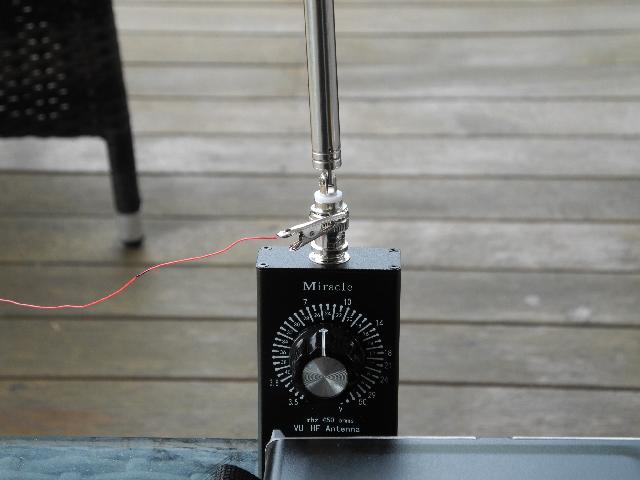
There has been a lot of comment recently on the SOTA Australia list about the effectiveness (or not) of the “miracle whip” antenna and its derivatives. Well I have a Chinese version of this design and have found the tuner component to be very effective when used to tune an End Fed Half Wave antennas against their counterpoises. The EFHW is a larger set-up than simply using the telescopic whip on the tuner. Having read that adding a counterpoise improves what is otherwise a “not so good” performance. I decided to to test out this statement. I was able to add a tab to the BNC plug that holds the whip, by using a solder tab ring that would normally sit behind a round BNC socket.

This done I used my antenna analyser to come up with a resonant length of the wire wrapping 30 AWG tin covered copper wire that I use. This length turned out to be  9 metres 87.5 centimetres. This provides a dip both on 40m (1/4 wavelength long) and 20m (1/2 wavelength long). The result on received signals was immediate – an increase in signal strength of 2 S-Points compared to the whip without a counterpoise. As yet I have not managed to make a contact, so the transmit side remains a question mark – maybe tomorrow.

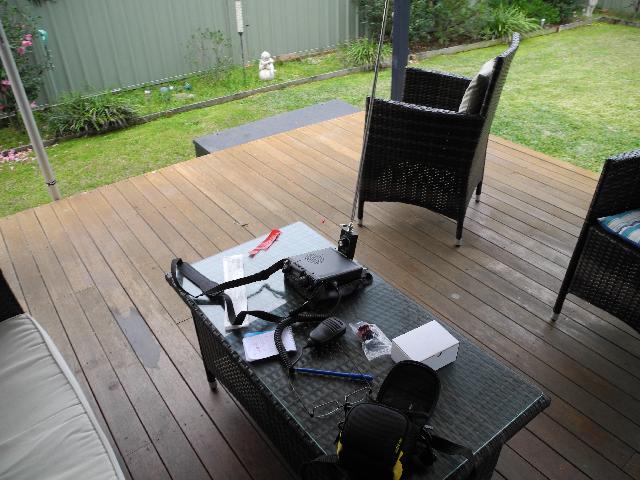
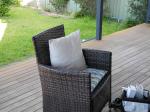
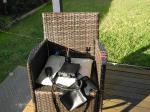
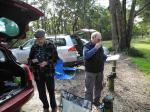
Here are some pictures of the (very simple) set-up on the back deck of my house.

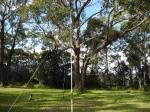
Overview of test set-up. FT817 running off internal batteries, Miracle Whip tuner, telescopic antenna and counterpoise going off into the garden.

Overview of test set-up. FT817 running off internal batteries, Miracle Whip tuner, telescopic antenna and counterpoise going off into the garden.

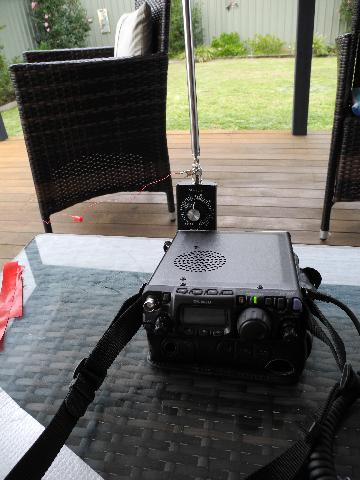
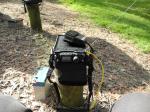
Operating position with ft817 sat on its bag and the Miracle whip connected.

Operating position with ft817 sat on its bag and the Miracle whip connected.

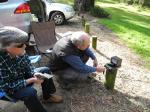
Close up of counterpoise connection to the whip.

Close up of counterpoise connection to the whip.

22nd. June – Further Antenna Tests at Mt. Elliot

Test twice – use once.

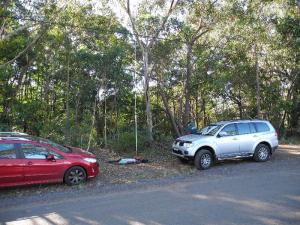
Following the work on the end-fed wires in the back garden, the time had come to try them out on a summit. So with Jim VK2LC, Col VK2ZCO, Rod VK2LAX and Graham VK2GRA, it was off to Mount Elliot again. As I have said before, this is a very easy summit to get to but will probably be the only SOTA classified summit within 2 hours driving time for those living in the southern part of the NSW Central Coast. It has the advantage of many options to support an antenna – trees and bushes abound as do wide open areas where squid pole based antennas such as my 40m horizontal loop antenna can be erected as I did on my last visit here. This time however I was looking for the most simple of set-ups for the end-fed and found it in a small area of grass and bushes where I simply laid the antenna out, touching the plants between 1 and 1.5m off the ground. Jim had brought a tripod based vertical antenna along and local reports gave it about a 1 S-point advantage  which given its extra height is not surprising. That antenna wont fit in a trouser pocket as my full set of HF band end-feds will though.

The highlight of the day was hearing and then working Andrew on 40m SSB who was operating as VI100ACT from VK1/AC-018. He was a good strong 5-9 signal and came straight back to my call of just 5W into the end-fed antenna from the FT-817.

The “lowlight” if we can call it that, was that the the rig started cutting out. At first I suspected the use of the rig on the 20m version of the end-fed had caused this perhaps because of a bad VSWR but it turned out simply to be that the battery had discharged. I had forgotten to charge it up since its last outing and to add insult to injury, the rechargeable AA cell battery pack that I had brought along as backup was no better. It later turned out that 4 of the new 8 NiMH cells were faulty and not holding charge.

I can hardly believe myself how well the end-fed laid simply on bushes works – for the ultra-light QRP portable station, this is definitely my recommendation when teamed-up with a very small and light antenna coupling unit – I use the one that is part of the Chinese version of the Miracle Whip that I bought.

Here are a few pictures illustrating the set-up at Mt Elliot.

A short video is up on YouTube at – http://youtu.be/crvdx5xn98U


Operating position - FT-817 antenna tuner and wire antenna on a fold-up chair.

Operating position – FT-817 antenna tuner and wire antenna on a fold-up chair.

Wire antenna leaving operating position over chair arm.

Wire antenna leaving operating position over chair arm.

Wire antenna simply drapes over fence and into bushes.

Wire antenna simply drapes over fence and into bushes.

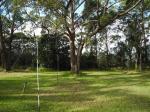
Antenna laying simply across the top of the grass.

Antenna laying simply across the top of the grass.

15th and 16th June – Antenna Tests

First failure, then success.

Following a disappointing first test of my end-fed 40m wire antenna up at a local high-spot on Saturday 15th. (I could hear all very well, but no one could hear me!) some re-thinking and investigations took place overnight. I found differing lengths specified for the driven and counterpoise elements on the antenna from different internet websites. My feeling was that the antenna was not resonant but the “miracle antenna” auto-transformer ACU was matching it to give a good VSWR to the rig but the antenna was not radiating well as would be the case if the length was wrong.

I measured off wires to the new lengths (19m driven element and 10.5m counterpoise) ready for testing on Sunday 16th.

I laid out the antenna simply over bushes in my back garden – about 1.5m above ground level. Testing first of all using a Rig Expert antenna analyser I had to extend the driven element another 3m before resonance came down to 7.1MHz.

I then attached the FT-817ND to the ACU and antenna and listened around – again receive working fine, but what about transmit? First I called a strong local station – Bill VK2XT and although I was a relatively weak signal, I managed a nice QSO with this great gentleman who has been licensed for over 80 years.  As I now knew I was getting out I was more confident and when I heard Ron VK3AFW/P up on VK3/VW-009 calling CQ SOTA – I thought “give it a try” and sure enough Ron came back and we exchanged 5-4 reports in both directions. Later I was also able to call and work Marshall VK3MRG/P on VK3/VN-027. It’s really amazing what can be worked running just 5W at each end and very simple antennas!

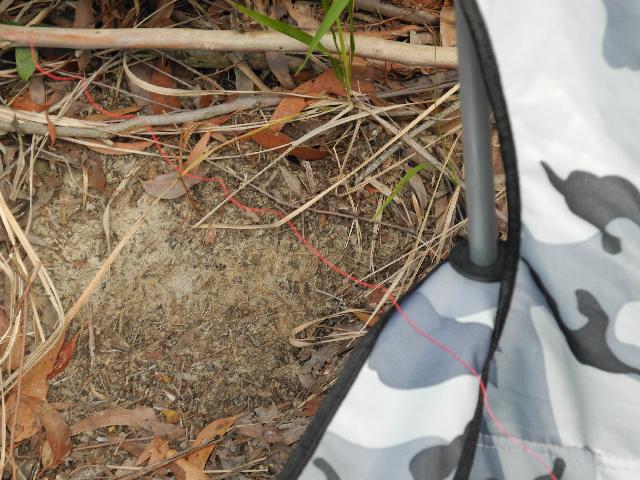
Here are a few photos of the very basic antenna set-up (click on the photos to see the larger format) – the thin red line you can (hopefully) just see in the pictures is the AWG24 wire wrapping wire (usually used to patch connections under printed circuit boards).

Monday June 10th. 2013 Mt Elliot – SOTA Antenna and Transceiver tests

Mt Elliot being the only likely future SOTA summit near Gosford, NSW and being a 5 star easy summit – Drive up, walk a little, lots of area to set up, toilets on site, electric BBQs on site, benches and cover, makes it an ideal test site for equipment to be used on more difficult peaks later.

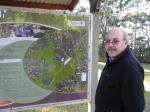
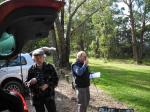
Here are some photos from the days activities – some pictures of the area, the views and then some radio work – those shown in the pictures are Rod VK2LAX the one looking at information board and in other shots, Dave VK2DLS in a few shots wearing the cap – a new convert to SOTA, he came up to see what it was all about after a conversation with me via the local 2m repeater on the way up and in the last shot myself operating the FT-817 and lightweight version of  a 40m horizontal loop antenna. Please note, although sat near the cars, no power was coming from them, in the spirit of SOTA the rigs are powered either by internal of SLAB batteries. (still waiting in connectors for my Lipo battery).

I am glad to report the tests of the 40m full wavelength loop antenna using lightweight 3m squid poles, mini-tripod supports, very thin, single core, “wire wrapping wire” and a Q-section of  RG-179 coax of the correct length (based on its velocity factor) worked very well indeed. Initially we used my FT-817 at 5W but for a couple of calls after lunch I decided to really test the antenna with 100W from Rod’s FT857 – all worked without issue. as a comparison the a buddy pole “seemed” about 1 S-point down on receive compared to the loop.

Thanks to the following activators for their contacts from this /P site – Wayne VK3WAM/P on VK3/VS-014 & VS-011, Peter VK3ZPF/P on VK3/VN-028, Rik VK3KAN/P on VK3/VE-001, Mark VK3PI on VK3/VC-034,  Paul VK5PAS/P on VK5/SW-011, Brian VK3MCD/P on VK3/VC-001 and Darren VK3FDJT/P on VK3/VN-016.

I have just received a Chinese copy of the “miracle whip” which I intend to test out next weekend also using its ATU with a 40m end-fed and counterpoise, again made with the ultra thin connection wire.

19th. May 2013 – “reccy” of two possible future VK2 SOTA summits.

Mount White & Mount Elliot.

Having done the work to classify the summits in the southern half of the Hunter region in VK2, Rod (VK2LAX) and I decided to go and check out the two closest to our home locations to see how easy access would be once (hopefully) they are accepted into the SOTA system.

SOTA – VK2 – Hunter Region.

Mount White.

The first area we planned to visit was Mt. White, which is part of the Central Coast of NSW just north of the Hawkesbury River. We aimed to get there in time for the multiple activations planned in VKs 1, 3 & 5 before and after the UTC clock change-over. Our intention was never to scale the actual peak, just to operate portable from somewhere in the area. Not having been to the area before we did not know what to expect and when we arrived and headed for the end of the highest road, we found there was nowhere to pull off the road to park and set up station. The fields, used in the most part for horse breeding and training in this , were fenced right up to the roadside or where there was some space it had be prepared like a front lawn by the owners of the adjacent property and certainly would object to us parking our cars on it and setting up a mast! So we headed for our second choice high road in the area only to find similar problems except on one verge were all seemed OK, there were high voltage power lines so low that our vertical antenna would be amongst them.  Luckily after parking, we realised this before we set up the antenna.  After more searching (and with time running out), we eventually found some space at the side of the road and set up quickly. There was still a cable overhead but just a telephone cable this time. Although it looks sunny in the photos there was a bitter wind and we had set up in the shade so the sun did not help to defrost the frozen fingers trying to operate – I must remember gloves next time!

Generally access to the actual summit looks like it will be only possible through negotiations with the local land owners, There does not appear to be any public right of way to the summit and if there were, there’s no where to park on the public roads.

MtWhite-1   MtWhite-3  MtWhite-2

After setting up we managed to work a great number of activators most,  both before and after the change over – so thanks to: Rik VK3KAN, Ian VK1DI, Marshall VK3MRG, Al VK1RX, Kevin VK3KAB, Glenn VK3YY, Paul VK5PAS for the chaser points!

Following verification of summit data, unfortunately it has been found that Mount White does not have the required prominence to qualify – so the issues to get access to the summit are no longer important.

Mount Elliot.

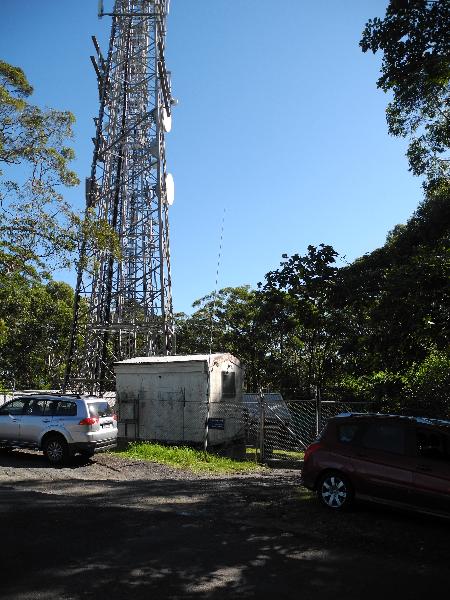
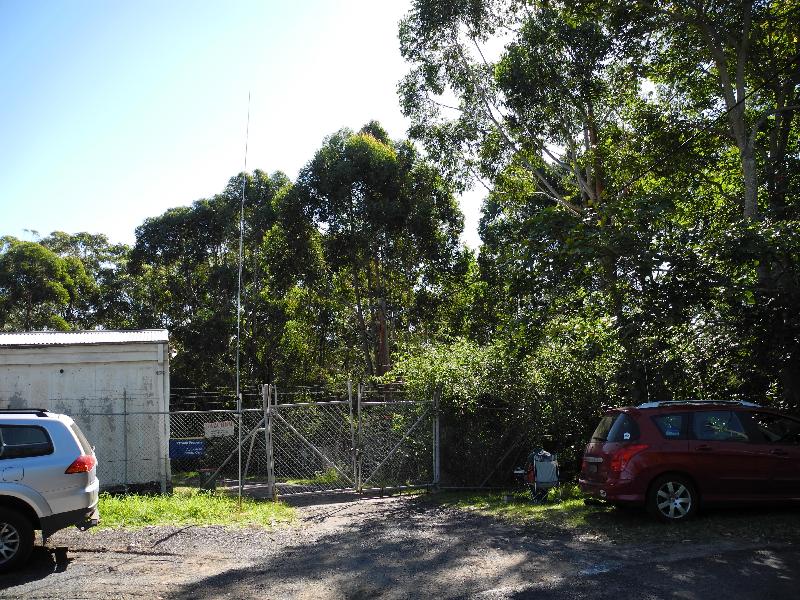
Mount Elliot, just north of Gosford is almost certainly one of the easiest summits anywhere to reach with a road right up to the summit. As you will see from the photos there is a communications station almost on the summit, that we parked outside of. I say almost on the summit, as the actual highest point is actually in the garden of the house across the road. The owner of that house came by while walking his dogs to ask us what we were doing and was very interested (he was duly left with a WIA brochure and contact card for our local (CCARC) club. I’m sure it would be an easy negotiation to park the cars in the car park down the hill and walk up the last 100m to the top, set up and operate in this residents front garden. There’s more here however. Down the road (a lot less than 25m drop in vertical height), there’s a small park with seats and an electric barbeque, where it should also be simple to set up a SOTA station. Activation in 5 star comfort!

MtElliot-2      MtElliot-1

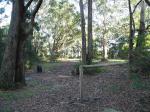
Although we heard several none-SOTA stations from this location, it was at the time when the activators in VK1 & VK3 were moving from their first to their second summit and we ran out of time because of other commitments to wait at this location for their return. The noise level here was also high, most likely from being so close to  the communications station, so the park a little way down the hill sounds like the best place to try – perhaps another Sunday.

Phegans Bay Heights.

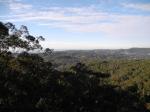
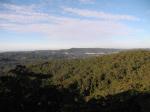
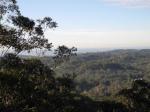
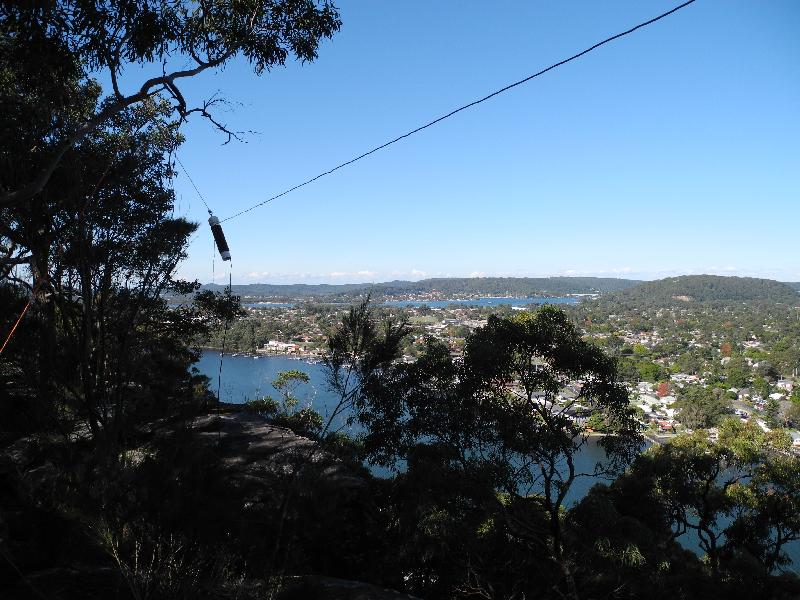
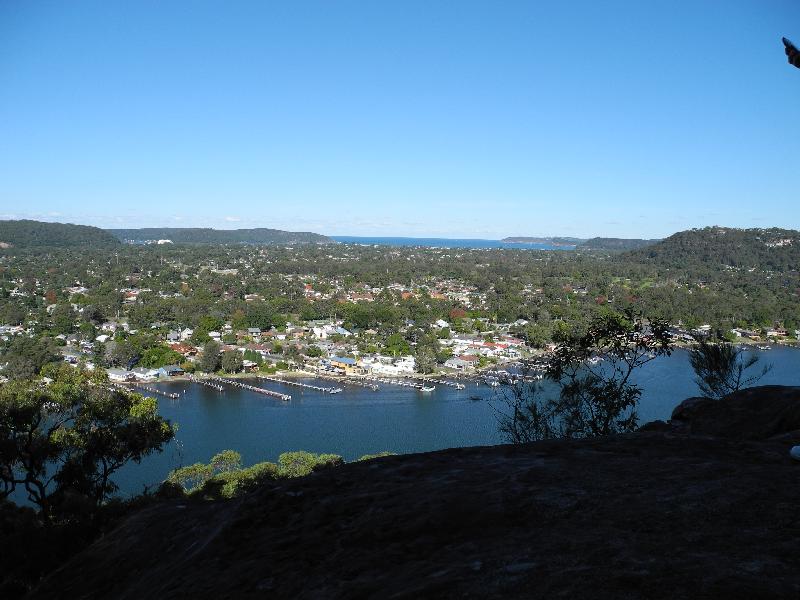
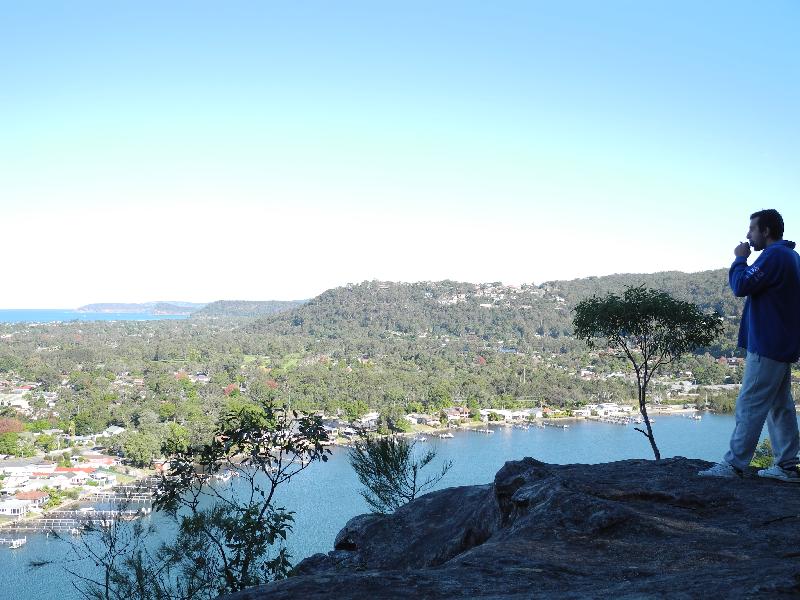
I stopped off on my way home at Pheagans Bay Heights where another local amateur, Doug VK2MDC was operating from with an FT-817 and a home made dipole, and was able to work Kevin VK3YY and Glenn VK3YY who had by this time moved from Mount. Stirling to Mount Buller through the snow and also Allen VK3HRA. This was not on a prospective SOTA summit but the set-up used by Doug is closer to what will normally be used and I’ve included a couple of photos here because of the fantastic view from up above Brisbane Waters and the Woy Woy Peninsula.

Phaegans-2  Phaegans-1  Phaegans-3