DD5LP – June 4th. 2015 – DL/AM-176 Rentschen

Preparation/Location/Activation:

This activation was planned to be of DL/AM-178 Ammerleite but when we approached, the single track road up to the summit was closed and full with tractors harvesting the field and this on a public holiday. Apparenly this road in now pemanently closed to motorised vehicles (so much for rights of way it seems). There may be an alternate access including  little more walking but as I had my wife and our dog with me for this activation, I decided it was better to experiment on my own, some other time.

So although I have already activated Rentschen, this year (I nearly got blown away from it back in  March this year) I decided it would have no issues with access and the flat area on it’s top would be fine for the dog to go for a walk on. (Rentschen is very much an easy summit).

The sumit is even signposted off the main ST2059 road! .

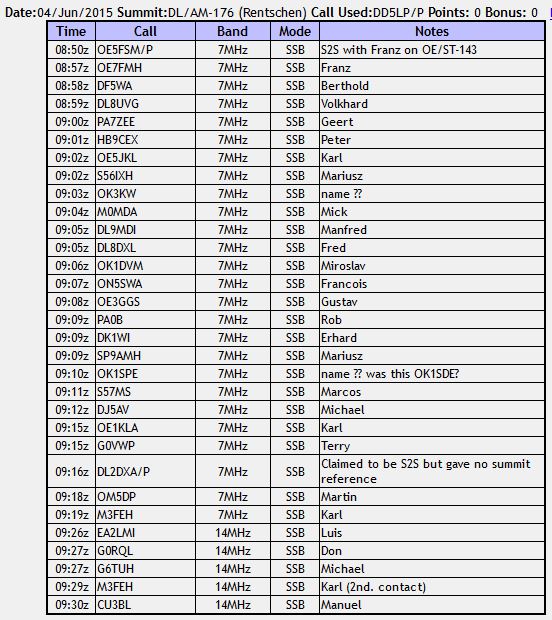
DL-AM-176 satelliteOn arrival the pile of logs that were useful as support for the mast last time had grown considerably and again provided an easy mast support with the ends of the OCF (Aerial-51) antenna pinned out into the field. Despite the cancellation of the planned summit, I managed to get on 10 minutes before my alerted time on the replacement one. After about 40 minutes operations I had made 31 contacts. Mostly on 40m SSB but with a few on 20m. Interestingly UK stations that I would normally hear on 40m only managed the skip on 20m this time. There were a few other activators alerted and spotted as on when I was active but apart from one S2S contact, I could not hear the other activators. So this activation brought no activation points (as I had already activated this summit) and only the chaser points from one S2S but it was a nice day out with the wife and dog. The first SOTA activation for B 0 N N Y.

Here are some photos from the activation –

DSCN2895 DSCN2896 DSCN2897

Equipment:

Yaesu FT817ND

Ramsey QRP amp (25w 40m, 15w 20m)

Aerial-51 404-UL asymmetric dipole

6m squid pole.

Log:

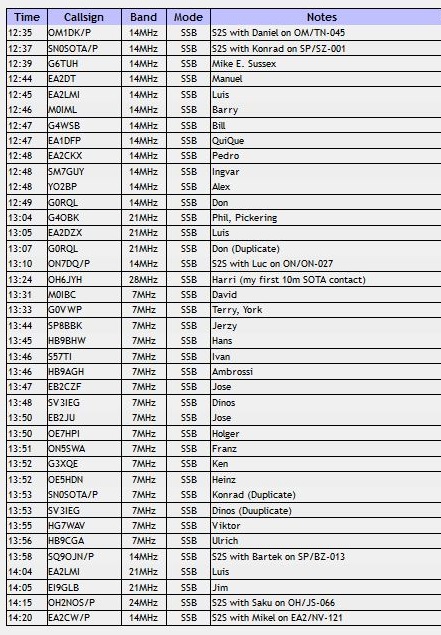
activator-log

Conclusions:

Don’t exepect sites to stay accessible, they can be closed off at any time – always have a reserve activation site.

73 ’til the next Summit!

DD5LP – May 17th. 2015 – Falkenstein and Zwolferkopf twice – DL/AL-167, DL/AL-166, OE/TI-670

Preparation:

I planned to activate a “border summit” (one that has two SOTA references in different associations) and one that should have been an easy summit, so that my wife and dog could accompany me. As it turned out this became a solo effort. I was determined to bag that border summit and start my entry into the 10 metre challenge by activating on 10m. I think in the end I really earned the few points these summit brought, as you will read below in my activation report.

I decided upon the usual FT817, 6 metre mast and Aerial-51 antenna (no amplifier used – but actually carried on this trip, but didn’t unpack it as the amp doesn’t cover 10m). I always recharge batteries and re-pack equipment after an activation, so everything was ready to go.

The Location:

The location of Falkenstein is quite close to Eisenberg, which I managed to activate after a couple of aborted attempts. On the map, it looks quite simple – turn off onto Konig Ludwig weg just before entering Pfronten. Well at the roundabout before the road to Pfronten, there was a clear sign to Falkenstein. Great! However that was the ONLY sign and the road I was looking for, although shown on the map as Konig Ludwig weg, has in fact another name. After driving past the road into Pfronten, expecting to find further signs (there were none), I back-tracked and took the road that I thought it MUST be. For others looking for this road, it goes into a suburb of Pfronten called Meilingen (and is signposted to there). If, like I, you end up in the middle of the village, simply keep taking roads that go up-hill and if you pass the “AlpenBad” you are heading in the right direction. When I came down from Falkenstein I managed to bypass the centre of the village completely.

The Activation:

I already knew that part of the way up the road to Falkenstein I would have to wait for traffic lights on the last, single track part of the road and pay €3 for the use of the private road. They have a strange set up where the road is open for cars going up the road for 45 minutes each hour and then it’s open for 15 minutes for cars coming down. They must assume that cars travel at three times the speed coming down as going up. Unfortunately I did not have the chance to try this theory out as the road was closed! The reason being one day a year (yes wasn’t I lucky, this was the day), the local ex-servicemen clubs hold a service at a memorial to fallen soldiers that is near the top of Falkenstein and there is only limited parking. So those attending the service were transported up and back down in a minibus belonging to the Red Cross. Kindly they offered me a lift up as well but as the last bus down would be at 12 noon, I would have to walk down (which turned out fine, walking up with all the radio gear, food and water would have been pretty hard).

OK, so when I arrived at the memorial, I had probably another 25 or so vertical metres to struggle up to the ruins of the Falkenstein castle. This is the highest ruined castle in Bavaria and had been bought with the intention of being rebuilt á la Neuschwanstein style by Konig Ludwig of Bavaria before his suspicious death. So it stayed a ruin and someone built a very posh and expensive hotel below it. On the day I was there the hotel had a Ferrari, a Mercedes, a Porsche and an Audi R8 parked in the car park.

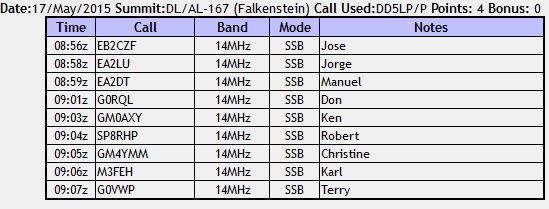
The weather forecast was for some showers, but luckily none came. At my first summit DL/AL-167 Falkenstein. I set up at the back of the ruins where I just managed to fit the inverted-V antenna in. I started on 10 metres, and found to my horror an S9 signal warbling all over the bottom half of the band. It sounded like an unstable signal generator with a large amplifier attached. It was not radar like. I was a real problem though. There was a couple of other activators who had spotted activations on 10m. I took a listen – no chance. I then moved up the band far enough to miss the worst of the interference and put out a call but then I had all kinds of problems with Radio Rucksack Tool complaining about errors in XLS files and shutting down. I found the problem later, it was that I did not have any Internet credit left on my phone and it seems the RRT reacts strangely when it can’t get Internet access. In any case, the self-spot on 10m did not help so, I decided to move to 20m where I managed a few contacts. I also took a look on 40m but there was some contest on meaning I could not find a free frequency. I made enough contacts to qualify the summit in any case. As time was pressing on and I could see the next summit in the distance at the top of a pretty craggy climb, I decided if I was going to manage my “border summit”, I would need to pack up and head off, With having to walk back down the mountain a ways and then climb up the other side, I estimated it would take me an hour – it took nearer to an hour and a quarter.

Again sign-posting did not help at all. There was no reference to Zwolferkopf or Einerkopf that comes before it, on any of the walking track signs, so I “plumpted” for the one that I hoped was correct. For future reference, the track starts at the Austrian border stone shown in my pictures below just off the road up to Falkenstein – about 2/3 of the way up from the start of the private, single track, traffic light controlled section.

It was certainly a long climb up to Zwolferkopf, but you certainly knew you were above everything else once you got to the top, where two seating banks are located alongside the track. The track doubles as the German and Austrian border marker.

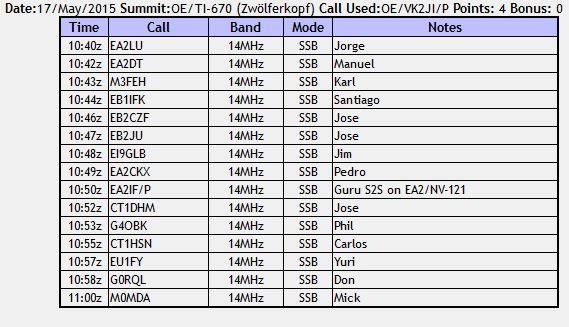
Once set-up I called first in Austria using my Australian call sign – OE/VK2JI/P (when I am outside of Germany, I dont have to use my German call, I can also use either my Australian or English call sign). This was Zwolferkopf defined in SOTA as OE/TI-670. Although 10m was again a wash out with the Interference, I made a good selection of contacts on 20m including a S2S with Guru EA2IF/P on EA2/NV-121. I think using the VK call helped somewhat in the number of chasers calling. After grabbing some lunch, I then activated as DD5LP/P from DL/AL-166 (still Zwolferkopf). This time the number of contacts were less, so I decided to try 40m and managed a few more contacts there.

As usually happens, once I had packed up a couple more activator spots came through that I might have been able to work, but with everything packed away ready for the climb back down the hill, I couldn’t unpack everything again. The walk down to the road went quite quickly but the walk from there down to the car park was some distance, leaving some blisters on my feet.

All in all an exhausting but successful day!

Photos:

1. Falkenstein

This slideshow requires JavaScript.

 2. Zwolferkopf:

This slideshow requires JavaScript.

Equipment:

Yaesu FT817ND,

Aerial-51 model 404-UL asymmetric dipole.

6 metre squid pole.

Logs:

Falkenstein DL/AL-167:

DL-AL167-log

Zwolferkopf OE/TI-670

OE-TI670-log

Zwolferkopf DL/AL-166

DL-AL166-log

Conclusions:

I have been unable to find what caused the horrible interference on 10m near Falkenstein and Zwolferkopf however I’m sure it is local and would suspect something within the hotel, a plasma TV possibly.

I really do need to cut down my equipment to one rucksack from the current rucksack plus camera bag and if I decide that I don’t need the amplifier, take it and it’s 2 5aH LIPO batteries out of my pack!

I’m not fit – I need to get out some more. It was a real achievement to get to the top of Zwolferkopf but I shouldn’t have been panting so much when I got there and there were  few points where I almost twisted my ankles. Definitely more exercise is called for!

73 ’til the next Summit!

DD5LP – March 29th. 2015 – Two Ammergauer summits in half a day – DL/AM-176 & 177

Preparation:

Originally planned to be three summits to catch the last possible weekend for 2015 SOTA winter bonus points (the period finishes om March 31st.). After the second being very difficult due to hurricane force winds, I cancelled the third summit which was to be DL/AM-178 Ammerleite.

Preparation was only planning the activations to fit into my very tight weekend schedule, that I now have as I have a full time job again. Equipment used was the usual FT817, Ramsey QAMP amplifier, the Aerial-51 antenna and the 6m mast – all of which had had their batteries recharged and the tangles taken out of the antenna wire following the previous activation, so I was all set to go.

The Location:

The locations had already been activated and report from those activvations can be found here:

DL/AM-176 Rentschen

DL/AM-177 Kernberg

The Activation:

Although the weather forecast was for some showers, the winds were the surprise. At my first summit DL/AM-176 Rentschen, although a little cold, it didn’t start windy but by the time I packed up the winds were extreme. The other problem for both of these activations, was that there was some contest on, on both 20 & 40m covering all of the band with S9+++ splatter. I had hoped to possibly get an S2S with Gerard VK2IO who was planning to be on Mt. Elliot (my old local summit) in NSW Australia. Whether we could have made a contact without all the QRM, I suspect not as the conditions were probably not good enough but by the contest stations destroying the band we will never know if we might have been able to make contact.


Despite the winds at Rentschen, I decided to try for the next summit, Kernberg, anyway in the hope that the winds might die down, When I arrived it was not too windy however it didn’t take long for them to build up. Blowing my ruck sack off the bench at one point (and it is quite heavy). I struggled to even get the required 4 contacts at this summit. After the third contact the squid pole decided to drop down from 6 metres to about 3 metres but I didn’t think it worth fighting my way to the mast to put it up again, given that it probably would come straight back down again. Hence that Swedish contest station that was my forth contact had to realky work to hear me (despite that he still gave the contest standard 5-9 report!). Along with the winds and the contest QRM, I also had major problems with Rucksack Radio Tool, the application on my phone that I use to spot myself with and see which other activators are out. By calling and giving a contest station a point, I eventually managed the required 4 contacts. I may have done better if I had connected up the Ramsey amp on Kirnberg as I had on Rentschen but that would have been more equipment out to be blown away, never to be seen again!

Photos:

This slideshow requires JavaScript.


It’s hard to tell from the short film however it was really windy on Kirnberg, so much so that if I did not fasten or hold everything down, it would have blown away!

Equipment:

Yaesu FT817ND,

Aerial-51 model 404-UL asymetric dipole.

6 metre squid pole.

Ramsey QAMP (only used on Rentschen).

Logs:

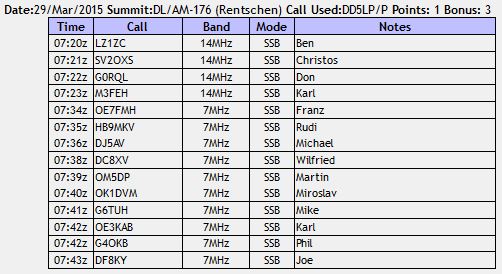
Rentschen_activator_logkirnberg_activator_log

Conclusions:

It is always best to air on the side of caution. There were times on Kirnberg when the winds were so strong that it was dangerous. Going on to Ammerleite would probably, at the least, ended up with some broken antenna equipment.

The use of the Ramsey Amp does help getting through, especially when there are contests on.

Never assume everything will work properly. After working perfectly for many activations, RRT kept aborting meaning I had to try up to 10 times before I could get a spot out as the program kept failing. I think this was due to lack on 3G signal, but the program shouldn’t abort for that reason.

,73 ’til the next Summit!

DD5LP – March 21st. 2015 – DL/AM-001 Pießenberg & DL/AL-179 Weichberg.

Preparation:

In the hope of bagging a couple of VK contacts and taking advantage of the fact that most of the snow had cleared, I planned these two activation of 1 point summits before the end of their winter bonus period. After the previous problems with activating Burndorfer Buchet a couple of weeks earlier (this is a simple, no winter bonus, summit) becuase of a fully iced over track, I was hoping not to meet similar conditions on Auerberg and Weichberg. These activations would have to be strictly time controlled as I had to be back home for an appointment at noon.

The Locations:

I have already activated these summits a couple of times. They are easy to access, with just the last section needing to be walked in. For fuller detail on the summits and access, please check my reports on this website from last years activations.

The Activation:

I’m glad to report no snow or ice related issues in getting to Peißenberg. The traffic was heavier than expected however I still arrived and set-up ahead of my planned activation time. I started on 20m hoping for long path into VK as I had managed from Peißenberg before, but no luck. Even other European summits that had been spotted, I could not hear. I spotted myself and started calling. It took a little while but I managed two contacts into Finland and Bulgaria with good signals in both directions. When I switched to 40m however, it was a completely different story. A “wall of noise” of chasers that went on for a solid 15 minutes, by which time, with my tight schedule, I had to pack up in any case to move on to Weichberg.

On arriving at Weichberg, the access track was a little muddy but apart from that no ice or snow problems. I tried to quickly set-up however I was joined by some inquisitive walkers, an 85 year old with his 80 year old wife, so once I had explained what Amateur Radio is about, I was getting to my planned activation time before I finally go on. Given my experience on Peißenberg, I decided to start on 40m and again ran straight into a pile up that lasted again 15 minutes. I then decided to try 20m quickly before packing up. Conditions on 20m were no better than earlier and I only managed 3 contacts on 20m this time.Marko from Finland again and two Spanish stations.

So it was only a matter of untangling the antenna after taking it down and packing up as quickly as I could with frozen fingers (yes it was still very cold on both of these summits) and then head home and out to my appointment, which I “just” made on time.

Photos:


This slideshow requires JavaScript.

Equipment:

Yaesu FT817ND,

Aerial-51 model 404-UL asymmetric dipole.

6 metre squid pole.

Ramsey QAMP, modified to cover 40m & 20m.

Green plastic sheet.

Logs:

Peißenberg

Peissenberg-log Weichberg.Weichberg-log

Conclusions:

Propagation is a fickle partner, especially a couple of days after a major CME has hit the earths atmosphere, one should always be prepared for more than one band. The Aerial-51 is fast becoming my “go to” antenna for SOTA operations replacing the SOTABeams linked dipole as it appears to perform just as well but it is a multi-band antenna that doesn’t need to be taken down to change bands. The Ramsey amplifier also now appears to be operating reliably, it’s a shame that it only gives me 15W output on 20m (25W on 40m is a nice level). This is probably due to the design running the transistors under their preffered voltage.

Try not to plan SOTA activations into a tight schedule. I was lucky this time, but it could have been that a delay on the summit could have caused me to be late for my appointment.

73 ’til the next Summit!

DD5LP – March 13th. 2015 – DL/AM-180 Berndorfer Buchet.

Preparation:

Andrew VK1NAM contacted me via email earlier in the week to ask if it would be possible for me to get out on Friday morning my time as he was looking for a second contact into the DL association to count towards his Mountain Hunter award (he already had one DL contact and just needed the second). I had already planned an activation on the Saturday from Peissenberg but gladly agreed to head out on Friday instead. As this had to be an early activation to catch the long path window I decided on my closest summit Berndorfer Buchet. I already knew the summit from activating it in 2014. Being only 30-40 minutes away from home this was the best option (or so I thought). Given the difficulty of access due to the remaining ice and snow, Peissenberg (with it’s winter bonus) would have been a better choice. Heinsight is a fine thing but I chose Berndorfer Buchet. I’ll need to try to “knock off” the easy summits with winter bonuses next week before the period ends, or leave them until December.

I decided to take the 10m squid pole this time instead of the 6m one, but apart from that the usual equipment was packed up ready to go the night before.

The Location:

Berndorfer Buchet is in the middle of a forest on a hill overlooking the village of Paehl, just south of lake Ammersee. Probably an hour’s drive from Munich but only just over 30 minutes from where I live. This is an easy summit and as such only gives 1 point even in winter.

The Activation:

There were a few surprises and not just the band conditions. AM-180 Berndorfer Buchet is a small hill, not very high when compared to the alps, because of this it doesn’t get a winter activator bonus. While most snow and ice has cleared around here (including on many of the lower summits that get the winter bonus points), it hadn’t from the approach (walking) track to AM-180. Luckily the last 30m vertical climb had cleared of snow otherwise I may not have got to the summit at all.

What looks like snow in the pictures below, is snow with a layer of ice on top of it and where the forestry vehicles had been, it’s solid ice and very slippery! Although sunny, I doubt the temperature got over 0 degrees even in the sunshine, while I was there.

As soon as I had set up, I saw a spot for Andrew and could hear him about S2 or S3 and tried calling for 20mins but I was swamped by the stronger chasers. I then spotted myself on 20m and qualified the summit with a bunch of the usual chasers.When I returned to Andrew’s frequency I couldn’t hear Andrew any more. The 20m band was not as good as it has been. I then saw an OE portable station spotted and went to see if I could get an S2S but due to the proximity (skip distance), I couldn’t hear him at all. Still hopeful of catching Andrew I went back to his frequency and thankfully, conditions were back and the wall of chasers calling had gone down in number and we managed the contact!

After this I decided to go onto 40m and give a call. It was crazy – lots of callers most at S9+. 40m was really “popping”.

Just as I was about to pack-up with bitterly cold fingers, I saw a spot on 20m for Mike (2E0YYY) and Dave (G4ASA) so called them and had an easy contact to complete the activation.

Photos:


This slideshow requires JavaScript.

Equipment:

Yaesu FT817ND,

Aerial-51 model 404-UL asymmetric dipole.

10 metre squid pole.

Ramsey QAMP, modified to cover 40m & 20m.

Green plastic sheet.

Log:

activator-log

Conclusions:

Just beacuse most of the area is cleared of snow, do not assume that the summit you want to activate is! I raved in the last activation report about the clip-on spikes for my boots and how valuable they are. I needed themon this activation but left them at home!

73 ’til the next Summit!

DD5LP – February 26th. 2015 – DL/AL-169 Auerberg.

Preparation:

Having not activated for over a month, the urge was great and as this was an especially nice, sunny (if still cold) day, I decided to reactivate a favourite summit – Auerberg. Actual preparation was simple for this summit; check the route, decide which antenna and mast I’ll use (and put the others in the car just in case). Take a sheet of plastic to cover the likely wet wooden seat outside the church and then set-off with my two “go bags”.

The Location:

Since moving last year this summit is now only about 40 minutes away from where I live rather than the hour plus previously. It is a really beautiful spot with the classic church dominating the summit and a restaurant walking distance down the hill from it. Unfortunately this restaurant and hotel is closed until the 3rd. of March as normally at this time of year they don’t get many visitors. Their busy time is spring through autumn when it is a favourite hang-out for bikers cruising the Allgau area that it sits in. I’d love to ride a motorbike up there, the long curved winding road is ideal for motorbikes. If someone wants to make a “SOTA holiday” this would be an ideal spot to stay.

The Activation:

I arrived at Auerberg almost an hour before my planned start time and despite the sub-zero temperatures when not in the sun, manged to quickly put up the mast and antenna (the aerial-51 asymmetrical dipole this time) and set myself up on the same seat that I used last year. This time however I needed to crack some ice off it and put the plastic sheet I had brought with me, on it. As it was still icy underfoot, I decided to add my clip on spikes to my boots, which was a very good idea in these conditions.

I intended to start on 20m with the hope of some late long path into VK, but it was too late. Then I saw that Hans PA3PYG was active on DM/BW-159 on 40m as DL/PA3PYG/P so I went over to 40m and after a couple of calls managed an S2S. I then went onto 20m and the contacts came thick and fast. When they dried up I went back to 40m and again got a lot more contacts there. QRM was not nearly as bad on these bands as I have experienced in the past and the Ramsey amp, seemed to give that little extra “punch” with reports being most 5-9 both ways. Once the flood on 40m ran out, I decided to try some other bands and got one contact on 15m with Jack OH3GZ (thanks Jack) but I could not raise one contact on 10m. On 15 & 10m I was only running 5W as my amplifier wont work that high but I also could not hear anything much on these bands so I guess the conditions were simply not there. I then had a final session back on 20m, picking up a couple of the regulars that I had missed before and then packed up, happy with the mornings efforts.

Photos:

This slideshow requires JavaScript.

Equipment:

Yaesu FT817ND,

Aerial-51 model 404-UL asymmetric dipole.

6 metre squid pole.

Ramsey QAMP, modified to cover 40m & 20m (not used on 15m or 10m).

Green plastic sheet.

Clip on spikes for boots.

Log:

activation-log

Conclusions:

A very successful activation, however towards the end when the equipment had got really cold, the RF VOX switching in the Ramsey amplifier started “chattering”. I will need to increase the capacitance across the relay coil to stop this happening while not keeping the Tx on too long under normal temperatures.

73 ’til the next Summit!

DD5LP – January 14th. 2015 – DM/BW-078 Römerstein & DM/BW-484 Bussen.

Preparation:

I had intended to use my new 40/20/17/15/12/10m linked Inverted-V dipole for these activations, but adjustments over the previous 2-3 weeks (between snow storms and high winds) had proved annoying in that once one problem was solved another came up and the antenna simply wasn’t ‘Idiot-Proof” enough for use on a summit yet. Maybe next time.

My 6m squid pole’s base seal has broken, I have repaired it, but to be safe I decided to take the (albeit heavier) 10m DX-Wire mini-mast that I bought at Freidrichshafen in 2014 and along with that as I needed to cover 10 & 15m, the Aerial-51 OCF dipole.

I also packed the RHM8B vertical and it’s tripod in the car, just in case access to either summit turned out a lot harder than expected or if there was no where to put up the Inverted-V. This antenna actually stayed in the car and was not needed.

Apart from those changes, the planned equipment was the usual Yaesu FT-817ND running off the internally installed 2500maH LIPO battery, with a spare LIPO along just for backup. Although I also packed my small amp and cables, as this only works on 40,30,20m it wasn’t used and stayed packed in the bag. All contacts were made on 5W output with the DF4ZS RF Speech clipper in the microphone boosting the signal a little.

Navigation: For my activations unless I know the summit I usually write out a route based on the route google maps produces, but simplified to just the important points. The google printout is too detailed and this makes it unlclear to read when driving alone to a summit. I do have a GPS navigator program in my smart phone but I don’t trust it. It can ask me to go down roads that are not public access and generally doesn’t find the shortest route. I prefer to take the google maps produced list and check it against the map to understand the route. I made three navigation lists. One from home to Römerstein, one from Römerstein to Bussen and the third from Bussen, back home. All are printed in large text so that they are easy to read when driving.

The Locations:

The locations were DM/BW-078 Römerstein and DM/BW-484 Bussen. Both of these summits are about 1hr. 40mins drive from my home QTH. As they are in the same general (North West) direction, rather than making two separate trips, I decided to combine the two summits.

I also wanted to try to get a second W4V contact to qualify W4V as an association (and also North America as a continent) for my Mountain Hunter Platinum Award. In the meantime, I managed two contacts into the Canary Islands, which gave me Africa as my third continent but I still wanted the NA continent. Eric W4EON again offered to go out to a summit for me to try a S2S contact. It appears the best bands currently for an EU to NA contact is 15 or 10m from about 1400 to 1600 UTC, so the plan was set. I would call Eric at 14:30 on 15m and then we’d both move to the activation for other chasers by spotting ourselves at 15:00 UTC. As you will read below, the best laid plans don’t always go well….

The Activation:

Römerstein is easy access with just over a 1Km walk from the car park on the main road. Despite several rain storms that I drove through on the way, when I arrived it was not raining. The track from the car park was very muddy from the previous nights rain so some care was needed but I still got up the track OK. At about 700m the track joins the forestry road to take you to the top of the summit with it’s tower, hut and picnicing area.

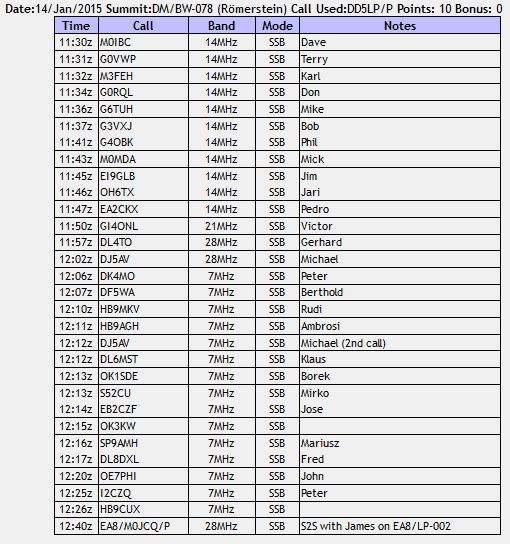
I set up by the open fireplace and was quickly operational. No RF noise and strong signals but when the sun was not out, it got very cold, very quickly. I was glad of my thermo gloves which allowed me to operate and log without any issues. I managed 30 contacts from Römerstein the final one being a summit to summit contact with James M0JCQ on the Canary Islands – La Palma summit EA8/LP-002.

Although my abreviated notes got me simply and without any issues to the first summit (Römerstein) I got lost on the way from my first summit to my second. Either I missed a turn or Google got it wrong. In any case I found my self in a village that I didn’t recognise the name of and the road signs to the next towns & villages didn’t ring any bells either. At this point it appears from checking later that I had travelled only about 8Km after missing a turn Without paper maps of the area I set up my Navi (yes it was my fallback).

  The “navi” eventually appeared to be taking me in some logical direction and indeed I did eventually arrive at Bussen but coming into it from the totally opposite direction than I would expect (i.e. from the South rather than the North where the previous summit was) but the time taken in setting up the GPS (yes it was my fallback), the time to return to where I should have turned off and the extra time the navigator took in asking me twice to do a U-Turn on the same road(!), plus the fact that it then took me a longer way to the destination probably lost me at least 40 minutes.
End result, by the time I had climbed to the summit it was almost 1500 UTC and by the time I had set up it was 1505. Thankfully the climb from the cemetry car park to the summit is short (if rather steep) up a roadway. Almost as soon as I reached the summit, the ice-rain started. As I was now probably too late for my sked with Eric in the US, I decided to activate as quickly as possible to qualify the summit and get back out of the wet and cold into my car. Having problems with the rain on the Smart phone screen meant I couldn’t type easily to put my spots up, which was ultra-annoying! I did manage 10 contacts to qualify the Bussen summit. I will not be driving to summits in the area of these two summits again, without a paper map of the area. The roads are terrible and the road signs worse.

Bussen was a difficult activation with the wind and ice-rain and at the time when I decided I would pack up my equipment, the antenna came down on it’s own, tangling the dipole wires in the tree branches, so it took a while to get everything packed up. The drive home in the wind, rain, dark, spray from the road and glare from headlights, was not a pleasant experience either. That’s the trouble with a late afternoon activation some distance from home at this time of year I guess. As mentioned above, the reason for the late afternoon activation was that I had arranged a sked for an S2S contact into the US but unfortuantely I missed it by about 15 miutes with all the delays in getting to Bussen.

Photos:

Römerstein:

This slideshow requires JavaScript.

Bussen:

This slideshow requires JavaScript.

Equipment:

Yaesu FT817ND,

Aerial-51 model 404-UL asymetric dipole.

10 metre DX-Wire Mini-mast squid pole.

Logs:

DM/BW-078 Römerstein:

Activator_logDM/BW-484 Bussen:

Activator_log

Conclusions:

Do not rely on a route written out from Google Maps and then miss a turn. Do not rely on a GPS Navi to take the shortest / quickest route when GPS reception is affected by stormy weather. Do not do late afternoon activations a relatively long distance from home at this time of year.

73 ’til the next Summit!

DD5LP – December 14th. 2014 – Four Ammergauer summits in half a day – DL/AM-176,177,178 & AM-001

Preparation:

After re-activating Weichberg about 10 days earlier, when I could not get access to Eisenberg, I realised that even though I did not get the points for the summit, I did get the bonus points for activating while in the winter period. Weichberg was successful in bagging my first summit contact into the US with Eric W4EON in the W4V association. Eric has been kind enough to try to put on activations at his end when I have been able to get out to a summit here (we have had no success with me chasing from home – I simply cannot hear the US stations over the local RF noise with my not-ideal antenna on the bands where the contacts can be successful. So I have been trying to set up a second contact with Eric on a different W4V summit, so that I can get my required 3rd. continent for platinum level in the Maountain Hunter award. The forth of these summits (DL/AM-001 Peissenberg) was the one where I could be at, for the arranged time to try for the contact. The first three summits were three that are easy to activate and I could build into the loop route to pick-up the winter bonus points from all four summits by re-activating them.

I have done some work with my Diamond RHM-8B vertical mounted on a photo tripod and the antenna analyser gave me a good report for its use in this fashion, on 40, 30 and 20m – all with an SWR of 1.3:1 or better. So my plan was to take advantage of the quick set-up and take down of this antenna and bag 4+ contacts on each of the first three summits and then concentrate on setting things up on the forth summit for the trans-atlantic attempt.

The Location:

The locations were:

DL/AM-176 Rentschen

DL/AM-177 Kernberg

DL/AM-178 Ammerleite

and

DL/AM-001 Peissenberg and 2nd activation.

By clicking on the names above, you can find information about all of these summits from my earlier activation(s) of them.

The Activation:

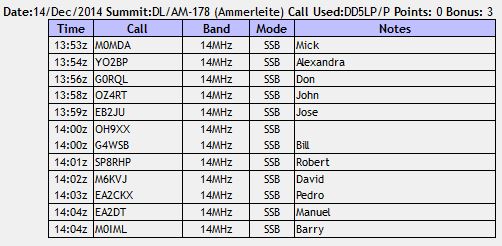
Although I managed all four summits DL/AM-176 Rentschen, DL/AM-177 Kirnberg, DL/AM-178 Ammerleite and DL/AM-001 Peissenberg, it was not without some “Challenges”…….

I had hoped to keep the first three very easy and fast just operating on 40m with the vertical on a tripod. It was not to be. I found out at my first summit (Rentschen), that there was an Italian SSB contest on 40m – so there were NO free frequencies and any that seemed like a free frequency were splattered across by the over modulated 3KW+ station 5 KHz away! So I decided to switch to 20m on the vertical only to find the SWR on 20m was horrible (it had been 1.3:1 when I tested it on the antenna analyser two days previously). So I had to unpack the mast and linked dipole, which I had luckily with me as a backup. All of this added to the time on the first summit meaning I lost the time that I thought I had spare as I had set off 30 minutes earlier than planned from home.

At the next summit, Kernberg, I managed to bog my car while parking before even getting to the summit. Luckily the summit is next to a farm and the farmer (a real Bavarian gentleman) pulled me out with his tractor. So summit number two ran over my time scheduled.

By the time I got to my third summit, Ammerleite, time was still slipping away and on this summit apart from the fibreglass pole repeatedly coming down when I was trying to put the OCF dipole up everything went OK. Once I finished and packed up however I was very short on time to get to summit number four, Peissenberg.

When I arrived I found that a large piece of the forest where I used to fasten one end of the dipole into, had been cut down. There were also far more people at this (easy to get to) summit that I have seen here before. I found an alternate anchorage point for the dipole and then set-up fairly smoothly however the extra people around, several wanting to know what I was doing, also took some time out of the schedule. Some how I managed to get on air just 5 minutes late. Unfortunately conditions on 10m and 15m were not as good as they have been and the 10m ARRL contest did not make things easier. Although I managed a contact into Virginia, it was not with Eric W4EON/P on his summit, rather Arno W4AKO who was able to hear Eric and me but I could not hear Eric and he could not hear me. Perhaps next time ….

All in all a trying day of SOTA activations but enjoyable as well.

Some chasers worked hard to work me on as many of the summits as possible, Manuel EA2BT (one of the few calls where I rember the name) and Mick M0MDA both managed to contact me on all but the first summit, where the QRM on 40m was horrible from the Italian contest, Carolyn G6WRW had a remarkable signal from her mobile and contacted me on two of the summits as did Don G0RQL, Robert SP8RHP, Bill G4WSB and Leonel CU3EJ. It’s really nice to have contacts with the same chasers from multiple summits. It’s also nice to hear the regular chasers each time I go out. It really makes one feel part of the SOTA “family”.

Photos:

This slideshow requires JavaScript.

Equipment:

Yaesu FT817ND,

Diamond RHM-8B loaded vertical, SOTABeams linked dipole & Aerial-51 model 404-UL asymetric dipole.

6 metre squid pole.

Logs:

am-176_log am-177_log am-178_log am-001_log

Conclusions:

Do NOT assume the ground is solid when parking a car and then when bogged, do not try to get out yourself (it only makes it worse).

Try to avoid weekends when contests are on – mid week activations have a better chance of long distance contacts especially when only running 5W of SSB.

73 ’til the next Summit!

DD5LP – Eisenberg DL/AL-171 Activation XMAS Day 25th. December 2014.

Preparation:

 This SOTA summit has the ruins of two castles (Eisenberg & Hohenfreyberg). Access is from a track from the village of Eisenberg or a track from the Schlossbergalm, a nice old fashioned Bavarian mountain restaurant located at exactly 1000m ASL. Service is quick and freindly and prices are very reasonable for such a tourist spot. The climb up the remaining 105m is steep in places but the track is well maintained as this is a tourist magnet for the local area.

Access to the Schlossbergalm restaurant is up a single track road (Bergweg), that many walkers use – they park at the bottom ot half way up the road and then walk to the top. If like I, you drive to the restaurant, there is parking there for about 25 cars.

I did a reccie of the site in November 2014 and activated on Chridstmas Day after two failed attempts – the first thwarted by freezing fog where I had to turn back after only getting about 10 km from home and the second where I had to turn back half way up the mountain as road repairs were being done and the road was closed.

The weather on the reccis was sunny with temperatures between 10 and 18 degrees, whereas the activation took place between snow and rain storms with the wind chill factor taking temperatures under zero degrees.

Rad access is from the next village of Zell. Go past the Burghotel Bären on Dorf Strasse and then 2nd. right into Burgweg, at the junction in the field take the road on the left.

The road is in a reasonable condition but has a metal gate on it, that may be closed if the road is blocked by snow.

The summit itself is under the Eisenberg castle ruins. The ruins have two wooden platforms as lookout points. The first, before entry to the main ruin is relatively small but has a wooden bench. The second platform at the other end of the castle ruins has a very large area (one child described it as a dance floor and he was not too far wrong from the size!). This second platform has no seats.

Checking with my small SW receiver, there appears to be some electrical noise on 20m on the first platform (possibly from the cell phone antenna mounted on it) 40m seems OK. The second platform has less RF interference on 20m & 40m.

Cell phone coverage gives full signal on both Telekom and Vodaphone networks.

Time to walk from car to summit (without equipment) – 15 minutes, 20 minutes with equipment. Return (mostly down hill) walk to the restaurant and car park takes 10 minutes.

The Location:

eisenberg-mapSince the staff at the restaurant were so friendly and helpful – here’s a small advert for them – if you decide to acctivate this summit a stop at the restaurant is well worth while, and not just because you are using their car park and road.

Schlossbergalm

The Activation – Aborted twice, successful once:

As this is a relatively easy summit, with just a 15-20m slog up the last 100 vertical meters from the car park of a mountain restaurant up prepared tracks, I wanted to activate this summit for the VKSOTA on November 15th. I didn’t get 10 kilometres from home before I decided to turn back because of freezing fog.

On Thursday 4th. December 2014 I intended activating Eisenberg for an S2S with Eric W4EON on a summit in Virginia. This seems to be an unlucky summit for me as when I had driven over an hour to the base of the summit and part of the way up, the road was closed. A farmer was putting in road markers for when the snow comes and he told me that further up the road it was damaged and being repaired and all this work had started on the very day that I wanted to activate the summit. He told me there was another access track – the other side of the village of Zell, which lies under Eisenberg but when I got there, the forestry commission were cutting down trees and it was at least a 1/2 to 3/4 hour walk to the castle ruins on the summit where I wanted to set-up.

I therefore decided rather than letting Eric down I would go to another summit that I activated earlier in the year (Weichberg DL/AL-179) and had driven past on the way to Eisenberg. I got back there and setup just in time for my sked with Eric (I have added a short update on this second activation of Weichberg, with some pictures of the site oprerating in the clouds in the existing report on this blog).
When I set off on Christmas day to head for Eisenberg, the weather forecast was for mixed weather and mixed it was! On the journey there, I had heavy rain and high winds. I thought more than once about calling off the activation. The return journey was similar except for the addition of a snow storm around the village of Seeg.

Luckily upon arrival at the Schlossalm restaurant car park, the weather was “OK”. A little drizzle but nothing else, so I decided to haed up to the ruins straight away rather than first having lunch at the restaurant as I had planned. This was a good decision. After the 15-20 mins slog up the last 105 vertical metres, it was obvious than winds were going to be a problem and the rain was getting heavier. As I did not have any external protection from the waether in the form of a small tent or bothy bag, I looked to see if I could finf some protection within the ruins and indeed found two small rooms that had sort of a roof over them (actually a third, currently closed viewing platform). So as quickly as I could, I set up the SOTA Hopper antenna on my 6m smini-quid-pole, at a reduced height so that the coax would reach into the semi-protected room. The positioning of the antenna meant that the wires were both not as high off the ground as one would like and one leg was close to the ruins wall, touching it in places.

Despite this limited antenna, I checked 40m and could hear several (non-SOTA) stations, so looked on one of the common SOTA frequencies – 7.118 MHz, which was free, so I put out a CQ call at the same time as sending a spot from my smart phone, with already freezing fingers. It’s allright having gloves with me but I cannot operate the the phone or rig with them on and setting up the antenna needed some dexterity as well. End result, by the end of the activation, almost unable to feel my fingers!

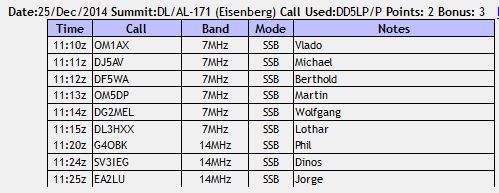
I managed six contacts on 40m before switching to 20m to hopefully have Phil G4OBK hear me. He had tried calling me on 40m but I was just too waek with him. Well 20m worked fine (perhaps as the 20m part of the antenna was not touching the castle walls) and I worked Phil and two others on 20m. By this time the winds were howling around the castle and the rain had become heavier and changed to being ice-rain, so I decided to call it a day (there were no other callers and no others summit activators active at the time). The pull-down took about a third of the time of the put-up actions and I was on my way back down to the restaurant to thaw out and enjoy a hearty goulash soup along with a Glühwein to get some heat back into the body.

 As mentioned above, the drive home saw a snow storm and further heavy rain and winds. I was glad I had set off back as soon as I had and suspect that I would not have been able to activate this summit in the following days as snow was now forecast for the next three days.

Slide Show.

1- Reccie:

This slideshow requires JavaScript.

2. Activation:


This slideshow requires JavaScript.

Equipment:

Yaesu FT817ND,

SOTABeams Bandhopper linked dipole.

6 metre squid pole (at about 3.7m high).

Log:
Activator-log

Conclusions:

Winter activations need the use of warm clothing – but how to manage the equipment with thick gloves remains a problem.

Even with a limited antenna set-up, it is still possible to activate a summit.

Consider a bothy bag or similar for future activations.

73 ’til the next Summit!
DD5LP – October 11th. 2014 – DL/AM-060 Laber

Preparation:

As we approach the change of clocks in Europe, getting to a summit and activating early enough to catch the EU_VK long path window is going to become more difficult, so with this activation, I hoped to perhaps make a short path contact to a VK chaser and/or a US chaser or activator in the late afternoon. The weather forecast was for dry, sunny weather up to 26 degrees centigrade.

As I found out on the last activation, my Ramsey QRP amplifier that I use to boost the FT817’s signal had decided to stop working, so once I decided on Wednesday to activate Laber on Saturday, I used what spare time I had to take apart, fault find and repair the amp. Once repaired, I also ran tests and found a healthy 15W output on 20m and 25W on 40m.

Also for this activation, I wanted to try 15m as this should give the best chance of a contact into the US at the time I planned to be on the summit. This meant, I would be taking the Aerial-51 404-UL antenna rather than the SOTABeams linked dipole as my model of the linked dipole only has links for 20,30,40 and 80m operation.  The Aerial-51 antenna is heavier than the SOTABeams due to its balun however with my modification it sits nicely on top of either my 6metre or 10metre squid pole. I planned to take the 10m  high one this time, but later decided on the lighter 6m pole. The advantage of the Aerial-51 antenna is that I can change bands without having to lower the antenna remove or connect a link and raise it again.

By Friday all was set for Saturday, so everything was laid out ready to be packed into the car for the about 1.25 hour drive down to Oberammergau (where the Laberbergbahn starts) the next day.

The Location:

Laber is one on the mountains looking down onto the town of Oberammergau.

Oberammergau is famous for its “Passion Play” which has been run every 10 years since 1634 when it was put on as an offering to God to rescue the town from the plague.

In 1632 the pestilence, a plague, had infested Oberammergau and by 1633 nearly every family had come to experience death. People, brought down with the pestilence, vowed to perform every ten years at the towns cemetery, a Passion play depiction of the suffering and dying of Christ if there would be no more deaths by the pestilence.

© Passionsspiele Oberammergau

On Pentecost 1634 the population of Oberammergau performed for the first time the “Play of suffering, dying and revival of our lord Jesus Christ”: on a stage which has been built at the pestilence cemetery, over the graves of those who had dies of the plague.

Access to the Laber summit is either via one of two walking tracks taking around 3 hours from the town or using the oldest cable car system in Germany which takes about 15 minutes from the valley to the mountain station with the journey stopping half way up. This halt is needed to unload or load people at the base or mountain station. There are 4 cars on the system, each of which can hold up to 12 people. They are not large but are standing room only with just one small box to sit on in them.

On arriving at the summit station, it’s only a short walk down the (very steep) track to get to the edge of the AZ, however the best location to set up is to use one of the benches on the actual summit, next to the cable car station and restaurant.

The Activation:

The weather on Saturday was not at all like what had been predicted. It was foggy and cool and on the drive down rain showers started. As part of this trip we were to visit the Weis Church and look around Oberammergau, so hopefully the weather would clear up in the afternoon. It didn’t and by the time we got to the valley station of the cable car, the mountain didn’t look very inviting at all. Cold, misty and light rain. The webcam monitor in the cable car station showed the weather on the mountain as even worse than in the valley. We asked the lift operator if he thought it would pass and he said it was set in for the day (according to the Internet).

After some consideration, we (my wife and I) decided to risk it and hope that the wether would improve – which it did a little for about an hour of the 2 hours that we were on the mountain.

 It was damp more than wet most of the time. Visibility varied from being just 20m to being able to see Oberammergau in the valley. Certainly not the views we expected but I got to work 37 stations over about 100 minutes. To my surprise I worked some on 10, 12 & 15m as well as the usual 20 & 40m. The Aerial-51 antenna is not designed to work on 12m without an ACU, but it worked well enough for one contact and that was an S2S into Finland!

I managed six S2S contacts around Europe – actually a duplicate S2S (the 7th) when the other station called me again when I changed bands. There were some contests running which made finding a free frequency difficult and the habit of contest stations not to check whether a frequency is free before starting to call CQ is annoying to say the least. 40m had an S8 noise level from the microwave antennas and equipment about 50m away, so all of the (many) contacts I had on 40m were strong to overcome the local RF noise.

Slide Show.


This slideshow requires JavaScript.

Equipment:

Yaesu FT817ND,

Aerial-51 model 404-UL asymetric dipole.

Ramsey QAMP amplifier.

6 metre squid pole.

Log:

Activation_log

Conclusions:

16:30 local (currently 14:30 UTC) is too early for contacts into the US or Australia. Once the clocks move back an hour at the end of this month, it may be worth trying again as 16:30 local becomes 15:30 UTC, however a new test would probably need to be from a hill that does not need a cable car to access it as many of the cable cars will be out of service in November while they get their annual inspections, upgrades and approvals before the skiing season starts in December. Being on a walk-up hill would also give the possibility of staying later, which could be an advantage for contacts to the US, but later in the day will make it past midnight for even those VK stations in Western Australia, so I wouuldn’t expect any contacts from VK.

Contests, and contest stations can be a pain. Apart from them taking up most of the band, their signals being too wide (or overpowering the receiver), there attitude of just calling on a frequency without checking it first and even if they do check, ignoring anything other than an S9 reply is a PITH!

I need to look again at how I can reduce the equipment that I take with me. For a winter activation – possibly involving skiing-in to a site, I need a minimum set of gear and a simple to install and remove antenna that does not obstruct other people – so most likely a vertical anntenna with radials for each band. Some more thought is required around this.

73 ’til the next Summit!