G8GLM/P – UK visit Feb 2016. Tees to Wash region. G/TW-005 Normanby Top and G/TW-001 Urra Moor.

Preparation

As I didn’t manage to activate G/TW-001, the last time I was in the UK in November, I wanted to complete it in this visit. At the same time G/TW-003 isn’t that far away and so might also be possible. As I have already activated G/TW-002 and G/TW-004, I would just then have G/TW-005 to completely activate all summits in G/TW, so perhaps I might be able to fit that one into the plans as well.

The original plan was to activate G/TW-001 & 3 on the weekend of the 20/21 Feb, but as you’ll read later, the weather forecasts said this wasn’t going to be a good idea so some rescheduling around other plans was needed.

Now what about equipment? Well as I was flying from Germany to the UK both weight and size were considerations. The Qamp and its Lipo batteries were not packed, so these will be qrp (5w) activations. What about the antenna? On my last visit to the UK I brought my tripod mounted diamond RHM-8B loaded hf vertical and it did not work well! I found the problem a couple of weeks later, the counterpoise needed to be kept off the ground. I still didn’t have confidence in the vertical over the dipole however, so I packed the 5m fibreglass telescopic pole and the spiderbeam dipole as well as the vertical.

The Locations:

The G/TW-001, 2 and 3 summits are relatively close to each other in North Yorkshire. G/TW-004 is further south in East Yorkshire and G/TW-005 is still further south in Lincolnshire. Luckily my planned trip has two bases, one in East Yorkshire and one in North Yorkshire.

Having already activated G/TW-004 and G/TW-002 on previous trips, I wanted to try to activate G/TW-005 Normanby Top, G/TW-001 Urra Moor and possibly G/TW-003 Guisborough Moor.

The Activations:

While my UK visit was split into two parts, activation of Normanby Top G/TW-005 would need to take place in the first half when I was still based in Hull. It was decided to try to beat the forecast bad weather and activate on Wednesday morning (17th. Feb.). The trip down, over the Humber Bridge and past the airfield where I had arrived a couple of days earlier, was uneventful except that it started to rain.

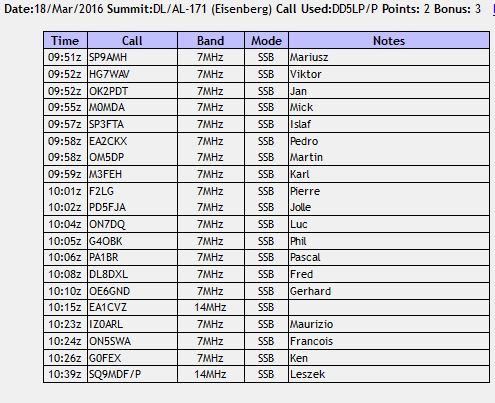
We, my brother Jim G8DCD and myself, were not going to be able to outrun the weatherfront and indeed when we arrived on site (I wont call this a summit as it’s a large plateau), the rain had changed to driving sleet. As it looked unlikely to stop any time soon, we sought out a position far enough past the radio towers to hopefully avoid any interference and I quickly set up a very basic station. I was not even able to put down my usual painters sheet as the high winds blew it away so all operation was performed standing with the FT-817 hung around my neck with the coax running off to the dipole on the usual 5m squid pole. I decided 40m was probably going to give the quickest activation, however despite this being mid-week there was hardly a free frequency on the band, I found one slot at 7.180 MHz so I started calling cq sota, while fumbling with, now frozen, fingers to send out a spot.

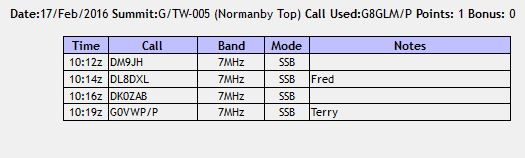
Luckily it seems I was putting a reasonable signal into North Germany and quickly bagged two contacts. Fred, DL8DXL from South Germany was the next in the log with my report only being a 3-3, so it seems propagation was not great for longer distances. The final (4th.) entry into a now very wet log, was Terry G0VWP who was mobile in the York area. With everything now wet and/or frozen, I decided to pull the plug and take down and pack everything away while my hands could still feel anything!

So what I had expected to be an easy activation, turned out, thanks to the weather, not to be easy at all!

The other activation(s) were at first planned for Saturday 20th. February, then moved to Sunday the 21st. followed by Tuesday the 23rd. and finally back to Monday 22nd. because of the constantly changing weather forecasts – all of which usually turned out to be inaccurate!

Given the uncertainty of the weather and other factors, the North Yorkshire activations were curtailed to only one – G/TW-001 Urra Moor (Round Hill). Gisborough Moor will have to wait for another visit, to complete activation of all of the Tees to Wash region SOTA summits.

As mentioned earlier the activation of TW-001 was aborted last year, due to lack of time. For this activation at least the route to Clay Bank car park was known and the drive there was uneventful. Upon arriving it only took a couple of minutes to throw on the rucksack with all radio equipment in it, and we were off, heading back down the road to where the Cleveland Way crosses the road where we take the track to the left going up the hill (note there are other tracks that start near this car park – make sure you get the one signposted as the Cleveland Way. If you are not on a path made of stones, you are on the wrong path). The path climbs steeply and when you reach the top of the first climb you are still a long way from the destination. There follows a long section over relatively flat moorland with grouse and sheep on it and then you start another climb up to the highest point in the North Yorkshire Moors – all the way you follow the main path, the Cleveland Way. The journey up took almost exactly an hour with the return journey only being about 5 minutes less.

The trig point itself is about 2-3 metres higher than surrounding land on what appears to be an artificial mound. There is no obvious way to support at mast directly at the trig point, so I set up using the convenient (and sturdy) signpost at hunters crossing, running the two ends of the dipole off and down the ground in clear spots in the brush, so avoiding impacting the path for other walkers.

Once on the moorland, while it was not raining, there was a bitterly cold wind. I would say it was probably 2-3 degrees but with windchill it was definitely at or below zero degrees. Indeed on the way up parts of the track were iced over and there was some patches of snow still on the ground. This again was to be an activation where I would look to make the needed contacts, plus anyone waiting and then pack up. In fact I started off with a non-SOTA contact with John in Norfolk simply as he was putting such a strong signal into Urra Moor. Sometimes it’s nice to have a “normal” contact before spotting and as my brother said he was getting no cell phone signal, I might have had to seek out “normal”  contacts to make up the needed four. While my brother was right, that Vodafone had no coverage, BT had a healthy signal (this is exactly why I have a dual-SIM phone) and I was able to self spot and the contacts came sreadily in. I did try an S2S contact but it seems my 5w was too weak to be heard by the other activator, despite other chasers telling the activator to listen for the S2S.

After about 40 minutes on the summit, it was time to pack up and head back down the hill, into the car and off for a late lunch at a cafe we know. By the evening, we were glad that we hadn’t tried to fit Guisborough Moor in as well, it would have been too much in the weather. It can be a nice activation for later in the year when the sun is shining!

Photos:

G/TW-005 Normanby Top.

This slideshow requires JavaScript.

G/TW-001 Urra Moor (Round Hill).

This slideshow requires JavaScript.

Equipment:

Yaesu FT817ND.

Spiderbeam Aerial-51 UL-404 off centre fed dipole.

5 metre squid pole.

Logs:

G/TW-005 Normanby Top.

Activator LogG/TW-001 Urra Moor (Round Hill).

Activator LogConclusions:

Weather forecasts are becoming less and less reliable. Do not plan on weather predictions without being able to change plans constantly when (not if) they change!

73 ’til the next Summit!

DD5LP/P – February 5th. 2016 – 5 Summits in a day.

Preparation:

The 10m/6m challenge finishes on February 13th. 2016 and I wanted to pack in some more 10m summit activations before it ended. Without travelling to a different country (e.g. Austria), an activation on 6m is not possible as portable 6m operation is illegal in Germany. I have already tried going to two Austrian summits and was unable to get even one 6m contact on either of them, so I decided to look at any local summits where I have not been able to get a 10m contact from during either of the two halves of the challenge.

I activated DL/AM-001 Peissenberg on January 26th, again with no 10m contacts, so I wanted to try that summit again – it is also one of the closest and easiest summits for me to get to. As propagation on 10 metres was absolutely horrible, I alerted the local amateurs to my activation plans in the hope that I could at least manage one ground wave / line of sight contact on 10m.

The other local summits that I had not activated on 10m in the challenge period so far, were DL/AM-178 Ammerleite (tried in December again without success), DL/AM-177 Kirnberg, DL/AL-169 Auerberg and DL/AL-179 Weichberg. Making five summits in all – with the drives between these summits and the walking times from where I will be parking my car, this will take a complete day.

With mixed weather, there was the real possibility that one or more of the summits may not be accessible. In this case I would try to activate it/them the following week.

As some of the summits required a fair walk, I took the small radio kit, but also packed the larger kit in the car in case I decided I needed it.

The Locations:

Peissenberg – DL/AM-001

About 45 minutes from home and a logical first summit for the loop of activations. This summit I last activated on January 26th 2016, and hence would not gain any activator or activator bonus points, but perhaps a 10m contact.

Ammerleite – DL/AM-178

About 30 minutes drive from Peissenberg but then with a 20 minute climb to the summit.This summit I last activated on December 31st 2015 and  hence would be able to gain both activator and winter bonus points along with another 10m summit point if all went well.

Kirnberg – DL/AM-177

About 20 minutes drive from Böbing where I park the car for Ammerleite. I have not activated this summit this year so as well as the hoped for 10m multiplier point in the challenge, I should be able to get the summit activator point as well as the 3 winter bonus points.

Auerberg DL/AL-169

The trip over into the Allgäu region takes a while from Kirnberg, around 45-50 minutes. Like Kirnberg as I have not activated this summit this year as well as the hoped for 10m multiplier point in the challenge, I should be able to get two summit activator points as well as the 3 winter bonus points.

Weichberg DL/AL-179.

Just up the road from Auerberg, this is the shortest drive between the summits about 15-20 minutes and again I have not activated this summit this year so as well as the hoped for 10m multiplier point in the challenge, I should be able to get the one summit activator point as well as the 3 winter bonus points if all goes well.

So there’s the plan – 5 summits, all of which I have activated before and hence know the best approach to each of them. A possibility of earning 5 10m challenge summit multiplier points, 5 activator points and 12 winter bonus points.

The Activation:

The planned day was on and then off a couple of times as the weather forecast kept changing. Friday the 5th. of February I set off expecting some rain showers but nothing much and that the snow would have gone from most of the summits. This turned out not to be true. The rain never came, but the snow was still there at all summits making access to Ammerleite, Kirnberg and Weichberg particularly difficult when climbing through snow drifts and sliding on wet, slushy ground.

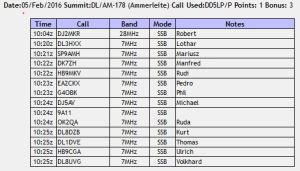
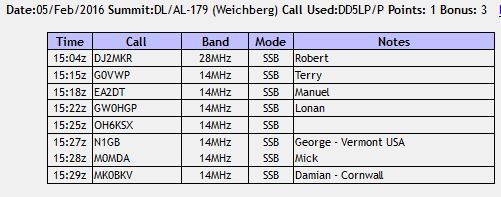
Peissenberg, the first summit turned out to be horribly cold and after getting just one contact with Robert DJ2MKR (a local station to me here) on 10m using the loaded vertical on a tripod, I packed up while I still had some feeling in my fingers. If the weather was to stay as cold as this, it was going to be a difficult day! I also was not happy with the SWR from the vertical and so decided to use the usual 5m fibreglass pole and Spiderbeams OCF antenna on all following summits, even taking the 40m/20m amplifier and its batteries with me as well (but never using it).

The next summit was Ammerleite or rather Schnalz as the actual summit is called. I used the longer (official) access route following the closure of the road to the easier access point last year. After parking I picked up the two bags that contain the larger radio configuration and set off up the track. This is quite a steep ascent up a forestry track which in parts was like a river and in other parts very slippery. The final approach to the summit is across two fields which were still partly covered by snow drifts, making the ascent “interesting” as I was certainly the first person up this “track” since the snow had fallen. Once on the summit, setting up took a little longer than normal, this time not because of the cold but rather because of high winds. In any case once set-up, I was able again to get a contact with Robert on 10 metres (but with no one else). I then changed to the zoo that is 40m and made another 13 contacts before packing up. Although the short activation at Peissenberg had put me ahead of schedule the extra ascent time through the snow to Ammerleite had lost that time and I knew I would have to take the descent slower than I would like, so I was concerned not to lose any more time.

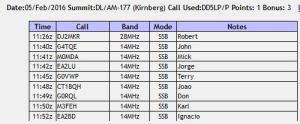
Once I was back at the car and had warmed up a little, I checked my route to Kirnberg and set off, eating a sandwich en-route. The distance from the parking spot to the summit at Kirnberg is not far but again, it was made difficult by the still laying snow as was the erection of the dipole antenna when I reached the summit. While Peissenberg had been very cold and Ammerleite very windy, Kirnberg turned out to be both very cold and very windy, with the result that I was eager to get the activation done and get on with the long drive over to Auerberg as soon as I could. Once again Robert on 10m was the first in the log but despite several calls I was unable to find anyone else on 10m. Rather than the zoo on 40m, I decided to try 20m this time to pick up the needed extra 3 contacts. In fact I got 8 more contacts before the chasers ran out, so I packed up again and slid my way back down to the car.

The trip from Kirnberg to Auerberg took a little longer than planned as I missed a turn off and only when I realised this when I saw I was approaching a different SOTA summit (DL/AL-170 Zweisselberg). So I had to turn around and back-track until I found a way through to the road that I should have been on. I had hoped that the Panorama Restaurant at Auerberg may have been open, so I could have got a warm drink, but unfortunately it wasn’t. It’s probably not worth them opening except at weekends at this time of year. Once I was set up behind the church on the summit, reliable Robert was there again on 10m for me but this time I also managed a contact with Michael DJ5AV near Lake Constance on 10m aswell. I saw that there were a few other activators on while I was at Auerberg and managed an S2S contact with Hans DL/PA3FYG/P but with the other three activators I called, I simply could not get through the pile-ups to them with just my 5w (with cold fingers, I didn’t try to install the amplifier to give me 25w instead of 5w and even with that boost I may not have been able to “break the pile-up”). I worked a total of 25 other 40m contacts from Auerberg in about 50 minutes. At this point, I was running behind schedule, so it was time to shut down and pack up again and see if indeed I could manage all 5 planned summits in the day and get home at a reasonable time.

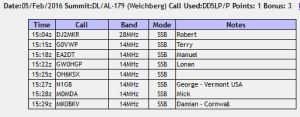
Auerberg to Weichberg was probably the shortest drive of the day at about 15 minutes. The parking spot for Weichberg is not normally a long walk from the summit, but in this case no one had used the track up the hillside and I had to “break the track” through the snow to mark the way up to the chapel on the summit. The 4 or 5 people who came up while I was operating probably appreciated my marking the track – on the way down it was a lot clearer and easier to negotiate as it had been used more. Weichberg would have been a good summit to use the vertical on a tripod from as there is only limited places to install the fibreglass squidpole but as I had left the vertical in the car, I was not going to go down to get it and so the dipole went up as best it could. One call on 10m and there was Robert, reporting this was the weakest he had heard me but I still broke over the top of some S5-S7 noise he was having on 10m from some local installation. Apart from Robert, I worked a further 7 stations on 20m, with some weak reports. It was only after getting home that I realised that the FT-817 had switched down to 2.5w output from its maximum 5w due to the battery voltage dropping. I had a spare (charged) battery with me however on Weichberg, I just wanted to bag as many chasers as could hear me and then pack up and head home to a warm bath tub! So it was after 25 minutes of operating on Weichberg, I packed up for a last time, happy with the fact that I had managed to activate all 5 summits but glad it was over. The state of the paths and the fact that there was still quite a lot of snow around had surprised me as all snow at home had gone some days before.

Photos:

DL/AM-001 Peissenberg.

This slideshow requires JavaScript.

DL/AM-178 Ammerleite.

This slideshow requires JavaScript.

DL/AM-177 Kirnberg.

This slideshow requires JavaScript.

DL/AL-169 Auerberg.

This slideshow requires JavaScript.

DL/AL-179 Weichberg.

This slideshow requires JavaScript.

Equipment:

Yaesu FT817ND.

Diamond RHM-8B on tripod (used on Peissenberg only)

Spiderbeam Aerial-51 UL-404 off centre fed dipole on 5 metre squid pole (all other locations).

Log:

DL/AM-001 Peissenberg.

Activator Log  DL/AM-178 Ammerleite.

Activator Log  DL/AM-177 Kirnberg.

Activator Log  DL/AL-169 Auerberg.

Activator Log  DL/AL-179 Weichberg.

Activator LogConclusions:

At this time of year, fives summits in one day is probably the most I could have achieved. In summer 7 may be possible as I drove past one summit (Rentschen) which I had already activated on 10m and activated this year and so would get no points for it and the DL/AL-170 Zweisselberg summit that I almost reached by mistake would probably also be a possible seventh candidate!

73 ’til the next summit! ….. or summits?
DD5LP/P – January 26th. 2016 – DL/AM-001 Peissenberg.

Preparation:

January 26th. is Australia Day. One of the three days in the year when VK stations can change their calls to start with AX rather than VK (the other two days are Anzac day and International telecommunications day). As John VK6NU had said he would be out late enough VK-Time (late afternoon) to hopefully catch some long-path contacts into Europe, I decided to go out to a local summit (early morning here in Germany) to try for an S2S contact back to Australia.

I managed to complete the move of my Ramsey QAMP from it’s flimsey plastic case into a die-cast aluminium case the day before and testing it, it actually still worked apart from the fact that the power LED that I had added didn’t light up (swapped its leads around and even that then worked!).

I had made contacts both to chasers and activators via long path from DL/AM-001 before, but not at this time of year. In any case, if you don’t try you’ll never know.

I also hoped to get some 10 metre contacts for the current challenge as no one has activated this summit on 10m before.

The Location:

Peissenberg is a drive-up summit with about 300 metres from the car park to walk to my comfortable operating position. I have been to the summit on several occasions before so I needed no map to find it. The views are fantastic, especially early morning and with the luxury of toilets on-site this would be an ideal summit for someone new to SOTA to have as their first summit activation. In my case it’s one of a few summits that are less than an hours drive away from home and as such suitable for early morning activations.

The Activation:

After a non-eventful drive down, I started to set-up my gear on the usual bench and strapped the 5m fibreglass mast to the railings as normal using “Bongo-ties” (these are great things – rubber bands with a small wooden toggle on them (that looks like a miniature bongo drum, hence the name)) so that you simply wrap them around objects and clip the ends back into each other. You can of course tie two together to get extra length, which I have done. While sorting out the rig and log book I suddenly saw the mast tipping over as one of the ties had released itself and fired off down the mountain, never to be seen again. I normally have a spare with me but could not find it, so I then had to re-arrange the base of the mast so that it would be held sufficiently well with just one double bongo-tie. With that problem sorted I started to unwind the dipole sides and the small spool that I use to wind the wires on fell apart and in the process knotted up the wire and cord. This of course took a little while to untangle sufficiently for me to be able to install the antenna. The day was not starting well and all of this in under zero degrees temperatures my fingers were already feeling frozen.

Despite these  couple of problems, I got on air at my alerted time and started putting out a CQ on 10 metres and self-spotted. Nothing! I tried for 15 minutes, still nothing, so I moved to 20m put the amp in circuit and started calling there – again no replies. I wondered if the antenna was simply not working, but the SWR looked OK. I tuned around and found a Swedish station activating a WWFF park, so gave him a call, got through and got a report – so I was getting out! Some more tries and spotting on both 10m and 20m resulted in one chaser call on 20m. I then saw the spot for John VK6NU in Australia but couldn’t hear a thing from him. The conditions on both 20m and 10m were horrible. So in order to at least qualify the summit, I moved to 40m and the difference was immediate – pile-ups despite the fact that Peissenberg is only a 1 point summit, it seemed the whole world (or at least all of Europe) wanted a contact with it!

So at the end of the day a successful normal activation, unfortunately with no VK or 10m contacts though. Better luck next time?

At least the QAMP worked without issues in the field!

Photos:

This slideshow requires JavaScript.

Equipment:

Yaesu FT817ND.

Spiderbeam Aerial-51 UL-404 off centre fed dipole.

5 metre squid pole.

Ramsey QAMP 20/40m amplifier

Log:

Activator log

Conclusions:

Unlucky with the 10m and 20m band conditions (10m improved later in the day).

January is not the month to try for Long Path SSB contacts into VK.

73 ’til the next Summit!

DD5LP/P – December 31th. 2015 – DL/AM-178 Ammerleite.

Preparation:

My attempt to activate Ammerleite earlier in the year had been stopped by the road being blocked by a farmer moving his crops and I was told that the road that I had used three times before was private and I could not access it. This is despite Google and other mapping systems reporting it as a public road. As always in SOTA, we have to avoid causing issues especially around access routes, so I have been researching an alternate access route from the other side of Schnalz (which is the correct name for the Summit – Ammerleite is the complete area). There is even a road called Schnalzstrasse that comes out of the village of Böbing, that the summit overlooks.

Even with the new route, I did not consider it too difficult and indeed my wife agreed to come along as well.

The Location:

The new route:

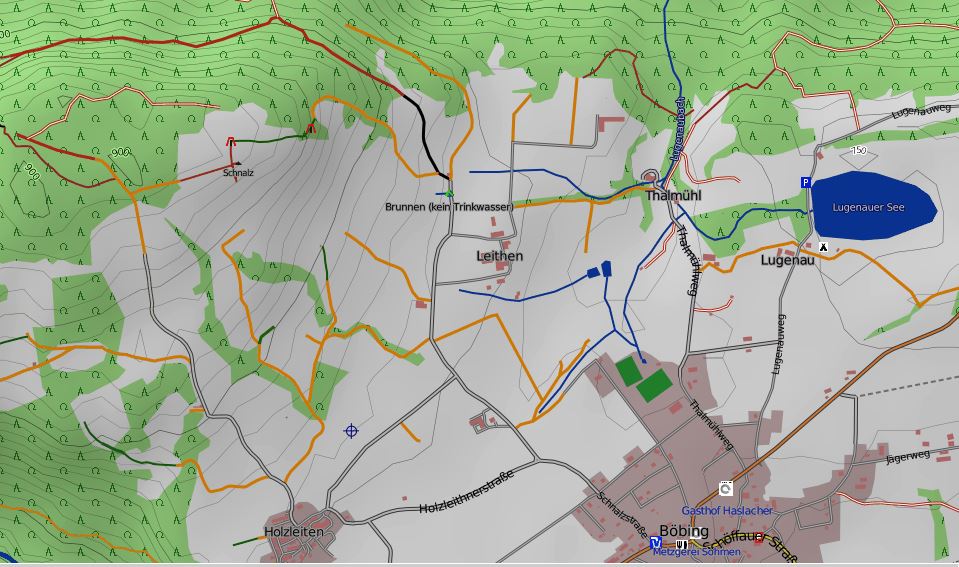
As noted above, there is a road named SchnalzStrasse on the western end of the village of Böbing. Take this road until you leave the village and come to a junction – now take Leitner Strasse (the direction being up the hill). If I remember correctly, the walking trails are also signposted from this point onwards – you need to follow B7 which on some signs is called Schnalz Gipfel or Schnalzrundgang or similar. Driving further up Leitner Strasse you come to a Y junction where the left fork has the sign saying that access past this point is restricted to farming and forestry workers only. This is just past where there is a small fountain on the left that has a horses head in wood as its spout (water not for human consumption). There is also a hut on this junction (see photos in slideshow below), I drove down the right hand fork and parked on the grass (later others had done the same, so this seems to be the acceptable point to park and start walking). Now it is simply a matter of taking the left hand fork, following the route B7 up the ever steeper hill and around the corner until you go through a stile into an open field. The opposite side of the field has a turnstile and after you go through that you can just see the cross through the trees up and to your left. This is where you need to head to, to take advantage of the two benches and fence posts to locate your radio gear.

SchnalzThe Activation:

Once I had put the antenna up, and laid out the rig and log, I found a faulty contact on the coax from the antenna but was able to position it so that it was connecting (after investigation at home, it was the inner core of the coax that had broken away from the centre pin of the BNC plug). I also noticed that although the SWR was now fine, the power out indication seemed low. I then realised that I had the FT817 switched to 2.5w rather than 5w output for all of the last activation on Herzogstand!

I tuned around the bottom 1MHz of 10m and apart for the DL0IGI beacon on 28.2050 on Peissenberg being off the scale on the FT817 (I could see the antennas from my summit) there was nothing on except for some interference, presumably from equipment not meant to be on 28MHz at all (I suspect the weather station – which was also very close – but I can’t prove this) – there was NOTHING on the band that I could hear. So I tried spotting myself and putting out CQs for about 10 minutes but to no avail. The band was totally dead!

Never mind, now I know the “authorised” access route I can try again in the new year, bag the activator points again and hopefully some 10m contact points as well for the challenge.

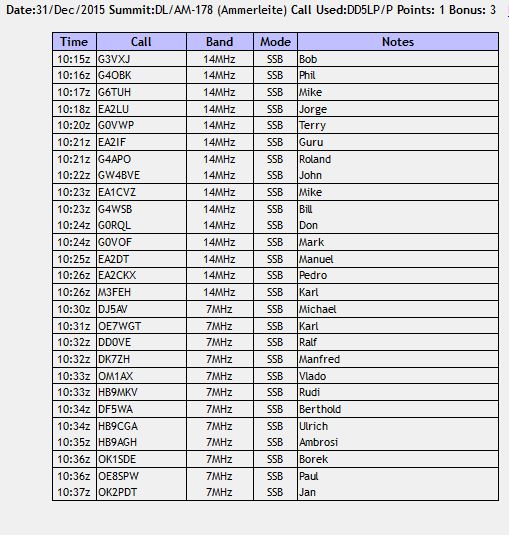
I then decided to try 20m, where the results were far better with 15 contacts in 12 minutes. I followed this with a stint on 40m and bagged another 12 contacts in 12 minutes. On both 20m and 40m I was still just running the 5w from the FT-817 into the OCF dipole. I didn’t unpack and set up the amp as I could see a storm coming in. Indeed just as I stopped operating, the first few rain drops fell. A quick pack away and head down the hill and when we reached the car the rain storm really started.

The activation was completed with a stop for soup in a nice cafe in Rottenbuch on the way home.

Photos:

This slideshow requires JavaScript.

Equipment:

Yaesu FT817ND.

Spiderbeam Aerial-51 UL-404 off centre fed dipole.

5 metre squid pole.

Ramsey QAMP 20/40m amplifier and batteries (taken but not used)

Log:

Activator log

Conclusions:

Unlucky with the 10m band conditions (they improved later in the day), but lucky to get down and away before the storm came through. Although somewhat further and a lot steeper, this access route appears to be, by all of the signposts, the way that the locals want you to approach Ammerleite – or we should now say Schnalz.

73 ’til the next Summit!

DD5LP/P – December 29th. 2015 – DL/EW-022 Herzogstand.

Preparation:

I’ve had Herzogstand on my “to do” list for a while. It is a relatively easy climb and attracts a large number of walkers, so I expected that I would be limited on space to put up an antenna and so packed the loaded vertical and all other equipment into one rucksack. I was hoping to add it to my activated on 10m, summits list and hence receive another multiplier point for the current 10m/6m SOTA challenge.

The Location:

Herzogstand is a mountain above Walchensee in Southern Bavaria, access is via a cable car to the neighbouring mountain (Fahrenberg) from where it’s a ten minute walk to the Herzogstand Gasthaus (Restaurant) and then one takes the track along the side of Martinskopf mountain to the start of the serpentine track up to first the holy cross and then the pavilion on the very top of Herzogstand. Expected time from the restaurant to the summit is 45 minutes.

The Activation:

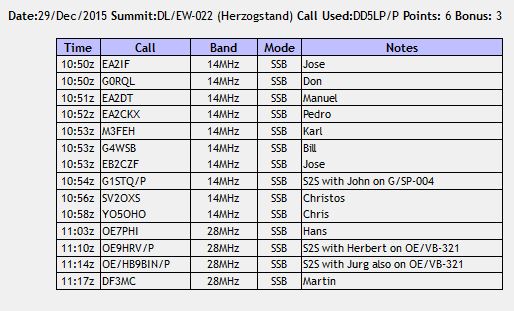
My journey to the summit from getting in the cable car to arriving at the summit took me 40 minutes. It probably would have been five minutes quicker except for the number of other walkers on the (partly iced over) track up (I’m glad I took my spikes to add to my hiking boots!), Once I reached the summit, after pausing and taking some photos at the cross,  I saw an area next to the pavilion that had once been some kind of small building but all that remained were it’s foundations (about 6 foot by 4 foot). OK for me – I set up the tripod and loaded whip in one corner and ran the counterpoise wire out along the top of one pf the partially remaining walls. I did not add any extension to the top of the whip on this activation as I was restricted for space as to where I would run it and my main aim was for contacts on 10m where I don’t need the extension. Putting down my plastic painting sheet in the opposite corner of the fountations from where I had put the antenna up, I put the rig and logbook on it, took off my skiing jacket (it was warm on the summit in my sheltered position, but cold when one was in the wind) and got ready to start some SOTA action. I immediately started calling CQ SOTA on 10 metres on 28.370 after checking the frequency was clear. I then spotted myself but to no avail. After about 15 minutes, I decided it was better to activate the summit anyway, even if I could not get a 10m contact, so I adjusted the vertical antenna to 20m and called CQ there where I got a quick response from many of the usual chasers. Reports of my signal were not as good as usual which I put down to the antenna but I realised on my next activation, that the FT817 had been running at only 2.5w output on Herzogstand not the full 5w, so that would also have been a factor. After logging 10 contacts in 9 minutes on 20m, one being an S2S, I decided to give 10m a go again as I only intended to be on the summit 30 minutes due to having to be back home mid-afternoon. I was rewarded on this second try of 28MHz with 3 contacts with Austrian stations, one of them an S2S. After I had already announced I was going QRT, I got a telephone call from Martin DF3MC who had activated Herzogstand the previous day, I called him on 10m and we made a QSO, meaning he had a completed summit within 24 hours.

Some interest was shown by one of the walkers on the summit and after explaining what I was doing, he said that he used to be involved with CB and had done some portable operating with friends, years ago. He seemed interested possibly in Amateur radio and I gave him a DARC brochure with the necessary contact information, so that could be a new Ham at some time in the future.

He also mentioned to me that Herzogstand used to have a very large LF antenna running down the mountain that was used in the 1920’s for long distance Radio Telegraphy. At the time, the only other equally sized antenna was in Indonesia and these two were the largest in the world. Later the antenna was used for research before being taken down. Shame! It would have been nice to see how such an antenna with 5w of Amateur radio power would have performed HI.

After completion of the activation, packing up and the route back down was, thankfully uneventfull and I arrived home exactly on schedule.

Photos:

This slideshow requires JavaScript.

Equipment:

Yaesu FT817ND.

Diamond RHM-8B loaded vertical.

Log:

Activator log

Conclusions:

A nice day out. Definitely the correct decision to take the small pack and small antenna, with so many people (and dogs) on the summit and no where to safely set up away from the summit, had I taken the fibreglass pole and dipole, I would not have been on the air. Next time I should check more carefully that the rig is set to full power. Very glad I got the 4 10m contacts, for sometime there I thought I wasn’t going to. Very lucky with the weather at this time of year.

73 ’til the next Summit!

DD5LP/P – December 25th. 2015 – DL/AM-176 Rentschen.

Preparation:

While the weather has been unusually mild (12 – 14 degrees & no snow) my wife asked if we might go somewhere, where she could walk the dog while I operated radio, for a couple of hours. I had originally planned to try to access Ammerleite via a different, longer route, as the straight forward (still labelled as a public road on all maps) was closed off by the farmers as being a private – no access road the last time we went there. On the day however, I decided the best option would be to go to a known summit where access is easy and we had, had the dog (Bonnie) there before. So Rentschen it was, even though I had activated the summit twice this year already, I might just get it as a new 10m summit for the challenge.

The usual, reliable kit that I had used on many activations before would be used. The “two bag configuration”.

The Location:

Rentschen is well signposted (see previous reports) and is about 40 minutes drive from my home QTH. The road runs over the top of the summit, so it’s a matter of parking up and then walking a respectable distance away from the car, to ensure no support is being obtained from it, as required in the SOTA rules, setting up and away we go.

On the last two activations, I set up using a pile of cut down tree trunks to support the antenna mast, this time the pile of wood had gone, so I had to find an alternative and saw a small post further into the field. Unfortunately this was fairly close to some overhead power lines but luckily they caused no QRM (they were also high enough not to be a physical danger). The post was not very stable but as there was no wind was adequate to hold the base of the fibreglass squid pole that the OCF dipole was run from. Interestingly at the foot of the post was the Trig Point stone for the summit, so there’s no question of my location! I am slowly finding more and more of these stones that are used to mark the exact summit when no summit cross or other monument has been erected.

The Activation:

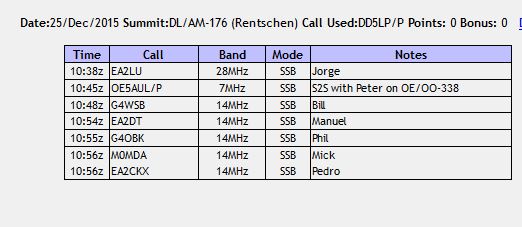
Once I had put the antenna up, laid out my small plastic sheet with the rig and the logbook on it, I immediately started calling CQ SOTA on 10 metres on 28.360 after checking the frequency was clear. I then spotted myself and after some time Jorge EA2LU came back to me but when I passed back over to him there were 2 or 3 other Spaniards talking on the frequency. Either I had coincidentally picked someone’s net frequency or these were other Spanish chasers discussing the fact that they couldn’t hear me (in Spanish), either way I move 10KHz up, re-spotted and completed the contact with Jorge. That was the only 10m contact for the day, I looked and saw that Peter OE5AUL was on another summit and manged an S2S with him on 40m. I finished off the activation five more contacts on 20m and then my wife was back with the dog and it was time to eat our picnic. So a short, but enjoyable activation for all involved. Finding an alternative route to Ammerleite (which is also quite close to my home QTH) is still on the list to complete.

Photos:

This slideshow requires JavaScript.

Equipment:

Yaesu FT817ND.

Spiderbeam Aerial-51 UL-404 off centre fed dipole.

5 metre squid pole.

Ramsey QAMP 20/40m amplifier and batteries (taken but not used)

Log:

activators log

Conclusions:

A nice day out with the family. Not a great number of contacts but enough to activate the summit and add one to my summit multiplier number for the 10m/6m challenge. Unfortunately as I had worked Jorge from another summit on 10m before, he does not count in the challenge any more.

As on Gschwandkopf there seemed to be a pipe on 10 metres into Spain, but very little else on 10m to be heard.

73 ’til the next Summit!

OE/VK2JI/P – December 19th. 2015 – OE/TI-690 Gschwandkopf.

Preparation:

Still looking for points in the 10m/6m SOTA challenge, I wanted to get out and add some six metre activator points to my score. Living in Germany I am not allowed to operate portable on 6 metres so a trip into another country is needed to make this happen. After activating Hohe Salve a couple of weeks earlier, I didn’t want to have such a long drive this time and so looked at the summits around Seefeld in Tirol. I found the six point, plus 3 winter bonus activator points Gschwandkopf (OE/TI-690) with its 4 seat, seat lift direct to the summit. As with many lifts in the alpine regions this lift had been out of service for maintenance and on the web site it simply said back in operation sometime early in December. Looking at the webcam on Thursday it was obvious it was not yet back in service. I sent an email on Friday asking when it would be back in service to get a reply saying they had just started service again that day. So the plan was set down to Seefeld the following day and up Gschwandkopf. I then heard that two CMEs were heading earthwards and could mess up propagation but how often have these not arrived or not had any effect? So I decided still to go and hope for the best.

Rather than risk taking the repaired but untested six metre lightweight beam I decided to make do with the Spiderbeam Aerial-51 UL-404 off centre fed wire dipole that I would be using for 10, 20 & 40m in any case. While it wont give any gain on 50MHz it is defined as working on six meters.

So I would in fact be using the reliable kit that I had used on many activations before. The “two bag configuration”.

The Location:

Gschwandkopf located above Seefeld which is about 10 minutes drive from the German/Austrian border on the road from Garmisch Partenkirchen to Innsbruck. Somewhat further than my usual German summits but not nearly as far as Hohe Salve. In Seefeld itself the Gschwandkopf lift is signposted but not at every turn, so it was good that I had mapped out and written down the road names in my planning. I also have a printout of the roads through Seefeld but did not need that – the list of road names was sufficient to get me to the valley station of the lift in 1.75 hours from leaving home, exactly as Google Maps had predicted.

Ticket prices are interesting on this lift – the cost to go up and down the lift was €17 with a €2 deposit on the re-usable electronic ticket. But the lift is also listed as requiring 4 points on a points card, so in principal, I should have been able to buy an 8 point card at €3 less than the simple ticket but I was then told that the points cards are only sold to those skiing, not to pedestrians.

Once I got to the lift, there was a separate section for pedestrians who had to wait until the half / full hour before they could use the lift. This was because they had to slow the lift down to load and unload those not on skis.

The Activation:

Once on the summit, there were two restaurants (only one open as the number of people skiing was not big) and a small hillock (the actual summit) which as well as some benches also had a transmitter building and mast from the Austrian Broadcasting company. While I thought twice as to whether I should set up so close to this station, it caused me no interference and this is a lovely spot with some great views. I could see this being a good site for a 2m FM repeater or some 2m SOTA simplex contacts but I was here mainly for 6 meters not 2 meters, so I set all the usual gear up and started calling CQ on 50.140 and tried to self spot. I had especially taken out an Internet package on my Vodaphone SIM, but this refused to work in Austria, so I fell back to good old Deutsche Telekom (I have two SIMs in my phone) and sent the required SMS code to enable Internet connectivity and this time (not like on Hohe Salve) it worked. There was no free WiFi on this summit as there had been on Hohe Salve.

I spent probably about 15 minutes on 6 metres calling and calling and calling, with not one response. SWR was fine, just propagation was not there. I then tried 10 meters and was happy to be able to get a total of seven contacts on 10 meters. The first 6 from Spain – good solid, easily readable signals. There seemed to be some propagation “tunnel” between me and Spain. The seventh 10m contact was with Karl M3FEH in Cornwall England and that was a difficult contact with very low signal strengths in both directions, but somehow we managed it. Thanks Karl.

Once it seemed there were to be no more 10 meter contacts I saw some other activations were on 20m – of these about half I could not hear , two I called could not hear me but in the end I did manage three S2S contacts – two on 40m and one on 20 metres. 14 chaser contacts on 40 meters completed the log. After the last contact an S2S, I had to hurriedly pack up the station to be able to get to the lift to go down on the half hour – otherwise I would have to wait another half hour before I would be allowed on the lift.

Photos:

This slideshow requires JavaScript.

Equipment:

Yaesu FT817ND.

Spiderbeam Aerial-51 UL-404 off centre fed dipole.

5 metre squid pole.

Ramsey QAMP 20/40m amplifier and batteries (taken but not used)

Log:

activator log

Conclusions:

This is a very easy access summit. I was surprised initially while planning as to why so few people have activated it, until I saw it had only been added to SOTA in October 2015. I expect a lot of people will now include it in their holidays to Tirol and in Summer, I expect the lift will take pedestrians without a delay.

The propagation on 6 metres was not there however there seemed to be a pipe on 10 metres into spain. Was the extra drive worth it – no I’m sure I would have been able to capture the 10m contacts from a German summit.

73 ’til the next Summit!

OE/VK2JI/P – December 7th. 2015 – OE/TI-517 Hohe Salve.

Preparation:

As the 10m/6m SOTA challenge part 2 has now started, I wanted to get out and add some six metre activator points to my score from part 1 of the challenge. Living in Germany however, I am not allowed to operate portable on 6 metres so a trip into another country is needed to make this happen. I had activated Hohe Salve over 2 years previously, and knowing it is an easy access summit (cable car to the summit and then walk 100m or so to a spot to operate from) and as of December 1st. it also gains 3 winter bonus points for the activator it was my choice. Many summits in Austria and Germany had not yet restarted their cable car services after the annual maintenance period however Hohe Salve’s Salvenbahnen were scheduled to come back into operation on December 5th. – which they did.

For six metres I ordered and built a super-lightweight 2 element Yagi antenna, however during testing on the 5th. of December the fibreglass squid pole that I had mounted it on, for vswr tests in the garden, collapsed snapping the boom of the antenna. I must be considered partially to blame for this as I had decided on a very simple mountiing method for the beam – simply drilling a hole through the plastic pipe boom and dropping it over the top of the squid pole. I managed to source some replacement (thicker walled) plumbing plastic pipe from the local DIY store the next day, however decided rather to rely on the Spiderbeams Aerial-51 UL-404 off centre fed wire dipole that I would be using for 10, 20 & 40m in any case. While it wont give any gain on 50MHz it is defined as working on six meters and I wouldn’t have the guying complications needed with the beam.

So I would in fact be using the usual kit that I had used on many activations before. The “two bag configuration” and not the vertical lightweight pack.

The Location:

Hohe Salve is located above Hopfgarten about 20 minutes drive from the German/Austrian border at Kiefersfelden/Kufstein. As you need a special sticker to drive on Austrian autobahns (at they don’t do a 1 day pass), I had to leave the German autobahn at Kiefersfelden and follow the old roads through to Hopfgarten. The journey would possibly have taken ten minutes less if I had an autobahn pass and used the autobahn right to the Wörgl turn-off but the trip from my home to the bottom station of the cable car took 1hr.45 minutes rather than the 2 hrs.15 minutes quoted by Google maps. The return journey was a different story! I was stuck almost a hour in slow moving and stopped traffic on the Munich ring road.

Since the last time I was here, there appears to be a new cable car lift called the Hohe Salve lift, which come up the other side of the mountain from Söll. It would take me longer to drive to that lift than the one in Hopfgarten however if the Salvebahn were to be stopped or simply very busy for some reason, this would be another option to get to the summit.

The views on the way up in the cable car were of green fields until you got to an artificial snow machine and there you had the piste. Basically the main pistes from the top to the middle station of the cable car had been prepared using cooled sprayed wather than turns into snow, so that the skiing season can start. It was not busy but there were a few families enjoying skiing on the mountain.

When I got to the summit, I wanted to head to the same grassy spot that I had used previously but that (the summit and about 20m down the slope was actually covered with real snow) was roped off. I thought this was to stop the people trying to ski down in this direction and find that the piste on this side of the mountain hadn’t been created with artificial snow. About an hour later I found the real reason. The area is used by those crazy enough to leap off the mountain and use a para-glider to get down the mountain.

I looked around and found a viewing platform with a handy railing to attach the antenna mast to and some benches to sit and put the gear on. Luxury – but only as long as the kids climbing rock and slide aren’t in use. On this day the kids were more interested in getting in their first ski runs of the season, so I was left pretty much alone apart from one gentleman who approached me while I was packing up, he seemed interested and left with a German language brochure about amateur radio that I take with me. Perhaps a future Ham – who knows….

The Activation:

I had planned the activation to start at 12:30 local time (11:30 UTC) but was in fact set up and calling a half an hour before this. I first started on six metres but then when I tried to self spot, I found I could not get Internet connectivity to work. On previous actvations in Austria I had received a message from my Telco warning me that Internet usage wouuld be expensive when roaming, now it seems you have to buy a days package and as I use a PAYG SIM card, there wasn’t enough credit on my card to buy the package. I tried spotting myself via one of the phone apps that supports spotting by SMS but could not tell if it had actually got through as for that I would need Internet to see what appeared at SOTAWatch. Then I wondered…. in some ski resorts there is WiFi available either free or chargable to a credit card and when I checked, sure enough, I could get a weak WiFi signal and once I accepted the usage terms and conditions I had Internet acess for free. Now I could see if my spots were getting through and just as important as it turned out, see who else was activating.

My spots and calls on 6 metres were all in vain. Band conditions were terrible, so I tried 10 metres – still no takers. Then I saw OE7PHI/P was activating OE/SB-163 so I called him and we had an S2S contact on 20m. I asked him if he had 10m and while he had no antenna for 10m we decided to give it a try anyway and indeed the copy on 10 metres was actually better than on 20m. YAHOO – at least one contact on 10m for the challenge and an S2S at that (although it wont count for normal points as I had already had the contact on 20m, but it does count for the challenge). I put a couple more CQs out on 10 metres before returning to 20 metres and 40 metres where I managed contacts with a few chasers, so the summit was then activated. Later I tried 6 metres and 10 metres again and was surprised (and happy) to get another call on 10 metres. This was Stephan DM1LE who was activating DL/EW-022, so not only more challenge activator points but another S2S to boot! I finished up with a total of 18 contacts in about an hour, of which 6 were S2S contacts (5 of those counting for chaser/S2S points and 2 counting towards the challenge). So despite the lack of 6 metre contacts (which was the reason that I needed to travel outside of Germany to activate), the day was successful. I may head back to Hohe Salve in the new year to give it another go before the end of the challenge and while the winter bonus points are still available.

Photos:

This slideshow requires JavaScript.


Equipment:

Yaesu FT817ND.

Spiderbeam Aerial-51 UL-404 off centre fed dipole.

5 metre squid pole.

Ramsey QAMP 20/40m amplifier and batteries (taken but not used)

Log:

activator logConclusions:

The propagation on both 6 metres and 10 metres was horrible. The 10 metre contacts I managed were certainly ground wave or “line of sight”. I am so happy that I went on the day I did as two days later the webcam shows a “white-out” of the whole area!

73 ’til the next Summit!

DD5LP – November 8th. 2015 – DL/AM-001 Peißenberg.

Preparation:

Andrew VK1NAM/P posted on the SOTA reflector that he wanted some S2S contacts into Europe, including one into DL, so as I was happy that the small kit was working having used it a few days before on Zweisselberg, I offered to put the full kit together and head up to Peißenberg. I had already activated this summit earlier in the year so I wouldn’t get it’s 1 point added to my activators total however it is an easy access summit, where I know how I will install my gear. It’s also only about 40 mi nutes drive away from my home.

The last time I had used the “full pack” with my home built Ramsey QAMP, it had given me problems so before relying on it again, I decided to test it out and what do you think I found? It failed to work again. At least this time it was only two wires that had broken their solder joints from the switch I use to select the appropraite Low Pass Filter on the amplifiers output. The transistors seemed to be OK. After resoldering the wires to the switch, the second test showed the amplifier working fine on both 20 and 40 metres. So after checking all I need was packed and removing the items only used in the “small pack”, my camera bag and small rucksack were ready for a very early departure on Sunday morning.

Top row left to right: Tripod with SO239 mount, spare 2500 maH battery below it, FT-817 and Nikon camera sitting on top of painters sheet (thick plastic).

The Location:

Peißenberg, or Hohe Peißsenberg to give it, its full name, sits above the village of Höhen Peißsenberg about half way between Weilheim and Schongau in upper Bavaria.

Checking on Google Maps I found that I would probably be able to cut about 15 minutes off my trip if I took some country roads to avoid going through Weilheim. This I did and the route was very clearly marked. I was nice to drive the small open roads across country and they actually let to the back of the mountain compared to my usual approach. In fact Google suggested I take some even smaller roads and approach the site from the rear, however I decided to follow the country road around to where it met the B472 and then access the mountain using Berg Strasse as I usually do from Höhen Peißenberg village. Perhaps I’ll try the really small roads next time.

The Activation:

I had arrived and set up all of my gear by 0640 UTC. The sun had risen and the views were amazing. The trip would have been worth it just for the views but I was there to try and get a contact with Andrew VK1NAM/P on 20m and soon after my arrival he spotted that he was calling CQ on 20m. When I tuned to the frequency I could hear nothing, but then after a while two weak Russian stations came up on frequency. I don’t know if Andrew could also hear them, but he changed frequency and spotted again. I listened again – still nothing. Then I heard Marek 4X4JU try a call to Andrew with no response (Marek was looking for the WWFF points rather than SOTA). Over the next hour between putting out my own CQ calls I kept listening for Andrew without success. I believe Marek heard something from Andrew at one point but the propagation was certainly not with us today. Added to the bad long path propagation, lots of stations came on both 20m and 40m around 0730 UTC taking part in some contest, so it became very difficult to find a free frequency to call on without having heavy QRM from adjacent frequencies or in some cases have a contest station simply grab your frequency without checking if it was in use or not.

In any case, I managed 15 contacts during the activation and got to test out the “full pack” set-up again, with the QAMP behaving itself this time.

Photos:


This slideshow requires JavaScript.

Equipment:

Yaesu FT817ND.

SOTABeams bandhopper linked dipole on a 6 m squidpole.

QAMP 40/20m amplifier (25W 40m, 15W 20m).

Thick plastic painters sheet

Log:

Activators Log

Conclusions:

The propagation following the recent solar CME “glancing blow” are not yet back to normal but the late Autumn sunny weather made the activation a pleasure, even if an S2S contact with Andrew VK1NAM/P was not achieved.

The QAMP is working again and is probably due to be built into a better case (lets hope it still works afterwards!).

73 ’til the next Summit!

DD5LP – November 5th. 2015 – DL/BE-003 another Zwieselberg!

Preparation:

I had been wanting to activate the second Zwieselberg in the DL region for some time. This one is located near Bad Tölz about an hours drive away from my home. I had activated Buchberg across the valley from the Blombergbahn that I would use to approach this Zwieselberg a couple of times.

I had hoped to activate Karwendelspitz while it still has both an Austrian and a German SOTA code but at first the path from the cable car station to the summit was closed by snow before I went over to the UK and when I returned, although the path was open again, the cable car had stopped running. Many of these services are stopped at the start of November so that the complete system can undergo inspection and maintenance before the start of the ski season which is when they are used the most. As I realised Karwendelspitze was not going to be a possibility, I looked around for another summit and found that at the end of the week, the Blombergbahn would be switching its schedule to only running on weekends and public holidays until the ski season. I’d have to move quickly to get up on the mountain on a week day (when there are less tourists). So Wednesday became a “fix-it” day for the vertical antenna that had let me down somewhat in the UK. In fact, by testing in the garden, I found that the counterpoise wires needed to be elevated off the ground (or at least not laid on soil – stone is OK) and then the VSWR came down when the antenna was adjusted correctly. So I decided to use this activation to test out the antenna with the counterpoise supported off the ground using my walking poles.

The Location:

As mentioned above this Zwieselberg is near to Bad Tölz and approached via the neighbouring mountain, Blomberg (which used to be SOTA summit DL/BE-001 up until 2009). There are other routes to get to the summit from other directions, even mountain bike-accessible paths and as far as the Blomberghaus there is a track for those authorised to drive their cars up it. For the majority of people however, the route is the one I took using the 2 seat Blombergbahn chair lift up from the B472 road. By the way, when you park in the car park, take the small half of your €2,00 parking ticket to the lift’s ticket office and you will get €2.00 off the €9,50 ticket to ride up and down the lift, this is so that those using the lift’s car park but not the lift have to pay. Once you complete the 20-25 minute ride up the lift a well-signposted and wide track takes you to the Blomberghaus – the restaurant on this summit. It is about 1 km. away from the lift and after a steep walk down and slow walk back up, you are at the Blomberghaus in about 15 minutes.

BlomberghausFrom here you can see Zwieselberg towering over you and a sign, that says 2km to the cross and an expected walking time of 1 hour. 2km in 1 hour? Well once you follow the (still wide at this point) track for about 1km into the forest, you will see why you might need more time than you would think as the track goes off to the side and becomes steep and difficult to navigate as this is the way the water runs off the mountain when it rains. During this part of the walk, I was thanking the fact that I had put my walking boots on, not left my tennis shoes on as it was a rough surface.

When I climb a track I tend to go at it quite hard and fast, then take short breaks when I am out of breath. On this track, I passed everyone who was going up the track and it took me 30 minutes from the restaurant to the summit, not an hour. At a “normal” pace I would expect it to take 45-50 minutes and indeed the first people I passed on the climb arrived at the summit about 20 minutes after me, and I had already got all of the equipment out and was ready to operate.

There is a hut called Zwieselalm, do not follow the track to that as you will then still have a good 20-minute walk to get to the correct summit.

The Activation:

Once I reached the cross on the summit and had taken some pictures, I set up on some boarding about 10m behind the cross. By this time the sun had come out and I took off my quilted jacket, not needing it for the rest of the day. The weather was beautiful, a real contrast to my last activation of G/TW-002 the previous week! A few people asked me what I was doing and of course, I explained. I did have a copy of the DARC brochure explaining what Amateur Radio is about, but forgot that I did, as I only had the “minimum kit” with me (as used in the UK), I will have to put this out somewhere next time (I have several copies in the “full kit”).

I set the vertical up with the tripod at full height (no wind – great) and both the 20m extension to the whip and the counterpoise elevated off the ground. Tuning the antenna to the same marking that I had used during testing the previous day in my garden, the VSWR was very low – all looked good. I then saw a spot for Antonio EC2AG on EA2/BI-068 and managed to get an S2S with him he was 5-4 with me and he gave me a 4-4 report. Well, I was only running 5W so fine we’re working. I then spotted myself and the calls started coming in. I was happy to hear Karl M3FEH calling me with his QRP signal from Cornwall, England. Weak but fully readable. After working ten stations on 20m (including another S2S), I decided to switch to 40m. With this set-up, I used a different (longer) extension to the whip on the top of the Diamond RHM-8B for 40m, so there was some changes required and movement of the support walking poles. 40m did not tune as well as 20m. This was surprising as in the garden testing it was the other way around. In any case, I then managed after a lot of calling and help from chasers, to tell him there was an S2S calling, another S2S contact this time with Mario HB9HAT/P in Switzerland. In all, I worked a total of 15 stations on 40m before packing up after an hour on the summit.

The walk back to the Blomberghaus restaurant was a lot easier than the ascent to the summit, I would have liked to have stopped for a break but time was running short, so I pushed onto the top of the chair lift and that last climb back up to the chairlift took almost as much effort as some of the earlier steep climb sections!

Photos:


This slideshow requires JavaScript.

Equipment:

Yaesu FT817ND.

Tripod mounted Diamond RHM-8B loaded vertical whip.

Painters sheet to sit on.

Log:

Activators Log

Conclusions:

You can only correctly test equipment in situ as the ground conditions are variable from summit to summit and indeed from one day to the next on the same summit. So one has to be ready to adjust an antenna (especially a compromise one like the Diamond) when you reach the summit. Overall the activation went very well and if I do eventually get to activate Karwendelspitze (or similar limited space summit) I know the set-up I have will work well enough to get me contacts across Europe if not further.

73 ’til the next Summit!