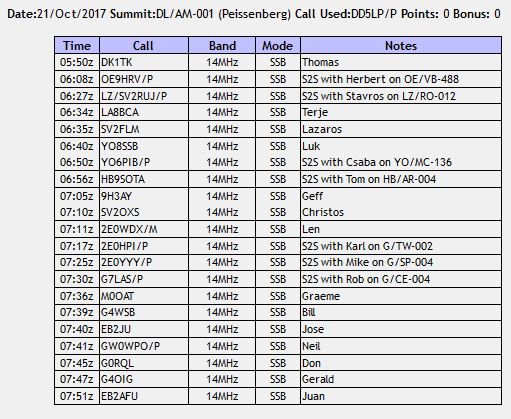
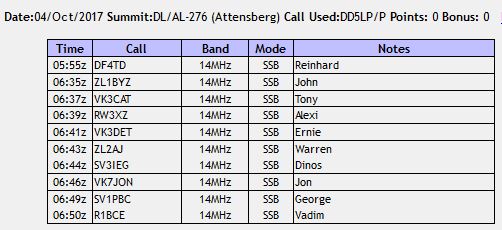
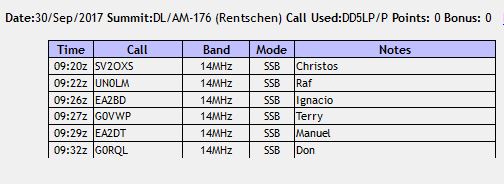
DD5LP/P – September 23rd. 2017 – DL/AL-276 Attenberg.

Preparation:

I have recently bought a new antenna, a wideband (40m – 10m) Komunica Bazoka PRO, which first tests mounted on a magnetic mount sat on my car roof, with the car parked in the open country, worked very well receiving stations from all around Europe, Australia and New Zealand. As the specification for this antenna says that it needs no ground plane (as provided by a metal car roof), I decided to try it out connected on top of a tripod with no ground plane, counterpoise or radials and according to the Rig Expert AA-30 antenna analyser, the SWR trace was not a great deal different, to when mounted on the car roof. I therefore needed to try the antenna on the small tripod, “in the field” or rather on a summit. The enemy of a vertical antenna is trees and many of the summits local to me are wooded, so I needed to look further a field.

The Location:

There are several summits near to the Bregenzer Wald / Southern Allgau area that I have not activated.  These are all at least 1.5 hours away from my home QTH and so not easy to get to early enough, for, for example a long path contact to VK and ZL. In this case however I wanted to find a summit, not covered with trees where I could try out my new antenna. At the same time, I was looking for a hotel where the complete family (my wife, the dog and I), could take a short break and this area looked like a nice option. In fact the hotel below the Attenberg summit, accepts guests with dogs. So this activation was to be a pre-cursor to possible activation of some other summits in the area later.

The Activation:

The drive down was uneventful and relatively straight forward. Interestingly for some reason the GPS Navigator took me home via a different route. In any case the trip down and back both took just over 90 minutes.

Once I arrived and parked in the car park of the Paradise Cafe Oberstaufen, it was only a short walk up the hill to the summit. The weather forecast was good and indeed upon arriving at the summit at about 11 am local (0900 UTC), the sun was shining and there was no sign of any rain. Station set-up took less time than when I use my dipole antenna and the first contact with Lothar DL3HXX was in the log 15 minutes later. This was on 40 metres and the band was very busy. On two occasions after checking a frequency was free and spotting myself and putting out a CQ, I found another station had simply started transmitting oon the same frequency, or very close to it, meaning I had to QSY and re-spot etc. This was somewhat annoying as I know the stations doing this should have been able to hear me (as I worked stations close to them during the activation) but they obviously considered their use of the frequency for a special event station (GB0CMR) was more important, than my use of the frequency.

I was happy to have an S2S contract with Juerg HB9BIN, on holiday on a summit in Poland as well as chaser calls from Germany, Poland, Spain and the UK. The antenna was as far as I could determine, working as well as my dipole on 40 metres, so I decided to try 20 metres. As soon as I switched to 20 metres, the band sounded very quiet, even the normal atmospheric noise seemed to be low. I don’t know if this indicates that the antenna was not working well or simply that the band was not open to anywhere. I could hear one or two stations on the band but at signal strengths where I didn’t consider calling with my 25 watts. I did self spot on 20m and put out some CQ calls but with no replies. At this point in time, the sun was covered by clouds and the temperature dropped and as some walkers came by are were interested in what I was doing, time got away from me. Where I was on this summit there would have been space to put up the linked horizontal dipole to compare signals however I decided better of it, leaving that for another time and packed up and headed back down to the Hotel’s Cafe to have a warm soup and to inquire about the hotel and confirm that guests with a dog were welcome.

For those looking for a VERY easy summit to access and activate, the one pointer Attenberg (known as Kapf by the locals) is one of the easiest.

Photos:

This slideshow requires JavaScript.

Equipment:

Yaesu FT817ND.

Komunica Bazoka PRO wideband vertical antenna mounted on a camera tripod.

Modified QAMP amplifier (35W on 40m, 25W on 20m).

Log:

Conclusions:

Although this was a positive test for the Bazoka PRO on 40 metres with no ground plane, I still do not know whether it works well on other bands. The next time I test this, I do need to set up the linked dipole or the OCF first and then I can compare the Komunica Bazoka PRO loaded vertical on both receive and transmit to the horizontally polarised antenna.

73 ’til the next Summit!

DD5LP/P – August 30th. 2017 – DL/BE-094 Irschenhausen.

Preparation:

Mike 2E0YYY contacted me suggesting that we might try for some long path contacts into VK/ZL as conditions had improved a little from the horrible state they had been in for the last couple of months. This would mean me chosing a summit that I could get to by 8am  local time, which rules out several nice summits as they need the cable car lift to get to them and they don’t start running until 9am or later.

I looked at the summits that would be accessible and realised that I hadn’t activated Irschenhausen for the last two years and I had made a contact into VK from there. So Irschenhausen it would be. I would use the usual kit – the FT817, my small modified Ramsey amplifier to take that up to 20 or 25 watts, feeding the SOTABeams Band hopper linked dipole on a 5 metre pole. I would also take my screw-in base as well, as I have found that it’s easier to carry that than look for a suitable post or small tree.

The Location:

I have moved my home QTH since my original activation of this summit, so the drive to my parking spot has increased to nearly an hour. Irschenhausen is located above the village of the same name just off the B11 road running north-south down the Eastern side of Starnberger Sea – one of five large lakes near Munich. The walk from the parking spot takes about 40 minutes, first along a field track and then into the forest and keep going upwards at every junction until you find yourself at the highest spot.

The Activation:

The alarm was set for 5:45am and all the gear laid out ready to be picked up and taken. I actually woke at 5:30 am and was able to leave by 6:30am rather than my planned 7am, which worked out well as I missed most of the heavy traffic en-route. The weather forecast was for a dry morning, but rain to appear in the afternoon, however as I planned to be back home by 11am, this didn’t concern me. On getting to the turn off from the B11 to Irschenhausen, I saw half the road was blocked off with a barrier and a sign saying that access was only possible up to the restaurant in the village – not knowing where that was, I decided to try in any case but as I got into the village, my next turn-off was also half closed with a sign that said access only possible up to the road works and no further. Again not knowing how far up the road the road works were, I decided to try anyway – it might just mean some more walking. As it turned out, despite a trough cut all the way up the road, that had been recently filled in (but not fully up to the road level), I managed to get all the way to my parking spot. I had been lucky.

Once I got the gear out of the car, I started my walk, which seemed longer than I remembered but indeed it did take just over 20 minutes to walk to the summit. As I set off I saw a wind turbine that hadn’t been there at my last visit and I hoped it wasn’t on the summit – in fact it turned out to be much further away and caused me no issues at all. This summit has a forest all over it – which I believe may account for some of the problems that I was later to have on the bands. In any case, on arrival at the summit I screwed the sun umbrella base into the ground and dropped my 6m fibreglass mast into it. After running the dipole out and setting up that station on the ground on my faithful painter’s thick plastic sheet, I started by listening around 20 metres. It was very quiet and it was hard to find more than one or two stations on. To add to the problem the local cell phone networks were playing up meaning that getting a self spot out was very hit and miss. It seems that although Vodaphone indicates a 4G Internet data link from this summit, it doesn’t always work and Telekom’s 3G link often dropped to “edge” (slow) speeds.

To start with there were a lot of late season mosquitos – most of which I flattened before they could bite me, but I did go away with a few “souvenir” bites. I was surprised to find these so late in summer and so far away from water but I guess the forest creates a damp climate for them.

As the main reason for the activation was to try for a long path contact into VK or ZL I continued trying on 20m and just by tuning around found a couple of interesting contacts. One contact was with Jesus, EA9ACF in Ceuta, the Spanish enclave in Northern Africa. He was booming in. After a while my self spots got out and I managed contacts with a few of the usual chasers but QSB was a real problem. Later I heard a Japanese station JA8COE, Tako at a true S9 and then what appeared to be an Italy – Australia net where a station in NSW and one in Queensland, Australia were getting through at about 5-5 or 5-6. I had no chance of getting into the net or through Tako’s pile-up but the path was definitely open. I also listened for some other SOTA activations in Europe that had been spotted without success but thanks to perseverance from Christos and Stavros (SV2OXS and SV2RUJ), I managed an S2S with SV/MC-089. Once I decided 20 metres wasn’t improving and while I had alerted, I would operate on 40 metres as well as 20m, I decided to take down the antenna, adjust the links and switch the 817 and amplifier and try 40 metres. It was like chalk and cheese. The band was full! Finding a free frequency was difficult and after one SOTA QSO would normally become unusable from the splatter of other stations, so I was constantly moving and re-spotting (when the spotting worked). After a while I decided that time was short as we were to visit friends in the afternoon and I had to first get home and ready for the second trip of the day. Pack-up and return to where the car was parked and no sign of road work blocking my exit, so it was back home before the traffic got worse later in the day.

Photos:

This slideshow requires JavaScript.

Equipment:

Yaesu FT817ND.

SOTABeams Band Hopper linked dipole.

LambdaHalbe 6m Mini-mast.

Modified QAMP amplifier (35W on 40m).

Thick plastic painters sheet.

Sun Umbrella screw-in base.

Log:

Conclusions:

Whilst band conditions were difficult on 20 metres the trip out was worth it as the fact that I heard a Japanese and two Australian (presumably super) stations, does mean band conditions are getting better.

I suspect the trees on this forested summit may have been part of the reason that I did not get out very well. The use of a vertical antenna may have been better for DX but it would have suffered even more from the tree landscape.

For just one point, there has to be a reason to come to this summit (for me it was the activation time) there are several just as easy to get to later in the day better summits.

73 ’til the next Summit!

DD5LP/P – August 13th. 2017 – DL/AL-149 Blender and DL/AL-179 Weichberg (sort of).

Preparation:

After meeting Thomas DK1TK in a local electrical retail store, where he works and realising we were both Hams, we discussed me taking him on a SOTA activation, so he could see if it’s something he would like to get involved with. He was already equipped with good portable gear and operates portable QRP with a KX2 and a home made vertical antenna on a 10m fibre glass pole.  After some discussion we decided on activating Blender (a reasonably easy summit) along with Hauchenberg (DL/AL-145). My research on Hauchenberg however showed that the location in SOTA Maps for the summit and that shown on other maps was different and so I sent a note to the last activator – Herbert OE9HRV to ask his advice. Unfortunately I only received a reply on the day of activation, when we had already decided to play it safe and make Weichberg our second summit. Perhaps we’ll do Hauchenberg next time – it will require a lot of time to climb and we were limited on time as it turned out anyway.

Equipment from my side would be the usual FT-817 plus amplifier, 6 metre pole and linked dipole.

The Locations:

Blender is located quite a long way from my home QTH, west of Kempton and north of Buchenberg. After a small diversion to pick up Thomas en-route, we got there at around the planned time. I had hoped to go to a different location on the hill than my last activation of this summit a couple of years ago but it turned out that what is shown on open street maps as a road is not much larger than a footpath, so the road up to the radio tower was the route we ended up going on and parking before climbing the last (steep)  ascent and in fact going and finding a seat across the summit from the tower, (well within the activation zone).

Weichberg, near Rettenbach is a summit I know very well, it’s “almost” a local summit for me but this time we would be approaching it from the other side along the B472 road.

The Activation:

These were not to be quick activations. The weather was nice, we set up both Thomas’s and my equipment at Blender so that we could demonstrate and compare. This was the first time I had seem a KX2 from Elecraft – it is indeed a very nice (if expensive) piece of equipment. Most impressive is the ability of the built-in ATU to tune almost any antenna. Unfortunately the front end was not able to filter my transmissions on 40m out from the 20m band (we were very close after all). From my side, it was clear the extra power of the amplifier (35w on 40m) makes a difference when calling non-SOTA stations.

Although Thomas did work a couple of SOTA stations, as well as a few non-SOTA stations (so qualifying the summit) he was put off a little by the pile-ups. English is not Thomas’s first language and this combined with the speed of the contacts took a little away from the SOTA experience. I have suggested that we look at GMA next time, while this would be mostly in German and somewhat less hectic.

We had several interested people come by either on foot or on bikes and a few stopped to ask about the hobby. One I thought was an amateur as he knew about propagation and antennas, but it seems he was more of an SWL. In any case I gave him a brochure and he went off happy.

After about 90 minutes on Blender, we decided to pack up and head off for what I expected to be a 30-40 minute drive over to Weichberg.

The drive turned out to be almost an hour, which surprised me and restricted what we could do. We agreed to just take Thomas’s equipment up to the top of Weichberg and let him have a go without interference from my station. Thomas decided to use a different antenna this time and he tied a large nut to the end of some thin silver coated copper wire and threw it up over a convenient tree branch. Again the ATU in the KX2 amazed me that it could tune this random length of wire, but it did. How well the 10w from the KX2 radiated, I don’t know but reception was good, we could hear a station from the middle east as well as stations from all around Europe. The band conditions were very good this time out. Thomas worked a couple of special event stations in France and Germany as he likes to collect their QSL cards and then we decided to call it a day.

  After dropping Thomas off, I arrived home about 90 minutes later than I had planned. A good day out, but next time I need to check better how long the drive to, and between, the summits will take.

Photos – Blender:

This slideshow requires JavaScript.

Photos – Weichberg:

This slideshow requires JavaScript.

Equipment:

Yaesu FT817ND.

SOTABeams Band Hopper Linked Dipole.

LambdaHalbe 6m Mini-mast.

Modified QAMP amplifier (35W on 40m, 25W on 20m).

Thick plastic painters sheet

Screw-in sun-umbrella base

Log Blender:Log Weichberg:

No log for DD5LP. DK1TK/P operation only.

Conclusions:

Although the GPS Navi only let me down once on this trip (en-route to Weichberg from Blender), I knew the suggested route was wrong (probably shorter but using farm roads) and was able to quickly correct the route. There are a few summits, not far from Blender that I have either never activated or not activated this year. I would like to go back to the area and combine two or three into a day. I MUST however check driving times very carefully and also plan for rapid installation and pack-up to fit them all in.

At the moment 40m is still the “money band” but 20 metres is getting better again. The luxury of a short antenna and speedy installation may have me using my 15/17/20m J-pole antennas again next time.

73 ’til the next Summit!

DD5LP/P – July 15th. 2017 – DM/BW-348 Gehrenberg (group activation).

Preparation:

This activation was planned in conjunction with a trip to the HAM RADIO event in Friedrichshafen. After the last revision of the list of DM/BW summits, there is now only one practical summit near the HAM RADIO show which is Gehrenberg, a summit I have activated twice before.

The overall plan came together via the SOTA reflector and it was possible to build a “SOTA Day” for the Saturday of Friedrichshafen. This started with the regular 12 noon meet-up at the QSL wall followed by the afternoon lectures, then came the SOTA group activation and finally I also organised the (very well attended) SOTA dinner in the evening.

Equipment packed to support this group activation was my usual SOTA kit.

The Location:

Gehrenberg should be about a 45 minutes drive from the “Neue Messe” in Friedrichshafen, where the HAM RADIO event takes place. I was lucky enough also to find a restaurant for the dinner, not too far from the summit also, so things would not be to bad a drive for all taking part.

The Activation:

My in-car GPS is a couple of years old now but has just had new maps added and I was confident from previous outings that I could rely on it bringing me, and my two passengers (Gerard VK2IO and John VK6NU) to the summit without any problems. I was so wrong! The GPS Navi tried to take us first of all up a farm road that simply came to an end (I suspect there “may” have been a small track up to the back of the summit previously but it’s certainly not there now). After resetting our plans and looking at some on-line maps and asking some directions, we ended up at the Gehrenberg look-out tower. This however is NOT on the SOTA summit and hence another back-track was need and eventually, based on my memory of what some of the roads looked like from last time, we arrived at the parking spot about a kilometer from the summit, unpacked and started the walk up the forestry track, only to be passed by two other amateurs in their cars, who said there were no driving restriction signs. I had not checked, there were some signs the year before. In any case upon arrival, one group had gone to the absolute summit, so I decided to set-up in a spot by the radio transmitter tower, that I had used the last two years as I knew was well within the activation zone. This was a good hour and a half after leaving Friedrichshafen, so time was against us, if we were to get to the restaurant on-time.

A group of Czech Hams had walked further along the track, to be clear of the other stations. As we were setting up Juerg HB9BIN joined Gerard, John and I and we all shared my dipole antenna. We all managed the required 4 contacts, before pulling all the equipment down and heading back down the hill to the car.

Even though the activation was different from what I had planned – I had hoped to have two stations in place before the others arrived and have them simply rotate through to get their 4 contacts for the 8 point summit – it all worked out in the end and it was followed by a lovely evening with good food and chatter at the restaurant for the SOTA dinner, where Luc ON7DQ was awarded the prize of a WSPRLite unit for the most original SOTA clothing.

Photos:

This slideshow requires JavaScript.

Equipment:

Yaesu FT817ND.

SOTABeams band-hopper linked dipole.

LambdaHalbe 6m Mini-mast.

Thick plastic painters sheet.

Log:

Conclusions:

Do not assume the Navi is going to take you to the best access point for a summit, take printed maps as well.

I have already been asked if I will run something similar next year. I am considering it, but it would be nice to go to a different summit. That would however need a lot more time, so perhaps I’ll just organise the dinner as I have done, the last two years and leave the activation out of what was quite a busy day.

73 ’til the next Summit!

DD5LP/P – May 30th. 2017 – DL/EW-001 Wank.

Preparation:

Wank is an easy access summit. As you will have seen from my earlier posts, I like summits that my wife can accompany me on and that means access with a cable car to a summit with a restaurant on it. This one has two restaurants on top of it. I was surprised to realise that the last time I activated Wank was in 2014. I have no idea how I missed this summit in 2015 and 2016. If you have read my last couple of reports, you’ll know that I have had problems with both of my HF dipole antennas. I managed to break the centre feed insulator on my SOTABeams Band Hopper linked dipole antenna and the wires coming out of both sides of the BALUN on my Aerial-51 404-UL OCF were frayed. Both antennas have been repaired and this activation will be used to test out the repaired antennas. I also still want to try to get some 2m SOTA contacts just using a HT with my new RH770 antenna, so I’ll be taking that along as well.

Looking back at my report from 2014, I saw that I had some problems finding somewhere to support my mast, so this time I decided to take my sun umbrella screw-in base with me with the hope of finding some softer ground.

The rest of the kit will be the usual FT-817ND plus my 25/35w amplifier and my 6m LambdaHalbe fibreglass mast and as noted above the Wouxun HT and antenna will also be packed.

The Location:

The Wank mountain is located above Garmish Partenkirchen on the Bavaria / Austria border about an hour and a quarter from my home QTH. The cable car takes about twenty minutes to get from the valley to the summit. Technically interesting is the fact that the 4-seat cabins actually run on two cable car systems changing from one to the other at the middle station. You don’t need to move from one car to another, the car changes over between the systems. So to reach the summit, stay in the car, don’t get out when the door opens at the middle station. From the mountain station (where the Sonnenalm panorama restaurant is located) it’s a short walk and about 40 metres climb up to the actual summit, where as well as the Wankhaus restaurant, there is also the Cross and several transmitter stations and their antennas. There’s actually an amateur radio repeater in one of these huts.

The Activation:

My in-car GPS is a couple of years old now and has reported non existent speed cameras around Garmish Partenkirchen the last couple of times I have driven through there, so I had updated the speed cameras file on the card and, even though I knew the route, I let the GPS Navi, tell me the way there and indeed, no more false warnings! I also tuned into the American Forces radio station (Garmish is one of the last remaining locations for the American forces in Germany, kept as a rest and recuperation resort in the most part for soldiers returning from conflicts before going home). It seems they have reduced their 90.3 MHz FM transmitter power down to 50 watts so that it only now covers the base and the town. Previously I could receive it from a lot further away than I can now (or perhaps VHF propagation was a lot better the last time I came through?). Interesting for a change in style of broadcasting compared to the German stations in any case.

The drive down was uneventful and thankfully, this being a week day, the cable car was not busy and I got a cabin to myself both for the trip up and down, allowing me to take some photos using my smart phone (see below). I arrived pretty well on schedule and sought out a spot on the very summit (although there is a large area within the activation zone if others come to activate on a busy day). Indeed here I found what I found last time – only brush wood – none of it strong enough to support the mast, so I took out the sun umbrella base and found some soil where I could screw it in, with enough room at each side to run the antenna out without it obstructing any of the paths. Although there are also some nice bench seats on the summit, none were near enough for the antenna lead, so I got out the trusty painters sheet (a thick PVC sheet) and put it down on the rough rocks and then pulled out and set up the rest of the gear.

Although this summit is high, it seems none of the towers are a cell phone repeater and Internet access was patchy. I tried both of my Networks, Deutche Telekom and Vodafone. I suspect the problem was, that being so close to the Austrian border, the phone was switching back and forwards between roaming mode to an Austrian phone network and my local cell networks.

My first transmit test unfortunately showed that my amplifier wasn’t going onto transmit. I use RF triggering, rather than a PTT line to switch the amplifier into circuit and at the time I thought that it could be something in this circuit that had failed. After getting everything home and taking a look inside the amplifier however I found the main fuse had blown, which is the past has been caused by one of the two push-pull power transistors shorting power to earth. I will need to confirm this and repair it before my next activation. For now however, on the summit, I took the amplifier out of circuit and packed it away, connecting the lead from the SOTABeams linked dipole antenna which I had put up, directly to the FT-817 and ran the whole activation at 5 watts. Even the unsuccessful (no calls) two metre part of the activation was at 5 watts as that’s what the Wouxun HT puts out on 145MHz. So this was a true QRP activation on all bands used.

Given that I made 26 contacts across 40m and 20m in about 45 minutes, I think even at only 5 watts I was still getting out, albeit some people were having more difficulty than usual in copying me.

As is often the case, I had one couple come up to me and ask what I was doing, they were interested to hear that our hobby and technology exists but I don’t think they will be looking any further into it. It was a nice short chat in any case.

The bottom half of the 40m band was full of interference, I suspect from one or more of the microwave transmitters on the summit. 20m was clear of interference and the easier band to operate this time around.

All in all a nice activation and at around 1pm local, I was already back in the cable car heading down the mountain, to both miss the forecast incoming storms (that never came) and also to be able to take care of some chores when I got home.

For those visiting southern Germany, this is a nice summit to visit, easy to activate and even nice for any non-radio people coming long. I certainly wont be waiting another 3 years before activating this summit again.

Photos:

This slideshow requires JavaScript.

Equipment:

Yaesu FT817ND.

Repaired SOTABeams band-hopper linked dipole.

LambdaHalbe 6m Mini-mast.

Modified QAMP amplifier (35W on 40m, 25W on 20m – when it’s working …).

Thick plastic painters sheet.

Sun Umbrella base.

Log:

Conclusions:

A nice activation weather wise, luckily the threatened storms never arrived.

The repaired SOTABeams band-hopper worked perfectly which is more than can be said for my amplifier but as long as the FT817 continues to work, even 5w gets out when there are a lot of chasers looking for you. The repaired Aerial-51 still needs testing, that’ll have to wait for the next activation.

Two metres was a disappointment again, despite this really great location. Sad but it seems 2m SOTA is not very popular in Southern Germany.

73 ’til the next Summit!

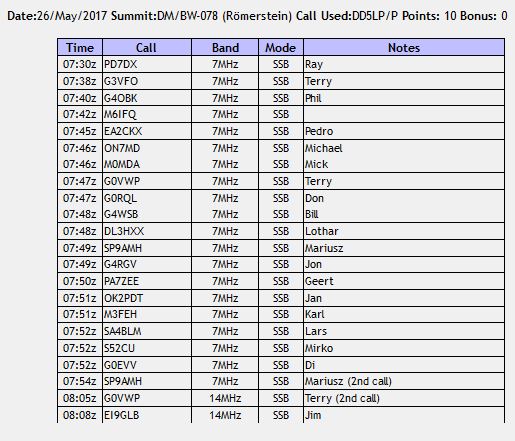
DD5LP/P – May 26th. 2017 – DM/BW-078 Römerstein & DM/BW-695 Teck.

Preparation:

The original plan was to activate three summits in the BW region – the third being DM/BW-094 Kornberg, however after the second summit and a couple of problems, I decided to leave that one for another day.

The summits to be activated are 2 hours drive away from where I live and that’s only to the car parking spot from where I need to begin my walk. The walking up to the summit can take 20-30 minutes, so fitting three summits into a day when they are far away from home and about 30mins drive away from each other is a challenge.

I wanted to test out my new RH770 whip antenna on my 2m HT and so the first summit would need both VHF and HF equipment to be carried to the summit. I will be heading over to the UK later in the year and am considering just taking 2m FM to activate the last of 5 G/TW summits that I haven’t as yet activated.

In case conditions are not good on 2m (or the antenna doesn’t work) – I decided to be ready to run 20m & 40m as well on the summits. For this I would take my standard pack – FT817 plus amplifier and 6m. mast. This time however rather than the lighter SOTABeams Band Hopper linked dipole I would be relying on my Aerial-51 OCF antenna as I managed to break the centrepiece on the SOTABeams antenna and am awaiting a replacement piece to come in the post.

The Locations:

Römerstein (DM/BW-078) I have activated twice before and know the route up from the car park well – last time it was through mud but as we’ve had a few dry and sunny days, that would not be the case this time.

Teck (DM/BW-695) on the other hand is a new summit for me but from what I could see it’s a favourite tourist spot with a castle on the summit and a nice restaurant/beer garden as well. So it can’t be hard to walk the 2 kilometres up the track right…. Wrong the access track from the Hörnle car park, outside of the village of Owen,  up to the castle is long and quite steep. Not ideal for carrying heavy gear if it can be avoided…

The Activation – Römerstein:

The drive from home to Römerstein was fairly straight forward with the first 3/4 being autobahns – well apart from a total of about 20 Km of road work sections with no overtaking and 60 KPH speed limits… What was quite strange was that the GPS Navi told me to exit the Autobahn using a “Behilfsausfahrt” – i.e. not a road to a particular town or village but one that is used to release traffic should the Autobahn be blocked. As it turned out, this was the quickest route to the area around the summit and I quickly spotted my normal parking area on the side of the road. After packing what I thought I would need into two bags, I started off up the track through the forest to the summit.

As I approached the summit I could see the tower was open for visitors and some people were there cleaning up around it. The “Römerstein Turm” is normally open only on weekends in summer and public holidays so I was surprised to find it open on a Friday. I thought I might take a look from the top of the tower once I had finished my activation, but that didn’t happen as during my activation about 30 young adults appeared and started various activities, including inspecting the tower. As I started to set up the mast and equipment, one of the people there, who was, in fact, one of the custodians of the tower, came across and said why not operate from the top of the tower. He would be quite OK with me dropping a wire out of a window down the outside wall! Unfortunately I didn’t have my end-fed antenna with me and trying to rig a dipole from there would have taken too long. So I thanked him and continued to set up at ground level.

I had brought my 2m FM HT along as well to test but as I saw a couple of activators already spotted, it would need to wait until I saw if I could manage some S2S contacts. This was not to be but while tuning on 40m I heard someone with a strong signal calling CQ and getting no answers so I gave Ray PD7DX a call and we had a short chat. I then looked around for a free frequency spotted myself and started calling CQ. The band was strange, with very deep QSB and some stations sounding like there were in a motorboat. Whether this was an effect of the fast solar winds which were hitting the earth at the time, I don’t know, but it was strange.

After the calls dried up after 20 contacts on 40 metres, I decided I’d better try two metres, it being one of the reasons that I was activating the summit. I wanted to see if my Wouxun with the RH770 antenna performed as well as others have said. I was hoping to get a contact and then swap the antenna back to the standard one and see what difference (if any) it made on receive and transmit. After self-spotting and calling on the 2m FM calling frequency on and off for 4 minutes, I got absolutely no contacts on 2 metres FM. By this point the 30 youngsters had appeared and had started a football match near to where I was rather than on the sports field – they were just having fun, but before one of them ran into the dipole wire, I decided it was time to start wrapping up. As I had alerted that I would also operate on 20m, I switched over, spotted and called. In twelve minutes, I only managed two contacts – thanks to Terry G0VWP and Jim EI9GLB. The 20m band was even more strange than 40m, the normal background (atmospheric) noise simply wasn’t there.

While packing up, I noticed on the 404-UL that the dipole wire, just as it exited the BALUN box was frayed – the outer sheath had completely gone and the wire itself was having to take the full load. I taped this up to give some strength to it, so that it wouldn’t break in transit. I consider calling off the next summit as I had no back-up antenna with me but decided to go ahead. At the same time one of my mini-wire winding coils (usually used for earphone cable for smartphone headset), fell apart and the dipole wire was everywhere and tangled up. I took time to untangle it best I could and did a quick repair to the coiling loop to get me to the next summit, think in the worst case if this happened again when packing up at Teck, I would just “bundle” the antenna wire into my rucksack and sort everything out at home. At this point, I made the final decision not to try to activate the third summit (Kornberg). There were simply too many things that might not work after the quite long walk to that summit.

The Activation – Teck:

After walking back down to the car and bundling everything in I set the GPS Navi to take me to Teck which is not far from Römerstein near to the village of Owen and should take just about 20 minutes to drive from car park to car park. As I had only packed limited food and as now, that I had decided not to activate the third summit, I had time to stop at a supermarket and pick up some drink and food supplies. Even with the supermarket stop, the journey still only took just over 30 minutes.

The route to Burg Teck (Castle Teck) is well signposted when you get into Owen. In fact, you are guided to the car park on “Hornle” hill whereas it turned out, the local model glider club were having a competition, launching their model aircraft off the side of the hill down a grassy slope.

I had looked at this route on the map and although there is a closer car park, the track from that one is much steeper and this one turned out to be more than steep enough itself. It appears the track between the castle and the car park is a favourite track for mountain bikers with several pushing (and puffing) their way up the track with me to the summit, where they would most likely grab a cool drink in the beer garden before hurtling back down the track.

The track seemed to go on FOREVER! But eventually, as I turned around another corner after a steep section, there was the castle gates (and a lot of people taking photos and resting). I snapped a couple of shots on my smartphone camera and continued through the gates (which also have public toilets in the sidewalls of the entrance). I continued on, past the restaurant and beer garden on the right, into a kind of parkland area and after surveying possibilities decided I could use a bench in the middle and run out the dipole without causing danger to others. While setting up, I saw the gardener fighting to get an old petrol power lawn mower to start, which he did finally manage. I hoped he wasn’t going to want to cut the grass where I had my antenna up. I had been able to throw the cords on the end of the dipole over some tree branches and when the mast was raised, the wire was high enough for people to walk (or ride) under without catching it.

At this point, the gardener came over to see what I was doing and it turned out he was from Serbia and had been a member of an Amateur Radio / CB club there when he was younger. In fact, the club had acted as a civil warning method for bombing during their war. By warning people where bombs were being dropped, to keep away from those areas. Interesting guy!

Once set up, I checked what was spotted and bagged two Summit-to-Summit contacts straight away before spotting myself and calling. The bands were still strange, with 20m very quiet – in fact, I wondered at this point whether the wire had either broken or frayed further since I took it down at Römerstein, despite the tape I had put on it. This was not the case and the antenna got repaired (the wire at both sides of the BALUN were fraying) once I got home.

So as not to disturb the ever-increasing number of tourists arriving at the summit, I “donned” my headphones and managed a total of sixteen contacts in 35 minutes on 20 & 40 metres. I didn’t bother with any 2-metre tests from this summit given the lack of contacts from the last one and the worry that the HF antenna could fail at any time. I also had a 20-minute walk down to the car and a 2-hour drive back home to look forward to, so I closed down the stations at 1100 UTC, 1PM local, packed up, said goodbye to the young lady and her horse who had joined me on the other end of the table and set off back down to the car park.

I’m sure it took less time to get down the track than come up it, however, one had to be careful on the gravelly surface not to slip, especially while carrying probably 8 kilograms or more of gear. The drive back home to a similar route to the one coming, including all of the road works on the Autobahns and I arrived back home at around 15:30 local time. I was glad that I decided not to go on to the third summit as I was somewhat exhausted and if I had gone on, I would have been driving back in peak hour traffic.


I am going to look at combining Kornberg and Wasserberg, two other summits in this same “Schwabische Alpen” area at some point in the near future.  Those 10, 8 and 6 pointers are very attractive when one is used to 1, 2 and 4 pointers that are harder to climb! If only they weren’t so far away from where I live.

Photos – Römerstein:

This slideshow requires JavaScript.

Photos – Teck:

This slideshow requires JavaScript.

Equipment:

Yaesu FT817ND.

Aerial-51 OCF wire dipole antenna.

LambdaHalbe 6m Mini-mast.

Modified QAMP amplifier (35W on 40m, 25W on 20m).

Wouxun KG-UVD1P HT with RH770 antenna

Log Römerstein:
Log Teck:

Conclusions:

It’s always advisable to have a back-up for everything. While the antenna didn’t fail, it could so easily have done so. If I had, had an end-fed antenna (and tuner) with me that could have been a nice experiment from the top of the Römerstein Tower!

Planning to activate 3 summits in one day, so far away from home is only sensible if I have already activated all of them before and know what to expect. While it is very tempting, given the far higher points allocated for these relatively easy summits, the drive to and from them takes a lot of time and effort, from where I live.

73 ’til the next Summit!
DD5LP/P – May 17th. 2017 – DL/AM-060 Laber.

Preparation:

Having missed the EU-NA S2S event the previous Saturday because of feeling ill, I wanted to get out and activate a summit while the weather stays nice. I decided to try 60 metres again along with 40 metres as a back up. So the modified for 60m SOTABeams linked dipole along with the FT-817 and amplifier (for 40 metres usage – 60m would be barefoot 5 watts PEP).

The Location:

Laber is about an hours drive from my home QTH – to the valley station of the cable car in the village of Oberammergau (famous for its “Passion play” that has been held every 10 years for several hundred years). The cable car is the oldest in Germany at over 60 years old and takes about 10 minutes to reach the summit.

From the mountain station of the cable car it’s only about 30 metres walk to the very summit with its convenient bench seat.

The Activation:

All went to plan except squeezing the antenna into the available space with the extra length for 60m while there are other people on the summit. This meant I got started about 15 minutes later than planned. I started on 60 metres using frequencies that overlap between the UK “bandlets” and the IARU WRC15 allocation that we have in Germany. The band did not cooperate – perhaps the antenna was not good with the ends on 60m relatively close to the ground. In any case I only managed contacts into Germany and Switzerland – locals from where I was.

After switching to 40 metres things were better and I actually called a non SOTA station first, this was PI4C at a museum near Schipol Airport in Holland. It was being operated by Trevor a British ex-pat in Holland who came originally from a town about 10 miles away from where I lived as a child! Small world! Band conditions on 40m were variable, some of the usual chasers being weaker than normal and some the normal strength. At the end of my activation I could hear the lightning strikes that had been reported earlier by some UK stations, but in the end the storm never got to me thankfully. As the winds were increasing I decided to shut down and pack up after about an hour in the hot sun. While closing down someone came to ask what I was doing and he seemed quite interested, so I gave him a DARC introduction brochure to Amateur radio. In my rush now to pack away, I managed to break the central insulator/feed-point plastic of the antenna so that will have to be replaced or repaired. It’s lasted 5 years of some quite rough handling, so it as done well.

All in all, I was happy that I got out and did an activation in the nice weather – can you believe in a few days snow is forecast again for the summit (and this is the middle of May!).

Photos:

This slideshow requires JavaScript.

Equipment:

Yaesu FT817ND.

60/40/30/20m Linked dipole antenna (Modified SOTABeams Band Hopper).

LambdaHalbe 6m Mini-mast.

Modified QAMP amplifier (35 watts on 40m).

Log:

Conclusions:

The location is not a good one for 60 metres due to the restricted space for the dipole.

I need to look at the compression level in the FT-817 Mic RF-Speech-Clipper and back it off a little.

The output BNC socket on the amplifier needs to be tightened and locked (glued) in place before its turning breaks the cable.

The centre insulator on the dipole needs to be repaired or replaced.

73 ’til the next Summit!

DD5LP/P – April 8th. 2017 – DL/AM-180 Berndorfer Buchet.

Preparation:

This activation would not earn me any new activator points as I have already activated this summit in 2017. It is however the closest to me at about 35 minutes drive from home. The day before after discussions with Karl M3FEH, who was planning to go out, I decided to go out early this Saturday morning as well. The main aim was to see if indeed a long path contact into VK or ZL was possible on 40 metres as 20 metres has not been performing so well in the last weeks. Also with an SFI of about 118 and K index of 1 – conditions should be good, right? No – in fact from Friday to Saturday the SFI dropped to 66 – the lowest it had been for several years and the K Index rose to 3, sometimes 4. I didn’t know this was going to happen of course and only found out after returning home, making what was achieved even more interesting.

No experiments with equipment – the FT-817ND plus amplifier and the 6m portable mast to support the Aerial-51 OCF dipole were prepared for the early start. The OCF having the advantage of covering both 20 & 40m. My sun umbrella support was also put with the two equipment bags and all was set.

The Location:

As mentioned above Berndorfer Buchet is the closest SOTA summit to my home QTH. It is on a hill above the village of Pähl south of the Ammersee lake in southern Bavaria. As you will see from the photos, the summit is completely wooded, which is not the best situation as they de-tune antennas (especially vertical), but I have made contacts into VK from here before, albeit when radio conditions were somewhat better than they are at present.

The Activation:

An early start – away before 7am local time (now 0500 UTC) and a clear run down the country roads across country to the summit. I was half expecting to see snow as I approach the summit however there was (thankfully) none to be seen. What I did see however was the sun rising through the early morning mist – it looked like a large orange ball. If I hadn’t been driving at the time I would have taken a photo of it – it was impressive.

The weather wasn’t bad but the temperature was down at 0.5°C and stayed that way for a couple of hours until the sun burnt through all of the mist.

The set-up of the mast, as you’ll see from one of the pictures ended up as a combination of a “natural” support and the sun umbrella base. The antenna went up without any major problems and the station got set up on the painters sheet on the ground. I started by tuning around 40 metres and indeed I coul hear some VK fixed stations in conversation as well as some US stations. But in the couple of opportunities I took to call them, I got no response, being flattened by far more powerful stations with larger antenna systems I expect.

After self-spotting, I got some european chasers but they were not as strong as normal. I suspect the skip distance on 40m was long at this time (just after 0600 UTC). I gave 20m a try and was rewarded with a call from John, ZL1BYZ but this was a difficult contact – especially from John’s end. Without John great antenna systems, I don’t think this would have been possible. Certainly an S2S with VK/ZL on 20m would not have been possible today. Later when I found out that the SFI had dropped so far, it was no surprise that contacts were difficult on 20m. The purpose of the activation was to check out 40m for DX so I switched back to that band and did some “search and pounce” operations, getting a few more contacts including the TM100VIMY special event station. Following that there was a run of the usual chasers and the conditions on 40m continued to improve on 40 metres for inter-Europe contacts (so the skip was getting shorter I think), these stations were still not as strong as usual, but better than earlier. One more trip to 20 metres was rewarded with VK1MD calling me along with a few European chasers. At this point I replaced the battery on the amplifier which had drained without the monitoring device saying anything – it showed down to about 90% and then simply stopped working (all 4 cells were actually at 0% as I found out when I got home). One final run on 40m, which was now back to european stations only, no NA or VK DX and then it was time to pack up and head back to the car.

All in all a good test. I could hear the VK stations on 40 metres at between 5-5 and 5-8. One was actually working portable with a dipole but admittedly running 300 watts, while another home station, again with a wire antenna was running just 95 watts. I think given possibly 50-100W and ideally a better antenna than a dipole, arranged S2S contacts between EU – VK and EU-NA early morning (EU time) would be possible. So as we continue down to Solar minimum perhaps we need to look to larger stations with more power on 40 metres for long path contacts to VK/ZL?

Unfortunately, although I saw Karl M3FEH spotted on SOTAWatch, I didn’t manage to hear him from this activation.

Photos:

This slideshow requires JavaScript.

Equipment:

Yaesu FT817ND.

Aerial-51 OCF horizontal wire dipole UL-04.

LambdaHalbe 6m Mini-mast.

Modified QAMP amplifier (25W on 20m, 35W on 40m).

Thick plastic painters sheet

umbrella screw-in base.

Log:

Conclusions:

I have replaced the LIPO monitor unit with a second one that I have – unfortunately, this one doesn’t have such a big display but perhaps it will be more accurate! I think 40m EU-VK S2S contacts will be possible if both ends can run more power. As this will involve heavier gear and batteries, this would perhaps need to be an activation with more than one person and larger flatter summits would probably make things easier to install that small high peaks.

73 ’til the next Summit!

DD5LP/P – March 31st. 2017 – DL/AL-171 Eisenberg.

Preparation:

As the winter bonus period comes to an end in the DL association on March 31st. and as the weather has stayed beautiful, in fact through this week has slowly got better and better I decided I should fit in one last bonus activation before the season starts again at the end of the year. I considered an 8 pointer (DL/AM-031 Branderschoffen) where I found the Tegelbergbahn lift required to get within 180 vertical metres and 45 minutes walk of the summit is still running (most are closed for maintenance at this time of year) but rather than risk that summit which I have not activated before, I decided to play it safe and have a nice easy activation of Eisenberg – a 1055 metre high “2 pointer” hill with some castle ruins on the top of it and just as important a wonderfully friendly restaurant (Schlossbergalm Zell) about 60 vertical metres below the summit, where I can park my car.

Equipment to be used would be the FT-817ND plus amplifier and the 6m portable mast along with the Aerial-51 OCF HF dipole.

The Location:

Eisenberg is about a 50 minutes drive from my home QTH near the village of Eisenberg and not far from the town of Pfronten in the Southern Bavaria region of Allgau.

The Activation:

I had decided to take this activation slowly as I was not aiming for any DX long path contacts, so after taking our dog “Bonnie” out for her morning walk, I set off from home at 09:30 local time (07:30 UTC). Set the “navi” to guide me, although I know the route well, to find that the unit was determined to take me a different route via the Autobahns – which while possibly quicker is far more stressful than the cross country route that I normally take. It took the Navi at least 15 minutes before it finally accepted the route I was taking (which according to Google maps was the quickest route). Normally the navi is very good. I have downloaded the two German SOTA regions and loaded them onto the programs SD card. It is very useful to be able to simply select the SOTA reference of the summit and let the Navi guide you there.

The drive down was uneventful, until I arrived at the restaurant car park to see the restaurant tables full of children, it appears there had been some “clean-up” event as there were also a pile of buckets and gloves near the building, so the snack and lemonade at the restaurant was probably the reward for that. I had the fear that the Castle would soon be overrun by these children, so I set off straight away on the climb to the summit. as it turned out, the group did not come up to the castle ruins and I had the lookout platform all to myself.

Once set-up, I self spotted and called CQ. It was great that a foundation licence (QRP) station out of Cornwall in the UK, Karl M3FEH was first in the log today as he often gets drowned by the other chasers. I was half expecting a pile-up and while I got 25 contacts on 40 metres in 18 minutes, this was not nearly as hectic as the activation of Ammerleite ha been two days earlier, so conditions were not quite as good as then however, again, better that predicted. Having run out of chasers on 40 metres I took a couple of minutes to take a few photos and then switched to 20 metres where conditions were awful. I did manage 4 contacts there but after there were no more calls, I decided to pack-up and head down to the restaurant for a Weissbier and some käsespätzle, exactly at noon. A nice end to a successful short activation. The drive home was uneventful and I was back in time for our dog’s afternoon walk at 14:30.

There was one strange occurrence during the activation – my mobile phone gave an error saying the battery was getting too hot. I rebooted it and it still gave the error, so I pressed ignore and carried on. There doesn’t seem to have been any permanent damage however I will need to look at keeping the phone out of the sun on any future activations when the weather is so nice.

Photos:

This slideshow requires JavaScript.

Equipment:

Yaesu FT817ND.

Aerial-51 OCF antenna (40-10m).

LambdaHalbe 6m Mini-mast.

Modified QAMP amplifier (20W on 20m, 35W on 40m).

Thick plastic painters sheet

Log:

Conclusions:

A nice morning out in the hills topped off by a nice meal at the restaurant sat outside in the sunshine, looking over the valley – what is better?

On the technical side, I need to consider the heat problem on the equipment when sat in the sun. I had this issue in Australia and actually added white “Fablon” (in German D-C-Fix) sticky backed white plastic on the top of the FT-817 case to reflect the heat. It looks like I will need to do that again for both the FT-817 and my homemade amplifier case. How I can avoid the phone complaining that it is getting too hot is another problem – perhaps I can make a foldable box for it to sit in, that not only protects it from the heat but also keeps it visible is high sunlight?

It also appears that my adjustment of the compressor in the microphone since the last activation has worked fine as I had no complaints on audio quality this time.

73 ’til the next Summit!

DD5LP/P – March 29th. 2017 – DL/AM-177 Kirnberg & DL/AM-178 Ammerleite.

Preparation:

With the winter bonus period coming to an end and some easy summits not yet activated this year, along with the weather being dry and sunny, I decided to grab the opportunity and head out and activate two summits I know from previous activations. I posted no alert on SOTAWatch. I decided rather to just self spot (in fact this worked on the first summit but with no cell coverage at Ammerleite I was happy to be spotted by a chaser on the second summit). No special equipment on these activations, rather the kit I know works reliably – the 817, Amp and Aerial-51 OCF on the LambdaHalbe 6m pole. All of which was ready to go following the previous activations. I always charge the batteries before putting the bags in the cupboard, so that I can simply “grab and go”.

The Locations:

Kirnberg is next to a farm called Gigersau towards the end of a fairly long single track road. Be careful where you park – one time here, I had to go and ask for help from the farmer to tow my car out of some boggy ground! No worries with that on this activation, but I still parked on the side of the road, rather than on the grassy patch in front of the notice board!

Ammerleite is above Böbing and on my first two activations, I could drive up to the same level as the summit and then walk about 50 metres across to the cross at the summit itself. That access road is now classified as farm and forestry use only and while in some areas the locals don’t mind, in this case, they can get quite annoyed, so the alternate parking spot (as described in detail in last years blog on the activation of Ammerleite (aka Schmalz)) is located just to the north of Böbing at a small hut. From here it’s about a 3 kilometer walk with a rise of about 1200 metres, so allow 20-25 minutes for this (each way).

The Activation:

My plan was to activate both Kirnberg (DL/AM-177) and Ammerleite (DL/AM-178) in one outing. Logically it made sense to do Kirnberg first and then Ammerleite.

Arriving at Kirnberg all went to plan – I set everything up, took some photos, spotted myself and then called CQ. The following 25 contacts on Kirnberg took just 13 minutes !  As I was packing up a walker appeared and asked what I was doing. He was from the north of Germany and staying at a “farm-stay” down the hill (I think he had just popped out, to get a break from the family) in any case we had a nice conversation and then as he left I kept packing up. I then realised my “short chat” had been nearly 20 minutes, meaning my hope of getting to the next summit an hour after I had gone QRT on this one was not to be. But the weather was nice and I had time, so I headed back down to the car – only a few minutes walk down the slope from the summit, packed everything in and set-off for Ammerleite.

As I was driving along I was thinking about the number and strength of contacts made and would have been happy with that success. Little did I know that this first contacts total would pale into insignificance when I had finished on the next Summit. On both summits I have to say I was bowled over by the number of chasers and their patience and persistence.

Upon arriving at the last spot the road at Böbing that is open to the public and parking up. I picked up my gear and set off up the track. This time the track seemed longer and steeper than I remembered and it wasn’t long before I started panting for air, so I slowed down a little. Around the next corner the track was blocked. A farmer had his tractor and trailer across the track, cutting and loading firewood. After a short conversation with him, confirming I was on the “approved” route up to the cross, I set off again. I was probably only about a quarter of the way up at this point. Suffice to say that when I got to the summit, the wooden benches there were put to good use while I took a drink of water and rested a while.

While setting up I got another farmer visiting me, he was collecting wood which had already been trimmed from the trees. I explained to him what I was doing and again he expressed interest and warned me that f I needed to use my cell phone, coverage was very patchy in this area. He was 100% correct and despite having two SIMs on the two main networks in Germany in my smartphone, I was unable to spot myself. After putting out a CQ however I had a couple of contacts and I asked Pietro I2CZQ if he wouldn’t mind spotting me – this he did and then there was just a wall of stations!

The pile-up was very impressive, I managed to work 52 chasers in 30 minutes and I know I missed a few – it really was a wall of noise – as witnessed by a passing local bicyclist who turned out to be a HAM – he had heard of SOTA but was blown away by the pile-up! I noted his call down but I must have got it wrong unfortunately. Perhaps I’ll meet him again on another summit?
So much for “bad” conditions HI.

While operating a couple of stations said my (compressed) audio didn’t sound right, so I turned the RF-Clipper off and noted that I needed to look into that when I got home. Following the battery problems with the amplifier on the last couple of activations, I had a monitor attached the whole time and at the end of the activation the four cells in the LIPO battery were all showing around 55-60% charge left. Interestingly this translated to 25-30% charge indicated on the battery charger at home. I wonder which indicator is showing the correct value? (The battery was disconnected before I packed the gear up, so it did not discharge the extra amount between the summit and home).

All in all, although about an hour behind schedule at the end of the day, it turned out to be two very successful activations for which I got one activator point and three winter bonus points for each summit.

Now I wonder if I can fit in another activation before the end of the month ….

Photos – Kirnberg:

This slideshow requires JavaScript.

Photos – Ammerleite:

This slideshow requires JavaScript.

Equipment:

Yaesu FT817ND.

Aerial-51 OCF wire dipole antenna.

LambdaHalbe 6m Mini-mast.

Modified QAMP amplifier (35W on 40m).

Screw-in sun umbrela base

Log Kirnberg:

Log Ammerleite:

Conclusions:

Don’t trust band condition predictions. Things can turn out a lot better than you expect! Always be prepared to take some time to explain Amateur Radio to strangers who show an interest.

73 ’til the next Summit!