
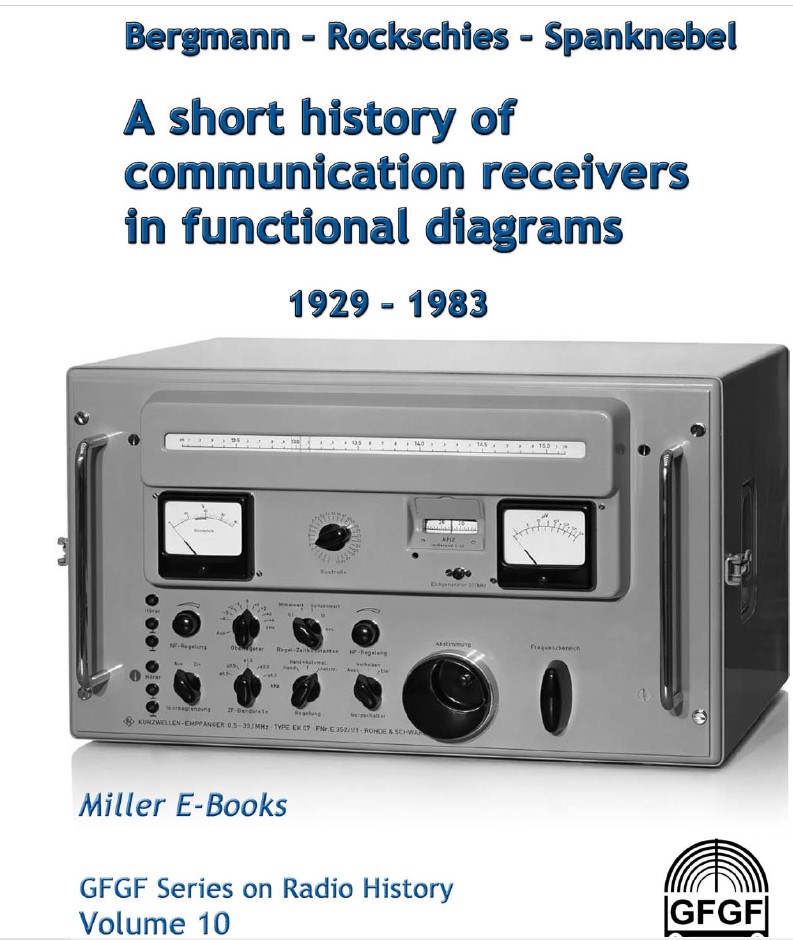
1: A short history of radio communication receivers in functional diagrams
When Wolf-Dieter Roth (DL2MCD) first approached me to review this English translation of a classic German reference book, I wasn’t sure how I would do that as I am not a book reviewer, but rather an editor.
This was also a translation, and I was afraid I would spend my time correcting the text rather than enjoying the content.
While there are some „unique“ translations, the translation is generally good, but what surprised me when I got a copy to read was that it was not what I expected.
This is not a normal textbook with different people‘s opinions of how good or bad a radio was or how it worked. It is more a technical reference that while, indeed it explains how certain radio models worked and the progression of the technologies used over the years between 1929 and 1983, it does this mainly through technical diagrams of the different radios.
These diagrams have not been recreated and many contain German text with a translation of the terms used from German to English underneath the diagrams.
This is therefore more of a reference book than an educational book and that may well appeal to people looking to restore any of the radios featured.
The translation of the book was sponsored by GFGF who are a foundation that is interested in radio history of all kinds (not just amateur radio, although most members are radio hams).
Each chapter of the book has a brief description of the particular receiver design method used and then launches into particular examples of radios using that technology. Providing block diagrams of the stages in the particular radio model. Any unique changes from the normal design for the radio type are covered in a short text on that radio’s page.
The radios featured are mostly of German origin (Telefunken, Lorenz, Siemens, Sommerkamp etc.) however some US models (National HRO, Hallicrafters, Hammarlund, Collins, Drake, Heath, Ten-Tec etc.) and some early Japanese Yaesu and Kenwood models along with Racal receivers out of the UK are also covered.
The first digital receivers from companies like Rhode & Schwarz, ITT, RFT and Cubic at the start of the 80s finish off the coverage of this brief overview of many communications receivers over the years from 1929 to 1983.
For someone wanting to get an idea of what the differences are between these communications receivers without having to dig into pages and pages of user or technical manuals, the summaries are a clear and valuable resource.
I see this book as a high-level tool to decide between different radios that may be available to the reader for restoration.
Its simple and consistent format throughout makes it easy to „flip through“ backwards and forwards to reference the data from different radios.
As I said above, the authors of this compendium have taken away a lot of the work needed when deciding which old receiver to buy and restore. That’s not to say that the book does not also provide a guide through the technologies used over these years but I see the value in this book being with those wanting to have a high-level understanding of how a particular radio model from this period worked.
Buying this book of course also helps finance the ongoing work of the GFGF foundation in documenting and „keeping alive“ radio history.
June 2023 Ed Durrant DD5LP.
 DD5LP / G8GLM / VK2JI blog
You must be logged in to post a comment.