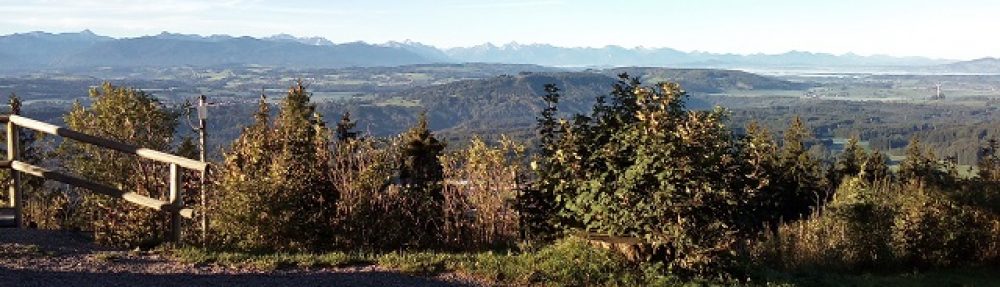
Preparation:
This is the second preservation/nature trail I have submitted for inclusion in the POTA award system and it was also accepted. This trail is very interesting, starting as it does at the spot where King Ludwig was found drowned on Lake Starnberg and finishing near his world-famous Neuschwanstein Castle (think of the well-known Disneyland castle – that was a copy of this real-life one). Along its route, it entails a ferry trip across Ammersee a visit to the UNESCO-listed Weichkirche church and at least one SOTA summit. The route runs right past the seat that I use to activate the DL/AM-001 SOTA summit.
One reason for this activation was to be the first to activate from the trail and to do that one does not have to walk the 6-day long trail but rather just set up somewhere along its route. Although I have already activated the SOTA Peißenberg summit this year and hence won’t get any points for it, I chose to do the combined activation as then I could call on two groups of chasers for contacts and my second reason for the activation would benefit from having as many contacts as possible. The second reason was to test out equipment prior to its use during the International Lighthouse and Lightship Weekend in August. I had found on previous ILLW activations, that the signal from my 20w radio was getting stomped on by other stations, so (as well as using the two-element wire beam this time), this year would have some more power on board, specifically 50-70w RMS (over 100w PEP) depending upon the band in use. I have worked at trying to get a Chinese amplifier to work reliably for a couple of months but with the MOSFETs blowing regularly it did not look promising and I decided to buy a commercial HF amplifier. Now those designed for ham bands are expensive, however, those designed for the CB bands are a lot cheaper and can be modified to work across the complete HF spectrum (3-30 MHz). I bought an RM-Italy KL-203P unit. The missing component in a 27MHz amplifier is protection against harmonic emissions. In an amplifier designed for amateur radio use, switched low-pass filters are used to block any harmonic signals. As I had, from my work with the Chinese amplifier a switchable LPF board I cased this up and cabled it to follow the amplifier and precede the ATU-100 tuner. While the LPF box uses Butterworth filters, it can operate on transmit and receive. So, as you can see, the station for the ILLW event is made of several, cabled together units and this combination needed to be tested in a portable operation before relying upon them for my ILLW station. This activation would be that equipment test.

Map where POTA nature trail and SOTA summit meet.
The Activation
POTA DE-0797 / SOTA DL/AM-001
Originally planned for Tuesday but rescheduled to Wednesday as some strapping components were delivered later than promised by Amazon and so I would have had no chance to do a dry run from the home station – that test took place on Tuesday with a contact with Leif LA9BM in Norway. He commented that the G106 with my RF Clipper speech processor and the amplifier and other components after if, while OK, the audio sounded a little deep and muffled. This report was also received later during the activation and the adjustment to the speech processor is an outstanding action to be completed.
As regards the activation itself, I had the alarm set for 6 am, was on the road by 7 am and set up and running at 8 am (all local times – UTC+2).
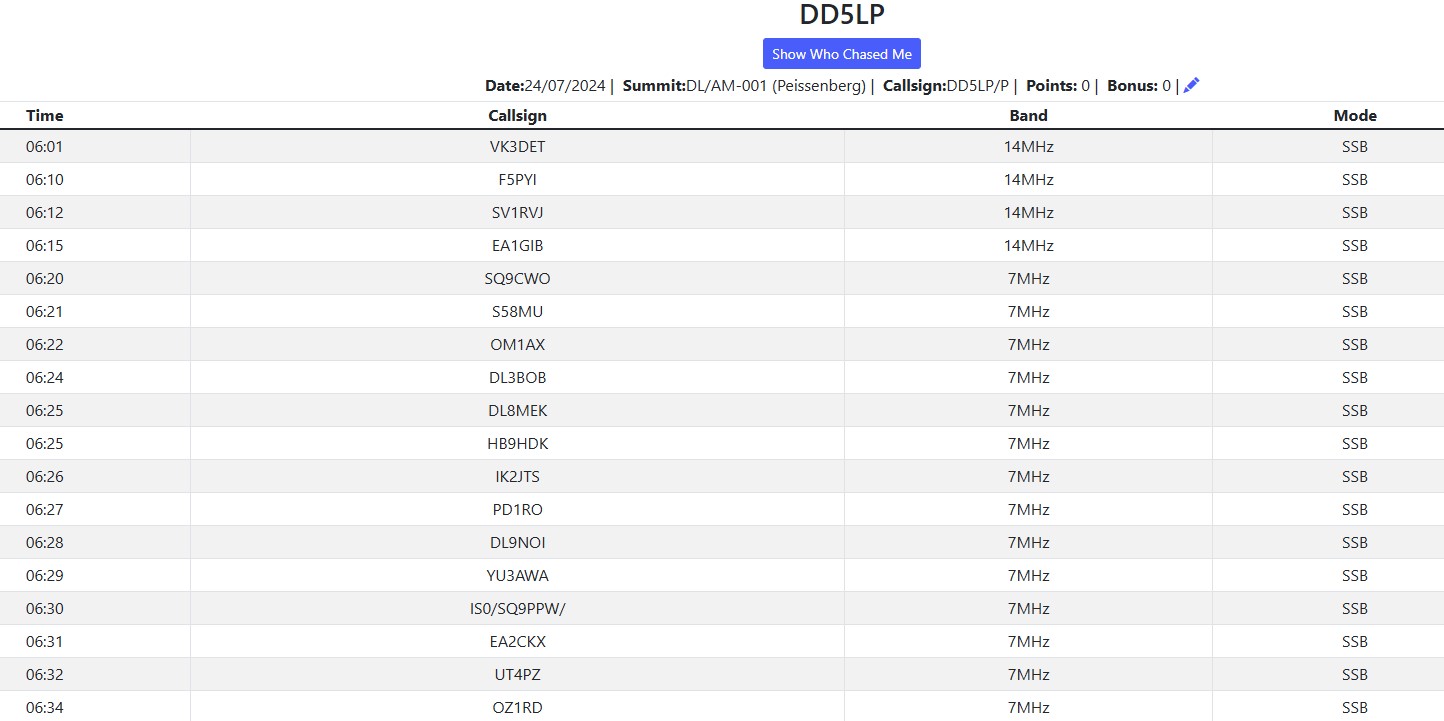
A quick tune of 20m showed a couple of US stations booming in. First in the log was Ernie VK3DET and we exchanged the same report on signal strength with Ernie running 100w, that seems a good start. It took a while to get the needed 4 contacts to qualify the summit. I put this down to the crowded part of the 20m band where I was operating. I could have moved to another frequency on 20 metres but rather I decided to change to 40 metres, as another test of the equipment. On 40 metres I had no problems finding the extra 6 contacts needed to qualify a POTA trail, indeed I had 18 contacts in 35 minutes and then, as the skies were darkening again, I decided to call it a day with the new combination of units working well together. Three further callers commented on the audio being a little difficult to read, so this confirmed what I already thought to be the case and that will get looked at while at home.
When I got home, I calculated that I had drained 2 Ah from the 8 Ah battery in just over 35 minutes so I will need to take a spare battery (or two) along for the (longer) ILLW activation next month.
Photos:
Equipment taken:
- Xiegu G-106 radio.
- DF4ZS Mini-RF-Clipper speech processor.
- RM-Italy KL-203 P amplifier.
- Switch LPF filters box.
- ATU-100 tuner.
- Aerial-59 OCF UL-404 dipole antenna.
- Six metre mast.
- Komunica Power HF-PRO2-PLUS-T loaded multiband vertical (not used).
- 5-band linked dipole antenna (not used).
- 8Ah LifePO4 battery.
- 4Ah Eremit LifePO4 battery (not used).
- 4 Ah 3S LiHV battery (not used).
- Plastic painter’s sheet and seat pad.
- Lightweight headphones.
- Smartphone for spotting.
Logs:
POTA DE-0797 König Ludwig Weg.

SOTA DL/AM-001 Peißenberg

Contacts Map
Conclusions:
- The activation went well, I was the first activator of this POTA trail, and the radio equipment performed well. The battery drain level will need to be watched at the higher power levels and the speech processor needs to be adjusted.
73 until the next activation!
 DD5LP / G8GLM / VK2JI blog
You must be logged in to post a comment.