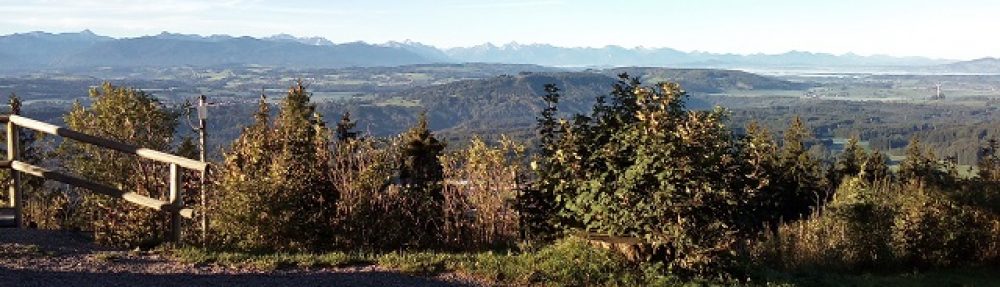
Preparation:
Fresh back from my trip to Austria, it looked like John VK6NU was going out while on holiday in Ireland to an EI SOTA summit. Mike (2E0YYY) would also head out to give John a call and to round it off if we both could get to our summits early enough Ernie VK3DET had offered to try for a contact. So a contact with either John or Mike would be both an H2S and S2S contact as my chosen summit is in both schemes.
The set-up would be the tried and tested G90 plus Linked dipole and the 6m mast, all of which pack into, or onto my medium-sized rucksack. However, after struggling with carrying the rucksack over the last few days, I decided to try something different and bought a shopping trolley with fairly large wheels from the local Aldi store for €30. when the shopping bag is removed my 40-litre rucksack sits perfectly on the frame and is held there using the existing straps and clips on the rucksack.
As the Long path window to VK had been opening earlier over the last few days, this was going to be an early start to be on air by 0630 UTC – meaning I needed to set the alarm for 0630 local time (0430 UTC) to get up, drive to the parking area, walk with the (as yet untested) trolley to the summit and set-up the gear ready for operation.
The Activation
Berndorfer Buchet – HEMA DL/HBY-064 and SOTA DL/AM-180.
This is my closest summit and it took just over 30 minutes to get to the car parking area early in the morning.
Once parked, it was a single action to take the rucksack on the trolley out of the rear of the car, so that saved a couple of minutes. I set off, half expecting to have a problem with the trolley before I got to the summit and then I would need to stop and “de-strap” the rucksack from the trolley and carry it for the rest of the distance. Luckily this did not happen and the trolley served me well, even when “bush-bashing” up the last (steepest) part of the access, where no clear path is available, there is high grass with nettles and thistles in it and the ground is covered with dead twigs and leaves.
When reaching the summit, I was able to leave the masts in the side of the rucksack, strapped to the trolley, get the linked dipole out of the top of the rucksack, unpack it and thread it onto the top of the mast, run the wires out to roughly where I thought I would be tieing them off on trees and then raise the mast to its full height. This is an improvement on the usual process of screwing the sun umbrella base into the ground, adding the mast and so on.
After also taking my thick painter’s sheet out of the top of the rucksack, I opened up the front of the pack to take out the radio and battery. This whole process worked very well and overall saved me at least 5 minutes, possibly 10.
Once I was set up, I sent Mike 2E0YYY/P a message via the “signal” messaging app (this summit has a good cellphone and hence Internet coverage) to find his frequency. A couple of minutes later we had a contact, weaker than usual but good. At this point Ernie, VK3DET tried to listen for me and gave me a call. Although I could just hear Ernie, it was difficult and again a lot weaker signal than expected. It was no surprise (given the power difference) that he could not hear me. That’s the way the bands are sometimes – however, looking into this later I think I know the reason why;
MUF during the activation – this explains some of the QSB and other problems on 20m (remember as a general rule, you will get the best DX conditions on the highest band under the MUF line). In short, 17m and even 15m might have been a better choice rather than 20m:

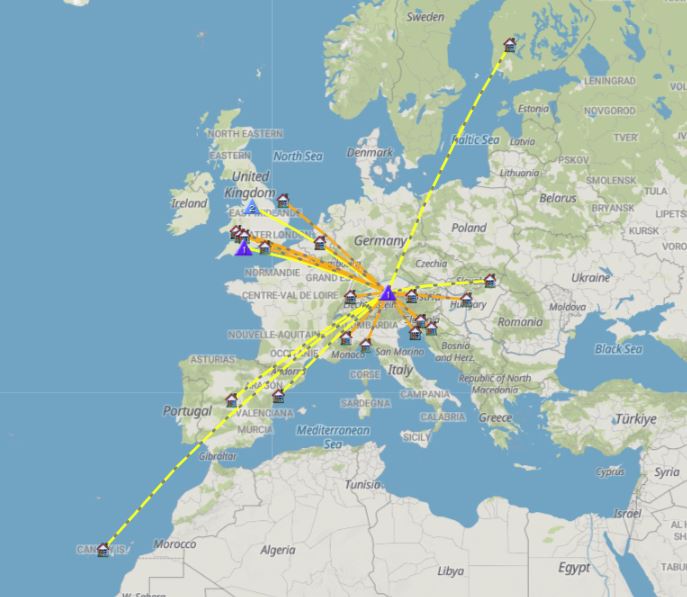
Being a weekend, there was of course the hassle of wide splattering contest stations (and wanna-bees) so finding a free frequency was especially hard on 40 metres but in the end, I got a few contacts in the log from around Europe as you will see from the logs below.
After packing up, thankfully, the route back to the car with the trolley was no more difficult than on the way up.
Photos:
Equipment taken:
- Mountaintop travelling 40-litre rucksack mounted on a shopping trolley.
- Xiegu G90.
- Komunica Power HF-Pro2-PLUS-T loaded vertical antenna. (not used)
- Modified mini photo tripod with clip-on radials (not used)
- Lamdahalbe 6m mini-mast.
- Screw-in sun umbrella support (not used).
- SotaBeams linked dipole.
- Aerial-51 404-UL OCF dipole antenna (not used).
- 4000maH LiHV battery (not used).
- 4 Ah LifePO4 Eremit battery.
- Painter’s thick plastic sheet and gardener’s kneeling pad.
- Lightweight headphones.
- Smartphone to spot and back-channel comms.
Logs:
Berndorfer Buchet
HEMA DL/HBY-064

SOTA DL/AM-180

Contacts Map:
Conclusions:
- Weather conditions in Ireland meant that John VK6NU never got properly on the air before having to head back down ahead of the storm front.
- Band conditions were variable on 20m and 40m was almost unusable because of contests that were going on, leaving hardly any free frequencies to operate on.
- The equipment all worked as it should. The trolley helped with getting the heavy rucksack along the tracks however did have some problems as I went “Bush-hacking” up the final 25 vertical metres of ascent through grass, thistles and fallen twigs on a layer of old leaves. It performed wonderfully, however, as the base support for the antenna once I got to the summit. So “the jury is out” as to whether using the trolley is better than carrying the rucksack on my back. It may be better for some summits than others. It would be easier to pull if the handle was a little higher, so maybe some modifications will happen to the trolley over the next few activations.
73 ’til the next summit.
 DD5LP / G8GLM / VK2JI blog
You must be logged in to post a comment.