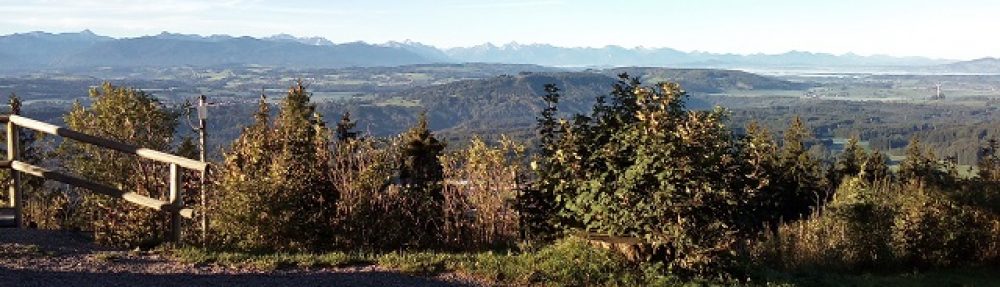
DD5LP/P – May 23rd 2022 – DL/MF-082 Schwarzer Berg.

Preparation:

As I would likely be out of operation for a few days following my next COVID booster jab, my wife suggested I get out and activate a summit on this Monday. She didn’t have to suggest this twice and as it turned out, Monday was the only day of the week that it would have been possible because of the weather (more of which later).

As the chosen summit is near to where an amateur, Rob DM1CM, whom I haven’t seen for a couple of years, lives, I invited him along as well.  As he was also looking at refreshing his portable radio equipment and was considering the same Xiegu G90 radio and Komunica Power HF-Pro2 antenna that I use, I said come along, try them out and see what you think.

On the wish list for this summit was to test some antennas out for 17 & 15m but as it turned out those bands were closed and so that is a task that will move on to the next activation.

The rucksack was going to be heavy this time and I also decided, as this is effectively a drive-up summit, to take my new seat with me as well, so that I would not have to squat on the floor.

The plan was to leave at 7 am and be on the air by 9am (both local times) so as usual the equipment was loaded the night before, into the car.

The Activation

The route to this summit can either be via Autobahn and around Munich or over country roads. In principle, the Autobahn route should be the better (and quicker) choice however hitting the Mittler ring around Munich at 8 am on a Monday morning is not a recipe for a quick trip and so I decided to take the country roads route to get there and come back via the Autobahns.

 All went fine and I was set up by 8:45 am. I sent Ernie in VK3 a message via Signal and after searching for a free frequency at both ends on 20m, we made contact 10 minutes later. This was using the linked dipole at about 5m AGL next to the (closed) observation tower. If that is ever open it would be fun to try an end-fed antenna dropped from the top of the tower, however it looks as if the tower is permanently boarded up. Perhaps it is unsafe? 

Several contacts around Europe followed, often at 59 both ways, so the equipment was certainly working reliably, which is always good when you want to demonstrate something. Rob arrived about 30 minutes later and got to see and handle the small radio. When I returned to my spotted frequency, there was Christos SV2OXS checking if I was still around and a short and easy QSO followed. After a couple more easy contacts, I suggested I get out the Komunica Power HFPRO-2-PLUS-T loaded vertical antenna and we’d try 40m. The band was full from end to end and calling some stations we could not get through because of the QRO stations – a common issue these days on 40m and often also 20m. Rob suggested that radiation may be being hindered by the fact that we were in a forest and the vertical trees can absorb the RF. Before I could change bands to try perhaps 17m on either the vertical or the linked dipole. The rain started. Not heavy to start with but getting heavier. Rob and I agreed that we’d call it a day and I packed everything away and headed back down the slope to the cars. Of course, just as I finished packing up, the rain stopped but this was a warning for later when Bavaria got some really damaging storms, that evening which brought down a newly installed support mast for my 40m and up Skyloop antenna at home. This was repaired on Tuesday with some added strength to its month, to stop (hopefully) a repeat.   

With twelve contacts in the log ranging from Australia to north, south and western Europe, I was happy with the activation. the new 4AH €39 LifePO battery had worked flawlessly as well. The bands were difficult for DX but 20m was easy within Europe. It was good to see Rob again and perhaps as he gets his portable gear together again, we’ll do some joint activations, whether it be SOTA, HEMA, GMA or WWFF.

 Photos:

This slideshow requires JavaScript.

Equipment used:

  • Mountaintop travelling 40-litre rucksack.
  • Xiegu G90 HF transceiver.
  • New “pop-up” seat.
  • Lambdahalbe 6m mini-mast.
  • Screw-in sun umbrella base.
  • SotaBeams linked dipole.
  • SOTAbeams end-fed antenna (not used)
  • Komunica Power HF-PRO-2-PLUS-T loaded vertical and tripod.
  • 4000 maH LiHV battery (not used)
  • Battery box (2 x 5000maH hard-case 4S LIPOs) (Not used).
  • New LifePO4 4AH battery.
  • Painters thick plastic sheet.
  • Lightweight headphones.

Log:


Conclusions:

  • The new LifePO4 battery worked flawlessly.
  • For once, demonstrating equipment did NOT make it fail without reason!
  • The Xiegu G90’s 20w was enough to get several 5-9 reports from around Europe.
  • The seat worked well, but having a “table” of some sort would be an improvement, as leaning over from the seat is not ergonomically correct. Perhaps I should try it with one of the small foldable seats that I used to use on SOTA activations some years ago?

73 ’til the next summit.
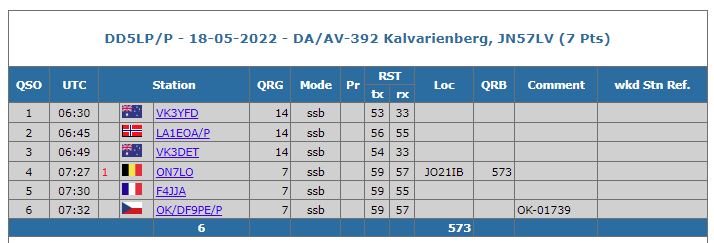


DD5LP/P – May 18th 2022 – GMA – DA/AV-392 Kalvarienberg.

Preparation:

With the weather improving and the bands being kind for DX contacts lately, it was time to get out and test the antennas on the higher bands (17m, 15m, 10m). I didn’t want a long journey and so decided to see if a local GMA (Global Mountains Award) summit would serve as a testing ground for antennas going forwards. this would be my first GMA activation since 2018 and the online website has had a lot of features added, indeed spotting and alternating and monitoring all cover several schemes whether it be WWFF, SOTA, Castles, Lighthouses or GMA, all are covered through the system.

The summit, which I had never visited is just a 15-minute drive from my home, so if this worked out as a good summit, it could be very useful for tests.

Being so close I wouldn’t need to get up and leave so early if I wanted to try for contacts with VK. I loaded my rucksack with additional antennas and masts into the car on Tuesday afternoon in any case, to minimise what I would need to do on Wednesday morning.

The Activation

Although I have never been to this summit before I have been through the village that it overlooks many times. On the map, there is no public car park but looking at a satellite picture I saw an area with a car parked in it that was close to the start of the track up to the summit. On arriving there, the car park is labelled as an official public car park for walkers.

It was no time at all before I had parked the car, and put on my rucksack after deciding to take one antenna and one mast out of it to lighten the load a little. I crossed the road and headed along the parallel to the road bitumen path to where the track up the hill starts. As you will see from the photos, there is a series of monuments with pictures of Christ carrying his cross up a hill, so this is definitely a pilgrim way up to the small church on the top of the hill. 

Although steep in places, it is a reasonably easy climb to the top and after passing the grotto you come onto a sort of lawned area before you get to the church. There is also a grassed area by the church but the first one had two bench seats and I could set up there without obstructing the way for others, so that is what I did and I was fully operational with the first of my two wire antennas (a 40m OCF antenna from Aerial-51) by 0630 UTC (8:30 am local time) half an hour ahead of schedule.

I tuned around 20m and could hear several VK5 and VK2 stations on the band. Most activity on the band was in the bottom half. I believe this is because the lower half of the band will open first as the MUF increases.

  I messaged Ernie (VK3DET) and Ian (VK3YFD) in Victoria Australia and my hope was to try 20, then 17 and then 15m with them and see how the antennas performed.

Contacts were more difficult than usual today but with some hard work on their ends, I got Ernie and Ian into the log. To make sure it was not a problem with the Aerial-51 OCF antenna, I took it down and replaced it with the SOTABeams linked dipole. Although Ernie and Ian reported a slightly stronger signal from me, I believe this was just a change in radio conditions rather than the antenna. Of course, the best would have been to have both antennas up at the same time and switch between them but there is not enough space at this summit to do that without risking interaction between the antennas. Checking 17 metres from both Australia and Germany – it was dead and it was obvious that I was not going to be doing any tests on 17 or 15 metres. 

After finishing with Ernie and Ian, I spotted myself on the GMAWatch site and put out calls on both 20m and 40m. The final total for the activation was contacting just 6 different stations. a bit of a disappointment but at least I had been able to check out this local GMA summit which looks like a nice place to go in good weather but could also fill up quickly with tourists making radio operation difficult if not impossible.

 Photos:

This slideshow requires JavaScript.

Equipment taken:

  • Mountaintop travelling 40-litre rucksack.
  • Xiegu G90.
  • Komunica Power HF-Pro2-PLUS-T loaded vertical antenna. (not used)
  • Modified mini photo tripod with clip-on radials (not used)
  • Lamdahalbe 6m mini-mast.
  • Decathlon mast base spike (not used).
  • Sun Umbrella screw-in base.
  • SotaBeams linked dipole.
  • Spider beam / Aerial-51 404-UL 40m OCF inverted-V dipole.
  • Battery box (2 x 5000maH hard-case 4S LIPOs).
  • 4000maH LiHV battery (not used).
  • Painter’s thick plastic sheet (not used).
  • Lightweight headphones.
  • Smartphone to spot and back-channel comms. 

Log:


Conclusions:

  • While the weather was sunny (which lifts the spirits) the radio conditions were not nearly as good as they have been of late. This meant NOTHING was happening on 17m and above and I was lucky to get the contacts on 20m.
  • As conditions were changing, I was not able to conclusively say whether the linked dipole is a “better” antenna than the OCF or whether simply the conditions changed.

73 ’til the next summit.


DL20SOTA/P – May 5th 2022 – DL/AL-179 Weichberg & DL/AL-169 Auerberg.

Preparation:

As weather and radio conditions were OK and I had the opportunity to use the 20 years of SOTA special event callsign DL20SOTA again, I decided at relatively short notice to activate these two easy summits. I was looking for summits where if the weather turned bad, I knew them well and could safely get back down from them with the limited risk of injury. They also needed to be not too far away as I planned to get on the first summit at least in time for some 20m long path contacts into Australia and possibly New Zealand. It seems that now, in May, the greyline is coming across earlier and hence I would not be lucky enough to get 40m contacts “down under” but I did plan to try for some 17m contacts as well.

With a planned leave time from home of 7 am, the gear was packed in the car the night before and I also decided to take my new seat along for use on the second summit as the last time I was there, the benches had been removed. While this is a short walk from the car park the extra weight of the pop-out seat would not be a problem. 

The Activation

The trip down was uneventful and quick as this is a route that I know without the need for maps or GPS having been there many times (mind you, that didn’t stop me from missing one turn in the route between the two summits and having to turn back to find it).

Weichberg – DL/AL-179.

My plan was to work Ernie VK3DET, Ian VK3YFD and Mike 2E0YYY/P on 20 and possibly 17 and 40 metres before I started the “true” activation where I expected (and got) pile-ups from SOTA chasers wanting to talk to the special event station.

My equipment set-up did not start well. When putting up the antenna, running out both arms of the linked dipole (which also act as guys for the telescopic mast) one side broke off at the feed-point bracket. My belief is that this must have been bent backwards and forwards many times over the years and finally, it gave way.

While this was an unwanted problem, I did at least have 15 minutes or more in hand on my planned times. As you will see from the pictures I managed to jerry-rig a repair which thankfully worked for both activations. I had taken my Swiss Army penknife out from my bag just the day before as the wife wished to borrow it, so I had to revert to strip the wire covering off with my teeth. Thankfully everything went well and we were back in business. Had this not worked I also had my Komunica HF-PRO2 loaded whip antenna and tripod in my pack, however, I prefer to use the linked dipole when I have the option.

As I was a little early, Mike was still setting up as I worked Ian and Ernie on 20m. after those successful contacts I asked them to try 17m and while I could hear the guys in VK3, they could not hear me, so the band seemed not to be as good as it had been. By this time Mike had set up so we went back to 20m and then 40m, where I managed to work Mike but the others could not hear either of us on 40m. 

It was now getting close to my alerted time for the SOTA chasers, so I messaged the group via Signal and left them to complete their contacts while I went off and found a free frequency on 20m. Not a simple task as there are many stations these days on 20m in the morning. Many of whom were not around trying for contacts when conditions were more difficult over the last few years. Many of these stations need to go back and learn some manners as they start up without checking the frequency range that their wide signals cover is free for use. The end result is that the lower-powered stations like myself, have to change frequency often to be able to make contacts. Sometimes this frequency change can be combined with a band change to give different chasers a chance of a contact with the summit – and in these two activations with a contact with the special event call sign.

By the time I finished on weichberg, I had 39 contacts in the log mainly on 20 & 40m. 17m wasn’t working so well it seemed … but that was to change at the next summit.

Auerberg – DL/AL-169.

After packing up and returning to the car at the first summit, I set off for what should have been a 30 minute trip to the next summit (Auerberg). It actually took about 5 minutes longer as I missed one turn-off as mentioned before but I was still well within my time plan.

Because the last time I was here the benches behind the church (which is located exactly on the summit) had been removed, I took my new “telescopic chair” with me from the car. As I walked around the church, I saw there has been additional wooden benches installed at the side and as I turned the corner, also at the end of the church where I always set up. So the new chair was not needed after all.

On this summit, I did not try for any VK/ZL contacts as it was later in the morning and too late for long path, or so I thought. (I found out later that had I started on 20m rather than 40m from Auerberg I may have got a couple of VK contacts). In any case, on this 2-point summit, I wanted to get as many chaser contacts in the DL20SOTA/P log as possible. The surprise was three S2S (Summit-to-Summit) contacts including one with JW/LB1RH who is part of the DXpedition team to Svalbard way up in the Arctic Circle! That contact was even on 17m to surprise me even more. The other two S2S contacts only count as one as it was with Stavros SV2RUJ/P on a Greek summit – firstly on 17m and then on 20m. So 17 metres certainly seems like the band to look at to get away from the DQRM and general bad behaviour from some operators.

 I did get one request for a 60-metre contact and I only realised afterwards that I DID have the antenna extensions with me but while running the special event callsign and having the large pile-ups it was not the time to try out an untried antenna extension! That’s something to try when I’m “just” operating under my own callsign.

The totals from this second summit were 15 contacts on 40 metres, 4 on 17metres and 20 on 20 metres.

As I arrived home, the forecasted rain started but not as strong as had been predicted, at least not where I live. The heavy storms only arrived in the evening.

 Photos:

       DL/AL-179 Weichberg

This slideshow requires JavaScript.

     DL/AL-169 Auerberg

This slideshow requires JavaScript.

Equipment used:

  • Mountaintop travelling 40-litre rucksack.
  • Xiegu G90.
  • Lambdahalbe 6m mini-mast.
  • SotaBeams linked dipole.
  • 4000 maH LiHV battery (not used)
  • Komunica HF-PEO2-PLUS-T, tripod and radials (Not used). 
  • Battery box (2 x 5000maH hard-case 4S LIPOs).
  • Painters thick plastic sheet.
  • Lightweight headphones.
  • “Telescopic” seat (taken up to the second summit but not used).

Logs:

     DL/AL-179 Weichberg

     DL/AL-169 Auerberg

Contact maps from Sotamaps:

From Weichberg:

From Auerberg:

Conclusions:

  • The break in the linked dipole was a surprise from this, my most reliable antenna. It is now properly repaired and ready for a few more activations. At least my temporary fix held-up for both activations.
  • The Solar flares that arrived in the two days prior to these activations certainly had an effect on radio conditions but I was really happy to get the 17m S2S with the station on Svalbard – even more so when after getting home, I looked at where this island is! It is a lot further north than I had thought it was.
  • Overall the activation was a success with plenty of chasers getting a contact with DL20SOTA/P. The level of QRM on both 20m and 40m now, especially on a weekday, is becoming totally out of hand. Add to that incompetent or simply full-of-themselves operators and the WARC bands are becoming more and more attractive. I think I may try to use 60 metres next time out.

73 ’til the next summit.