DD5LP/P – May 31st 2019 – DL/AM-001 Peissenberg – hoping for contact into VK with VP2E antenna.

Preparation:

As Jonathan VK7JON was heading out with his wife to a beach in Tasmania to operate portable, Mike 2E0YYY, Bill F/G4WSB and I decided, despite the early hour that we would head out to some summits to see if we could get a contact via 40 metres long path.

Due to the early start needed to meet the long path window and Jonathan’s planned activation time, I chose Piessenberg even though I had already activated it three times this year.

There was also a chance to make a contact with Thomas operating as FR/F4HPX/P from Reunion Island off the coast of Mozambique on the 10 pointer FR/RE-004 summit about 30 minutes later (this most likely on 20 metres).

As I had updated my two VP2E antennas since getting back from Dayton, I decided it was best to check that they were still correctly resonant on their bands (one is 40/20m and the other 20/17m). This I did on Thursday (the day before the activation) and thankfully all was fine (if you are interested in this antenna, the full design details and my tests are documented on this website under Equipment/Antennas/HB9SL Vp2E antenna).

The Activation:

The 40 minute run down to Peissenberg went without any problems only when I arrived, there was a surprise. The car park was not there any more! It was covered with an enormous marque tent, such as sometimes are used for large wedding receptions. Luckily there was still some parking space off the road at the end (near the woodwork statue) and the area that I wanted to use (on the grass field at the side of the car park) was still clear. So I parked and then carried everything to one of the convenient bench seats.

 After setting the antenna and station up, while tuning around looking 40 metres for a free frequency I came across this strange transmission on the band.

I initially checked if 7090kHz was free, spotted my self and started putting out a CQ. after about 10 minutes of no contacts a CW station started up on the frequency. While this is the QRP channel, it is well outside of the normal CW area of the band. Given the slow speed of the morse, I guessed it was some form of CW teaching class and decided to go and find a different free frequency.

I ended up on 7163 kHz between two other stations as the band was quite busy. I was able to keep this frequency for the whole time I was active, however, so that worked out well. Perhaps as it was still silly-early there were not that any callers to start with and I wondered if in fact, I was getting out OK? I could certainly hear stations. I took a tune around and found GJ/OQ7A/P on an IOTA DXPedition on “The Minkies” in the Channel Islands. As he was not getting any responses to his CQ calls I gave him a call and we had a short chat proving that we were both getting out and it was the lack of chasers that was the problem. I then went back to my 7163kHz frequency and got a slow run of callers from around Europe, including an S2S call from Bill F/G4WSB/P on FL/VL-001. Mike 2E0YYY/P also called in, he had chosen to go to a closer HEMA summit rather than a SOTA one, so this didn’t count as an S2S contact in SOTA terms but a nice short chat in any case. In the ten stations that I worked there were both a few new calls and a few of the old reliable chasers. It was interesting that with some of the stations they were weaker than usual, while others were stronger. This I put down to the direction I had set up the VP2E antenna as it was “aimed” long path at VK. Unfortunately, even though Jonathan VK7JON managed a contact with Mike 2E0YYY in the UK, he never made it the whole way down to me which would have been another 1000 km and another skip off the Ionosphere. I was just thinking it might be time to take a listen for Thomas on Reunion Island as we had come to the end of the best possible part of the long path window to VK by this time and then I heard an engine. It was the local farmer coming across the field cutting the tall grass down. I managed to flag him down before he got to the antenna and told him I’d have it packed up and out of the way in 5 minutes. He was apologetic but explained that the field had to be cut at that time – hey it’s his field I’m in, he didn’t need to be apologetic. In any case, it was a nice meeting. He went off and cut another part of the field while I packed up and then came back to take care of that area. He said he wouldn’t be long and it would be fine if I wanted to set-up again in a few minutes. I thanked him but decided not to as it was already almost the time I was going to call it a day in any case.

That’s the first time my activation has been “cut short” as the antenna nearly was! in any case HI!

After packing up, it was a casual drive back home during which time it started to rain, so had I stayed longer, that would also have been with me.

Photos:

This slideshow requires JavaScript.

Equipment:

Xiegu X108G 20w HF transceiver

Surveyors large tripod

DX-Wire 10m “mini-mast”.

Homemade HB9SL VP2E antenna (Linked 40/20m).

Log:

Conclusions:

With the Kp Index still being between 2 & 3 from a CME that hit 48 hours earlier, some deep QSB and static cracks from the approaching storm, reception on 40m was never going to be good. I did hear at least one station calling me that I couldn’t make out in the noise. Another started but came up out of the noise so that I could work him, so with a LOT of luck and Jonathan calling me on my frequency – the contact “might” have been possible but it would have been a minimal contact, nothing like the 5-7 each way contact that he had with Mike 2E0YYY/P. That extra 1000 km and extra bounce off the Ionosphere make a big difference.

I continue to like the capability of putting the mast where I want it, with the surveyor’s tripod, despite its size and weight. At Peissenberg, I only needed to carry it about 70 metres in any case.

The VP2E does appear to work well and I know have the ends raised off the ground using my walking poles, so that the wire doesn’t drop into the grass.

As it was still early and there was little sun to speak of, I was able to operate the X108G without having to plug my SmartPhone into it to use as an external larger and brighter screen.

73 ’til the next Summit!

W8/VK2JI/P – May 19th 2019 – W8O/CT-001 Campbell Hill – Activation but no Qualification!

Preparation:

As part of my trip to Hamvention in the US I planned an activation of a summit in the US for my SOTA Mountain Explorer award. That of course comes with some restrictions and the “normal” SOTA kit was going to be too heavy and take up too much space to take on the plane.

Please refer to my last entry – the activation of Peissenberg (here) to test that the seven year old antenna solution still worked. – it did as so it was the solution that I packed.

The activation was going to have to be a quick one as I was with 4 others on this trip, three of whom who weren’t that interested in SOTA. I already new the exact summit was going to be closed as it’s in the private grounds of an educational facility but luckily there. a road alongside the fenced area that is still within the activation zone, so that would be my location.

The Activation:

Despite the fact that the morning was dry, as we got closer to the SOTA summit (the highest point in the state of Ohio) I saw a post on SOTAWatch from another activator on a SOTA summit in Ohio who was packing up as a storm front was coming his way.

Had we got to the summit at the originally planned time we would have been all right however our plans changed and it meant that the (very heavy) storm front hit as we were having lunch in Bellefontaine – where Campbell Hill is located.

we set off anyway in the hope that by the time we arrived at the summit, the rain would have stopped – it didn’t. It got WORSE!

We found a concreted area off the road which was a recycling drop off point and Edmund M0MNG (the other SOTA interested member of the ICQPodcast team) who had sensibly ONLY brought an HT and an extended antenna along, positioned himself under what cover from the rain could be found under the overhang from a small building on the parking area and started calling CQ SOTA on the US 2m FM calling frequency.

I in the mean time, started unpacking my EFHW antenna while trying to see which tree I might get the cord over to get the end of the antenna up in the air. It’s at this point that I remembered how long the 40m EFHW is and that hauling it up in any of the available trees would not allow me to use what little cover the was from the small buildings roof. I decided to wait a while in the car as I was already soaked through. At this point Edmund got his first 2m SOTA contact of the activation working VA3VAD/M – Canada!!! (actually not – it appears the Canadian Hams mobile in the US, simply use their Canadian call without the need for any prefix or suffix! In any case once Edmond had worked the station, I asked if he would let me work the station and of he did. In this way, we had both “activated” if not “qualified”, the summit as I was starting to doubt whether we would achive the required 4 contacts to get the points for the summit.

I waited a further 20 minutes and the rains did not subside – it was a constant downpour and the lightweight jacket I had with me was doing a good job but the jeans were dripping wet. I then asked Edmund whether he wanted to continue as the others were waiting for us still in the coffee shop in the village where we had dropped them off. Then at this point after 40 minutes of no contacts – he got a call and was eager to stay to try to get the 3rd & 4th needed contacts. Number 3 came relatively quickly but number 4 took some time, but it DID come and we were able to head back to the rest of the group. Well done for your perseverance Edmund!

I was disappointed that I didn’t get my station set-up on HF as I’m sure – despite the rain, the contacts would have been there. In hindsight (that great thing Hindsight) I could have attached the telescopic whip and “miracle antenna tuner” to my FT-817 to get on HF without the need for the long wire antenna – it would have been better than nothing, but I simply didn’t think of it! I could have operated on 2m or 70cm as well with the FT917’s “rubber ducky” antenna, but that would most likely have caused interference to Edmund.

  At least, with Edmund’s help, I activated the summit, in that I had a contact from the summit, but having carried all the HF gear with me from Germany, I would have liked to have used it.

An hour earlier and two hours later at the summit there was no rain but that was simply not possible with the travel schedule restrictions that we had.

Photos:

This slideshow requires JavaScript.

Equipment:

Wouxon KG-UV6D (Edmund’s)

Home made two metre loaded vertical whip (Edmund’s).

Log:

Conclusions:

Sometimes things just don’t go right! The rest of my trip went very well.

In hindsight;

If we had stuck with the original schedule the activation would have been finished before the storm arrived – possibly even with a HF S2S contact to the other W8O activator that was out.

I could have tried the “Miracle Antenna” on HF when it became clear I wasn’t going to be able to get the end-fed-half-wave antenna out.

It was lucky that Edmund had taken a different approach. without him having his 2m HT with him – unless I had remembered that the FT-817 does 2m as well, I wouldn’t have activated and Edmund, qualified the 4 point summit.

73 ’til the next Summit!

DD5LP/P – May 8th 2019 – DL/AM-001 Peissenberg – testing equipment for US trip.

Preparation:

as I intend visiting Hamvention in the US this month, I have also planned in an activation of a summit in the US for my SOTA Mountain Explorer award. That of course comes with some restrictions and the “normal” SOTA kit is going to be too heavy and take up too much space to take on the plane.

Seven years ago I made up some very lightweight end-fed half wave antennas for a trip from Australia to Europe where I had similar space and weight restraints. At that time however I hadn’t being doing SOTA for very long, so these were some of my first antennas for SOTA.

For the transmitter, I decided it would be easier to take my 5 watt FT-817ND rather than my Xiego X108G 20 watt transmitter, given the current aversion to Chinese products by the US Government (and possible questionable FCC approval). The Yaesu will have all of the US approvals while the Chinese unit may not.

So that will be the configuration; the FT817ND and the EFHW antennas for 40m and 20m matched to the 50 ohm antenna port on the rig using a small “Miracle Antenna” ATU unit.

I checked the antennas at home on the antenna analyser and they seem fine still after so many years of no use but I needed to check the complete configuration out at a site that would be somewhat similar to what I expect at the W8O/CT-001 Campbell Hill summit in Ohio. (Please listen for me and the rest of the ICQPodcast team around 1600 UTC on Sunday May 19th).

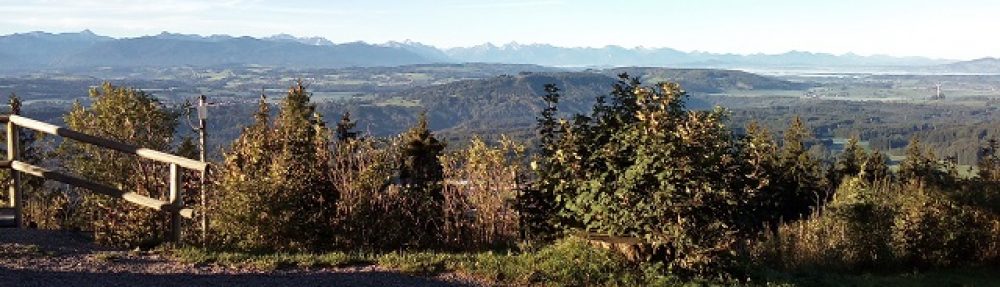
I chose Piessenberg for this. Not my usual location at the absolute summit, alongside the church but in the car park a little further down the hill, which is still in the activation zone and with a parking arae and a few trees is similar to what I expect at Campbell Hill.

The Activation:

Despite the fact it was cold and drizzling from time to time, it turned out to be a magic activation! My expectations of the antennas were not great before starting and the activation didn’t start well, with me throwing the throw bag too hard and it wrapping it’s cord around two branches. Luckily I had brought the standard gear with me as backup and I took the 6m fishing pole out and used that to untangle the mess I had made. After that I threw the bag with less force and all was fine.

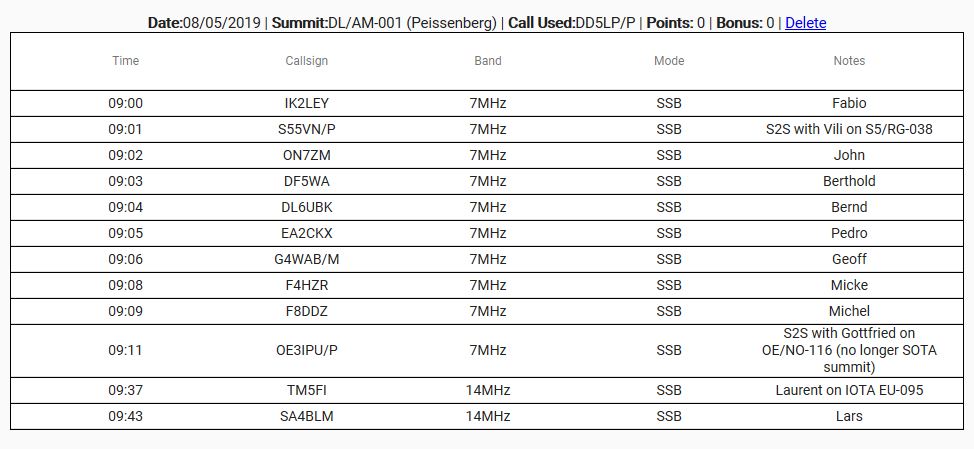
In a quarter of an hour I had 10 chasers call me on 40m, two of those were S2S calls. These came from pretty well most directions around Europe with (true) reports given from 3-3 to 5-9 – even the 3-3 got revised to 5-5 as the QSB came up and the QRM went down.

Taking the 40m antenna down and putting the 20m one up took about 15 minutes and once on 20m I had problems getting calls, so I tuned around and found the IOTA DXPedition station TM5FI who came back to my first call and we exchanged 5-9 reports – I don’t know if this was a true report, however the station after me only got a 5-6, so I think it might have been. A few more 20m CQs raised reliable Lars SA4BLM in Sweden who gave me a 5-3.

With just five watts and simple antennas only about 3m AGL in the lower tree branches at one end and on the bench seat at the rig end – I’m really surprised (and happy) with the results!

I had just one job to do when I returned home – I had managed to snap the 40m antenna while winding it up. I use printed circuit board patching wire (about 28 swg) for the antennas which make them REALLY compact and light to carry but one downside is that the wire breaks easily.

Photos:

This slideshow requires JavaScript.

Equipment:

Yaesu FT817ND

Home made end-fed halfwave antennas for 20m & 40m.

“Miracle Antenna” ATU.

Throw bag and cord.

Log:

Conclusions:

I start to wonder if the bigger heavy antennas I normally use are worth the extra effort when I get such good results with the simple antennas. Conditions weren’t great either. OK but not great.

What is clear is that this ultra-small configuration still works and will be what I take to the US in a weeks time.

73 ’til the next Summit!