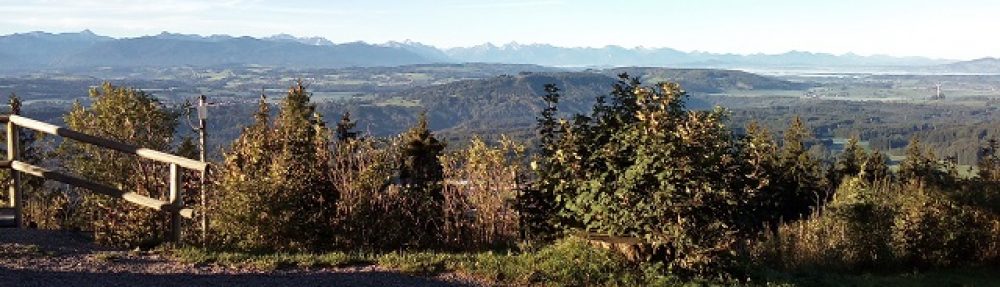
DD5LP/P – November 3rd 2018 – DM/BM-135 Hesselberg (NA-EU S2S) an activation that was more of a demonstration.

Preparation:

I decided that Hesselberg would be my summit for the big EU-NA “Transatlantic” S2S event. After the activation on the previous Thursday, this one is a “walk in the park” to get to from the car park.

Having had some success with two NA contacts from Hinteres Hornele, I was hoping conditions would hold up not realising the “small” contest that was on was actually the Ukrainian DX contest and it would cause problems.

I had decided that the new Komunica HF-PRO-2 plus tripod would be my primary antenna for 20m with the standard SOTABeams linked dipole covering 40 metres for me, as well as being a back-up for 20m. The rig would be the X108G again and I was not expecting any sunshine from the forecast, so maybe the difficulty of reading the display on this (marketed as an “outdoor” transceiver) rig would not be a problem (wrong!). After my experiences on Hinteres Hornele, I was back with the two backpacks. The camera case with the rig, battery box and headphones in it and my small rucksack with the wire antennas, to which I added my three J-pole antennas from Lambdahalbe (20m, 17m and 15m) – well you never know! I also put the 10m DX-Wire portable mini-mast in the car as I would need that if I decided to use the 20m J-pole. So again, I’d be taking more than I need but I could leave the heavy things in the car and pop back for them if I needed them at this summit.

Hesselberg is a 6 point summit, so I hoped it would be attractive to the chasers and especially other activators looking for an S2S contact. Timing-wise, given the 2 hour drive each way, I’d need to be leaving by 3:30pm local to head back home before it gets too dark. Based on this, a departure from home at 10:30am local would give me sufficient time on the summit, if a little earlier than ideal for EU-NA contacts.

The Location:

Hesselberg is located north of Augsberg and about half way between Ingolstadt and Stuttgart. It has the advantage that having a Radio transmitter mast on top of it, there’s a road almost all the way to the top. It is also in an area where access to the summit for walkers is well-defined. There are even disabled persons spots in the car park, making this summit a possible for disabled operators although some help getting up the last few metres to the summit would be needed as it’s a rough track.

At the summit, as well as the standard cross, there is also a mini-cross and a trig point stone along with two information boards and a table with bench seats at each side of it.

The Activation:

The drive was uneventful and the weather clear and it stayed that way on arrival for a change. I was actually able to take some shots from the summit that weren’t just clouds and fog as they had been in the last two visits.

After leaving the car park and heading up to the summit, I could see this was going to be a busy summit. The table and benches were occupied but as I approached, I was lucky, they were just leaving. There were also some other people standing around enjoying the view but they indicated they didn’t want the table, so I unloaded both packs, mast and HF-PRO-2 onto the table and set to putting the vertical antenna together. At this point I got asked what I was doing and I stopped to explain something about Ham Radio and gave out a brochure. This was going to be the pattern all through the activation. I spent more time explaining the hobby thank being on the air.

The HF loaded whip was set up quite close to the end of the picnic table and the 6m mast got fastened to one of the information signs and the linked dipole put up. One end of the dipole ran out nicely into some bush land. The other end unfortunately ran out into the open area. Later one woman tripped on it (despite it being bright yellow). She didn’t hurt herself, apologised and asked what it was all about … I put the peg back in and went through my explanation again. The worst visitor was one unruly young girl who despite being told by her teacher or parent (it was a big group) continually kicked at the antenna guy peg until it came out (bent). I was not happy but there was little I could do! To their merit another family group had three young ladies probably between 9 and 12 years old and they politely asked if they could sit at the table and asked polite questions and they were a pleasure to talk with. They were learning English at school but didn’t try any with me, the conversation was in German – but I think they’ll have a story to take back to school about meeting the crazy English man with his radio talking to people in other countries. Their parents also got one of the DARC brochures that I had luckily thought to print out on Friday.

Somewhere in between all the explanations, I did manage to get on the air. First I tried the HF whip on 20m – I could hear lots of stations as there was the contest in full swing but from the start of the activation to the end it was very, very difficult to read anything on the X108G display and while it was light, there wasn’t any bright sunshine. I could hear lots on the whip but all of the stations that I called and my CQs never received any answers. So I switched to the wire dipole and changed the links to cover 20m. to find …. I could hear lots of stations but no one came back when I called them! I started to wonder if I had hit one of the buttons on the rig and something wasn’t set right – but I COULDN’T READ THE DISPLAY!

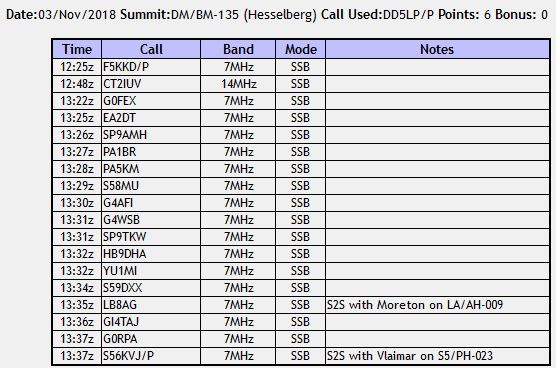
Perhaps it’s 20m? So I switched to 40m. and I managed to get through to F5KKD/P – this was my first contact after over half an hour on the summit! I was starting to think I wasn’t going to even get the needed 4 contacts to get the points for this summit, never mind any S2S contacts NA or EU! I went back to twenty metres to see if I could hear any of the other SOTA activators who by this point were on their summits – NOTHING and this using the trusted linked dipole. Conditions seemed to be going up and down but this was worse than I had seen for sometime. Had the solar winds already hit? (I found out later – no, we were lucky and missed those). Another 20 minutes, some more instruction on Amateur radio to visitors and then CT2IUV replies to my spotted CQ call (oh yes while using Vodaphone the Internet connection was questionable and I was unable to spot, despite the fact that the phone was showing 3 bars and a 4G indication – once I realised and switched to the other SIM to get a Deutsche Telekom 3G link, everything worked fine). Another half an hour passed by which time it had got cold on the summit and my departure time was fast approaching. This was starting to look like a failed activation, then all of a sudden I got a stream of calls on 40m – 16 contacts in 15 minutes.

Once the calls stopped, it certainly was time to pack up and while packing away the HF vertical, the clip for the radials broke from its wire (I don’t think this will have affected the performance as it was still hanging by a few wires I guess), but who knows and also the wire to one of the links in the linked dipole broke – this one I think could have affected the dipole antennas performance as would have the number of people stood next to the wire and that unruly female offspring kicking the peg!

Photos:

This slideshow requires JavaScript.


Equipment:

Xiegu X108G and Battery box

Komunica HF-PRO-2 and tripod.

SOTABeams Bandhopper linked dipole plus home-made loaded J-Pole for 20m and

LambdaHalbe “End Fed Half wave” (J-pole) antennas for 20m, 17m & 15m (not used).

Lambdahalbe 6m fibreglass mast.

DX-Wire 10m portable mast (not used).

Log:
Conclusions:

The good: I did mange two S2S contacts (albeit this side of the “pond”) and qualified the summit. The battery box with it’s diodes replacing the “Buck” converter worked without RFI problems again.

The Bad: The continuing problems with not being able to read the rigs display! The suspicion that perhaps one half of the antenna was not fully connected on 40m.

The Ugly: That little brat-ess kicking away at the antenna! In fact trying to operate from a summit when there is a contest on and it’s a summit that is easy to get to and so is crowded. The variation in the conditions and the fact that apparently, some better conditions arrived after I had packed up.

73 ’til the next Summit!

DD5LP/P – November 1st 2018 – DL/AM-058 Hinteres Hoernle – or another success with the HF-PRO-2.

Preparation:

For a few days twenty metres has been performing surprisingly well (at least compared to the last year or so). November 3rd sees the annual NA-EU S2S event now renamed to the transatlantic S2S event as we had hoped some South American activators may join in. I had originally planned this summit for that event, however over the last week, because of high wind the seat lift has not been running one day and OK the next, so this was a risk for the big event and I chose to activate Hesselberg DM/BM-145 instead. As November 1st is a holiday in most of germany, I decided that one last test after changing the power supply box to no longer use the noisy “Buck converter” unit and building a new cardboard shade for the X108G’s – unreadable in sunlight – display, would be a good idea and if the seat lift is running, then why not Hinteres Hoernle?

The equipment would be the X108G and battery box and headphones with the standard 6m mast and two wire dipoles plus my tripod and the Kommunica HF-PRO-2. Also water and all the usual fix it bits. Normally this would go in a small rucksack and a photo bag but this time I decided that as I would be taking the seat lift one rucksack with anything would be a better idea. So I dug out my full-sized rucksack, that I know the photo bag fits exactly in its bottom section and everything else went in the top section. Everything that is apart from the 6m mast and the HF-PRO-2 which even when taken apart is still over a metre long. these went strapped onto the two sides of the rucksack. This has the advantage that the antenna doesn’t stick out “too” far above the rucksack.

Great idea I thought and all was ready for the next day, where I had planned a casual 1pm departure with a 1 hour drive to the valley station of the lift and then, I was thinking a 15 minute ride up the mountain and then a casual 15-20 minute walk to the summit, right ? … wrong! Read further.

The Location:

Hinteres Hoernle is located above the village of Bad Kohlgrub, from where you take the seat lift. Remember to take the small tab from your parking ticket with you when buying a ticket for the lift, as they rebate 50% of the parking fee, so that the lift (up and down) plus my parking cost only €10. The “Hoernle Schwabebahn” built in 1956 (and it shows it), takes you up from Bad Kohlgrub (very slowly – it takes the best part of 30 minutes) to the “Vorderer Hoernle” (front horn). From there you walk past or over the “Mittlere Hoernle” (middle horn) before you get to the highest of the three summits – the Hinteres Hoernle (Rear horn). In my memory this walk would take 15-20 minutes (I had activated this summit in 2015). The actual signposts on the track indicate a 40 minute walk – and that is without obstructions – read on …

The Activation:

Before I set off at 12:40pm I was having second thoughts about the large rucksack. It appears putting the contents of two bags into one bag makes that bag weight 50% more than the combined weight of the two bags alone – too late now, I’ll have to manage. The drive down to Bad Kohlgrub went without incident although a new bridge and some changed road junctions at Bad Kohlgrub may confuse some GPS Navis if they’re not up to date.  I arrived at the Bad Kohlgrub valley station of the lift at 1:30pm and managed to get one of the last free parking spots. it looks like a lot of people had decided to visit the mountains on this public holiday.

Well the journey nearly ended before it started. While getting into the moving seats I nearly fell but luckily the attendant grabbed me from behind, by the collar, and pulled me back into the seat and I then manhandled the very heavy rucksack onto the seat beside me. That rucksack was far too heavy! Later, on the trip down the attendant took the rucksack off me and put it in the seat next to me before the seat reached me for getting on. Getting off this lift at either the top or bottom is very simple – you just stand up and the seat splits in two and goes around you. What a neat system! Anyway, I’m now on the lift catching my breath after the near accident and looking at the time. I had forgotten to ask when the lift stops working – I know the last ride up is at 4pm, but what about coming down – I must ask when I get to the top… I forget to of course! The lift takes ages to get up the mountain but it’s nice saying hello to the people passing you going back down to the village having been at the restaurant at the top of the lift for lunch. It’s cold but sunny and getting warmer all the time – of course I have my thick winter jacket on, something that over time I will regret. Once we reach the top I disembark without any problems, exit the lift station and take a few photos before heading off in the direction of Hinteres Hoernle. I think I’m running late for my schedule and it’s only after walking for about ten minutes that I realise that I forgot to check when the last lift would be going down. Oh well, I’m not going back, I’ll just have to be back their by 4pm to be certain of a ride down – otherwise it’s an up to 4.5 km walk down the mountain depending upon the route taken.  I now see the signpost saying I have a 40 minute walk in front of me, so I press on, that is until I come to a fallen tree that is totally blocking the track. If I didn’t have the rucksack I could have climbed over or through the tree branches as I saw someone else do but with the rucksack with the antenna pointing out of the top of it, no chance. So I had to scramble up the hill a little then cross behind a copse of trees and then get back down to the track. I could see by the number of footprints, this is what many people had already done today.

In my usual style I kept pushing on, passing lots of people and only occasionally stopping to catch my breath on some of the steeper parts. The sign on the path says to always stay on the main path but as Hinteres Hoernle came into view it was obvious everyone was simply going straight up the side of it as the route is far shorter than the one I had taken a year ago, so I did the same. I had taken almost exactly 30 minutes from the lift to a flat patch just down from the Holy Cross on the very summit, where there was room to set-up without obstructing anyone as it was quite busy by this time. This was about 2:30PM. I decided initially to set up for 20 metres as that was the band I was hoping would be open and the fact that the tripod and HF-PRO-2 was the quickest antenna to set up and needed the least space. I had them set up and the rest of the gear unpacked in about 15 minutes.

I spotted and started calling CQ SOTA and to my surprise my first chaser was N4EX, Richard in North Carolina. More contacts followed and in the end I had two US contacts, one from Northern Ireland, one from Cornwall (south-west England), one from Sweden, one from Greece and two German station contacts, all in just over 10 minutes. 20m was playing good again. I might have bagged some more contacts but a couple with a dog came along and expressed some interest, so I bent their ears about Ham radio for about 10 minutes. Not the dog – he got bored and went off to explore on his own on the top of the “Hinteres Hoernle” mountain. By the time I finished that conversation, I put out another couple of CQ calls and as there was no reply, I started to pack up as I was running short on time to get back to the lift. I had everything packed by 3:30pm and was heading back to the lift where I arrived as planned right on 4pm to find they were still going to be operating until 10 to 5. Oh well! Time to settle in for a calm 30 minute ride back down the mountain and think about what had been achieved.

I was blessed with sunny weather, which as I had dressed for the cold meant I sweated a lot on the climb up with the heavy back-pack! I had forgotten how far the summit was from the top of the chair lift and that along with the slow lift meant my time on the mountain transmitting was limited but at the end it was a lovely day out.

Photos:

This slideshow requires JavaScript.

Equipment:

Xiegu X108G and battery box.

Modified HAMA tripod.

Kommunica Power HF-PRO-2 loaded vertical antenna.

Thick plastic painters sheet.

New cardboard sunshade for the X108G display.

Other items taken but not used:

SOTABeams Band-Hopper linked dipole.

6 metre fibreglass “Squid Pole”.

Aerial-51 UL-404 OCF dipole.

Log:

Conclusions:

The Good: With the diodes dropping the voltage in the battery box in place of the buck converter there’s no more RFI from the box. Activation achieved with just the new Komunica HF-PRO-2 antenna – I did not need to put up the mast and dipole to get contacts.

The Bad: The new cardboard sunshade didn’t help at all …. but …. I found that standing the full-sized rucksack behind me (and so blocking the sun) did work and I could read the display. Now I don’t intend carrying the large rucksack to any more summits but perhaps I can work out some other kind of lightweight screen that I could set-up behind me using my hiking sticks (which would also have been useful on this outing but got left at home).

The Ugly: Me stumbling along with that rucksack – two lighter bags are better than one over heavy one!

73 ’til the next Summit!