DD5LP/P – January 26th. 2016 – DL/AM-001 Peissenberg.

Preparation:

January 26th. is Australia Day. One of the three days in the year when VK stations can change their calls to start with AX rather than VK (the other two days are Anzac day and International telecommunications day). As John VK6NU had said he would be out late enough VK-Time (late afternoon) to hopefully catch some long-path contacts into Europe, I decided to go out to a local summit (early morning here in Germany) to try for an S2S contact back to Australia.

I managed to complete the move of my Ramsey QAMP from it’s flimsey plastic case into a die-cast aluminium case the day before and testing it, it actually still worked apart from the fact that the power LED that I had added didn’t light up (swapped its leads around and even that then worked!).

I had made contacts both to chasers and activators via long path from DL/AM-001 before, but not at this time of year. In any case, if you don’t try you’ll never know.

I also hoped to get some 10 metre contacts for the current challenge as no one has activated this summit on 10m before.

The Location:

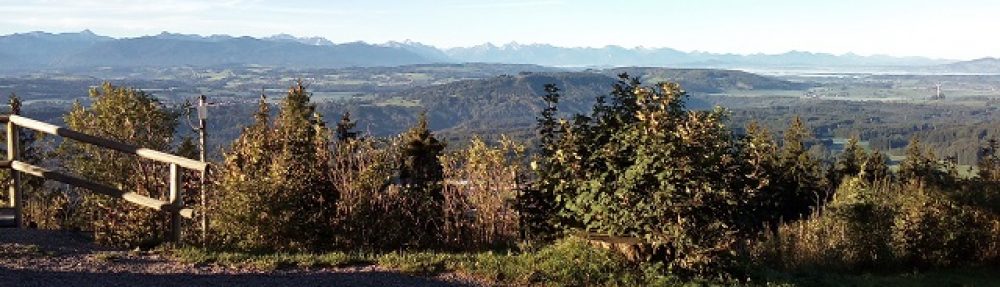
Peissenberg is a drive-up summit with about 300 metres from the car park to walk to my comfortable operating position. I have been to the summit on several occasions before so I needed no map to find it. The views are fantastic, especially early morning and with the luxury of toilets on-site this would be an ideal summit for someone new to SOTA to have as their first summit activation. In my case it’s one of a few summits that are less than an hours drive away from home and as such suitable for early morning activations.

The Activation:

After a non-eventful drive down, I started to set-up my gear on the usual bench and strapped the 5m fibreglass mast to the railings as normal using “Bongo-ties” (these are great things – rubber bands with a small wooden toggle on them (that looks like a miniature bongo drum, hence the name)) so that you simply wrap them around objects and clip the ends back into each other. You can of course tie two together to get extra length, which I have done. While sorting out the rig and log book I suddenly saw the mast tipping over as one of the ties had released itself and fired off down the mountain, never to be seen again. I normally have a spare with me but could not find it, so I then had to re-arrange the base of the mast so that it would be held sufficiently well with just one double bongo-tie. With that problem sorted I started to unwind the dipole sides and the small spool that I use to wind the wires on fell apart and in the process knotted up the wire and cord. This of course took a little while to untangle sufficiently for me to be able to install the antenna. The day was not starting well and all of this in under zero degrees temperatures my fingers were already feeling frozen.

Despite these  couple of problems, I got on air at my alerted time and started putting out a CQ on 10 metres and self-spotted. Nothing! I tried for 15 minutes, still nothing, so I moved to 20m put the amp in circuit and started calling there – again no replies. I wondered if the antenna was simply not working, but the SWR looked OK. I tuned around and found a Swedish station activating a WWFF park, so gave him a call, got through and got a report – so I was getting out! Some more tries and spotting on both 10m and 20m resulted in one chaser call on 20m. I then saw the spot for John VK6NU in Australia but couldn’t hear a thing from him. The conditions on both 20m and 10m were horrible. So in order to at least qualify the summit, I moved to 40m and the difference was immediate – pile-ups despite the fact that Peissenberg is only a 1 point summit, it seemed the whole world (or at least all of Europe) wanted a contact with it!

So at the end of the day a successful normal activation, unfortunately with no VK or 10m contacts though. Better luck next time?

At least the QAMP worked without issues in the field!

Photos:

This slideshow requires JavaScript.

Equipment:

Yaesu FT817ND.

Spiderbeam Aerial-51 UL-404 off centre fed dipole.

5 metre squid pole.

Ramsey QAMP 20/40m amplifier

Log:

Activator log

Conclusions:

Unlucky with the 10m and 20m band conditions (10m improved later in the day).

January is not the month to try for Long Path SSB contacts into VK.

73 ’til the next Summit!
DD5LP/P – December 31th. 2015 – DL/AM-178 Ammerleite.

Preparation:

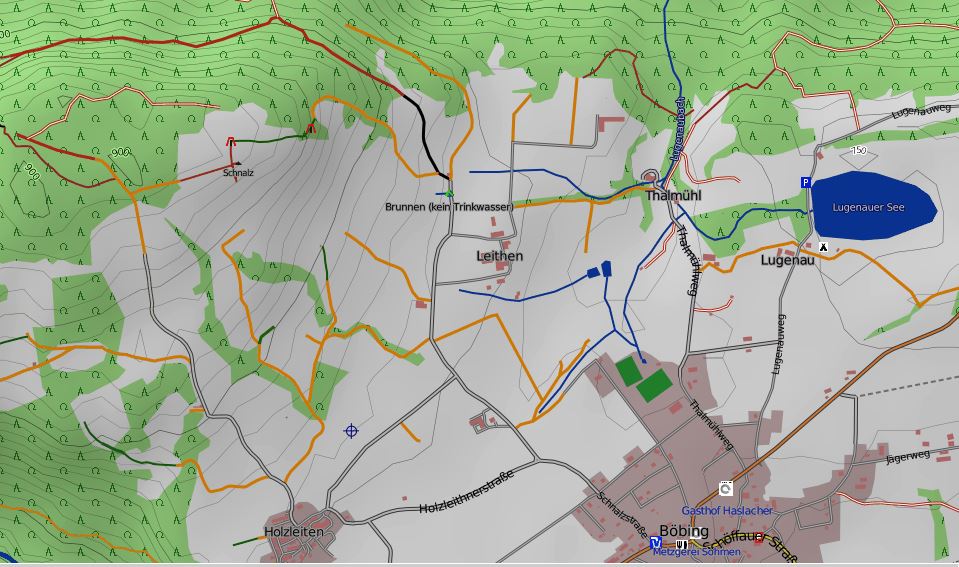
My attempt to activate Ammerleite earlier in the year had been stopped by the road being blocked by a farmer moving his crops and I was told that the road that I had used three times before was private and I could not access it. This is despite Google and other mapping systems reporting it as a public road. As always in SOTA, we have to avoid causing issues especially around access routes, so I have been researching an alternate access route from the other side of Schnalz (which is the correct name for the Summit – Ammerleite is the complete area). There is even a road called Schnalzstrasse that comes out of the village of Böbing, that the summit overlooks.

Even with the new route, I did not consider it too difficult and indeed my wife agreed to come along as well.

The Location:

The new route:

As noted above, there is a road named SchnalzStrasse on the western end of the village of Böbing. Take this road until you leave the village and come to a junction – now take Leitner Strasse (the direction being up the hill). If I remember correctly, the walking trails are also signposted from this point onwards – you need to follow B7 which on some signs is called Schnalz Gipfel or Schnalzrundgang or similar. Driving further up Leitner Strasse you come to a Y junction where the left fork has the sign saying that access past this point is restricted to farming and forestry workers only. This is just past where there is a small fountain on the left that has a horses head in wood as its spout (water not for human consumption). There is also a hut on this junction (see photos in slideshow below), I drove down the right hand fork and parked on the grass (later others had done the same, so this seems to be the acceptable point to park and start walking). Now it is simply a matter of taking the left hand fork, following the route B7 up the ever steeper hill and around the corner until you go through a stile into an open field. The opposite side of the field has a turnstile and after you go through that you can just see the cross through the trees up and to your left. This is where you need to head to, to take advantage of the two benches and fence posts to locate your radio gear.

SchnalzThe Activation:

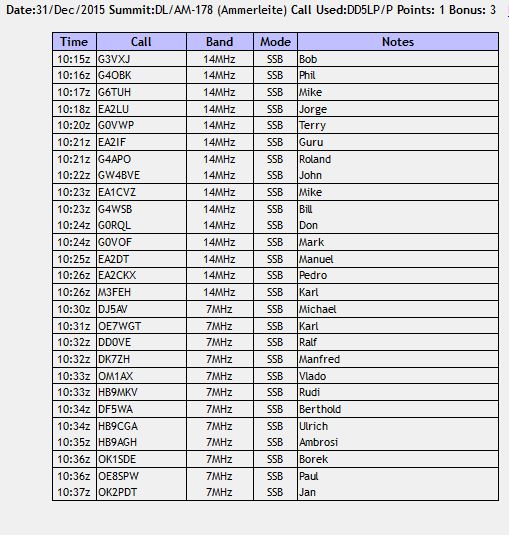
Once I had put the antenna up, and laid out the rig and log, I found a faulty contact on the coax from the antenna but was able to position it so that it was connecting (after investigation at home, it was the inner core of the coax that had broken away from the centre pin of the BNC plug). I also noticed that although the SWR was now fine, the power out indication seemed low. I then realised that I had the FT817 switched to 2.5w rather than 5w output for all of the last activation on Herzogstand!

I tuned around the bottom 1MHz of 10m and apart for the DL0IGI beacon on 28.2050 on Peissenberg being off the scale on the FT817 (I could see the antennas from my summit) there was nothing on except for some interference, presumably from equipment not meant to be on 28MHz at all (I suspect the weather station – which was also very close – but I can’t prove this) – there was NOTHING on the band that I could hear. So I tried spotting myself and putting out CQs for about 10 minutes but to no avail. The band was totally dead!

Never mind, now I know the “authorised” access route I can try again in the new year, bag the activator points again and hopefully some 10m contact points as well for the challenge.

I then decided to try 20m, where the results were far better with 15 contacts in 12 minutes. I followed this with a stint on 40m and bagged another 12 contacts in 12 minutes. On both 20m and 40m I was still just running the 5w from the FT-817 into the OCF dipole. I didn’t unpack and set up the amp as I could see a storm coming in. Indeed just as I stopped operating, the first few rain drops fell. A quick pack away and head down the hill and when we reached the car the rain storm really started.

The activation was completed with a stop for soup in a nice cafe in Rottenbuch on the way home.

Photos:

This slideshow requires JavaScript.

Equipment:

Yaesu FT817ND.

Spiderbeam Aerial-51 UL-404 off centre fed dipole.

5 metre squid pole.

Ramsey QAMP 20/40m amplifier and batteries (taken but not used)

Log:

Activator log

Conclusions:

Unlucky with the 10m band conditions (they improved later in the day), but lucky to get down and away before the storm came through. Although somewhat further and a lot steeper, this access route appears to be, by all of the signposts, the way that the locals want you to approach Ammerleite – or we should now say Schnalz.

73 ’til the next Summit!

DD5LP/P – December 29th. 2015 – DL/EW-022 Herzogstand.

Preparation:

I’ve had Herzogstand on my “to do” list for a while. It is a relatively easy climb and attracts a large number of walkers, so I expected that I would be limited on space to put up an antenna and so packed the loaded vertical and all other equipment into one rucksack. I was hoping to add it to my activated on 10m, summits list and hence receive another multiplier point for the current 10m/6m SOTA challenge.

The Location:

Herzogstand is a mountain above Walchensee in Southern Bavaria, access is via a cable car to the neighbouring mountain (Fahrenberg) from where it’s a ten minute walk to the Herzogstand Gasthaus (Restaurant) and then one takes the track along the side of Martinskopf mountain to the start of the serpentine track up to first the holy cross and then the pavilion on the very top of Herzogstand. Expected time from the restaurant to the summit is 45 minutes.

The Activation:

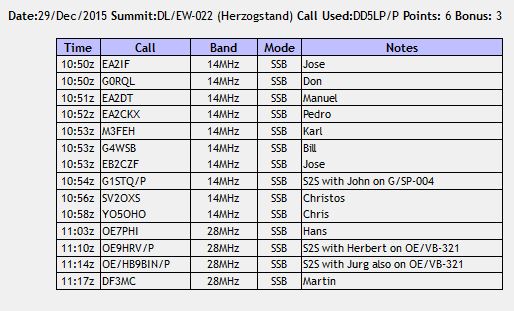
My journey to the summit from getting in the cable car to arriving at the summit took me 40 minutes. It probably would have been five minutes quicker except for the number of other walkers on the (partly iced over) track up (I’m glad I took my spikes to add to my hiking boots!), Once I reached the summit, after pausing and taking some photos at the cross,  I saw an area next to the pavilion that had once been some kind of small building but all that remained were it’s foundations (about 6 foot by 4 foot). OK for me – I set up the tripod and loaded whip in one corner and ran the counterpoise wire out along the top of one pf the partially remaining walls. I did not add any extension to the top of the whip on this activation as I was restricted for space as to where I would run it and my main aim was for contacts on 10m where I don’t need the extension. Putting down my plastic painting sheet in the opposite corner of the fountations from where I had put the antenna up, I put the rig and logbook on it, took off my skiing jacket (it was warm on the summit in my sheltered position, but cold when one was in the wind) and got ready to start some SOTA action. I immediately started calling CQ SOTA on 10 metres on 28.370 after checking the frequency was clear. I then spotted myself but to no avail. After about 15 minutes, I decided it was better to activate the summit anyway, even if I could not get a 10m contact, so I adjusted the vertical antenna to 20m and called CQ there where I got a quick response from many of the usual chasers. Reports of my signal were not as good as usual which I put down to the antenna but I realised on my next activation, that the FT817 had been running at only 2.5w output on Herzogstand not the full 5w, so that would also have been a factor. After logging 10 contacts in 9 minutes on 20m, one being an S2S, I decided to give 10m a go again as I only intended to be on the summit 30 minutes due to having to be back home mid-afternoon. I was rewarded on this second try of 28MHz with 3 contacts with Austrian stations, one of them an S2S. After I had already announced I was going QRT, I got a telephone call from Martin DF3MC who had activated Herzogstand the previous day, I called him on 10m and we made a QSO, meaning he had a completed summit within 24 hours.

Some interest was shown by one of the walkers on the summit and after explaining what I was doing, he said that he used to be involved with CB and had done some portable operating with friends, years ago. He seemed interested possibly in Amateur radio and I gave him a DARC brochure with the necessary contact information, so that could be a new Ham at some time in the future.

He also mentioned to me that Herzogstand used to have a very large LF antenna running down the mountain that was used in the 1920’s for long distance Radio Telegraphy. At the time, the only other equally sized antenna was in Indonesia and these two were the largest in the world. Later the antenna was used for research before being taken down. Shame! It would have been nice to see how such an antenna with 5w of Amateur radio power would have performed HI.

After completion of the activation, packing up and the route back down was, thankfully uneventfull and I arrived home exactly on schedule.

Photos:

This slideshow requires JavaScript.

Equipment:

Yaesu FT817ND.

Diamond RHM-8B loaded vertical.

Log:

Activator log

Conclusions:

A nice day out. Definitely the correct decision to take the small pack and small antenna, with so many people (and dogs) on the summit and no where to safely set up away from the summit, had I taken the fibreglass pole and dipole, I would not have been on the air. Next time I should check more carefully that the rig is set to full power. Very glad I got the 4 10m contacts, for sometime there I thought I wasn’t going to. Very lucky with the weather at this time of year.

73 ’til the next Summit!